A team preparing to enter a new market starts comparing competitors’ offers. One colleague records pounds, another finds a euro price, and the collector stops at a country selector. Before comparing offers in the spreadsheet, the team needs to establish what each person actually saw.
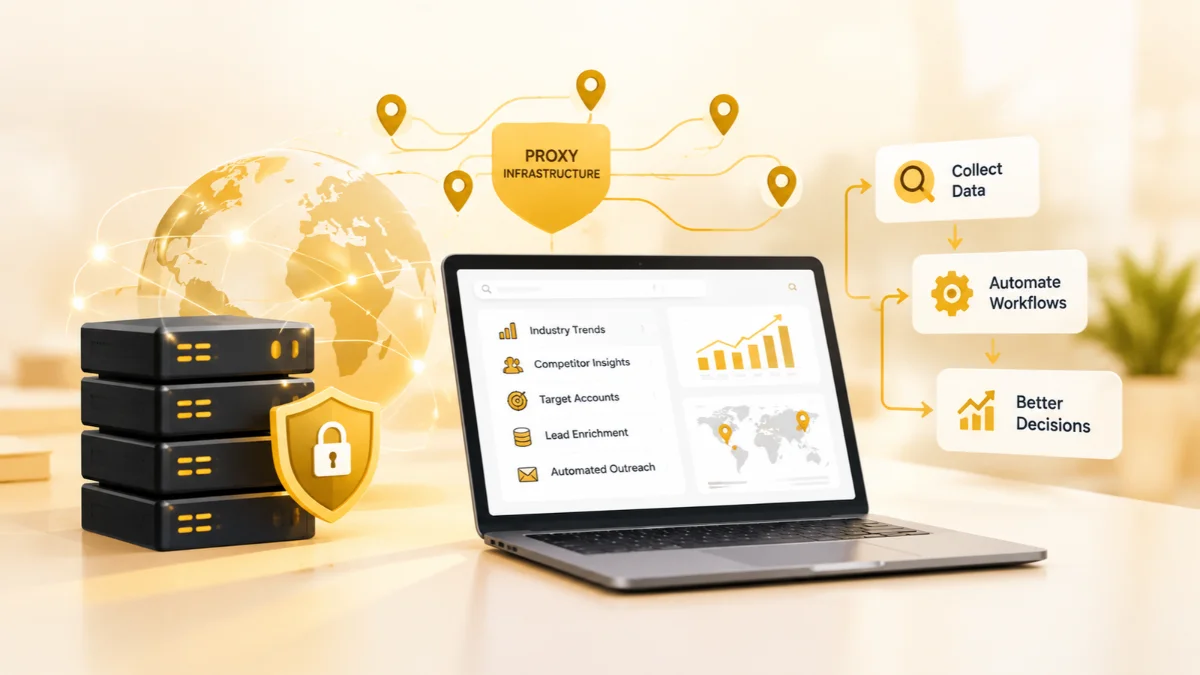
Proxy infrastructure lets the team choose where requests exit to the internet and check another region’s website experience. Research also needs comparable offers and a record of the checking conditions, whether the task concerns competitor pricing, advertising, or an automated report.
Where Proxies Fit into B2B Work
For a regional check, the connection can go through a proxy in the market being studied. A website that selects content by IP location will use the proxy’s exit address for that connection, so its regional offer may change.
Researchers can use that regional view to examine prices and publicly listed terms. Marketing colleagues can check their landing pages and search results through a regional connection; ecommerce teams can examine the stock and product listings available there. Once automated, the same checks can supply a regular report.
Before buying proxies for business, look at how the information will be obtained. An ordinary connection may cover a daily check in your own region. Look for an API or export from the source before building another collection route. The reason to add a proxy should come from the job itself: a required region, a specific network type, or the need to send requests through several exits.
Put collection times and comparison criteria in the research brief. Otherwise, a later difference in an offer will be harder to explain.
Competitor Monitoring Starts with Comparable Offers
Suppose you are researching SaaS competitors in Britain and Germany. In this hypothetical project, you want their public plans, supported integrations, and trial terms. Each market gets its own run, with a chosen exit country and browser language. Decide whether the visit will be signed in and which region will be selected on the website before starting. Proxies for market research provide the network exit. Changing the connection can leave the browser’s previous country choice intact. Its cookies and settings need attention too.
Read how the advertised monthly amount is billed: it may require the full year to be paid upfront. Record that commitment with the price, then check the features and tax terms on both regional pages. The same plan name is no assurance of the same features or payment schedule. Converting both prices to the same currency still leaves those terms to account for.
An analyst looking into a price change needs to see the earlier offer. For that review, the amount needs a source and timestamp. The entry should also identify the plan, its billing terms, and the currency displayed during the visit. Include the exit country so the analyst knows which regional connection produced that offer.
Label the failed check unverified. Find out whether it lost its connection, followed an outdated URL, encountered a verification prompt, or reached a page without its pricing content before reporting an offer as withdrawn. The failure alone says nothing reliable about a competitor’s decision to leave a market.
Local SEO research needs similar discipline. Compare identical queries under recorded conditions and keep the checking time. Record the results as what appeared during that check; a regional IP alone cannot reproduce the circumstances of every searcher.
Ad Verification and Localized Content
With a connection in the intended region, follow the campaign link to its final destination. Read the offer on that final page against what the advertisement promised.
Keep the screenshot linked to the visit that produced it, with the market, campaign, URL, language, and device recorded beside it. A colleague investigating the geo-targeted content can then repeat that visit. Compare the headline, currency, enquiry form, and available offer with the campaign plan.
Google recommends the Ad Preview and Diagnosis tool when you inspect your own ads. Ordinary searches for them can count as impressions in campaign statistics, which is an unwanted side effect of ad verification. The preview avoids that effect. Then open the destination through a regional proxy to examine how the landing page loads and behaves.
If your ad is missing, turn to the account data and campaign settings as well. The preview can leave some activity out. A successful visit to the landing page confirms that you could reach it from that connection; assessing who sees the ad takes evidence from the campaign.
Mobile checks need additional care. A carrier-network exit is what a mobile proxy supplies. A button’s position on a phone screen and its response to touch have to be examined in a suitable browser environment or on a phone. The network connection tells you neither.
Where the Proxy Fits in a Collection Job
During a scheduled run, the browser or HTTP client reaches the source through the proxy. The collector has to turn the response into a saved record by extracting and validating the required values.
The browser or collection software handles JavaScript and navigation and locates the data within the page. The proxy provides the network route. If the page element containing the price has disappeared, the parser needs attention regardless of which proxy is connected.
The SaaS team could give its UK and German checks separate contexts in Playwright. Each context has its own cookies and local storage and can be assigned a proxy. That separation prevents a country preference stored in one context’s cookies from carrying over into the other check.
Related actions should keep the chosen session and a suitable network exit. Someone opening a pricing page and then reading the detailed terms is following one regional scenario. Keep those steps together. Choose another exit for independent jobs where the workflow requires one.
Set the pace of your web automation per source, covering both request frequency and the number running at once. HTTP 429 means the client is sending requests too often. Wait for the period specified by Retry-After when supplied. A user, application, or resource limit can still apply after you rotate the IP.
Choosing a Proxy for Each Part of the Research
Write down the required regions, the actions that need to keep one IP, and the network environment the check is meant to cover. Then try a proxy type on a small sample of the team’s actual tasks.
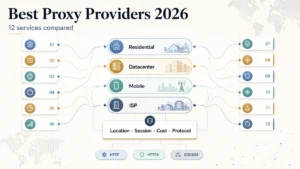
Residential proxies
Consider these for research requiring exits through user networks and a geographically distributed pool. They can support regional checks and public data collection across markets. Start with checks in the regions you need, looking at how the target site identifies each location and whether sessions behave as required.
ISP proxies
These use addresses associated with internet service providers. Static options suit related actions requiring a consistent IP, such as recurring work through one research profile. Keeping the address does not replace cookie or authentication management. For dynamic options, check how address changes are controlled.
Datacenter proxies
Evaluate these for technical monitoring and public sources that accept connections from datacenter networks. If they deliver the required quality on those tasks, they may suit that portion of the workload. Base the decision on a pilot using the actual sources.
Mobile proxies
Choose these when the research specifically requires an exit through a mobile carrier network, such as checking your own resource over that connection type. For an ordinary comparison of public pricing, establish whether a mobile exit adds anything the research needs.
MangoProxy is one example of a service offering residential, ISP, datacenter, and mobile options for this kind of setup. Teams can select different connections for research tasks and longer sessions. The service offers static ISP proxies for workflows requiring a consistent IP.
The promo code IVRISTECH gives a 7% discount on MangoProxy static ISP proxies.
Before Expanding the Workflow
“Collect competitor prices” leaves too much open for the person building the job. Give them the plans and countries to cover, the currencies and billing periods to record, and the fields expected in the report. Agree how errors, missing values, and changed offers will be recorded.
Try a small sample first. Verify the exit IP and inspect the target’s response to see which market it actually presents. An IP checking service provides part of the evidence; inspect the target website too.
Document session rules. Related actions need consistent settings, while independent regional checks need separate environments. Match rotation to the job. Changing addresses after every request can disrupt a process in which the website retains a selected region or other conditions between page visits.
Separate connection checks from content validation. After a successful server response, confirm that the required offer and fields are present. A country selection screen or verification page must not enter the report as a successfully collected pricing record.
To investigate a failed run, someone will need its time, source, checking conditions, error details, and number of retries. Keep proxy credentials outside shared logs and reports. A problem confined to one source is worth investigating there first. Read the responses and inspect the page for changes before replacing the IP pool.
For a useful cost comparison, count the records you can actually use after validation. How many records passed validation? How many needed retries? Also note which markets are missing data. Together, these findings help locate the work that needs doing: changing a connection, repairing the collector, or using another way to obtain the data.
Conclusion
A finding in B2B market research should leave colleagues able to return to the source and understand how it was checked. Proxy infrastructure contributes the regional access and connection choices. With sessions kept consistent, request rates controlled, and collected content checked, the team can make a better-informed judgment about an apparent market change.
FAQ
Does every market research project need proxies?
No. A one-off visit to a local page may need no special connection. For repeated collection, an API or export might already provide what you need. Proxies become useful when the work requires a different region or network type, or requests sent through several exits.
How often should an IP rotate?
Choose the interval around the job’s requirements. Related actions may need a consistent exit. Independent jobs can use a different rotation pattern, selected around the source’s requirements and tested in a pilot.
Can a mobile proxy replace testing on a phone?
The proxy supplies a mobile-network connection. To assess the interface, you also need a real device or suitable emulation that lets you examine the layout, browser behavior, and touch interaction.