
Updated July 18, 2026. Pricing and product details were checked against provider pages on this date.
The best proxy providers in 2026 are not interchangeable. Bright Data gives enterprise teams the widest set of proxy networks and data-collection tools. Decodo offers a stronger balance for self-service buyers. DataImpulse keeps the entry cost low, while SOAX is built for precise location and carrier targeting. The right choice changes when you need a stable ISP address instead of rotating residential traffic, or when unlimited datacenter bandwidth matters more than appearing as a household connection.
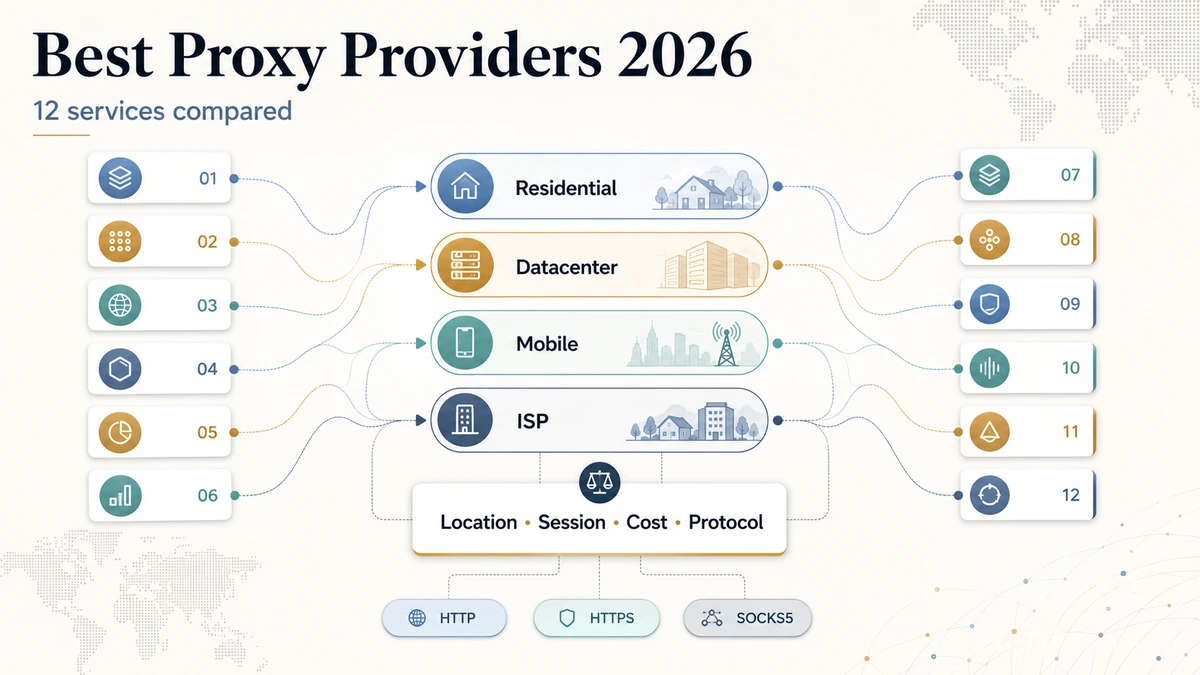
This guide compares 12 proxy service providers by the decisions that actually affect a deployment: proxy type, location coverage, session control, protocol support, traffic rules, sourcing transparency and the price a small buyer can realistically access. It is an editorial comparison based on current product documentation and public pricing, not a claim that we secretly benchmarked every network. Use the table for the shortlist, then read the reviews for the trade-offs that headline rates leave out.
Direct answer — What are the best proxy providers in 2026?
Bright Data is the strongest enterprise all-rounder, Decodo offers the best balance for many self-service teams, and Oxylabs is a premium option for large public-data projects. SOAX is best for granular targeting, DataImpulse for low-cost pay-as-you-go traffic, IPRoyal for non-expiring residential traffic, and Webshare for small datacenter deployments. Choose by proxy type, required locations, session behavior and total cost per successful request.
Key Takeaways
- Best enterprise all-rounder: Bright Data, because it combines residential, mobile, ISP and datacenter networks with mature proxy-management and extraction products.
- Best balance for self-service teams: Decodo, with accessible plans, broad proxy coverage and a comparatively easy setup.
- Best budget PAYG option: DataImpulse, which lists residential traffic at $1/GB and says purchased traffic does not expire.
- Best for granular targeting: SOAX, especially when country, region, city, ISP, ASN or carrier selection matters.
- Do not buy on pool size alone: live inventory, successful requests, location accuracy and session stability are more useful than an advertised global IP total.
Best Proxy Providers in 2026 at a Glance
The best proxy provider is the one whose network matches your actual workload. The table below uses a realistic public entry point where available, rather than presenting a high-volume discount as though every buyer receives it.
| Provider | Best for | Main proxy types | Public pricing reference, July 2026 | Primary caution |
|---|---|---|---|---|
| Bright Data | Enterprise coverage and tooling | Residential, mobile, ISP, datacenter | Residential PAYG shown at $4/GB during a 50% promotion | More platform and compliance overhead than a small project may need |
| Decodo | Best overall balance | Residential, mobile, ISP, datacenter | 3GB residential plan at $11.25, or $3.75/GB; lower rates at scale | The lowest “from” rate requires higher volume |
| Oxylabs | Premium enterprise projects | Residential, mobile, ISP, datacenter, SOCKS5 | Residential proxies from $6/GB | Entry cost and business verification can be excessive for casual use |
| SOAX | Location and carrier targeting | Residential, mobile, ISP, datacenter | Tiered network pricing starts around $3.75/GB for entry usage | Advanced tiers and targeting can raise the practical commitment |
| IPRoyal | Non-expiring residential traffic | Residential, ISP, datacenter, mobile | 1GB PAYG at $7.35; lower subscription and volume rates | The advertised lowest rate is not the small-plan PAYG rate |
| DataImpulse | Low-cost pay-as-you-go traffic | Residential, mobile, datacenter, premium residential | Residential $1/GB; datacenter $0.50/GB; mobile $2/GB | Advanced geo-targeting may require a premium product or add-on |
| Webshare | Small projects and datacenter proxies | Datacenter, static residential, rotating residential | 10 datacenter proxies free; rotating residential from $3.50 for 1GB | Less mobile breadth and fewer advanced controls than enterprise suites |
| NetNut | Recurring residential workloads | Rotating residential, static residential, mobile, datacenter | $99/month for 28GB, or $3.53/GB | $99 minimum is a poor fit for occasional usage |
| Rayobyte | Datacenter and ISP flexibility | Residential, datacenter, ISP, mobile | Rotating residential from $3.50/GB for 1–49GB | The product and pricing matrix takes time to compare correctly |
| Infatica | SOCKS5 across mixed proxy types | Residential, IPv6, ISP, mobile, datacenter | Residential PAYG at $4/GB; 7-day trial for $4 | Plan structure is dense, and the trial is paid |
| LunaProxy | Very low advertised residential rates | Residential, ISP, rotating ISP, datacenter | Residential advertised from $0.65/GB | Validate the qualifying volume, support and real target performance first |
| Evomi | Lowest residential price | Residential, mobile, datacenter | Residential from $0.49/GB | Confirm the live rate and targeting add-ons at checkout. |
| Proxy-Cheap | Budget static, IPv6 and SOCKS5 options | Rotating residential, static residential, mobile, IPv4/IPv6 datacenter | Promotional rotating residential from $0.78/GB; static from $2.12/month | Promotional and renewal pricing must be checked at checkout |
What a Proxy Provider Actually Does
A proxy provider operates servers or distributed IP networks that route your application’s requests through another address. The target website sees the proxy address rather than the original connection, while the provider manages authentication, routing, rotation, location selection and usage accounting.
That basic definition hides several very different products. A datacenter proxy comes from server infrastructure and usually prioritizes speed and cost. A residential proxy uses an address associated with a consumer internet connection. A mobile proxy uses a carrier network. An ISP proxy, often marketed as a static residential proxy, combines an ISP-registered address with a stable server-hosted connection.
A managed proxy service also differs from an anonymous public proxy list. Paid providers normally add a dashboard, account controls, support, predictable protocols, location filters and an acceptable-use policy. Free public proxies may be overloaded, disappear without notice or expose traffic to an operator you cannot identify.
How We Chose These 12 Proxy Service Providers
We reviewed each provider against the same eight criteria. The order reflects editorial fit by use case, not a laboratory speed ranking.
1. Proxy-type coverage. Providers earned more consideration when they offered a useful mix of residential, datacenter, mobile and ISP products rather than relabeling one network several ways.
2. Geographic controls. Country coverage is the floor. City, state, ZIP, ASN, carrier and ISP selection can decide whether a provider works for localized research or testing.
3. Rotation and session controls. Some workloads need a new address on every request; others fail unless one IP persists through a complete session. We looked for both rotating and sticky options.
4. Protocol support. HTTP and HTTPS cover many web workloads, while SOCKS5 matters for software that handles additional traffic types or needs a more general proxy protocol.
5. Accessible pricing. We distinguished a small-plan or PAYG rate from the lowest advertised enterprise rate. A “from $1.75/GB” claim is not useful if a new buyer sees $7.35/GB at checkout for 1GB.
6. Traffic and renewal rules. Non-expiring bandwidth, minimum commitments, fair-use allowances, targeting surcharges and renewal prices change the effective cost.
7. Sourcing and responsible-use transparency. Residential networks should explain how participants consent, how they can opt out and what customer behavior is prohibited.
8. Operational fit. Dashboard usability, documentation, authentication, API access, support and managed extraction tools matter once a proof of concept becomes a production system.
IMPORTANT
This article does not claim first-hand speed or success-rate testing. Any pool size, uptime, success-rate or response-time figure published by a provider remains that provider’s claim unless an independent benchmark is explicitly named.
The 12 Best Proxy Providers Reviewed
These are the 12 best proxy providers for different 2026 buying situations, each with a practical reason to choose it and a real limitation to consider.
1. Bright Data: Best Enterprise All-Round Proxy Provider
Bright Data is the most complete option when the proxy network is only one part of a larger public-data operation. It sells residential, mobile, ISP and datacenter access, then adds Proxy Manager, Web Unlocker, scraping APIs and datasets for teams that do not want to maintain every layer themselves. Its current product pages advertise 400M+ monthly residential IPs across 195 countries, with country, city, ZIP, carrier and ASN targeting.
Best for: Enterprise teams that need several proxy types, granular locations and a path from raw proxy access to managed data extraction.
Standout: The breadth of the ecosystem. A buyer can use rotating residential traffic for one target, dedicated ISP addresses for persistent sessions and an unblocker for more difficult pages under one vendor relationship.
Starting price, checked July 2026: Bright Data currently shows residential pay-as-you-go at $4/GB under a 50% promotional offer, compared with its displayed $8 standard rate. Unlimited shared datacenter plans start at $1.40 per IP for ten IPs, with a 100GB-per-IP fair-use allowance.
The catch: The product depth creates complexity. Verification, compliance controls and multiple billing models are appropriate for serious data programs but can feel disproportionate for a one-off script.
Verdict: Choose Bright Data when the cost of an incomplete platform is higher than the premium you pay for coverage and operational tooling.
2. Decodo: Best Balance of Features, Price and Usability
Decodo, formerly Smartproxy, is the provider most likely to fit a self-service team without forcing it into the budget-only or enterprise-only end of the market. It covers residential, mobile, ISP and datacenter proxies, supports common protocols and provides browser extensions, endpoint tools, documentation and scraping products.
Best for: Developers, growth teams and smaller data operations that need broad capabilities with a more approachable dashboard and commitment.
Standout: The residential plan structure is unusually clear. The current pricing page lists 3GB for $11.25 at $3.75/GB, 10GB for $35 at $3.50/GB and progressively lower rates as volume rises. The page also advertises rates from $2/GB at scale.
Starting price, checked July 2026: $11.25 for a 3GB residential monthly plan, plus applicable tax. Decodo also advertises trial and refund options, whose current conditions should be checked during signup.
The catch: The low “starting at $2/GB” headline is a volume rate, not the cost of the smallest residential package. Buyers comparing providers should use the package they can actually purchase.
Verdict: Decodo is the strongest default shortlist choice when you want good coverage and controls without beginning with an enterprise sales process.
3. Oxylabs: Best Premium Provider for Large Public-Data Projects
Oxylabs competes directly with Bright Data for enterprise buyers. It provides residential, mobile, ISP, shared datacenter, dedicated datacenter and SOCKS5 options, along with Web Unblocker, Web Scraper API and a headless browser. Its residential products support country, state, city, ZIP, coordinate and ASN targeting on supported configurations.
Best for: Established companies that need account management, detailed documentation and multiple routes for gathering public web data.
Standout: Its enterprise orientation is consistent across the portfolio. Oxylabs is not trying to be the cheapest casual proxy provider; it is built around larger, repeatable data workloads.
Starting price, checked July 2026: The official pricing page lists residential proxies from $6/GB. Separate products use per-IP, per-GB or custom billing, and taxes may be added where applicable.
The catch: The entry price and verification process can be unnecessary friction for a small buyer. The platform makes more sense when support, compliance and scale have real economic value.
Verdict: Oxylabs is a premium alternative for organizations that want a proxy provider to behave like a long-term infrastructure vendor.
4. SOAX: Best for Granular Location and Carrier Targeting
SOAX is strongest when the question is not merely “Which country?” but “Which city, ISP, ASN or mobile carrier?” Its current platform combines residential, mobile, ISP and datacenter access under a credit-based pricing system, with tiers that expand targeting and team controls.
Best for: Localized market research, ad verification, app testing and workflows where the wrong city or carrier makes the result unusable.
Standout: Targeting depth. SOAX lists country, region, city and ISP targeting on core plans, with ASN and ZIP capabilities available on higher tiers. It also supports HTTP(S) and SOCKS5, including broader protocol options on applicable networks.
Starting price, checked July 2026: SOAX’s tiered page shows entry network usage around $3.75/GB, with the effective rate falling on larger plans. Because credits can span several products, buyers should model the exact network and location tier they need.
The catch: A flexible credit model can be harder to compare with a simple $1/GB provider. Advanced filters and larger teams move the buyer into higher tiers.
Verdict: Choose SOAX when location precision is a requirement, not a nice-to-have filter.
5. IPRoyal: Best for Non-Expiring Residential Traffic
IPRoyal sells rotating residential, ISP, datacenter and mobile proxies, with a product mix that suits smaller buyers as well as teams that need static addresses. Its most useful residential differentiator is that purchased traffic does not expire, which reduces waste for irregular projects.
Best for: Users who buy residential bandwidth in bursts, need SOCKS5 support or want static ISP and datacenter products from the same account.
Standout: Flexible traffic ownership. A project that pauses for several weeks does not automatically lose its remaining residential allowance at the end of a monthly cycle.
Starting price, checked July 2026: The detailed residential page lists 1GB PAYG at $7.35/GB, 2GB at $6.25/GB and 10GB at $5.51/GB. Subscription prices are slightly lower. The broader pricing page advertises residential rates from $1.75/GB at higher scale, ISP from $1.80 per proxy and datacenter from $1.39 per proxy.
The catch: The homepage “from” rate is not the realistic rate for a one-gigabyte buyer. Compare the package size you need, not the smallest number on the page.
Verdict: IPRoyal is a practical choice when non-expiring traffic and mixed proxy types matter more than the absolute lowest small-plan rate.
6. DataImpulse: Best Low-Cost Pay-As-You-Go Proxy Provider
DataImpulse has built its proposition around simple traffic pricing. It offers residential, datacenter, mobile and premium residential products, with no subscription required for the basic pay-as-you-go plans and no expiration on purchased traffic.
Best for: Experiments, irregular workloads and cost-sensitive teams that want to start with a small amount of traffic instead of a $90 or $99 monthly plan.
Standout: A $5 introductory residential package buys 5GB at $1/GB. The same site lists datacenter at $0.50/GB and mobile at $2/GB. HTTP(S), SOCKS5, rotating sessions, sticky sessions, API access and IP authorization are listed across the core plans.
Starting price, checked July 2026: $5 for 5GB of residential traffic. Country targeting is included, while more precise targeting can require an add-on or premium residential product.
The catch: Cheap base traffic does not automatically include every targeting level. Calculate the final price for city, ZIP, state or ASN requirements rather than assuming the $1 rate covers them.
Verdict: DataImpulse is the best proxy provider here for a low-commitment proof of concept and one of the clearest budget PAYG options.
7. Webshare: Best for Small Datacenter and Static Proxy Deployments
Webshare makes it easy to begin with datacenter proxies and expand into static or rotating residential traffic. The dashboard is self-service, plan sizes are highly configurable and the free tier gives a new user a low-risk way to test authentication and integration.
Best for: Developers and small teams that need straightforward datacenter or static residential proxies without a sales call.
Standout: Ten datacenter proxy-server IPs are free. Paid monthly datacenter plans list 100 proxies at $2.99, while rotating residential pricing starts at $3.50 for 1GB and falls with volume.
Starting price, checked July 2026: $0 for ten proxy-server IPs, or $3.50 for 1GB of rotating residential traffic under the current displayed offer.
The catch: Webshare is strongest in datacenter and static products. Teams requiring broad mobile inventory, enterprise support or the most granular residential controls may outgrow it.
Verdict: Webshare is the easiest shortlist option for a small datacenter project and one of the few credible free entry points from an established provider.
8. NetNut: Best for Recurring High-Volume Residential Workloads
NetNut is aimed at organizations that expect residential proxy usage to be an ongoing operating cost. Its current rotating residential page lists a broad country footprint, unlimited connections on standard packages and progressively lower per-gigabyte rates as the monthly commitment grows.
Best for: Companies with recurring price monitoring, market research or data-collection jobs that can use at least a few dozen gigabytes every month.
Standout: The starter plan is transparent: 28GB for $99 at $3.53/GB. Larger packages move to $3.45, $3.32, $2.85 and lower rates as usage grows.
Starting price, checked July 2026: $99 per month for 28GB of rotating residential traffic. Business verification may apply to trials or onboarding.
The catch: The minimum is the issue. NetNut may be good value at consistent volume, but it is not a sensible way to buy two gigabytes for an occasional test.
Verdict: Put NetNut on the shortlist when you have a repeatable monthly workload and value business support over casual PAYG access.
9. Rayobyte: Best for Datacenter and ISP Flexibility
Rayobyte offers one of the broadest combinations of static and rotating datacenter, ISP, residential and mobile products. Its product matrix suits teams that expect different targets to need different IP types rather than forcing everything through a residential pool.
Best for: Technical buyers that want to mix high-speed datacenter addresses with ISP or residential traffic and are willing to tune the architecture.
Standout: Static datacenter products have no thread or bandwidth limit, while Rayobyte’s pricing page lists rotating residential at $3.50/GB for 1–49GB and lower rates at higher volume. Residential trials are available through account signup.
Starting price, checked July 2026: $3.50/GB for the smallest rotating residential band. Rotating ISP begins at $3.75/GB for up to 15GB, and static products use separate per-IP pricing.
The catch: Flexibility creates comparison work. Buyers need to distinguish rotating ISP, static ISP, residential, datacenter and unblocker pricing before calculating the real bill.
Verdict: Rayobyte is a good infrastructure-oriented choice when ISP and datacenter proxies are as important as residential traffic.
10. Infatica: Best Mixed-Network SOCKS5 Proxy Provider
Infatica provides residential IPv4 and IPv6, static ISP, mobile, shared datacenter and dedicated datacenter products. It supports HTTP and SOCKS protocols, several authentication methods, configurable rotation and city or ISP-level targeting on applicable plans.
Best for: Technical teams comparing SOCKS5 proxy providers across more than one IP category.
Standout: The current residential plan includes PAYG access, a paid trial and a clear volume ladder. The platform also documents API tools, login/password authentication and IP whitelisting.
Starting price, checked July 2026: $4/GB for residential PAYG, or $96 for 25GB at $3.84/GB. A seven-day trial costs $4. Higher-volume plans reduce the unit rate.
The catch: The pricing page contains many similar product tables. It is easy to compare the wrong network unless you confirm whether the quote is for IPv4 residential, IPv6, ISP, mobile or datacenter traffic.
Verdict: Infatica is a credible choice when SOCKS5 and mixed proxy types matter more than a minimal, one-product dashboard.
11. LunaProxy: Best Ultra-Low Advertised Residential Rate to Trial First
LunaProxy promotes residential, static ISP, rotating ISP, datacenter and unlimited products, with HTTP, HTTPS and SOCKS5 support across relevant plans. Its headline residential rate is one of the lowest in this comparison.
Best for: Cost-sensitive users willing to run a controlled trial before moving a production workload.
Standout: The official residential pricing page advertises traffic from $0.65/GB and a large global pool. Datacenter pricing is promoted from $0.11 per IP per day.
Starting price, checked against the latest indexed official page: Residential from $0.65/GB. The amount of traffic, package or conditions required for that rate should be confirmed in the dashboard before purchase.
The catch: A low headline rate tells you little about target-specific success, clean inventory, support response or the price available at your actual volume. Validate all four before scaling.
Verdict: LunaProxy is a budget candidate, not an automatic winner. Trial it against the exact countries and targets that matter.
12. Evomi: Cheapest residential proxies At $0.49/GB, Evomi offers the cheapest residential proxies on the market.
Standout: The public residential price starts at $0.49/GB. Sessions can rotate on each request or stay sticky.Starting price: $0.49/GB for Core Residential. Check the live rate on evomi.com before purchase.The catch: A low headline rate still has to be checked against the targeting and volume you actually buy.
Verdict: Choose Evomi when the decision is the residential price, and the other providers on this list start higher. Visit Evomi: https://evomi.com
13. Proxy-Cheap: Best Budget Static, IPv6 and SOCKS5 Mix
Proxy-Cheap covers rotating residential, static residential, mobile, IPv4 datacenter and IPv6 datacenter services. It is especially relevant to buyers looking for inexpensive fixed IPs or IPv6 options rather than one large rotating residential pool.
Best for: Budget projects that need static residential, IPv6 datacenter or SOCKS5-compatible addresses.
Standout: The current homepage shows promotional rotating residential from $0.78/GB, static residential from $2.12 per month, IPv6 datacenter from $0.15 per month and IPv4 datacenter from $1.49 per month.
Starting price, checked July 2026: Promotional residential from $0.78/GB and a seven-day trial listed at $1.99 per week on selected products.
The catch: Promotional discounts can make the comparison look better than the renewal. Confirm the normal price, target location, bandwidth rules and proxy-sharing model before paying for a longer term.
Verdict: Proxy-Cheap is useful when the product type and promotional economics align, but renewal and targeting details need extra scrutiny.
Residential vs Datacenter vs Mobile vs ISP Proxies
Use residential proxies when location authenticity matters, datacenter proxies when speed and cost dominate, mobile proxies when the target experience depends on a carrier network, and ISP proxies when one stable address must persist.
| Proxy type | What it is | Use it when | Avoid it when |
|---|---|---|---|
| Residential | An IP associated with a consumer internet connection | You need broad locations, rotating addresses or a household-looking IP | Your target accepts datacenter traffic and cost or speed matters more |
| Datacenter | An IP hosted in commercial server infrastructure | You need speed, predictable static addresses or high-volume low-cost traffic | The target heavily filters hosting-provider IP ranges |
| Mobile | An address routed through a mobile carrier network | You are testing mobile ads, apps, carriers or mobile-localized experiences | A residential or ISP address gives the same answer at a lower cost |
| ISP or static residential | An ISP-registered IP hosted on stable server infrastructure | You need a long session, dedicated address and residential-style registration | You need a large rotating pool rather than persistent identity |
Best Residential Proxy Providers
The best residential proxy providers in this comparison are Decodo for balanced value, Bright Data for enterprise controls, Oxylabs for premium business deployments, SOAX for precise filtering and DataImpulse for low-cost PAYG traffic. Buyers searching for the best residential proxy providers 2026 should compare small-plan price, targeting depth, traffic expiry and sticky-session limits, not only the total advertised pool.
Best Datacenter Proxy Providers
Webshare is the easiest low-cost starting point, Rayobyte is strong for static and rotating infrastructure, and Bright Data or Oxylabs fit larger global deployments. For unlimited-bandwidth datacenter proxy providers, read the fair-use terms carefully: “unlimited” can still include a per-IP allowance, connection cap or acceptable-use restriction.
Best Mobile Proxy Providers
SOAX is the leading mobile proxy provider here for granular location and carrier controls. Decodo, IPRoyal, Infatica, DataImpulse and Rayobyte also sell mobile products, but their billing units and minimums vary sharply. Buy mobile proxies only when a mobile-network address is necessary; they are usually more expensive than residential or datacenter alternatives.
Best ISP Proxy Providers
IPRoyal, Oxylabs, Rayobyte, Bright Data, Webshare and Infatica all offer ISP or static residential options. Compare whether the address is dedicated or shared, how much bandwidth is included, which countries are in stock and how long you can retain the same IP.
Best SOCKS5 Proxy Providers
Decodo, SOAX, IPRoyal, Webshare, Infatica, LunaProxy and Proxy-Cheap support SOCKS5 on relevant products. Confirm protocol support at the product level, because a company may offer SOCKS5 on datacenter proxies but not on every residential or mobile plan. Anyone revisiting a “best SOCKS5 proxy providers 2025” list should recheck 2026 prices and network availability before renewing.
Best Private and Anonymous Proxy Providers
“Private proxy” normally means an IP reserved for one customer, while “anonymous proxy” describes how much identifying information the proxy exposes. Oxylabs, Bright Data, Webshare, Rayobyte, IPRoyal and Proxy-Cheap sell dedicated or private products. Ask whether the address is truly exclusive, how replacement works and whether the provider logs connection metadata.
How to Find a Trusted Proxy Provider
A trusted proxy provider is transparent about sourcing, pricing, policies and the limits of its network. Use this seven-point check before committing.
1. Verify residential sourcing. The provider should explain how device owners consent, whether participation is compensated and how users can opt out. Vague phrases such as “ethically sourced” are weaker than a published acquisition document.
2. Read the acceptable-use policy. A reliable provider prohibits fraud, malware, credential abuse, denial-of-service activity and unauthorized access. “No restrictions” is a risk signal, not an advantage.
3. Test the exact location. A global pool can still have weak inventory in Denmark, Brazil or a specific Australian city. Buy the smallest viable package and verify geolocation accuracy before a larger order.
4. Measure successful output. Compare cost per successful request or usable record. A cheaper proxy that triggers more retries can produce a higher final cost.
Effective cost per successful GB = Total proxy spend ÷ Successfully processed traffic5. Check session behavior. Test rotation frequency, sticky-session duration and what happens when the selected IP goes offline. “Sticky” does not always mean one guaranteed address for an unlimited period.
6. Confirm the complete bill. Look for targeting add-ons, expiring traffic, top-up rates, renewal changes, taxes, fair-use clauses and annual commitments.
7. Review support and documentation. A proxy service becomes infrastructure once production depends on it. Good API documentation and responsive support can be worth more than a small per-gigabyte discount.
Proxy Provider Pricing Explained
Proxy providers charge by bandwidth, IP address, port, request or monthly commitment. Comparing unlike units is one of the easiest ways to choose the wrong plan.
| Pricing model | Common products | Best for | Question to ask |
|---|---|---|---|
| Per GB | Rotating residential, mobile, rotating ISP | Variable traffic and broad pools | Does failed or two-way traffic count? |
| Per IP | Datacenter, static ISP, private proxies | Stable sessions and predictable address counts | Is bandwidth included and is the IP dedicated? |
| Per port | Mobile and rotating services | Persistent access points | How many connections and rotations are allowed? |
| Per request | Web unblockers and scraping APIs | Teams that want managed extraction | Are only successful responses billed? |
| Monthly package | Business residential and mixed-network plans | Predictable recurring use | Does unused traffic expire or roll over? |
The cheapest proxy provider depends on the unit you need. DataImpulse is inexpensive for small PAYG residential traffic. Webshare has a free datacenter tier. Proxy-Cheap and LunaProxy publish aggressive promotional or volume rates. None is automatically cheapest after targeting fees, retries, renewal pricing and minimum commitments are included.
Best Proxy Providers by Country
Country-specific proxy searches should be answered with live location availability, not a generic global ranking. The provider must offer the right proxy type in that country and enough inventory for the city, ISP or carrier you intend to use.
| Country or market | Providers to investigate first | What to verify |
|---|---|---|
| Denmark | Bright Data, SOAX, Oxylabs, IPRoyal | Copenhagen coverage, ISP inventory, city and carrier targeting |
| United Kingdom | Bright Data, SOAX, Decodo, Oxylabs | City, postcode, ASN and mobile-carrier options |
| Australia | Bright Data, SOAX, Oxylabs, DataImpulse | Sydney and Melbourne latency, mobile coverage, sticky sessions |
| Brazil | SOAX, Bright Data, DataImpulse, Decodo | Regional inventory and carrier filters |
| Mexico | SOAX, Bright Data, IPRoyal, DataImpulse | Mexico City inventory and session persistence |
| Poland | NetNut, SOAX, Bright Data, Oxylabs | City targeting and static ISP availability |
| Spain | Bright Data, SOAX, Oxylabs, Decodo | Rotating residential depth and city filters |
| Switzerland | Bright Data, SOAX, IPRoyal, Oxylabs | City and ISP selection |
| South Korea | SOAX, Bright Data, Oxylabs, DataImpulse | Seoul inventory and mobile-carrier targeting |
| United States and Canada | Bright Data, Oxylabs, Decodo, Webshare | State, ZIP, ASN, carrier and dedicated-IP options |
| Austria and Belgium | SOAX, Bright Data, Oxylabs, IPRoyal | Live city-level inventory before purchase |
| China targeting | Bright Data, Oxylabs, SOAX and specialist enterprise vendors | Availability, regulatory obligations and target compatibility |
| Netherlands | SOAX, Bright Data, Oxylabs, IPRoyal | City, ISP and stable-session controls for authorized testing |
What Are the Best Denmark Proxy Providers?
Bright Data, SOAX, Oxylabs and IPRoyal are the leading Denmark proxy providers to investigate. Bright Data publishes residential, mobile, ISP and datacenter options for Denmark. SOAX lists Danish residential and mobile inventory with region, city and carrier targeting. Oxylabs publishes Denmark residential and datacenter coverage, while IPRoyal maintains a Denmark-specific location page. Inventory changes, so test the required city before scaling.
PRO TIP
For every country page or keyword, publish only what you can verify. A compact location matrix with proxy type, city targeting and a checked date is more useful than fifteen repetitive paragraphs that merely swap country names.
Free vs Paid Proxy Providers
A free proxy provider can be useful for a low-risk integration test, but an anonymous public proxy list is not a substitute for accountable infrastructure.
| Factor | Free public proxy | Established paid provider |
|---|---|---|
| Ownership | Often unclear | Identifiable company and terms |
| Availability | Unpredictable | Plan and support expectations |
| Location controls | Limited or inaccurate | Country, city, ISP or carrier options |
| Authentication | Often open or basic | Credentials and IP whitelisting |
| Traffic handling | Difficult to audit | Published privacy and usage policies |
| Business suitability | Low | Depends on provider and plan |
Webshare’s account-based free tier is different from downloading random proxy addresses from an aggregator. The provider is identifiable, the proxies live inside a dashboard and the user can move to a paid plan. Even then, do not send credentials, confidential data or sensitive personal information through a proxy unless the security model has been reviewed.
Common Mistakes When Choosing a Proxy Provider
1. Ranking providers by IP-pool size. Monthly pool numbers do not show how many addresses are live in the required city at the moment you send a request.
2. Choosing the wrong proxy type. Paying mobile rates for a job that works on datacenter IPs wastes money. Using datacenter addresses for a target that filters hosting networks creates retries and blocks.
3. Comparing enterprise and small-plan rates. A $2/GB one-terabyte rate is not directly comparable with a $4/GB five-gigabyte package.
4. Ignoring traffic expiry. A low monthly price loses its advantage when unused bandwidth disappears before the next project begins.
5. Assuming “unlimited” has no limits. Fair-use allowances, thread caps, port limits and target restrictions can still apply.
6. Skipping a country-specific trial. A provider can perform well in the United States and poorly in the exact Danish, Mexican or Australian location you need.
7. Treating a proxy as permission. A different IP address does not authorize access, override a platform’s terms or remove data-protection obligations. Use proxies only for lawful, authorized purposes.
Frequently Asked Questions
Bright Data is the best enterprise all-rounder, Decodo is the strongest balanced self-service option, and Oxylabs fits premium public-data projects. SOAX is best for precise targeting, DataImpulse for low-cost PAYG traffic, and Webshare for small datacenter deployments. The right provider depends on proxy type, location, traffic and session requirements.
Decodo offers the best balance for many buyers, Bright Data and Oxylabs suit enterprise teams, SOAX excels at granular targeting, and DataImpulse provides a low-cost PAYG entry. Compare the price at your actual volume, live country inventory, traffic expiry, rotation controls and sticky-session duration before selecting a residential proxy provider.
Choose a provider that publishes clear pricing, privacy and acceptable-use policies, explains how residential IPs are sourced, offers verifiable support and lets you test the exact country you need. A trusted proxy provider should disclose traffic rules, authentication methods, refund conditions and the limitations of its advertised network rather than promising universal access.
DataImpulse lists residential traffic at $1/GB with a $5 introductory package, while Webshare offers ten free datacenter proxies. LunaProxy and Proxy-Cheap publish lower promotional or volume rates on selected products. The cheapest provider changes after targeting fees, package minimums, retries, traffic expiry and renewal pricing are included.
Residential proxies use addresses associated with consumer internet connections, while datacenter proxies use server-hosted address ranges. Residential traffic offers stronger location authenticity and broader rotating pools. Datacenter proxies are usually faster, cheaper and easier to dedicate, but some websites identify hosting-network IPs more readily.
Decodo, SOAX, IPRoyal, Webshare, Infatica, LunaProxy and Proxy-Cheap support SOCKS5 on relevant products, while other providers offer it on selected networks. Confirm the exact plan before buying because protocol availability can differ between residential, datacenter, ISP and mobile products sold by the same proxy service provider.
Rayobyte lists no thread or bandwidth limits on static datacenter proxies, while IPRoyal, Bright Data, Webshare and Proxy-Cheap offer unlimited or traffic-included products in selected categories. Read the fair-use policy because an unlimited plan may still impose per-IP allowances, concurrency limits, target restrictions or additional charges after a threshold.
An account-based free tier from an established company is safer to evaluate than an anonymous public proxy list, but no proxy should be trusted automatically. Public proxies may have unclear ownership, weak availability or risky traffic handling. Avoid transmitting credentials or sensitive information until the operator and security model have been reviewed.
Bright Data, SOAX, Oxylabs and IPRoyal publish Denmark proxy availability. Bright Data covers residential, mobile, ISP and datacenter types; SOAX offers region, city and carrier targeting; Oxylabs lists residential and datacenter inventory; and IPRoyal maintains a Denmark location page. Test the required Danish city because live inventory changes.
Using a proxy server is not inherently illegal, but the activity performed through it may violate laws, contracts or platform terms. A proxy does not authorize access, permit fraud or remove privacy obligations. Use proxy services only for lawful, authorized purposes and obtain legal advice for sensitive data collection or regulated markets.
Your First Move
Choose the proxy type before choosing the company. Start with datacenter proxies when the target accepts them and cost or speed matters most. Move to residential when you need broader location authenticity, mobile when a carrier network is essential, and ISP proxies when the same address must persist through a long session.
Then shortlist three providers and buy the smallest comparable package from each. Run the same countries, request volume, session length and target pages. Track success rate, location accuracy, response time, retries and total bandwidth. The best proxy provider is the one that produces the lowest reliable cost for your workload, not the one with the largest number on its homepage.
Editorial note: Proxy pricing, promotions, pool sizes and country inventory change frequently. Recheck official pages immediately before publication or purchase.