A B2B buyer can now ask an AI system to compare vendors, summarize a category, surface implementation risks, draft an ROI model, and prep questions for a sales call before a salesperson even knows the opportunity exists.
That reads like a threat to sales. I think it’s a change in the job.
For a long time, part of the seller’s edge was access to information. Buyers needed someone to explain the category, frame the options, and make the case. That edge matters less than it used to. Information is everywhere. The hard part starts after the buyer has it: figuring out what to trust, what actually matters, which tradeoffs are acceptable, and whether the decision will survive everyone else who gets a say.
In enterprise sales I keep coming back to one distinction: seller activity and buyer progress are not the same thing. A deal can be full of meetings, demos, proposals, and follow-ups without becoming any easier for the customer to approve.
The modern seller is valuable less for what the buyer learns from them, and more for whether the buying group ends up with a decision that holds when the seller is no longer in the room.
Key Takeaways
- AI is making product and category information easier for B2B buyers to access, increasing the value of seller judgment rather than simple information delivery.
- Buyers may prefer rep-free research while still turning to salespeople to validate AI-generated insights, build confidence, and secure internal support.
- Complex B2B decisions have to survive multiple stakeholders with different concerns, from finance and procurement to security, operations, and executive sponsors.
- Because many buying groups form opinions and shortlists before contacting sales, discovery should focus on unresolved uncertainty, risk, and decision criteria rather than repeating information the buyer already has.
- A useful decision test is whether the buying group can clearly answer four questions: Why change? Why now? Why this? Why is it safe?
Buyers want fewer sales interactions, not zero human judgment
Gartner’s March 2026 buyer research found that 67% of B2B buyers prefer a rep-free experience. In the same research program, 45% said they used generative AI during a recent purchase.
A few months later, Gartner published the other half of the story: 69% of buyers prefer to validate AI-generated insights with sales reps. Buyers used an average of seven information sources during a recent purchase, and sellers mattered most when buyers were securing internal support and finalizing the deal.
Those findings sound contradictory. They aren’t. Buyers are just getting pickier about where a salesperson earns their time.
Nobody needs a seller to read the website back to them. Nobody needs another generic category overview, or a discovery call that asks questions the buyer already answered during their own research.
What they still need is judgment. Which differences actually matter in this environment? Which implementation assumption looks too optimistic? Which risk is real and which is noise? What tends to get missed? What would have to be true for this to work?
Gartner’s March study also found that buyers with high decision confidence were twice as likely to report a high-quality deal as buyers with low confidence.
That’s the more useful way to think about the seller’s role now. Less the primary supplier of information, more one of the few people who can help turn information into confidence.
A decision has to survive people who were never on the sales call
Complex B2B decisions don’t belong to one person. Forrester’s 2026 research puts the typical business purchase at 13 internal stakeholders and nine external influencers, with the network growing as the purchase gets more strategic. Procurement is a decision-maker in 53% of buying cycles.
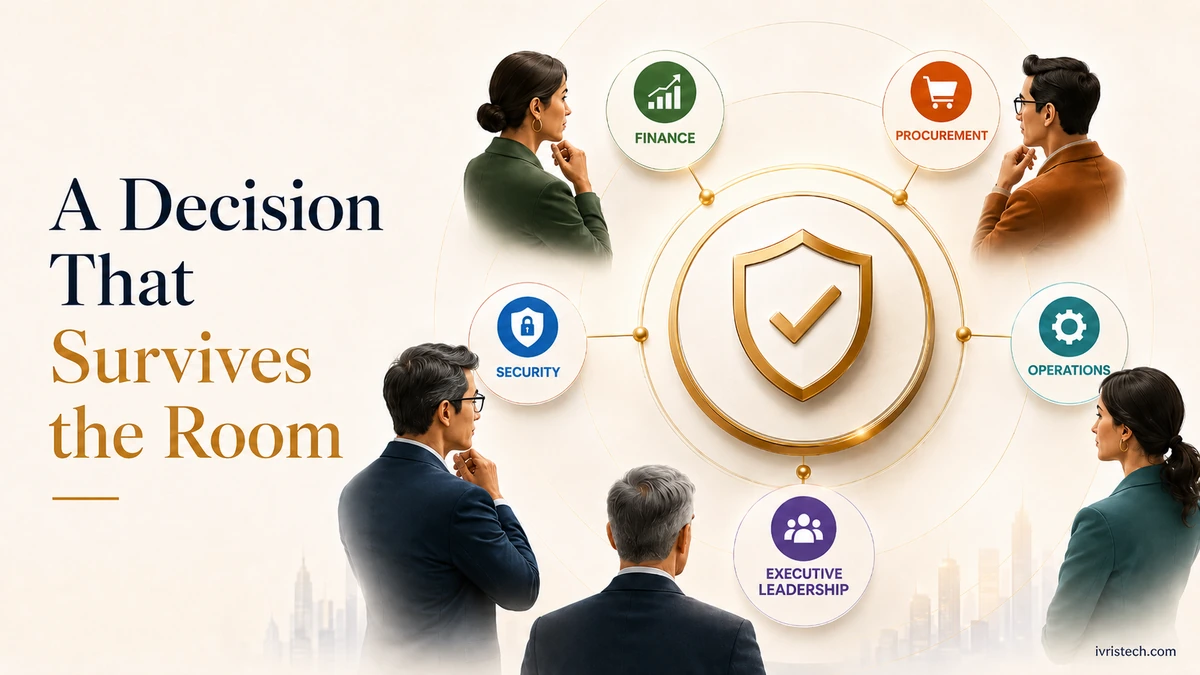
The headcount is not the interesting part. The interesting part is that each of those people is evaluating a different version of the same decision. Finance wants to know if the economics are credible. Procurement wants to know the terms and alternatives were tested responsibly. Security wants to know what new exposure the company is accepting. Operations wants to know who owns implementation after the ink dries. The executive sponsor wants to know why this deserves attention now instead of six months from now.
The person talking to sales has to carry some version of the decision into every one of those rooms.
One pattern I think enterprise sellers underestimate: translation. A champion who agrees with you is useful. A champion who can translate the decision into the language of finance, security, procurement, and leadership is worth far more.
That changes what good selling looks like. A good sales conversation persuades the person in front of you. A good enterprise sales process helps that person explain the decision when you’re gone.
To be clear, this is not an argument for stuffing more contacts into the CRM. Multi-threading has value, but collecting names is not the same as understanding a decision. The better question: what does this purchase have to survive inside the organization?
Most first calls begin after the buying group has formed an opinion
Timing matters too. 6sense’s 2025 Buyer Experience Report, based on nearly 4,000 B2B buyers, found that 94% of buying groups ranked their shortlist before engaging sellers. The vendor leading that pre-contact phase won 77% of the time. Buyers initiated 79% of first seller engagements themselves.
The first call still matters. Its purpose has changed.
Plenty of enterprise discovery still runs as if the buyer showed up with an empty page. Broad questions, the standard narrative, a slow build toward differentiation. Meanwhile the buyer may already have a shortlist, an internal favorite, prior experience with half the vendors, and a decent read on everyone’s strengths and weaknesses. What’s unresolved is often confidence, not information.
So ask different questions. Instead of only “What are your top priorities?” try:
- What has the team already agreed on?
- What is still unresolved?
- Which assumption are you least confident in?
- Who has to believe in this decision who isn’t in this conversation?
- What would make this hard to approve?
- What would make doing nothing feel safer?
Those questions reveal the state of the decision, not just the state of the account.
Four questions the decision has to survive
A useful way to pressure-test a complex purchase: can the buying group answer four questions clearly enough to carry the decision through the organization?
Why change?
What the buyer has to establish: The status quo has a meaningful consequence
What the seller can help clarify: Cost, friction, risk or lost opportunity
Why now?
What the buyer has to establish: The problem deserves priority now
What the seller can help clarify: Business trigger, deadline or cost of delay
Why this?
What the buyer has to establish: The choice fits the buyer’s actual criteria
What the seller can help clarify: Tradeoffs, fit and relevant evidence
Why is it safe?
What the buyer has to establish: The remaining risk is understood and acceptable
What the seller can help clarify: Proof, implementation reality and risk reduction
1. Why change?
Before a buyer can justify a vendor, they have to justify disruption. Changing software, process, infrastructure, or partners creates work. Even an obviously better option loses to the status quo if the cost of staying put was never made concrete.
Nobody needs a seller manufacturing pain. The useful work is making consequence concrete. What is the current problem actually costing? Who feels it? What happens if nothing changes? Is this an annoyance, or is it hitting revenue, cost, risk, speed, or customer experience?
If “why change?” stays vague, everything downstream gets fragile.
A simple test: could the champion explain the consequence of doing nothing in language finance and leadership would recognize? If not, you have interest without a business case.
2. Why now?
A problem can be real and still lose to twenty other priorities.
This is where sellers confuse urgency with pressure. A quarter-end discount doesn’t create a business reason to move. A string of follow-up emails doesn’t make the underlying priority more important. Real urgency belongs to the buyer. It comes from a strategic initiative, a renewal date, an operating target, a hiring constraint, a regulatory change, a launch, or the compounding cost of leaving the problem alone.
Forget “how do we get this deal done this month.” The real question is what makes solving this more important right now than everything else competing for the same money and attention.
If there’s no credible answer, pushing harder makes the seller feel urgency while the buyer feels friction.
3. Why this?
By the time a buying group reaches sellers, it often understands the category well enough to have formed an opinion. The useful work is making the tradeoffs explicit. What criteria matter most? Which requirements are truly non-negotiable? Where will the buyer accept complexity in exchange for a better outcome?
A feature is not a reason to buy until the buyer can explain why it matters in their environment.
You’re not trying to prove one option is universally best. You’re helping the group get precise about why one choice fits this specific set of constraints, priorities, and risks.
4. Why is it safe?
This is the question sales teams underweight most.
A buyer can believe the problem is real, agree it matters now, prefer one option, and still not move. Enterprise purchases create exposure. Financial risk, technical risk, implementation risk. Career risk. The risk of choosing badly, and the separate risk of being the person who recommended the choice.
Forrester’s 2026 research found that more than 60% of business buyers use some form of trial. That makes sense once you see a trial as a risk-reduction mechanism rather than a product experience. A claim becomes evidence. An implementation assumption gets tested. The buyer gains something they can carry into the approval process.
The same principle runs beyond trials. A clear implementation plan reduces operational risk. A transparent limitation reduces trust risk. Evidence from a comparable situation reduces perceived risk. A well-defined success measure reduces financial ambiguity.
You don’t have to promise nothing can go wrong. You have to help the buyer understand what could go wrong, what has been tested, and why the remaining risk is reasonable.
What this changes for revenue teams
If the job is shifting from information delivery to decision support, some familiar practices have to shift with it.
Discovery should uncover uncertainty, not just collect facts
Most teams already have account data, industry information, CRM history, and a growing pile of AI-generated research. Spending expensive human conversation time on questions that could have been answered before the call wastes the one part of the interaction that’s hardest to automate.
The better discovery questions surface disagreement, consequence, unresolved assumptions, and risk. Facts tell you what the account looks like. Uncertainty tells you what could stop the decision.
Content should help buyers carry the decision internally
Revenue teams produce enormous amounts of content designed to explain. The next opportunity is content designed to travel: a one-page business-case structure, an implementation map, a concise risk FAQ, an evaluation worksheet, evidence from comparable situations, a summary that makes the logic of the decision easy to retell.
The bar isn’t “did we send something useful?” It’s “could the buyer use this in a meeting we will never attend?”
Pipeline reviews should measure buyer progress, not only seller activity
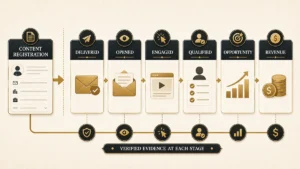
This is the distinction I find most useful in complex deals. Most CRM stages are rich with evidence about the seller and thin on evidence about the buying group. Meeting held. Demo complete. Proposal sent. Those are activities. They don’t mean the decision got easier to make.
A stronger review asks what changed on the buyer side:
- Is the consequence of staying the same understood?
- Is there a real reason to act now?
- Are the decision criteria clear?
- Has procurement or another risk owner entered the process?
- Is there an unresolved concern that could stop approval?
- Has the buyer gathered enough evidence to feel safe moving forward?
A deal can be extremely busy without actually moving.
Enablement should train sellers to interpret, validate, and de-risk
If buyers can pull product and category information on demand, memorizing more of it can’t be the endpoint of enablement. The higher-value skills are interpretation, challenge, context, validation, and risk reduction. Product expertise still matters. It just matters most when the seller applies it to the buyer’s decision instead of reciting it.
The strongest seller in an AI-assisted buying process may not be the person with the most answers. It may be the person who knows which answer matters next.
Information is abundant. Confidence is scarce.
AI will keep stripping informational work out of the sales process. Buyers will keep researching on their own. More of the explanation that once happened in a sales conversation will happen before that conversation begins.
None of that makes good sellers less relevant. It makes low-value selling easier to see.
A buyer doesn’t need another person making a complex decision louder. They need help making it clearer: what matters, what doesn’t, what could go wrong, which evidence is credible, and what has to be true for the organization to move responsibly.
You can’t make the decision for the buyer, and you shouldn’t try. But you can help make it strong enough to survive the conversations that happen after the call ends.
Information helps someone understand a purchase. Confidence helps an organization make one.
Author bio
Anderson Duncan works in enterprise technology sales and writes about complex B2B buying, enterprise sales, trust, and the human systems behind revenue. His work focuses on what actually happens inside buying groups when decisions become complicated.