Optimizely formally announced Virtual Teammates on August 31, 2026, introducing five role-specific AI coworkers: Chief of Staff, SEO & AI Search Analyst, Marketing Analyst, Personalization Strategist, and CRO Manager. Its Opal release notes show all five were already marked “Released” on August 25.
The important change is not the coworker label. Optimizely’s support documentation describes a persistent worker with its own memory and Opti ID identity, plus jobs that run on schedules or event triggers. Access is administrator-controlled, and the official documentation reviewed does not label Virtual Teammates as beta, preview, or waitlist.
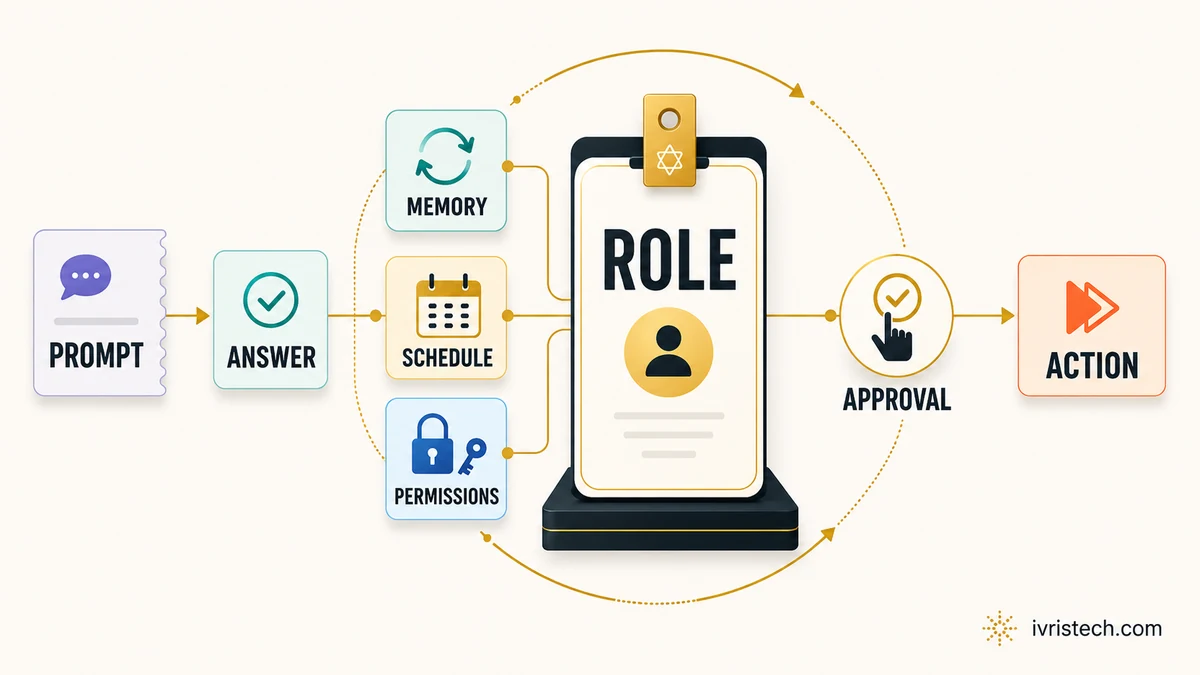
For B2B teams, that moves marketing AI beyond prompt → answer. A person can assign an ongoing role, let context persist, give it recurring responsibilities, and decide which actions require approval. That is narrower than the broader shift in our agentic AI marketing guide: the new question is who owns a standing AI job and how much authority follows it.
Direct answer — What changes with Optimizely Virtual Teammates?
Optimizely Virtual Teammates turn AI from an on-demand tool into a persistent, role-based worker. Each teammate can retain context, run scheduled or triggered jobs, and operate with scoped access under its own Optimizely identity. The practical change is governance: recurring AI work now needs a named objective, human owner, read/write boundaries, approval rules, and a reviewable activity trail.
Key Takeaways
- Optimizely announced Virtual Teammates on August 31; release notes mark the five initial roles as released on August 25.
- Jobs can run on schedules or events while the teammate retains memory and its own Optimizely identity.
- By default, Optimizely says a teammate proposes work for human approval before acting.
- Specific actions can later run automatically within boundaries set by the organization.
- The source materials establish role persistence and governance mechanics, not a claim that every marketing task should be delegated.
Optimizely Virtual Teammates make the role persistent
Most marketing AI still starts with a human opening a tool and asking for something. Optimizely is formalizing a different operating model: assign an AI a role, give that role durable context, and let it keep doing a defined job over time.
The five launch roles are deliberately familiar. A Chief of Staff can help coordinate work across Opal; the SEO & AI Search Analyst focuses on search visibility; the Marketing Analyst works on performance analysis; the Personalization Strategist targets audience and experience opportunities; and the CRO Manager looks for optimization opportunities.
The distinction is structural. Optimizely’s documentation says a Virtual Teammate has its own identity and access rights through Opti ID, maintains long-term memory, and performs jobs. Jobs can be scheduled or triggered by events, which means the worker can continue operating without a marketer manually reopening the same prompt chain every time.
That does not mean unrestricted autonomy. The useful way to read the launch is as a new layer of delegated responsibility inside an existing marketing stack.
Memory changes the accountability problem
Persistent memory is valuable because a role can retain context about objectives, previous work and operating preferences. It is also where governance stops being theoretical.
An on-demand prompt is easy to bound: a person asks, the model answers, and the interaction ends. A persistent role creates a longer-lived state. The system may remember decisions, prior jobs and context that affect what it does next.
That means teams need to distinguish useful role memory from uncontrolled accumulation. A marketing analyst should not inherit every conversation simply because the information exists somewhere in the platform. Memory should follow the role’s purpose, not the broadest technically possible context.
For operators, the minimum policy is straightforward: define what the role may remember, who can inspect or reset that memory, and what information should never become part of the role’s working context.
Schedules and triggers turn prompts into standing work
Optimizely says Virtual Teammate jobs can run on schedules or event triggers. That is the point where AI stops behaving like a chat utility and starts resembling an operating role.
A recurring job could be useful for monitoring conversion performance, checking search visibility or preparing periodic analysis. But recurring work also changes the failure mode. A bad one-off answer is one mistake. A badly scoped scheduled job can repeat the same mistake until someone notices.
Teams should therefore treat every scheduled or triggered job as a small automation with an owner, expected output, cadence, stop condition and review point. If nobody can answer who owns the job after the person who created it goes on leave, the delegation model is incomplete. Salesforce’s new Hunter makes the same long-horizon control issue concrete at the revenue-record level: long-horizon sales work needs explicit stop rules when ownership, qualification, stage, or buyer intent changes mid-goal.
Scoped permissions matter more than the teammate label
Optimizely documents Virtual Teammates as having their own Opti ID identity and access rights controlled by administrators. That matters because a persistent role should not borrow one employee’s full authority by default.
A clean model separates identity from permission. The teammate can be a recognizable system actor, while administrators decide what it can access. That makes activity easier to attribute and lets teams reduce privileges without dismantling the role itself.
The practical question is not whether the AI is called a coworker. It is whether the organization can answer: what can this identity read, what can it change, and which systems are outside its boundary?
Human approval is the default control surface
Optimizely says Virtual Teammates propose work for human approval by default. Organizations can later allow particular actions to run automatically within configured boundaries.
That is a useful separation because it avoids treating autonomy as an all-or-nothing switch. A team can allow a low-risk recurring analysis job to execute automatically while keeping changes to live experiences or campaign configuration behind approval.
The approval point should sit before the consequential action, not after it. A review workflow that only tells a marketer what the agent already changed is an audit log, not an approval gate.
What B2B teams should define before assigning a standing AI role
The launch gives teams a reason to formalize an AI role card before they scale recurring agent work. The card does not need to be complicated. It should answer five questions.
- Objective: What recurring outcome is this role responsible for?
- Owner: Which human is accountable for the role’s performance and exceptions?
- Context: What memory, data and prior work may the role use?
- Authority: What can it read, propose, change or trigger?
- Approval: Which actions require a human decision before execution?
Those questions matter more than the job title. A “CRO Manager” with vague permissions is riskier than a narrowly defined optimization assistant with explicit boundaries.
What the launch does not establish
Optimizely’s announcement and support pages establish the product model, launch roles, memory, jobs, identity and approval mechanics. They do not establish that persistent AI roles outperform human teams across every marketing function, nor that broad autonomy is necessary to get value from the product.
The vendor framing also should not be confused with an employment claim. Calling the tools teammates makes the interface legible, but the operational value still comes from software performing bounded tasks inside a governance model.
That is the standard B2B teams should use when evaluating this category. The question is not whether an AI can look like a colleague on an org chart. It is whether the recurring job, context, permission boundary and approval path are clear enough that a human can remain accountable.
The real shift is from prompt ownership to role ownership
Virtual Teammates make a broader change easier to see. Once AI has memory, recurring jobs and a distinct identity, prompt quality is no longer the only operating concern. The organization is assigning standing responsibility.
That moves the governance unit from the individual interaction to the role itself. Teams need to review what the role is for, what it can access, what it can do without asking, and who shuts it down when the job no longer makes sense.
For marketing leaders, that is the useful takeaway from Optimizely’s launch: persistent AI can reduce repeated setup, but only if recurring authority is designed as carefully as recurring work.