Direct answer:
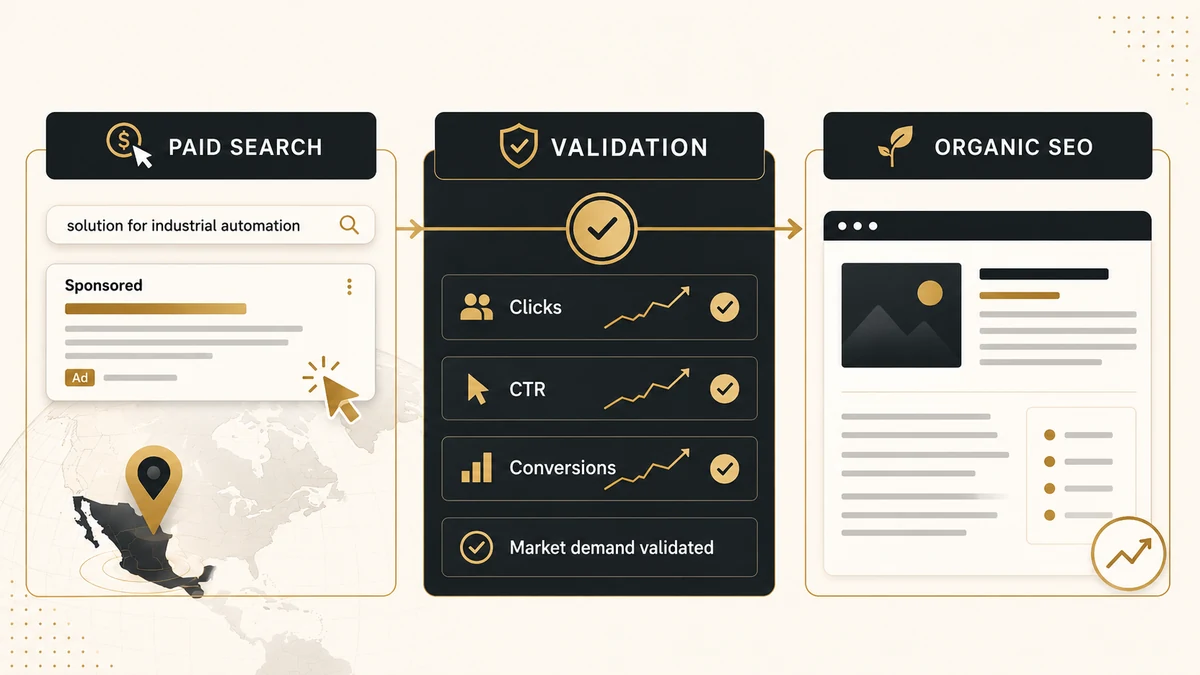
Google Ads cannot predict organic rankings or replace international SEO research. It can give B2B teams an early, controlled view of buyer language, query intent, localized page response and lead quality. Those observations help decide which organic pages to build, revise, investigate or stop before committing to a full market program.
Key takeaways
- Test the thesis. Use paid search to examine a market assumption, not to forecast organic traffic.
- Measure commercial evidence. Structure the test around query themes, landing-page response and qualified outcomes—not clicks alone.
- Control the country variable. Keep location, language, offer and measurement consistent enough to interpret the result.
- Separate transferable signals. Relevant search terms, buyer objections and qualified leads can inform SEO; ad CTR, Quality Score and paid impression volume cannot be transferred directly.
- End with a page decision. Build, revise, investigate or stop.
The gap between search volume and market evidence
A keyword plan is often the first spreadsheet in an international SEO proposal. The apparent precision is reassuring: estimated monthly searches, competition and a range of likely bids. Yet those figures are planning inputs, not proof that a particular company can acquire customers in that market.
Google explains that Keyword Planner forecasts incorporate bid, budget, seasonality and historical ad quality. For a new advertiser, they may rely on averages across advertisers rather than the company’s own performance. The tool therefore answers a narrower question: is there enough apparent search activity to investigate?
The investment decision requires different evidence. A B2B team needs to know:
- Search language: Which terms do people actually use when the offer is available to them?
- Commercial intent: Which query themes reflect buying activity rather than academic, consumer, recruitment or support intent?
- Offer response: Does the localized promise earn a meaningful response?
- Journey integrity: Do the form, consent flow and sales follow-up work in that market?
- Lead quality: Do submitted leads resemble the target account and buyer profile?
Organic search can eventually reveal some of this, but only after pages have been created, crawled and given time to compete. Paid search buys an earlier observation window. It does not eliminate uncertainty; it moves the cheapest uncertainties forward.
Start with a market thesis that can fail
“Test Google Ads in Germany” is a channel task, not an experiment. A useful test starts with a statement that the team is willing to reject. Consider this illustrative market thesis:
German operations leaders searching for enterprise inventory-planning software use a defined group of problem and category terms, will respond to a German-language assessment offer, and will produce qualified leads at a cost that justifies further organic investment.
This is a worked example, not a reported client result. It shows how a broad market-entry question can be converted into measurable hypotheses and predetermined decision rules.
Worked example: From assumption to test plan
Assume a B2B inventory-planning software company is evaluating Germany. Instead of treating “inventory planning software” as one keyword market, the team creates four query clusters: category terms, forecasting problems, inventory-optimization use cases and software comparisons.
Each cluster receives a localized ad and the closest relevant German-language landing page. The form records country, company type, role, use case and employee band so that submissions can be evaluated against the target buyer profile. Search terms are classified separately as B2B, consumer, education, employment or support intent.
Before launch, the team defines four possible outcomes. A cluster is marked Build when it reveals relevant local language and qualified demand; Revise when intent appears valid but the offer or page underperforms; Investigate when reach or lead volume is insufficient; and Stop when visible demand is materially irrelevant or incompatible with the company’s service model.
The team also records the maximum budget, test window and expected qualification delay in advance. No performance result is assumed. “No conclusion” remains a valid outcome, and every observed result leads to a specific organic-content decision instead of a general statement that the market “looks promising.”
Build a paid-search test that isolates the country
The test does not need to reproduce a mature acquisition account. It needs enough control to make the evidence interpretable.
Separate query themes by buyer problem
Start with three to five tightly defined clusters, each corresponding to a plausible organic page. These might include a category term, a problem term, an industry-specific use case and an alternative or comparison term. Keep branded terms, competitor terms, customer-support searches and recruitment queries out of the test because they answer different questions.
Use exact and phrase match initially for language validation. Google’s current matching system is meaning-based: phrase match reaches exact-match queries and more, while broad match can use signals such as landing pages, other keywords and previous searches. Broad match can aid later discovery, but it introduces more paths when testing a specific thesis.
This control is not perfect. Exact match can include close variants, and privacy thresholds mean the search terms report does not expose every low-volume query. Search terms insights can group some of that activity into themes without revealing the underlying query. Label absent query data as unknown rather than assigning it to a winning cluster.
Make location and language choices explicit
For a country-validation test, target people who are in or regularly in the country unless the product is explicitly sold to people researching that country from elsewhere. Google Ads can otherwise include people who have merely shown interest in the location. That broader option may be useful in categories such as travel or relocation, but it can contaminate evidence about in-market B2B buyers.
Language is not just a campaign setting. The ad, landing page, form, privacy notice, confirmation message and sales response should make sense together. A translated ad that opens an English form tests tolerance for a broken journey, not demand for the offer. If the company cannot yet support a fully local experience, document the gap and treat landing-page response as a lower-bound estimate rather than a clean market signal.
Hold the offer steady, then test the message
Each query cluster should land on the closest relevant page, not a generic homepage. The page should state who the offer is for, the problem solved, the next step, any important integration or delivery constraint, and the evidence a cautious buyer needs before responding.
Run a small number of message variants around real positioning choices: local terminology, outcome framing, industry specificity or the call to action. Do not change the keyword set, offer, page structure and qualification rules at the same time. If everything moves, the test can report a winner but cannot explain it.
Connect ad clicks to qualified outcomes
UTM parameters can support analytics reporting, but the ad click must also be connected to downstream lead status. Preserve the campaign, query theme, landing page and eligible click identifiers in the CRM. Obtain the required consent and handle personal data under the rules that apply to the market.
For B2B sales cycles, import later stages such as qualified lead or converted lead rather than optimizing to form submissions. Enhanced conversions for leads supports hashed first-party data. Google’s 2026 changes unified enhanced-conversion settings and moved supported offline uploads toward Data Manager workflows. Verify the account’s current implementation path before using an older guide. See About enhanced conversions for leads and the 2026 settings update.
Even if the test is too small for automated bidding to learn reliably, connecting media activity to CRM stages prevents the team from optimizing toward whichever form is easiest to submit.
Allow for conversion delay before closing the analysis. Google’s conversion-lag reporting exists because recent CPA or ROAS can look incomplete while later conversions are still arriving. The CRM may lag further if qualification requires a sales conversation. Set the readout date from the real qualification cycle, not from the day the media budget ends.
Read the evidence in three layers
A useful readout separates language, response and commercial quality. Combining them into one campaign average hides the reason a market passed or failed.
Layer 1: Search language and intent
Export the search terms report and code each visible term by:
- Query cluster: The commercial or informational task behind the search
- Local wording: The phrase, abbreviation or synonym used in the market
- Buying stage: The plausible stage and next action
- Intent class: B2B, B2C, employment, education or support
- Buyer clues: Implied company size, industry or technical requirement
- Destination: The page type capable of completing the task
The output maps the language the organic architecture must accommodate. A local abbreviation that attracts the right audience may deserve a commercial page’s title and H1; a technical qualifier may belong in its copy or FAQ. A large irrelevant theme may show that the translated category label means something different locally.
Layer 2: Landing-page response
Read engagement and conversion by query cluster and message variant, not only by campaign. A page can fail because the term was wrong, the offer was weak or the local experience reduced trust. Look at the sequence: ad impression, click, meaningful page engagement, form start, form completion and valid contact data.
Micro-conversions are diagnostic, not success criteria. A visitor who opens a pricing explanation or technical specification is signaling a question. That behavior can guide page design. It cannot replace a qualified lead when the investment case depends on pipeline.
Layer 3: Lead quality and economics
Join each lead back to its query cluster. Then classify fit, sales acceptance, reason for rejection and—where the window permits—opportunity creation. A cluster with an expensive click and suitable enterprise conversations may be more valuable than one producing cheap submissions from companies the product cannot serve.
Do not declare a market unviable from cost per click alone. Paid acquisition has auction costs; SEO has content, technical and authority-building costs. Compare the value of validated demand with the full cost and time of earning organic visibility. The question is not whether SEO will match PPC’s CPA, but whether the underlying demand merits pursuit.
Which PPC signals transfer to SEO?
The safest way to use the test is to label each metric by what it actually measures.
| PPC observation | SEO planning value | How to use it |
|---|---|---|
| Qualified leads by query theme | Strong | Prioritize commercial pages for themes that produce the right buyers |
| Relevant search terms and local synonyms | Strong, but incomplete | Shape titles, headings, copy and page taxonomy; retain a separate organic discovery process |
| Repeated objections or required details | Strong | Add proof, specifications, comparisons, FAQs and supporting articles |
| Landing-page conversion by theme | Moderate to strong | Compare offers and message-market fit when the page and traffic are controlled |
| Negative or irrelevant query patterns | Moderate | Clarify page scope and avoid ambiguous targets; do not assume organic traffic will have the same mix |
| Paid impression or click volume | Weak | Use as directional evidence only; budget, bids, match type, Ad Rank and targeting constrain delivery |
| Ad CTR | Weak | Compare paid messages within the test; do not forecast organic CTR from it |
| Paid conversion rate | Weak as an organic forecast | Paid placement and query selection produce a different visitor mix |
| Cost per click | Context only | Indicates auction economics, not organic ranking difficulty or total SEO cost |
| Quality Score | None as an organic ranking signal | Google describes Quality Score as a diagnostic, not a KPI |
The distinction matters most when the result is negative. Zero conversions may reflect no demand, insufficient reach, a mistranslated proposition, a poor form, a weak offer or an unfinished qualification cycle. State which explanations the test ruled out and which remain open.
Use a readout template that preserves uncertainty
Do not invent a benchmark or force a case study when publishable client data is unavailable. Use a decision table that records verified campaign and CRM observations. The rows below illustrate the structure, not performance claims; replace them with the real query clusters and evidence from the approved test.
| Query cluster | Verified evidence to record | Main uncertainty | Decision |
|---|---|---|---|
| Category | Visible search terms, local synonyms, qualified outcomes | Was reach sufficient? | Build / Revise / Investigate / Stop |
| Problem | Intent classification, page engagement, objections | Did the offer match the problem? | Build / Revise / Investigate / Stop |
| Industry use case | Company fit, technical requirements, sales acceptance | Can the company serve the revealed need? | Build / Revise / Investigate / Stop |
| Comparison or alternative | Competitor intent, proof requests, next action | Is this a page opportunity or research-only traffic? | Build / Revise / Investigate / Stop |
This structure keeps the conclusion tied to evidence. It also makes “insufficient evidence” a legitimate output rather than a reason to extend the campaign indefinitely.
Turn the test into an organic roadmap
End the experiment with page decisions, not a slide saying that the campaign “showed promise.” Assign one of four actions to every query cluster:
- Build: The cluster produced relevant terms, acceptable page response and evidence of qualified demand. Create or localize the commercial landing page first.
- Revise: Search intent appears relevant, but the offer or page underperformed. Resolve the message, proof, pricing or localization problem before scaling content.
- Investigate: The signal is mixed or the sample is too small. Use customer interviews, sales calls, local SERP review and competitor analysis to close the specific gap.
- Stop: Visible demand is materially irrelevant, the company cannot serve the revealed requirements, or qualified economics remain outside the agreed boundary after an adequate test.
For every build cluster, write a page brief from the evidence. Primary terms and synonyms define its language; modifiers clarify industries, use cases and constraints. Message response identifies the promise, while form and sales feedback reveal the proof needed near conversion.
Build supporting content from unanswered questions, not every term that generated an impression. Repeated implementation, migration, compliance, integration or comparison concerns can become articles supporting the commercial page. Informational SEO still needs separate research because a conversion-focused test will under-sample uneconomical early-stage queries.
A pre-SEO validation checklist
Before approving the organic program, confirm that the team can answer:
- Search relevance: Which in-market query clusters produced relevant searches?
- Language variance: Which local terms differed from the original keyword assumptions?
- Qualified demand: Which clusters generated qualified leads, not only forms?
- Rejected leads: What did they reveal about intent or service constraints?
- Local experience: Did every tested journey provide a coherent local experience?
- Measurement maturity: Has conversion lag elapsed, and has CRM qualification been joined to the ad data?
- Signal transfer: Which observations are transferable to SEO, and which are PPC-only?
- Page priority: Which landing pages should be built first, and what supporting questions deserve content?
- Stop rule: What evidence would cause the team to revise or stop the market investment?
Paid search cannot tell a B2B team how quickly a new page will rank, how many links it will need or what organic click-through rate it will earn. It can do something more useful at the start: expose the language, intent, offer response and lead quality behind an attractive volume estimate. When the test preserves those distinctions, a modest media budget becomes evidence for a much larger SEO decision.
Frequently asked questions
There is no universal duration. Set the window from expected query volume, budget, conversion lag and sales qualification time. Make it long enough to evaluate priority themes but cap it so inconclusive activity does not become permanent spend.
No. Placement, targeting, match types, ad copy and auction conditions produce a different visitor mix. Use paid conversion data to diagnose message-market fit, not to forecast organic conversion.
Record an inconclusive result and identify the missing evidence. Supplement it with local SERP analysis, customer interviews, sales-call language and partner input. Low volume can weaken the business case, but it does not prove that demand is absent.
About the author
Fucheng Zhang is an International SEO and Paid Media Strategist at ZheShan Tech, where he works on international website strategy, Google SEO, Google Ads and overseas customer acquisition for B2B companies. His work focuses on connecting search-demand research, localized landing pages, paid-search testing and lead-quality measurement to help companies evaluate new markets before committing to larger organic growth programs.
Disclosure
The author is affiliated with ZheShan Tech, which provides international SEO, Google Ads and website-related services. No client names, confidential campaign results or proprietary datasets are included in this article.