
Do AI watermarks hurt SEO? There is no documented Google penalty for the mark itself. An AI watermark is a provenance signal, not a hidden instruction telling Search to rank a page lower.
The current panic collapses four questions into one: can a provider mark its output, can somebody detect that mark, does Google Search use it while ranking webpages, and would Google give it a negative weight? The first question has a clear yes. The last two do not.
That distinction matters because publishers are being sold a solution before anyone has proved the problem. Rewriting a sound article to defeat a detector can cost accuracy, clarity, and trust while producing no demonstrated SEO benefit.
Direct answer — do AI watermarks hurt SEO?
AI watermarks have no documented negative effect on SEO. Google permits appropriate AI assistance and targets scaled, low-value content created mainly to manipulate rankings, regardless of whether a person or a model produced it. A watermark can indicate that a supported AI system processed enough content; it does not measure quality or tell Google to demote the page. Remove one only for a legitimate publishing, contractual, or rights reason, not for an expected ranking gain.
Key Takeaways
- Google has not publicly identified a Claude watermark, SynthID text signal, C2PA credential, or generic AI-detector score as a negative ranking factor.
- Google’s documented concern is scaled content abuse: producing many unoriginal or low-value pages mainly to manipulate Search, no matter how those pages were made.
- A detected Claude mark can indicate that Claude processed the text. It cannot prove that Claude originated every idea, sentence, or fact.
- OpenAI currently documents provenance signals for supported images and audio, not a generally deployed watermark for ordinary ChatGPT text.
- Google uses SynthID for supported Gemini text and media, but owning provenance technology does not prove that Search demotes marked webpages.
- There is no controlled public SEO experiment showing that removing an AI watermark improves indexing, rankings, or traffic.
| Question | Evidence-based answer |
|---|---|
| Do AI watermarks hurt SEO? | No public evidence shows that the mark itself harms rankings. |
| Does Google penalize AI content? | Not merely because AI was used. Google acts against low-value or manipulative content, including scaled abuse. |
| Should you remove a Claude watermark? | Not for SEO. No ranking benefit has been demonstrated. |
| Can Google detect Claude’s mark? | Google Search has not publicly said that it can detect Anthropic’s production mark or uses it in ranking. |
| Does ChatGPT watermark ordinary text? | OpenAI does not currently document generally deployed provenance signals for ordinary text. |
| Can watermarked content rank? | Yes. Google’s public policies do not make provenance an automatic barrier to indexing or ranking. |
What an AI text watermark actually is
An AI text watermark is a statistical pattern inserted during generation, not a visible logo and not necessarily a string of hidden characters. A system such as SynthID slightly changes the probability of otherwise reasonable next-token choices, creating a pattern that a detector with the right configuration can score later.
One word rarely reveals anything. The evidence accumulates across a longer passage. That is why detection generally works better on varied, model-generated prose than on a short factual answer with only a few sensible ways to phrase it.
Google DeepMind’s explanation of how SynthID changes token probabilities also describes the main limits. Mild editing may leave enough of the statistical pattern intact, while a thorough rewrite or translation can sharply reduce confidence. Constrained factual text gives the system fewer safe word choices, so it can carry a weaker signal.
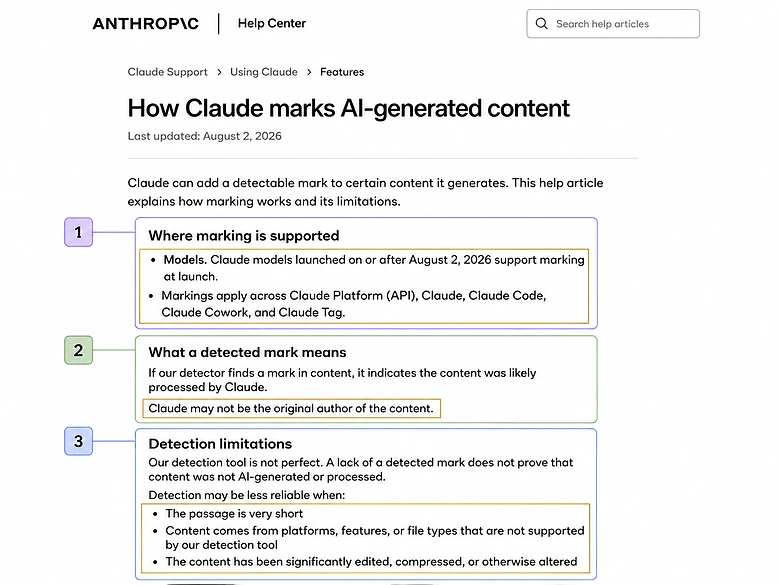
Claude’s current marking system follows the same practical idea from the publisher’s point of view: the mark travels with copied text and may survive some editing. Anthropic also says a positive result would mean the content may have been processed by Claude, not that Claude necessarily authored all of it. A person could have written the original and used Claude only to proofread, translate, summarize, or reformat it.
A watermark answers a narrow origin question. It does not answer whether the page is accurate, original, expert, useful, or deserving of a ranking.
Five systems people incorrectly call AI detection
AI detection is an umbrella phrase covering systems that test very different things. Treating them as interchangeable is the main reason the SEO discussion becomes unreliable.
| System | What it checks | What it cannot prove |
|---|---|---|
| Statistical text watermark | A provider-embedded pattern created through token selection during generation | Human authorship, factual accuracy, ownership, plagiarism, or a ranking outcome |
| C2PA / Content Credentials | Signed provenance information attached to or linked with a digital file | That the content is true, unbiased, legally owned, or wholly AI-created |
| Visible watermark | A label, logo, disclosure, or other mark a reader can see | Cryptographic authenticity or a complete production history |
| Generic AI detector | Language patterns that a classifier associates with AI-generated text | Definitive authorship or which provider produced the passage |
| Google ranking and spam systems | Relevance, usefulness, originality, reliability, and signs of manipulation | Public Google documents do not describe these systems as a simple Claude or ChatGPT detector |
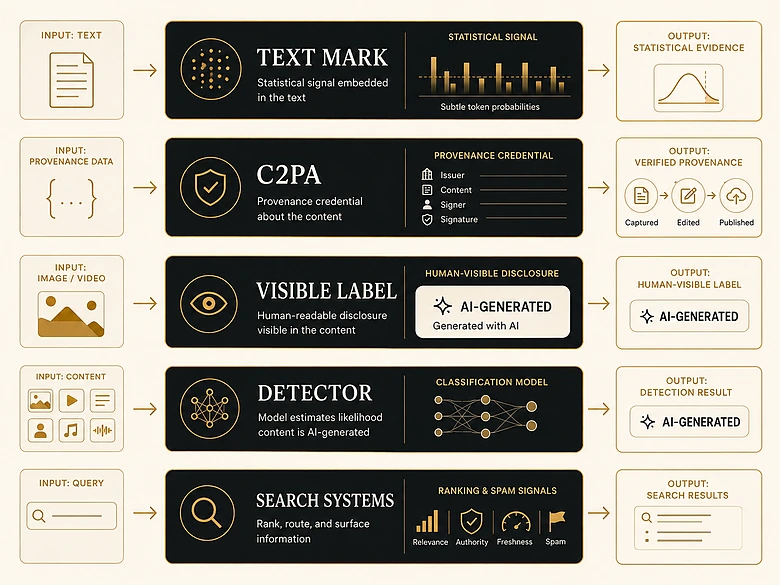
The distinction is easiest to see with a file. A generated image may carry a signed C2PA manifest recording the tool that created it. The same image may also contain an invisible watermark designed to survive some transformations. A visible label could be added on top. A classifier could still make its own guess. None of those systems measures whether the image is useful or whether the webpage containing it satisfies a search query.
The same separation applies to text. A provider-aware watermark detector checks for a deliberately embedded signal. A generic detector estimates authorship from linguistic patterns. Google Search decides whether a page deserves visibility. Those jobs can coexist without becoming the same job.
What Claude, ChatGPT, and Gemini currently mark
Provider coverage varies by model, product, file type, export path, and creation date. The table below reflects public documentation reviewed on August 25, 2026.
| Provider | Ordinary text | Images and files | Key limitation |
|---|---|---|---|
| Claude / Anthropic | Supported models embed machine-readable watermarks in generated text | Supported files can receive signed C2PA provenance metadata | Older-model coverage is still being added, and detection indicates possible processing rather than full authorship |
| OpenAI / ChatGPT | No generally deployed text signal is listed in current public documentation | Supported images use C2PA and SynthID; supported audio uses SynthID | Coverage varies by model, product, export route, file type, and date |
| Google / Gemini | SynthID marks text in the Gemini app and web experience | SynthID is used across supported image, video, and audio products | Detection confidence depends on modality, passage length, and the transformations applied |
Anthropic’s current Claude marking documentation is especially clear about what a result means. A mark can appear after Claude processes human-originated material, and no detected mark does not prove that AI was absent. Short passages, heavy edits, unsupported models, and stripped file metadata can all change the result.
OpenAI’s provenance coverage table currently lists supported images and audio. It describes text as a future expansion goal. The precise answer is therefore that OpenAI does not currently document a generally deployed watermark in ordinary ChatGPT text. That is not proof that text provenance will never be added.
This provider matrix will change. It should be dated and maintained rather than turned into a timeless claim that every AI tool marks every output.
What Google actually penalizes
Google penalizes spam and ranking manipulation, not a production method in isolation. Its current guidance says generative AI can help with research and with structuring original content, while generating many pages without adding value may violate the scaled content abuse policy. That policy framework now also has a geographic enforcement wrinkle: site reputation manual actions affect EEA and non-EEA search results differently, while the underlying site reputation policy still applies.
The operative test is the purpose and result of the publishing system. Google’s guidance for generative AI content tells site owners to meet Search Essentials and the spam policies. It does not say that a page becomes ineligible because a model assisted with research, editing, drafting, data processing, or structure.
The scaled content abuse policy is deliberately technology-neutral. It covers large numbers of pages created mainly to manipulate rankings, particularly when the pages are unoriginal or add little value, no matter whether AI, humans, or a mixture produced them.
That means a weak publishing operation is not made safe by removing provenance. A thousand keyword-swapped pages remain a thousand keyword-swapped pages after the watermark disappears. The site architecture, repetition, information value, factual quality, and underlying intent are still visible.
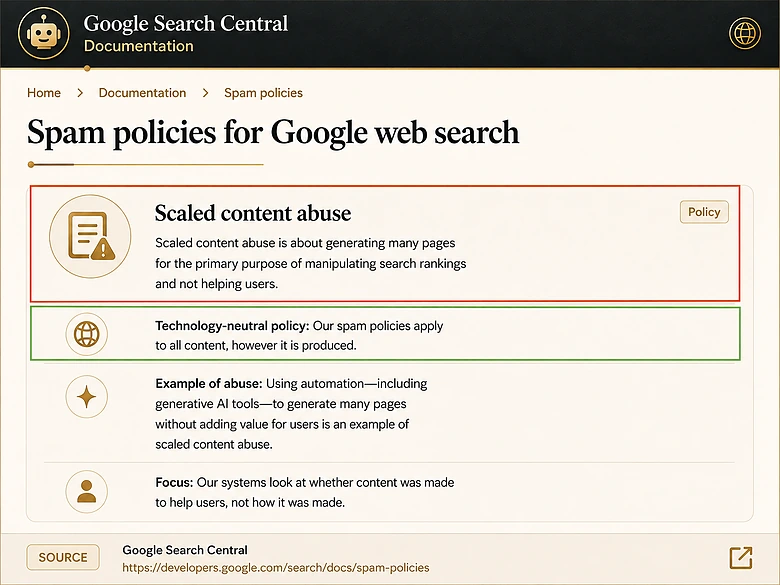
The reverse is also true. A marked page does not become spam when it contains original reporting, reliable sources, accountable review, and a satisfying answer. That production-method-neutral principle is already part of a sound B2B SEO strategy built around reader value and pipeline relevance.
IMPORTANT
“Google can detect AI” and “Google penalizes a provider watermark” are not equivalent claims. Technical capability does not establish ranking use, and ranking use would not automatically establish negative weighting.
The four evidence gates a penalty claim must pass
A credible claim that AI watermarks hurt SEO must pass four separate evidence gates. Most arguments stop after the first gate and assume the other three.
| Gate | Question | Current public evidence |
|---|---|---|
| 1. Technology exists | Can an AI provider embed a machine-readable origin signal? | Yes. Claude, SynthID, and C2PA provide documented examples. |
| 2. Search can access it | Can Google Search verify this specific provider, model, modality, and signal? | Supported for some Google media experiences; not publicly established for Claude’s production text mark. |
| 3. Search uses it in ranking | Does the webpage ranking system consume that signal? | No public evidence found for AI text watermarks. |
| 4. Search gives it negative weight | Does the signal make a page rank lower because AI was involved? | No public evidence found. |
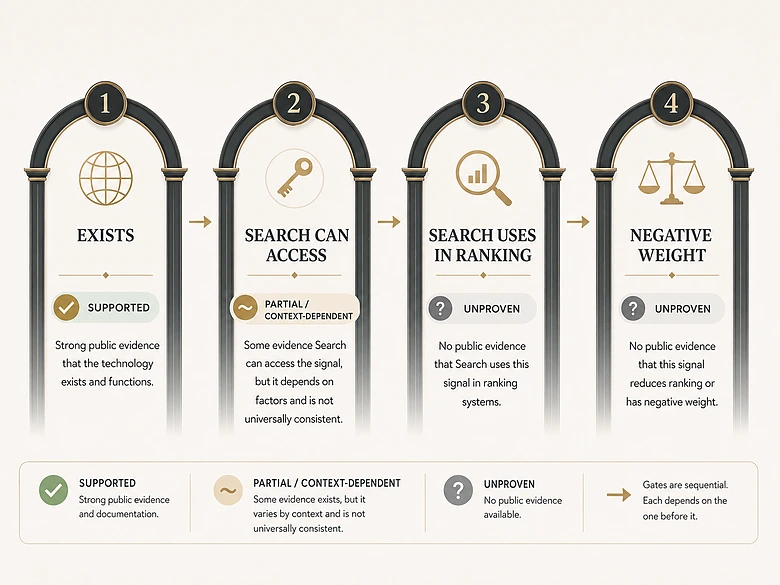
Gate one is not controversial. Providers can mark supported outputs. Parts of gate two are also supported: Google can verify SynthID in certain media experiences, and provider-specific detectors can check the signals they control.
Gates three and four are the missing steps. Google has not publicly said that its web-ranking systems inspect Claude’s text watermark, use a ChatGPT-origin classifier, or lower a page because a provenance signal is present. Public silence does not prove what every internal system does, but it does prevent anyone from presenting a watermark penalty as established fact.
An AI watermark is evidence about a production chain. It is not a Google quality score.
Can AI-watermarked content rank?
AI-watermarked content can rank because Google’s public rules do not make a watermark an automatic exclusion or demotion signal. The available ranking data also shows no binary block on pages classified as heavily AI-generated, although that evidence is not a direct watermark test.
Ahrefs analyzed ranking and indexing data in July 2026 and found that 5.3% of sampled pages in positions one to three were classified as entirely AI-generated, while 9% were classified as at least 80% AI. In a separate indexing sample, low-AI pages had a 49.28% observed indexing rate and very-high-AI pages had a 40.35% rate. The gap is meaningful, but it is not an exclusion: roughly four in ten very-high-AI pages in that sample were still indexed.
The study’s own limitations matter. It used a generic AI classifier, not a provider watermark detector. Its labels are probabilistic. It did not publish identical marked and unmarked versions on matched sites, and many other variables can explain performance differences. The responsible reading of the 331,000-page Ahrefs study is that heavy AI use often co-occurs with weaker content, not that the study isolated a watermark effect.
No controlled public SEO experiment found in this research did all of the following:
- Generate equivalent marked and unmarked passages.
- Publish them on comparable websites under matched conditions.
- Control for authority, links, intent, indexing, page quality, and internal distribution.
- Show a ranking difference caused by the watermark itself.
Until such evidence exists, “remove the watermark to protect rankings” is a commercial claim, not a demonstrated SEO practice.
Should you remove an AI watermark before publishing?
You should not remove an AI watermark for SEO because no public evidence shows that doing so improves rankings, indexing, or traffic. Edit the work when it needs better evidence, stronger analysis, clearer prose, or expert correction.
Use the following decision sequence instead:
- Your only concern is Google rankings: leave the provenance signal alone and audit the page’s usefulness, originality, accuracy, and publishing purpose.
- A client contract prohibits AI use: follow the contract. Removing a signal does not cure an undisclosed process or a broken promise.
- A generated file contains C2PA metadata: check editorial, licensing, and platform requirements before stripping useful origin information.
- The content covers regulated or public-interest information: apply the relevant legal and organizational disclosure rules separately from SEO advice.
- The draft is generic or unreliable: rebuild it with primary sources and accountable review. A detector score is not the repair target.
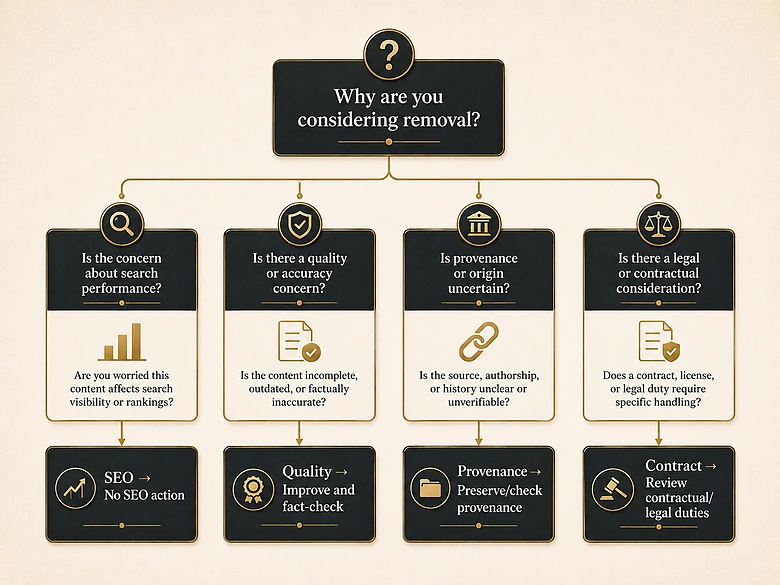
Mechanical “humanizer” tools solve the wrong problem. They can weaken a statistical pattern while also changing precise terms, introducing factual errors, or turning direct prose into awkward prose. Google has not documented detector evasion as a ranking advantage.
Normal editorial work may alter a mark as a side effect. That is different from rewriting solely to conceal provenance. The first improves the page; the second optimizes for an unproven fear.
What actually creates SEO risk with AI-assisted content
AI-assisted content creates SEO risk when it makes low-value production cheaper and faster. The danger comes from the publishing behavior and the resulting page, not from a provider label by itself.
Scaled pages with little added value
Publishing hundreds of pages built from the same template, with only an industry, city, role, or product name changed, is the clearest risk. Removing the watermark does not change the repeated structure or the absence of distinct value.
Unoriginal synthesis
A page that paraphrases the current search results without new evidence, judgment, or useful reconciliation gives readers no reason to choose it. The fix is information gain: primary-source tracing, original data, clearer definitions, conflict resolution, or operational guidance that the existing results lack.
Hallucinated facts and fabricated sources
Confident prose can hide a false statistic, invented quotation, wrong date, or citation that does not support the sentence. Those errors are especially serious in finance, health, law, security, and other high-stakes areas. Every consequential claim needs verification against the source it names.
Mass publication without accountable review
A system can create far more pages than an editorial team can responsibly check. When nobody owns the final claim, byline, or update cycle, factual drift and contradiction become predictable rather than accidental.
Content written for query variations instead of reader decisions
Creating one page for every possible wording of the same question fragments authority and produces near-duplicates. A stronger page resolves the complete reader decision and gives Google enough context to match related queries. The same principle applies when structuring pages for Google AI Overview citations without producing query-by-query duplicates.
Cosmetic editing presented as expertise
Changing sentence length, replacing words with synonyms, or adding a human name does not create expertise. Useful human review checks definitions, verifies evidence, adds judgment, removes unsupported certainty, and accepts responsibility for the final page.
Use this publisher checklist instead of a watermark remover
A safer AI-assisted publishing workflow checks the work readers and search systems can evaluate directly. Use these seven checks before a page goes live.
- Verify the claim: trace each material fact, statistic, quotation, and date to the strongest available original source.
- Add something new: contribute analysis, data, examples, a framework, or a decision that competing pages do not provide.
- Define the scope: state what the evidence establishes, what remains unknown, and which adjacent question the page does not answer.
- Assign responsibility: use an accurate author or reviewer who has meaningfully checked the work.
- Test the reader outcome: confirm that a worried publisher can decide what to do without returning to Search for the missing answer.
- Check the publishing pattern: make sure the page is not one item in a keyword-swapped or mass-produced set with little distinct value.
- Handle disclosure separately: follow applicable contracts, policies, laws, and reader expectations rather than treating SEO as legal clearance.
| Claim | Verdict | Confidence |
|---|---|---|
| Google permits useful AI-assisted content | Supported | High |
| Google penalizes every AI-generated page | Unsupported | High |
| An AI text watermark is a documented ranking factor | No public evidence | High about the public record |
| Google Search detects Claude’s production text mark | No public evidence | Medium |
| Removing a watermark improves rankings | Unsupported | High |
| Generic AI detectors prove authorship | False | High |
| Scaled low-value AI pages can violate spam policies | Supported | High |
| A detected mark proves the model wrote everything | False | High |
The practical verdict
AI watermarks do not have a documented Google penalty, and removing one has no demonstrated SEO benefit. The mark can tell a supported detector something about tool involvement. It cannot tell a search engine whether the page deserves to rank.
Publishers should spend their effort where the evidence points: source quality, originality, accuracy, expert review, clear intent, and a page worth reading even if no search engine sent it traffic.
Removing a watermark does not turn a weak page into a useful one. Leaving a watermark does not turn a useful page into spam.
Frequently Asked Questions
No public evidence shows that an AI watermark by itself harms Google rankings. Google’s documented concern is low-value or manipulative publishing, including scaled content abuse, regardless of who or what produced the page. Provenance and content quality are separate questions.
Google Search has not publicly confirmed that it can detect Anthropic’s production text watermark. Google owns related watermarking technology, but shared technical ancestry does not prove access to Anthropic’s implementation, use inside web ranking, or negative treatment. No ranking integration has been announced.
OpenAI’s current public documentation lists provenance signals for supported images and audio. It describes text support as a future expansion goal, so a generally deployed watermark for ordinary ChatGPT text is not currently documented. Coverage may change as standards and tooling mature.
Ordinary copying should not remove a statistical text watermark because the signal lies in the selected words, not in document formatting. Heavy rewriting may weaken detection, while short or lightly processed passages may never contain enough signal for a confident result.
Disclosure depends on reader expectations, contracts, editorial policy, and applicable law. Google recommends explaining substantial automation where readers would reasonably ask how content was created, but it does not describe disclosure as a universal ranking requirement. Separate legal or contractual duties may still apply.