Every content team is asking the same question in 2026: how to optimize content for Google AI Overviews without watching organic traffic collapse. The data is ugly. Most publishers report 20-40% drops in click-through rates on queries where AI Overviews now fire, and the fear is that the next Google update will accelerate the damage. But the panic obscures a more useful truth: AI Overviews cite sources. The sites that adapt how they write get cited more often, rank adjacent to the Overview, and in some verticals pick up higher-intent traffic than they had before.
This guide covers the specific optimization patterns that actually work in Q2 2026 — grounded in what’s citable in AI Overviews right now, not the generic “write great content” advice that fills most AEO posts. If you’re also rebuilding your broader content strategy, pair this with our B2B SEO strategy guide for the foundation layer.
Key Takeaways
- AI Overviews cite sources. Getting cited requires structural content changes, not mystical “quality” improvements. Specifically: answer-first paragraphs, question-based headings, FAQ schema, and primary-source citations.
- Lead every section with a 40-60 word direct answer. This is the single highest-leverage change: it’s the format AI models actually extract for Overview snippets.
- Structure beats length. A 1,200-word article with clean H2/H3 questions and scannable answers often beats a 3,500-word article with buried insights.
- Original data, firsthand experience, and expert quotes are the three E-E-A-T signals that separate cited content from aggregated content. Generic summaries of what other sites say rarely get cited.
- Traffic is changing, not disappearing. Queries where AI Overviews “steal” clicks often convert poorly anyway. Queries with higher intent still send traffic to pages that get cited.
What Are Google AI Overviews (and Why Optimization Changed)
Google AI Overviews (formerly Search Generative Experience, or SGE) are AI-generated summaries that appear above the traditional organic results for certain queries. They synthesize information from multiple sources into a single answer and display inline citations to the pages they pulled from. As of Q2 2026, AI Overviews fire on roughly 18-25% of all informational queries in most industries, with higher penetration in health, finance, and technical topics. The surface itself is also moving fast: Google’s May 6 rollout of Further Exploration, subscription labels, and granular inline links changes which optimization plays still work, particularly for content teams that depend on Overview citations rather than top-10 rankings.
Optimization for AI Overviews is different from traditional SEO in one fundamental way: the goal is no longer to rank a page, it’s to get a page cited inside the Overview. Citations appear as visible source links beside each claim, and they drive the majority of traffic from queries where AI Overviews fire. Getting cited is its own ranking factor now — distinct from, but correlated with, organic position. AI Overviews on time-sensitive product transitions can lag the news cycle by weeks — current example: the gpt-image-2 launch.
The shift matters because AI Overviews are extractive, not generative in the traditional sense. Google’s models aren’t making things up from thin air; they’re pulling verbatim or near-verbatim snippets from pages that already rank in the top 10-20 results for a query and that present information in extractable formats. Optimization for AI Overviews is really optimization for extraction: write the way a model can cleanly lift from you.
The 4 Pillars of AI Overview Optimization
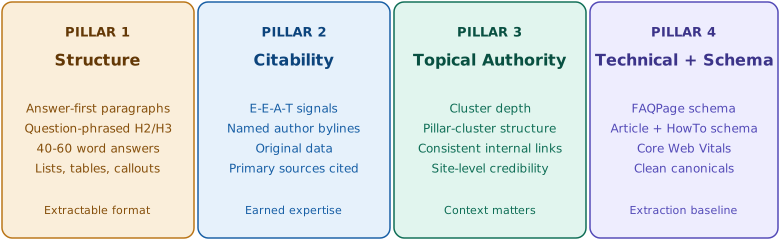
Every citable piece of content shares four traits. Articles that nail all four get cited repeatedly; articles that miss two or more almost never get cited even when they rank. These are the pillars.
Pillar 1: Answer-First Structure
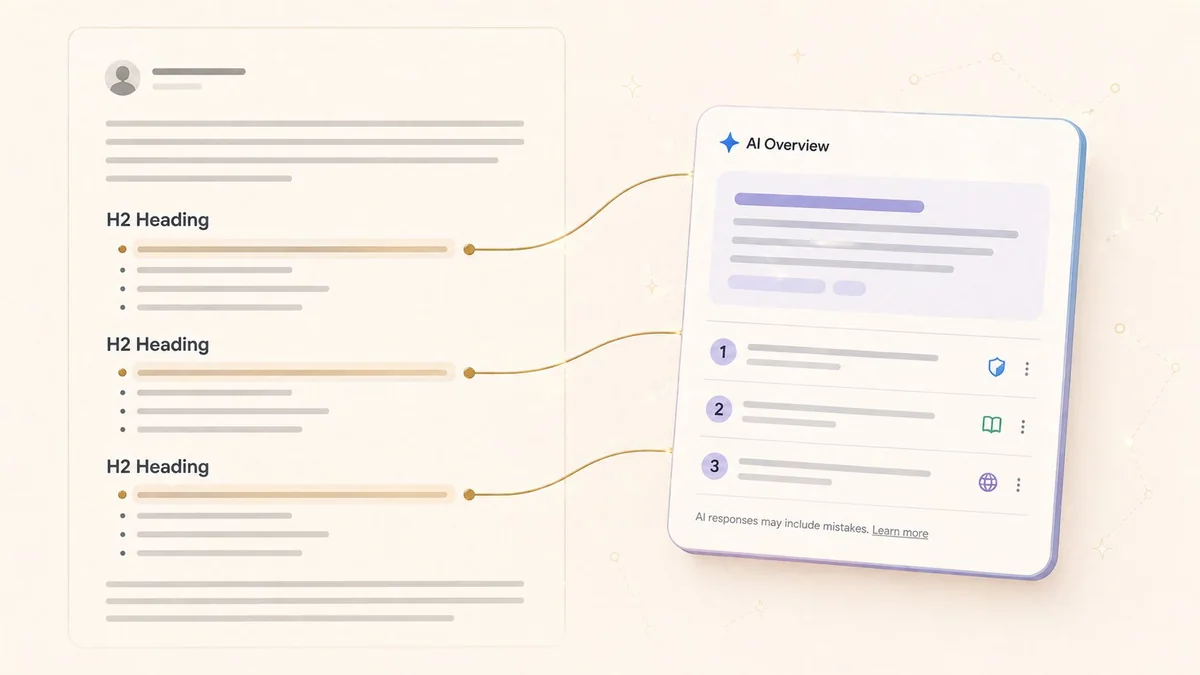
The single highest-leverage change is starting every section with a direct answer. A 40-60 word paragraph that states the answer upfront, in plain declarative prose, is the format AI models prefer to extract. Most B2B blog posts bury the answer three paragraphs down behind a preamble — that’s the habit that’s killing citation rates.
The pattern that works: H2 or H3 phrased as a question → first paragraph delivers the answer in 40-60 words → subsequent paragraphs add nuance, examples, or caveats. Google’s official guidance in Search Central confirms that high-quality, user-focused content following standard web best practices is what makes pages eligible for AI features, with no separate “AI Overview optimization” checklist. Translation: the best practices work, most sites just don’t actually follow them.
Pillar 2: Citability (E-E-A-T + Original Value)
AI Overviews preferentially cite content with signals of genuine expertise and original value. The specific signals that move the needle: a visible author byline with real credentials, firsthand examples (not aggregated summaries of what other sites say), original data or research, and primary-source citations for every non-obvious claim.
The inverse is what doesn’t get cited: listicles that recycle other listicles, AI-generated content with no human fact-check, statistics without sources, and “complete guides” that exhaustively restate what three top-ranking articles already said. This is why low-DA sites with original research sometimes outrank higher-DA aggregators on AEO-era queries. Authority still compounds with original content rather than replacing it, which is why teams pair strong research with the services that earn those off-site citations AI Overviews weight most heavily.
Pillar 3: Topical Authority at the Site Level
AI Overviews don’t cite pages in isolation. They cite pages within the context of what the site collectively appears to know. A standalone article on “AI Overview optimization” from a site that otherwise writes about recipes is far less likely to get cited than the same article on a site with 30 related SEO posts, a structured pillar-cluster architecture, and consistent internal linking. This site-level signal is why most B2B teams treating AEO as a campaign rather than a sustained program underperform — see our review of the 10 B2B SEO agencies that publish AEO/GEO methodologies for the operators built for sustained programs.
This is why one-off content efforts usually fail at AEO. The site has to look like a credible voice on the topic cluster, not just a page that happens to target the query. Our breakdown of the B2B keyword research framework covers how we map topic clusters before writing a single article.
Pillar 4: Technical SEO and Schema
The technical baseline still matters. Core Web Vitals passing, clean canonical tags, proper heading hierarchy, and (critically) schema markup. FAQ schema, Article schema, and HowTo schema all make content more extractable by giving AI models explicit structure to parse. Every page that expects to be cited in an AI Overview should have at minimum Article + FAQPage schema implemented correctly. Verifying that baseline across a whole site, rather than page by page, is a job for the crawlers and log analyzers that check this technical baseline.
How to Structure Content for AI Overview Citation
Structure is where most teams fail. They know to write quality content; they just don’t format it in a way AI models can cleanly lift from. The pattern below is what consistently gets cited across the AI Overview screenshots we’ve analyzed from our own content zone. The AI content-optimization tools that score a draft for this extractability before you publish, flagging weak answer paragraphs and missing structure, are the ones we compare in our guide to the best AI SEO tools and GEO platforms.
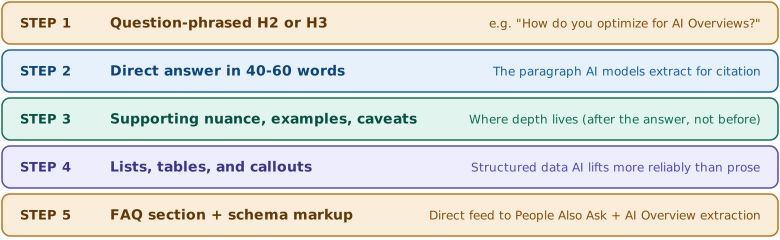
1. Use question-phrased H2s and H3s. Headings phrased as questions (“What is lead scoring?”, “How do you calculate MRR?”) match the natural-language queries users actually type. They also align with the way AI models segment content when deciding what to extract.
2. Answer in 40-60 words, right after the heading. Not 200-word preambles. Not anecdotes before the answer. The first paragraph under each question-heading should answer the question directly, in plain language, with no setup.
3. Add supporting detail in the following paragraphs. Once the core answer is on record, add the nuance, examples, exceptions, and context that depth readers want. This is where the “comprehensive” part of content lives, but it comes after the extractable answer, not before.
4. Use lists, tables, and callouts for scannable sub-points. AI models lift bulleted lists and tables more reliably than dense prose. When a section has 3+ parallel points, structure them as a list. When comparing attributes across entities, use a table.
5. Close with FAQ-schema’d questions. The final section of every optimization-target article should be a structured FAQ covering 3-5 specific follow-up questions. These questions feed both People Also Ask and AI Overview extraction directly.
PRO TIP
The fastest way to check if your content is AI-extractable: copy a section into ChatGPT or Claude and ask “What’s the one-sentence answer to the question this section is addressing?” If the model struggles to produce a clean answer, your structure needs work. If it produces a clean answer instantly, you’re in extractable shape.
Content Patterns That Get Cited (and Ones That Don’t)
Across the AI Overview screenshots we pull regularly in our own editorial sessions (including the one we captured for “what is revops” showing HubSpot Academy, Cognism, Fullcast, and Alexander Group cited together), clear patterns emerge for what earns citations versus what doesn’t.
Patterns that get cited
Direct definitional answers. When the query is “what is X”, pages that open with “X is [one-sentence definition]” dominate citations. Fullcast.com’s citation for “what is revops” is a textbook example. Their first sentence is a tight, declarative definition.
Comparative frameworks. When the query is “X vs Y” or “how to choose between X and Y,” pages with clean comparison tables or decision frameworks get cited preferentially. Raw prose comparisons get skipped.
Numbered lists with short item descriptions. “7 ways to X” with each item explained in 30-50 words consistently outperforms long-form narrative essays in AI Overview citation rates.
Original data and research. Pages citing their own data (survey results, platform data, customer data) get cited as primary sources even when larger sites have covered the same topic. Original data is the single most durable citation moat. Verification is the next moat after that, because the AI search statistics in widest circulation are also the least traceable, and we found which of those numbers can actually be traced to a method when you go back to the original sources.
Expert quotes and author credentials. Pages with named experts, identifiable authors, and visible credentials get cited more than anonymous “our editorial team” content. E-E-A-T is real in the AI Overview era.
Patterns that don’t get cited
200-word preambles before the answer. “In today’s fast-moving digital landscape, businesses everywhere are grappling with…” Content like this gets skipped entirely. AI models read the first paragraph and move on if it doesn’t contain an answer.
AI-generated content with no human editing. Google’s systems are increasingly effective at identifying low-effort generated content, and it rarely earns citations. Human-written, human-edited content dominates AI Overview sources.
Uncited statistics. “Studies show that 73% of companies…” with no link, source, or date. This gets either skipped or flagged as unreliable.
Aggregator listicles. “Top 10 X tools” posts that describe each tool using the vendor’s own marketing language get cited rarely. They add no new information Google can’t already extract from the vendor pages directly.
Listicles where every item starts with the same structural phrase. “Tool A is a powerful platform that…” / “Tool B is a powerful platform that…” reads as templated. Varied, specific descriptions with concrete use cases beat templated uniformity.
Schema and Technical Setup for AEO
Schema is the technical layer that makes AI Overview optimization work at scale. It’s not optional. It’s the markup that tells Google explicitly “this section answers this question,” “this is a list of steps,” “this is an article by this author.” Without schema, AI models have to infer structure from HTML alone, which is less reliable and less consistent.
Article schema provides author, publish date, and publication context. Required on every article.
FAQPage schema structures a FAQ section with explicit Question and Answer pairs. This is the single highest-ROI schema addition for AEO. Pages with clean FAQ schema frequently get cited in both traditional People Also Ask and AI Overviews.
HowTo schema applies when your content is a step-by-step process. Optimization-target “how to X” articles benefit from HowTo schema more than generic Article schema.
Organization schema (site-wide) establishes your publication as a known entity with expertise in specific topic areas. This contributes to the site-level topical authority signal. Corporate Ink’s B2B description-drift data is the practical reason to audit the entity layer: a cited brand still loses when AI repeats an outdated category or value proposition.
Person schema on author bio pages establishes the author as a credentialed expert. Linking Person schema to Article author fields creates a verified expertise chain.
Beyond schema, the technical baseline: page speed under 2.5 seconds LCP, clean canonicals, no thin content that dilutes topical clustering, and an XML sitemap that includes every target article. These aren’t AEO-specific (they’re standard SEO), but they’re preconditions for AI Overview consideration. On an online store those preconditions live on the product page, where optimizing each product page for SEO also makes the listing clean enough for an AI shopping answer to quote.
Content Formats That Work Best for AI Overviews
Not every content format is equally citable. Some formats consistently earn AI Overview citations; others almost never do regardless of quality. Knowing which formats to invest in, and which to deprioritize, shapes what your editorial calendar should look like in the AEO era. When that calendar outgrows what an in-house team can run, a dedicated AEO agency can own the whole cycle from format strategy to citation tracking.
Definitional and glossary articles. “What is X” pieces with clean definitions and category coverage. These dominate citations for education-intent queries because they’re the most directly extractable.
How-to guides with numbered steps. Structured sequential instructions get lifted into AI Overviews for procedural queries. Each step should be self-contained. Our recent guide on content marketing lead generation is built in this format and provides a worked example of the structure.
Comparison articles. Head-to-head comparisons with comparison tables, pros/cons breakdowns, and clear “who should pick which” guidance. Our HubSpot vs Salesforce comparison is an example of the format.
Data-driven studies. Original research pieces with methodology sections, charts, and statistical findings. These earn citations as primary sources.
Expert-authored frameworks. Named-expert pieces presenting a proprietary framework, maturity model, or decision tree. These earn citations because they introduce a structure other sites don’t have.
Formats that underperform: generic listicles (“top 10 tools”), news recap posts, broad industry commentary, and ultra-long-form pillar pages that try to cover every subtopic in one URL. Depth in a narrow question beats breadth in a broad topic almost every time in the AI Overview era.
How to Measure AI Overview Performance
Measuring AEO impact is harder than measuring traditional SEO because Google Search Console doesn’t yet separate “AI Overview citations” from standard impressions. Teams have to triangulate signals from multiple sources to understand whether their content is actually getting cited. For the GA4 side of that triangulation (referrer-based attribution, branded-traffic isolation, and the source/medium quirks AI Overview clicks introduce), see our guide to Google Analytics for B2B. That separation problem eased in June 2026 without being solved: Google now reports AI impressions but still withholds the clicks, so an AI click-through rate remains impossible to calculate from Search Console alone.
Manual AI Overview audits. Once a month, search your top 20 target queries in an incognito window, screenshot every AI Overview that fires, and log which sources are cited. This is tedious but currently the most accurate way to know if your content is earning citations.
Impressions-to-clicks ratio changes. Pages where impressions grow while clicks plateau or decline are likely being surfaced in AI Overviews without earning citations. This is the canary signal that optimization is needed. Third-party research backs this up — Semrush’s analysis of AI Overview impact on organic CTR confirms the same pattern across their dataset of monitored queries. Profound’s paid AI-search metric shows the paid side of the same measurement problem: teams need to know where visibility happens before they decide whether it is worth buying.
Brand search lift. If your content is getting cited in AI Overviews, branded search volume often rises over 60-90 days even when direct click traffic falls. Tracking brand search is a useful indirect indicator.
Third-party AEO trackers. Tools from Semrush, Ahrefs, and specialized AEO platforms now track AI Overview appearances and cited sources at scale. These are worth the investment once AEO becomes a formal KPI.
The metric that matters most is “percentage of target queries where we get cited.” Set a baseline, optimize systematically, and track the ratio monthly.
5 Mistakes Teams Make When Optimizing for AI Overviews
Most AEO failures aren’t about the tools or techniques. They’re about misapplying the advice or chasing the wrong signals. These are the five most common mistakes we see B2B teams make.
1. Treating AEO as separate from SEO. AEO is SEO done well in 2026. Teams that build parallel “AEO strategies” on top of broken SEO fundamentals waste effort. Fix the fundamentals first; citations follow.
2. Stuffing answer paragraphs with keywords. The 40-60 word answer paragraph works because it’s clear and direct. Keyword-stuffed versions read as awkward and get skipped by AI models just like they get skipped by human readers.
3. Abandoning long-form content. Yes, extractable short answers matter. No, that doesn’t mean you should delete your 3,000-word pillar pages. Depth still matters for topical authority; it just needs to live after the answer-first opening, not instead of it.
4. Over-relying on FAQ sections as a citation shortcut. FAQ schema helps, but slapping 10 FAQs on every page without the rest of the structure doesn’t earn citations. The FAQ section complements a well-structured article; it doesn’t replace the need for the article to be well-structured in the first place.
5. Ignoring author credentials. Anonymous “by the editorial team” bylines are disappearing from AI Overview citations. Named authors with real LinkedIn profiles, published credentials, and visible expertise dominate. This is a structural disadvantage for sites that hide behind generic bylines.
Fix these five and your citation rate rises materially. The techniques don’t substitute for genuine expertise and original thinking — but genuine expertise that’s structurally invisible to AI models gets cited less than mediocre content that’s perfectly formatted for extraction.
Frequently Asked Questions
Start every section with a direct 40-60 word answer, phrase H2s and H3s as questions users actually ask, add FAQ and Article schema, cite primary sources with dofollow links, and include named-author credentials. Pair these structural changes with genuine E-E-A-T signals (firsthand experience, original data, expert quotes), and AI Overview citations start appearing within 60-90 days of indexing.
AI Overviews reduce click-through rates on informational queries by 20-40% on average, but the impact varies sharply by query type. Pure definitional queries lose the most traffic; high-intent commercial and comparison queries lose far less. Getting cited inside the AI Overview partially offsets the loss by driving some referral traffic, and brand search typically rises over 60-90 days.
Question-headed articles with 40-60 word answer paragraphs, numbered lists for sequential content, comparison tables for multi-entity comparisons, and FAQ sections at the bottom. Definitional “what is X” pieces, how-to guides, and comparison articles consistently outperform generic listicles or long-form opinion pieces in AI Overview citation rates.
Yes. FAQPage, Article, HowTo, and Person schema all make content more extractable by AI models. FAQPage schema is the highest-ROI addition — pages with clean FAQ schema frequently earn citations in both People Also Ask and AI Overviews. Schema isn’t a magic ranking factor, but it removes ambiguity about what each section contains, which matters for AI extraction.
For well-optimized content on sites with existing topical authority, 30-60 days post-indexing is typical. For sites building topical authority from scratch, 90-180 days is more realistic as the site needs to accumulate topical depth and backlinks to become a trusted source. Original data and firsthand expertise compress the timeline; aggregated content rarely gets cited regardless of time.