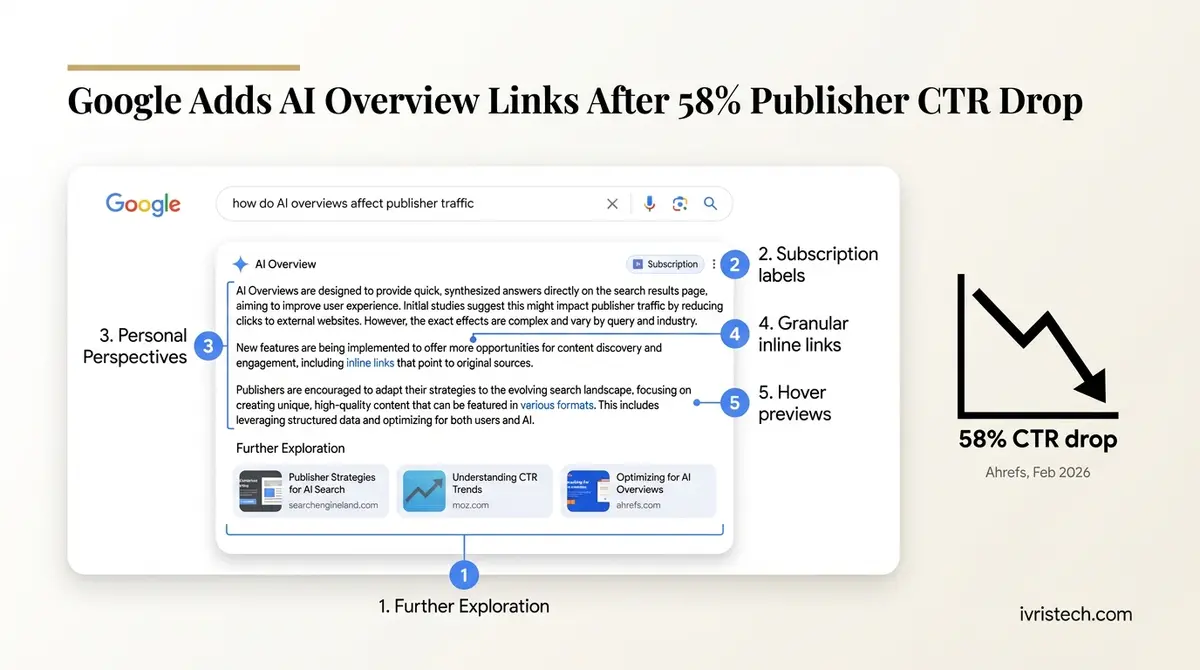
Google rolled out five updates to AI Mode and AI Overviews on May 6, announced by Hema Budaraju, VP of Product Management for Search. The most prominent of the five is “Further Exploration,” a new section that appears at the end of many AI responses with curated links to in-depth articles, case studies, and reports related to the query. The other four updates: subscription labels on links from a user’s paid news subscriptions, personal-perspective previews drawn from public forums and social, more granular inline links sitting next to the bullet they support, and desktop hover previews showing the destination website’s name and page title before a click.
The trigger context, which Google’s post does not mention but which every publisher reading the announcement does: an Ahrefs study published in February 2026 measured a 58% reduction in click-through rate on top-ranking pages when an AI Overview is present, nearly double the 34.5% decline Ahrefs documented in April 2025. Pew Research separately found that only 8% of users click traditional search results when an AI Overview loads, compared to 15% when it doesn’t. Chartbeat data covering 2,500 news sites showed Google search referrals down 33% over 2025. Penske Media has filed an antitrust suit. The European Publishers Council has filed a formal complaint with the European Commission. Paid search is not showing the same aggregate pattern: September 2026 Shopping benchmark data has CTR rising while impressions fall, but the AI Overview connection remains an unproven hypothesis rather than a measured query-level effect.
For B2B content marketers, who are not “publishers” in the Nieman Lab sense but who absolutely live and die on AI Overview citation outcomes, the five updates are worth dissecting carefully, because they shift the rules in two specific surfaces (Further Exploration and Personal Perspectives) where B2B brand content can plausibly win, and do nothing for one surface (subscription labels) where most B2B publishing programs don’t compete in the first place. Whether those plays are working is now measurable from Google’s side: Google’s new AI Performance Insights reports a brand’s Share of Voice inside AI answers, the first native read on AI-answer visibility. Comscore’s Q1 panel data now gives that shift a broader measurement frame: AI tools reached 36% of desktop users in Q1 2026, so Further Exploration is not a niche publisher issue.
Key Takeaways
- Google announced five updates to AI Mode and AI Overviews on May 6, 2026, headlined by a new “Further Exploration” section at the end of AI responses.
- The updates arrive after Ahrefs measured a 58% CTR drop on top organic results when AI Overviews are present (vs 34.5% a year earlier) and Pew Research found only 8% of users click traditional results under an AI Overview.
- Subscription-labeled links from a user’s paid news subscriptions now stand out in AI Mode and AI Overviews, Google says testing showed “significantly higher” click rates on labeled links.
- Personal Perspectives surfaces firsthand discussions from forums, communities, and social, with creator handle and community name attached, a new visibility surface B2B brands can target.
- Penske Media filed an antitrust suit, the European Publishers Council filed a formal EU complaint, and one-third of surveyed publishers say they will block AI Overviews once tools allow.
The Five Updates, Decoded for B2B
Further Exploration. A curated link section at the end of AI Overviews pointing to specific articles, case studies, and reports on different facets of the topic. This is the surface most B2B content teams should pay attention to. AI Overviews already cite sources inline; Further Exploration adds a second-tier surface that rewards depth and angle rather than mere citation eligibility. The composition signal Google is rewarding looks like: substantive original analysis, clear topical depth, and a distinct angle the AI response itself doesn’t already cover. In other words, the recap pieces lose; the analytical pieces win. Goodwater’s daily-user search data explains why that second-tier surface matters, since a growing AI-first audience sees the generated answer before deciding which source deserves a click.
Subscription labels. Article links from publications the user pays for now carry a “Subscribed” tag inside AI Mode and AI Overviews. Google says early testing showed “significantly higher” click rates on labeled links versus unlabeled. Publishers can submit their subscription linking through a Google form. For most B2B brand publishing programs, this is a surface that doesn’t exist, no subscription, no label, no benefit. The honest read is that this update redistributes residual clicks toward the Wall Street Journals and Bloombergs of the world, not toward B2B SaaS blogs.
Personal Perspectives. AI responses now include quoted perspectives from forums, social media, and other firsthand sources, with the creator’s name, handle, or community name displayed alongside. This is the second surface where B2B brand strategy can plausibly win. The trick is that the surface rewards real human voice, employee LinkedIn posts, community contributions, forum participation, and authentic firsthand experience. Brand-account content posted into the same surface looks the same to a reader as community content from a competitor’s customer; the differentiator is whether the perspective is identifiable and credible.
Granular inline links. Links now appear next to the specific bullet point or sentence they support, rather than collected in a sidebar. From a citation-tracking standpoint this is meaningful: the per-claim attribution is now visible to users, which changes how citation analytics should be read. The ghost-citation problem we covered earlier doesn’t go away, it just moves closer to the visible surface. Brands cited inline now have a fighting chance at a click; brands cited only in the sidebar collapse keep losing.
Hover previews on desktop. Hovering over an inline link in AI experiences now shows the destination website’s name and page title. Google’s reasoning: users hesitate to click unfamiliar links. Effect: brand recognition just got more valuable inside the AI Overview surface itself. Unrecognized domains will struggle to win the hover-to-click decision against recognized ones, which is a tax on the long tail of small B2B publishers and a subsidy to incumbent authority sites.
Why Google Announced This Now
The five updates are a tactical response to a structural problem Google has been hoping to push past on a longer timeline. The Ahrefs 58% CTR-decline figure is the number that pulled the timeline forward. The February 2026 study showed the click-through collapse had nearly doubled in twelve months, from 34.5% in April 2025 to 58% by February 2026, a rate of decay too fast for the publisher ecosystem to absorb on the trajectory Google was running.
The legal pressure is escalating in parallel. Penske Media’s antitrust suit alleges that Google’s AI Overviews are using publisher content to displace publisher traffic without compensation. The European Publishers Council’s complaint to the European Commission frames the same argument under EU competition law and the Digital Markets Act. The DOJ has already won its main antitrust case against Google and is considering whether to appeal for structural rather than behavioral remedies. The five updates announced May 6 are visibly designed to demonstrate good-faith effort before any court has to compel one, which is exactly the position Google needs to argue from when the regulatory case load is this heavy.
Our read: the updates are real, but they are a tactical concession inside a strategic direction that hasn’t changed. Google’s broader AI Mode strategy still positions Search as an agent manager rather than a link engine, and Sundar Pichai’s roadmap at Google Cloud Next 2026 explicitly described Chrome being rebuilt as an agentic browser that completes tasks without users visiting individual sites. The five updates restore some clicks; they don’t reverse the direction. Publishers that read this announcement as a return to the link economy are misreading it. Google’s I/O 2026 keynote a week later made the trajectory explicit: the launch of information agents inside Search formalizes the agent-as-intermediary layer the May 6 updates were the curtain-raiser for.
What B2B Content Marketers Should Do This Quarter
The new surfaces create three concrete plays for B2B content teams. None of them are tactical SEO tweaks; all of them are content-thesis adjustments.
- Stop optimizing for AI Overview citation alone. Start optimizing for Further Exploration eligibility. Citation eligibility rewards recap-style content that answers the AI’s query precisely. Further Exploration rewards angle, depth, and original analysis the AI response doesn’t already cover. The latter is harder to write and is where the click is now most likely to land. The AI Overview optimization framework we published needs a second pass to add a Further Exploration eligibility checklist, angle uniqueness, depth signal, and topical specificity now matter as much as citation cleanliness.
- Build the Personal Perspectives surface deliberately. The forum, community, and social attribution Google is now surfacing isn’t owned media, it’s earned visibility through real humans posting from identifiable accounts. For B2B brands, this maps to: employees posting on LinkedIn under their own name with their company affiliation visible, customer-success-driven testimonials that name the contributor, and active participation in industry communities (r/marketing, Reddit’s product-management subs, Indie Hackers, RevGenius, etc.). A brand handle posting “thought leadership” content does not win this surface. A named human at the brand posting an actual perspective does.
- Instrument AI Overview citation tracking with per-claim granularity. Granular inline links mean per-claim attribution is now visible to users. The internal tooling has to follow. Track which specific claims in your content are being lifted as citations, which are being lifted into inline link positions, and which are being relegated to Further Exploration. Per-claim attribution data tells you where to deepen and where to reframe. Aggregate AI-Overview-citation dashboards miss this entirely.
The medium-term implication is harder to act on but worth naming: the long tail of small B2B blogs gets compressed by the hover-preview change. Domain authority and brand recognition now matter inside the AI Overview surface itself, not just at the SERP rank. A B2B SaaS company building a content program from scratch in 2026 has to invest in domain-level brand recognition earlier than it did in 2024, because the AI surface punishes unrecognized domains more aggressively than the organic SERP did. HubSpot’s AEO push earlier this spring is the same recognition: the surface has moved from organic ranking to AI-citation eligibility, and the optimization layer needs to be rebuilt accordingly.
What This Doesn’t Fix
The five updates are unlikely to reverse the 58% CTR decline. Google’s own framing of the updates is careful about this, the post talks about helping users “explore the web” and find “trusted sources,” not about restoring publisher traffic. The economics haven’t changed. A user who gets a complete answer in an AI Overview still has no incentive to click through, regardless of how many curated Further Exploration links sit underneath the response. The Further Exploration section is a structural improvement for users who already want to go deeper; it is not a mechanism for retrieving the click from users who don’t. The May 21 core update that landed nine days later stacks on this picture rather than reversing it: a ranking-volatility window inside an environment where the click-through baseline has already compressed produces less recoverable traffic than the same volatility produced 12 months ago. That incentive contrast is why Bluesky’s proposed referral-revenue model is strategically different: the network would earn when referred traffic converts, not when an answer keeps the user inside the feed.
The publisher economics also haven’t changed. Per our earlier analysis of the citation-overlap collapse, the share of AI search citations that come from the same domains as the Google top 10 is below 20%, meaning even the publishers who do get Further Exploration placement aren’t necessarily the publishers who used to win the click. The Further Exploration surface introduces a new distribution game where the rules are different from organic SEO, and only the publishers who learn the new rules will see their CTR curves bend back up. The DOJ case, the EU complaint, and the Penske suit will continue independently of how the May 6 updates perform. Google’s win condition on the regulatory front isn’t reversing publisher traffic decline, it’s demonstrating enough good-faith effort that courts and regulators allow the structural direction to continue.
Frequently Asked Questions
The five updates announced May 6, 2026 are: (1) Further Exploration, a curated link section at the end of AI responses pointing to in-depth articles and reports; (2) subscription labels on links from paid news subscriptions; (3) Personal Perspectives showing firsthand quotes from forums and social with creator attribution; (4) granular inline links sitting next to the specific bullet they support; (5) desktop hover previews showing the destination website name and page title. The features are rolling out across AI Mode and AI Overviews in English first.
An Ahrefs study published in February 2026 measured a 58% reduction in CTR on top-ranking organic results when AI Overviews are present, up from 34.5% in April 2025. Pew Research separately found only 8% of users click traditional results when an AI Overview is shown, compared to 15% when no overview appears. Chartbeat data on 2,500 news sites showed Google search referrals dropping 33% over the course of 2025. The numbers come from different methodologies but converge on the same direction: AI Overviews suppress clicks to source content.
Further Exploration and Personal Perspectives. Further Exploration rewards depth, angle, and original analysis, content that gives a user reason to keep reading after the AI response. Personal Perspectives rewards identifiable firsthand voice from named humans in forums, on LinkedIn, and in industry communities. The subscription label update mostly doesn’t apply because most B2B brand publishing programs don’t run a paywall, and the hover preview update favors recognized domains over the long-tail blogs.
Unlikely. The economic incentive that produced the decline is unchanged, users who get a complete answer in an AI Overview still have less reason to click through to source content. The five updates add link surface area and context but don’t change the underlying motivation gap. Google’s own framing of the announcement is about exploration, not traffic restoration. The regulatory cases from the DOJ, the European Commission, and Penske Media will continue independently of how the May 6 updates perform.