Google began rolling out the May 2026 core update at 08:40 PT on May 21, 2026, logged on the Search Status Dashboard three minutes later under incident ID wdAXJk6LRRihEjpzEeWE. The rollout window is up to two weeks, with completion expected around June 4. Google’s framing was deliberately generic: “a regular update designed to better surface relevant, satisfying content for searchers from all types of sites.”
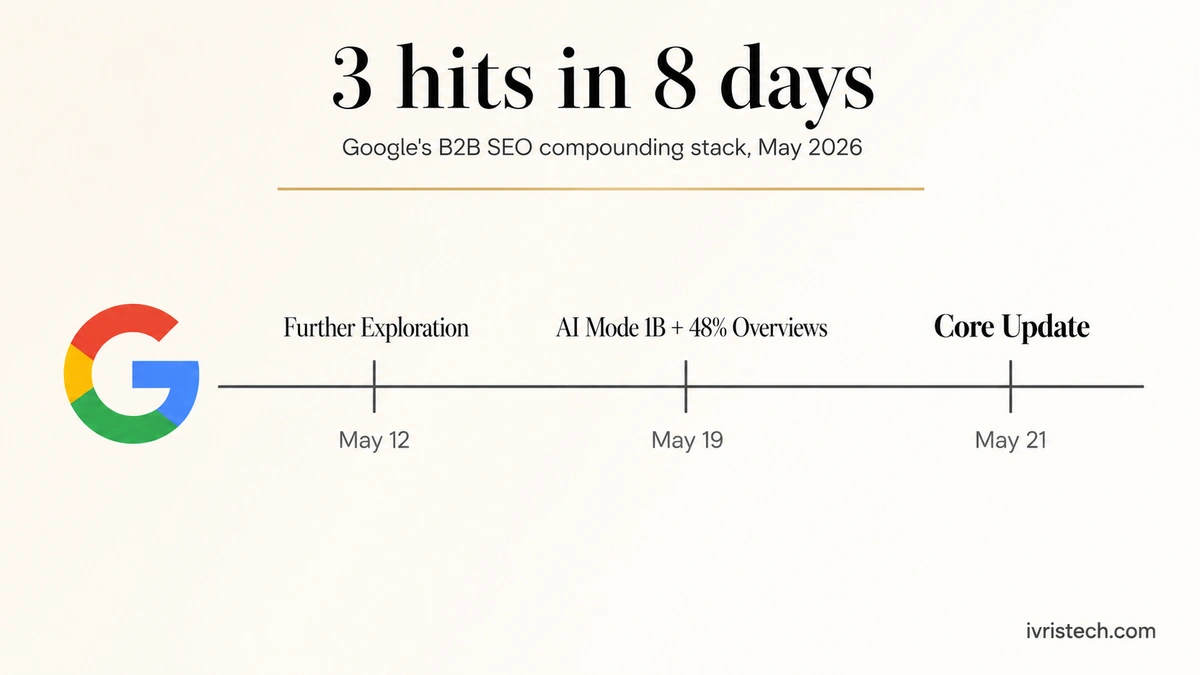
The bigger story is the calendar. The core update landed two days after Google’s I/O 2026 keynote on May 19, where Sundar Pichai confirmed AI Mode crossed 1 billion monthly users (10× growth in ~12 months) and Liz Reid disclosed that AI Overviews now reach 2.5 billion users monthly while appearing on roughly 48% of all tracked queries per BrightEdge data, up from 34.5% in December 2025. Three signals in eight days, all moving the same direction.
Our read: B2B SEO programs that absorbed the May 12 publisher-traffic study as a one-time hit are now staring at a compounding stack. None of the three shifts alone would force a structural rewrite of how a B2B content program is built. Together they do, and the May 21 core update is the third one in eight days that the SERP positioning playbook of February 2026 cannot price.
Key Takeaways
- Google began rolling out the May 2026 core update at 08:40 PT on May 21, 2026, with a rollout window of up to two weeks (completion around June 4).
- The update lands two days after Google I/O 2026, where AI Mode was confirmed at 1B+ monthly users and AI Overviews at 2.5B users / 48% of tracked queries.
- This is Google’s second broad core update of 2026 after the March 2026 update, which moved roughly 80% of top-3 positions and dropped one in four top-10 pages out of the top 100.
- The B2B-specific SERP shows Top Stories carousel + heavy YouTube cycle; AI Overview answers the “what to do for B2B” query inline, raising the bar for citation-eligible content.
- The 14-day rollout window is also a 14-day procurement window: B2B SEO programs should re-baseline ranking, citation, and AI Overview eligibility before reactive rewrites.
What Actually Shipped on May 21
Google’s announcement was minimal by design. The Search Status Dashboard entry says: “Released the May 2026 core update. The rollout may take up to 2 weeks to complete.” Search Liaison’s parallel post on X used the same language. Search Engine Land’s coverage and Search Engine Roundtable both flagged the brevity as standard practice: Google does not preview core update mechanics.
The historical comparison is the part Google does not write. The March 2026 core update we covered earlier moved roughly 80% of top-3 positions and dropped close to one in four top-10 pages completely out of the top 100. That was the most aggressive recent cycle. May’s update sits inside the same “specific, first-hand content tied to credible sources” reward pattern Google has applied across the last four updates, with one new variable: it is the first core update to ship inside a year where AI Mode and AI Overviews together constitute the primary discovery surface.
The variable matters because the relationship between organic rank and click-through has changed. When an AI Overview appears above traditional results, the position-one organic result loses about 18% of its clicks. Informational queries have seen 30-40% declines on affected categories. HubSpot has publicly estimated 70-80% organic-traffic loss; Chegg disclosed a 49% decline; DMG Media documented 89% on specific queries. A core update inside that environment does not just rerank pages, it reshuffles them on a surface that already gives fewer clicks per rank.
Why 8 Days Matters: The Compounding Stack
Three signals between May 14 and May 21 changed the structural picture, not just the tactical one.
Signal 1, May 12: Publisher traffic decline confirmed and contextualized. Our piece on Google’s Further Exploration update inside AI Overviews documented the 58% CTR decline on AI-Overview-affected queries and the limits of the new “explore the web” surface as a recovery mechanism. The framing then was tactical concession inside an unchanged strategic direction. The next two signals confirmed the direction.
Signal 2, May 19: AI Mode at 1B users, AI Overviews at 48% of queries. Pichai’s I/O 2026 keynote put numbers on what publishers were already feeling. AI Mode queries are 3× longer than traditional searches and follow-up queries in the US are growing 40% month-over-month. The same keynote launched information agents inside Search as a persistent vendor-monitoring layer. AI Overviews moved from “frequent feature” to “default surface for half of all queries.” Gemini 3.5 Flash became the new default model globally inside AI Mode.
Signal 3, May 21: Core update begins rolling out. Two business days after I/O. Same week as the AI Mode 1B milestone, the AI Overviews 48% disclosure, and the information-agents launch. Whatever ranking volatility the core update produces will land on top of the structural traffic compression the first two signals already confirmed.
The compounding effect is the operational point. A 15% ranking shift from a core update used to flow through to a roughly 15% traffic change. Inside the new AI-surface environment, a 15% ranking shift on an informational query inside an AI-Overview-affected category can flow through to materially less because the click-through baseline has already dropped. Sites that recovered cleanly from the March 2026 update do not get to assume the same recovery curve from this one.
What Structurally Changes for B2B SEO
The generic B2B SEO advice (better E-E-A-T, first-hand experience, topical authority) is already in the AI Overview for the gap-check query and is not the angle worth writing. Three structural changes are.
The optimization unit is no longer the page; it is the surface portfolio. A B2B SaaS company’s content program in 2026 has to be eligible on five surfaces simultaneously: organic SERP, AI Overview citation, AI Mode response, Top Stories (for news), and information-agent watchlists. Each surface rewards different signals. Pages optimized for one without the others underperform across the portfolio. The core update reshuffles organic SERP eligibility; it does nothing to the other four. Programs that treat the core update as the main event will under-invest in the surfaces that hold the actual reader.
Bottom-of-funnel content gains relative weight. AI Overviews most aggressively absorb top-of-funnel informational queries. The 30-40% declines hit “what is X” content harder than “X vs Y” or “X pricing.” For B2B SEO programs, this means the ROI on comparison pages, pricing transparency, integration matrices, and product-changelog pages rises against the ROI on definitional-blog content. The citation-overlap study we covered earlier in May already showed less than 20% overlap between AI citation domains and Google top-10 organic, with comparison pages and structured FAQ formats producing meaningfully higher AI engine pickup. The core update intensifies the rotation: definitional content that ranks loses clicks to AI Overviews; bottom-funnel content that ranks still gets clicks because intent is past the answer-extract stage.
Domain-level authority moves earlier in the timeline. AI Overviews and information agents both punish unrecognized domains harder than the organic SERP does. A B2B SaaS company launching a content program from scratch in 2026 needs brand-recognition investment in months 1-6, not months 12-18. Wikipedia presence, third-party citation density (G2, Trustpilot, Reddit threads), and named-author authority all start mattering inside the AI surface itself, not just at organic rank. The core update does not change this directly, but it raises the cost of waiting: domains that were already on the edge of citation eligibility will be tested first. The May 27 rollout adds a Google-side counterweight to that timeline: Google’s new Preferred Sources lever inside AI answers lets an established audience pull a brand into the labeled answer slot while its cold-start citation authority is still building.
Three Moves for the Next 14 Days
The rollout window is also the procurement window. Three actions before reactive content rewrites.
Re-baseline ranking, citation, and AI Overview eligibility before any rewrites. Pull Search Console data for the May 14-20 window as the pre-update baseline (after I/O announcements, before the core update started). Pair it with AI Overview tracking from the same window (BrightEdge, Profound, or Ahrefs AI Search). The post-rollout comparison needs three numbers, not one: organic position change, AI Overview citation change, and click-through change at each position. A site that loses two positions but gains an AI Overview citation is in a better shape than a site that holds rank but loses the citation.
Audit the surface portfolio before adjusting the content portfolio. Inventory each top-100-traffic page against the five surfaces: organic SERP eligibility, AI Overview citation eligibility, AI Mode response eligibility, Top Stories eligibility (Article schema + datePublished + featured image), and information-agent watchlist eligibility (pricing/changelog/integration pages that read cleanly to a vendor-monitoring agent). Pages eligible on only one or two surfaces are the targets for structural upgrades, not the pages that lost a position.
Pull forward the bottom-of-funnel investment quarter. If a B2B SEO roadmap had comparison pages, pricing-page rebuilds, or integration matrix pages slated for Q3, the case for moving them to June strengthens. The core update will not improve top-of-funnel informational traffic. Bottom-funnel pages are where rank still converts to clicks, and where AI Overviews are least likely to absorb the answer. Reallocating June and July writing capacity toward bottom-funnel formats is the action with the highest expected payoff in the next quarter, regardless of the specific ranking outcome from the rollout.
Frequently Asked Questions
Google began rolling out the May 2026 core update at 08:40 PT on May 21, 2026, logging the start on the Search Status Dashboard at 08:43 PT under incident ID wdAXJk6LRRihEjpzEeWE. Google said the rollout may take up to two weeks to complete, putting expected completion around June 4, 2026.
Mechanically, both are broad core updates applying Google’s standard “specific, first-hand content tied to credible sources” reward pattern. Structurally, the May update lands inside a different environment: AI Mode reached 1B monthly users on May 19 and AI Overviews now appear on roughly 48% of tracked queries. A given ranking shift produces less traffic change because the click-through baseline has compressed.
Three things before any reactive rewrites: re-baseline Search Console + AI Overview tracking for May 14-20 as the pre-update window; audit each top-100 page against five surfaces (organic, AI Overview citation, AI Mode response, Top Stories, information-agent watchlist) not just organic rank; and pull forward bottom-of-funnel investments (comparison pages, pricing transparency, integration matrices) where rank still converts to clicks.
No. Google’s own guidance is to wait until the rollout completes before drawing conclusions, and reactive rewrites during a core update typically muddy the data without improving outcomes. Use the 14-day window to baseline and audit; use the post-rollout window to act on confirmed signal, not noise.