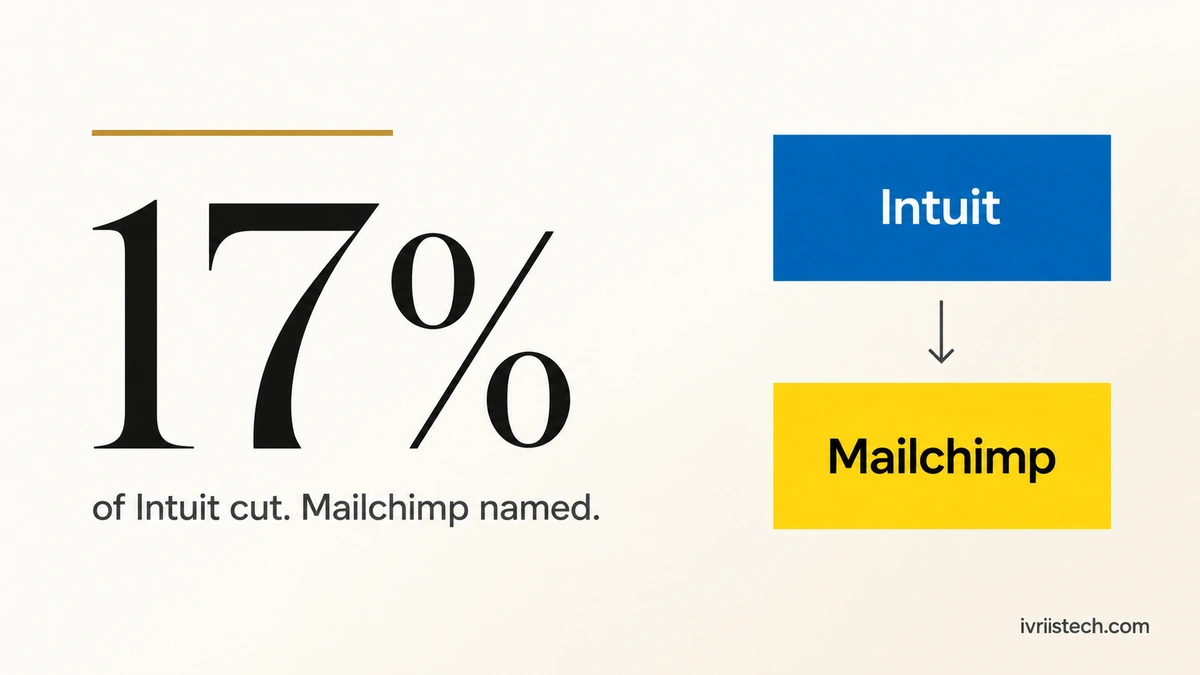
Intuit announced on May 20 that it will cut approximately 3,000 jobs (17% of its global workforce) while explicitly naming Mailchimp as one of the businesses where investment is being “reduced.” In the same week, CEO Sasan Goodarzi told analysts on the Q3 FY26 earnings call that Intuit had tried to sell Mailchimp and couldn’t find a buyer at an acceptable price.
The translation matters more than the headline. Intuit is now running Mailchimp for cash flow, not growth, a fundamental change in posture from the $12 billion crown jewel it bought in 2021. For the 11 million businesses that use Mailchimp, as MarTech’s Pamela Parker laid out on May 22, the practical question is whether to stay, evaluate, or migrate, and that decision now has a 90-day clock attached.
Our read: this is not a Mailchimp shutdown story. It’s a slow demotion that B2B email marketers have to plan for like any vendor-risk event. Intuit confirmed the strategic intent on the record, and the user-growth numbers tell the same story Goodarzi did. The piece below maps the math, the decision framework, and the destinations B2B customers should evaluate before the next renewal cycle.
Key Takeaways
- Intuit cut ~3,000 jobs (17% of global workforce) on May 20, 2026, naming Mailchimp explicitly in CEO Goodarzi’s memo as an area of reduced investment.
- CEO Goodarzi confirmed on the Q3 FY26 earnings call that Intuit explored selling Mailchimp but couldn’t find a buyer at an acceptable price in the current software equity environment.
- Mailchimp user count has been flat at 11 million since mid-2024 while MailerLite (+52%), Omnisend (+50%), HubSpot (+29%), Klaviyo (+28%), and Brevo (+20%) all grew double-digits.
- Intuit’s Online Ecosystem revenue grew 19% with Mailchimp vs. 22% without it in Q3 FY26, and the gap has held for four consecutive quarters.
- B2B customers with growing lists, complex automation, or multichannel needs have a defensible reason to evaluate alternatives in the next 90 days.
What Actually Happened
On May 20, Intuit Chairman and CEO Sasan Goodarzi sent a company-wide memo titled “Architecting Intuit for a new chapter of growth.” The memo announced a 17% reduction in full-time workforce, roughly 3,000 roles, alongside the wind-down of Reno and Woodland Hills offices.
The specific line about Mailchimp was buried in a five-bullet list of changes. Under “Reallocating resources to our primary growth engines,” Goodarzi wrote: “We are optimizing our business and reducing investments in certain areas, including Mailchimp, and streamlining parts of our engineering and product organizations to better align resources with our 3 Big Bets.”
The earnings call the same week made the strategic intent unambiguous. Deutsche Bank analyst Brad Zelnick asked Goodarzi how much of the restructuring was Mailchimp right-sizing versus AI efficiencies. Goodarzi declined to provide a breakdown but explained the decision behind keeping Mailchimp at all: “We believe that Mailchimp’s revised cash flow profile will generate more value for Intuit than a third party is likely to pay for that asset in the current equity and debt environment for software.” Bending Spoons’ Airtable deal puts a disclosed multiple on that same buyer environment: a business with approximately $480 million ARR and more than 20% growth agreed to sell at 2.7× enterprise value to ARR.
CFO Sandeep Aujla added the operating posture: “The terms of revenue you can get from a third party just are not there right now. That is what we are making sure we are running this for profitability.”
In a statement to MarTech, Intuit communications confirmed: “As part of our company-wide reduction, we are reducing our business investment in Mailchimp. The go-forward cost structure will allow us to optimize the profitability of our business.” The statement does not commit to any specific feature roadmap or investment level.
The Cash-Cow Math: Four Quarters of Drag
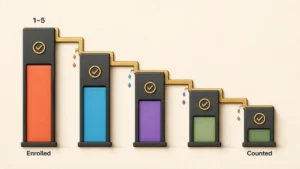
The decision makes sense once the segment numbers are visible. Across four consecutive Intuit earnings calls, the company’s small-business revenue has grown meaningfully faster when Mailchimp is excluded. The gap is consistent: 3 percentage points in Q4 FY25, 2 in Q1 FY26, 4 in Q2 FY26, 3 in Q3 FY26. Mailchimp revenue itself was “down slightly” in Q4 FY25 and again in Q2 FY26. The user base has held flat at 11 million since mid-2024 while every meaningful competitor grew double-digits per EmailToolTester’s January 2026 market analysis: MailerLite up 52%, Omnisend up 50%, HubSpot up 29%, Klaviyo up 28%, Brevo up 20%.
Aujla diagnosed the core problem himself back in August 2025: small businesses found Mailchimp “a bit harder to use, which hurts retention and expansion.” The February 2026 ecommerce-focused release was the attempted answer: more ecommerce triggers, SMS expansion to 34 European countries, ChatGPT integration. Nine months later, the answer has been judged insufficient. Investment is being aligned to current cash flow, not future growth.
The 90-Day Decision Framework
The MarTech piece set up the binary correctly: stay or evaluate. The B2B operational question is sharper. Three customer segments face different decisions on different timelines.
Segment 1, stable list, basic newsletters, low automation needs. If you send a weekly newsletter to a list that grew 5% last year, the drag-and-drop builder is your priority, and you’re not hitting automation limits, the case for staying is intact. Innovation cadence will slow, but a product run for profit can still ship maintenance releases and the integrations its ecosystem depends on. Revisit at next contract renewal, not now. beehiiv’s Summer Release consolidation case gives this segment a new comparison point, but only if Community, Copilot, exports, and moderation replace real jobs rather than add unused features.
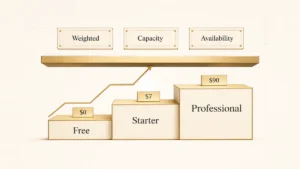
Segment 2, growing list, multichannel, or stack-tied to HubSpot or Salesforce. The pricing math turns against Mailchimp fast once contacts compound. Mailchimp’s Essentials plan is $230/month for 20,000 contacts (as of Q2 2026) compared to Brevo’s Starter at $29 and MailerLite’s at $10. If your list is growing and you’re already paying for HubSpot’s Marketing Hub or considering Salesforce Marketing Cloud Next, the consolidation case strengthens with every flat quarter Intuit reports. Build the migration plan in 30 days, run it in 60.
Segment 3, complex behavioural automation, B2B lead scoring, or SMS-first journeys. Mailchimp’s automation engine cannot segment users on complex behaviours like “opened Email A but did not click Link B in Email B” and has no drag-and-drop automation builder. Both are standard in ActiveCampaign and Klaviyo. If those are the workflows you depend on, you’re already on the wrong platform, and the restructuring just removes the option of waiting for it to improve.
This pattern fits the broader posture we mapped on the AI-vendor side in April. Once a vendor’s financial trajectory is the actual story, the procurement playbook is to add a vendor-financial-stability column to the evaluation matrix and stop treating it as a tech-only question.
Migration Destinations: A B2B-First Scorecard
For Segment 2 and 3 customers, four destinations are realistic in 2026. None is a drop-in replacement; each is a different bet.
HubSpot Marketing Hub. The strongest B2B fit if you want CRM, email, and lead scoring in one platform. HubSpot’s April 14 Prospecting Agent rebuild and Breeze’s outcome-based pricing show a vendor investing in agentic features, not harvesting cash. Trade-off: list-size pricing escalates fast above 5,000 contacts. Best for mid-market B2B teams running ABM and revenue motions in the same suite.
Brevo (formerly Sendinblue). The closest pricing replacement at the SMB layer. Brevo’s Starter at $29 (as of Q2 2026) for 20,000 emails versus Mailchimp’s $230 for the same contact count makes the math obvious, and Brevo offers free concierge migration for larger lists. Trade-off: B2B lead scoring is thinner than HubSpot or ActiveCampaign. Best for SMB and lower mid-market teams running email plus SMS plus transactional.
Klaviyo. The strongest ecommerce fit, with behavioural segmentation Mailchimp can’t match. Built for Shopify-first stores and DTC brands. Trade-off: B2B-tuned features are weaker than HubSpot. Best for ecommerce-led B2B (catalog distribution, partner portals) running on Shopify or BigCommerce.
ActiveCampaign. The strongest automation builder in the category, with drag-and-drop journey design Mailchimp lacks. Trade-off: less polished editor than Mailchimp, weaker design templates. Best for B2B teams whose pain point is automation depth, not list size or send volume.
The migration mechanics themselves have gotten easier since 2024. Brevo, MailerLite, and Klaviyo all publish detailed Mailchimp migration guides; the major friction is integration rebuild, not list export. Pull the integration map first, every Zap, every CRM sync, every form embed, and price the rebuild before pricing the platform.
The Pattern Behind the Restructuring
Mailchimp is the third B2B-relevant tech company in eight weeks to confirm that “AI restructuring” is also code for cost discipline at a slowing product line. Oracle’s March 31 layoff of 20,000-30,000 employees redirected cash into AI infrastructure. Brinker and Riemersma’s 2026 supergraphic showed a 9.7% gross churn rate across the entire martech landscape, meaning vendor mortality is now structurally higher than the procurement playbook assumes. The April AI subscription pricing reset showed that even the vendors who are growing are repricing in ways that make 2023 contracts look expensive.
The B2B implication is the same across all three: vendor stability is now a procurement scorecard item, not a tech-due-diligence afterthought. Mailchimp customers entering the next 90 days should treat the renewal conversation the same way a CFO would treat any concentrated SaaS line item with a soft growth story attached: audit, model, plan.
Watch the Next 90 Days
Three signals will resolve whether Mailchimp’s product trajectory matches Intuit’s reduced-investment posture or whether the company can hold its current pace at a lower cost base.
First, watch for product leader departures. Diana Williams (VP of Product) and Ciarán Quilty (SVP International) are the public faces of the February 2026 release. Either of them leaving in the next quarter would signal the restructuring cuts deeper than headcount alone.
Second, watch the release cadence. The February 2026 ecommerce release shipped 26% more ecommerce triggers, an omnichannel dashboard, and AI predictive analytics. If the next release ships in August on a similar scope, the maintenance-mode read is wrong. If it ships in October with materially less, the demotion is confirmed. The first post-restructuring test arrived earlier than expected: Mailchimp’s May 28 Analytics AI release shipped eight days after the cuts, so the open question is whether the team can sustain that scope at the next release.
Third, watch competitor migration tooling. Brevo, MailerLite, and Klaviyo are all running explicit Mailchimp-migration campaigns. If their next quarterly updates show double-digit growth in Mailchimp-originated customer counts, the migration wave has already started, and the platform’s network effects begin to weaken.
Frequently Asked Questions
No. Intuit explicitly confirmed Mailchimp continues operating and that the product roadmap remains intact for current customers. The May 20 announcement reduced investment levels, not the product itself. The shift is from growth mode to cash-flow mode, so innovation cadence will likely slow, but no service interruption is planned.
Intuit has not disclosed Mailchimp-specific headcount cuts. The 3,000 layoffs (17% of global workforce) span TurboTax, QuickBooks, Credit Karma, and Mailchimp. CEO Goodarzi’s memo named Mailchimp explicitly as an area of reduced investment, which suggests the Mailchimp cut is disproportionate to its share of total headcount.
It depends on segment. Teams with stable lists and basic newsletter needs can stay through next renewal. Teams with growing lists, complex automation, or HubSpot/Salesforce stacks should build a migration plan in 30 days and execute in 60. Teams running B2B lead scoring or behavioural automation are already on the wrong platform.
HubSpot Marketing Hub for mid-market B2B running ABM. Brevo for SMB pricing replacement. Klaviyo for ecommerce-led B2B on Shopify. ActiveCampaign for teams whose pain point is automation depth. The migration mechanics are well-documented for all four; the harder cost is rebuilding CRM, form, and integration plumbing.