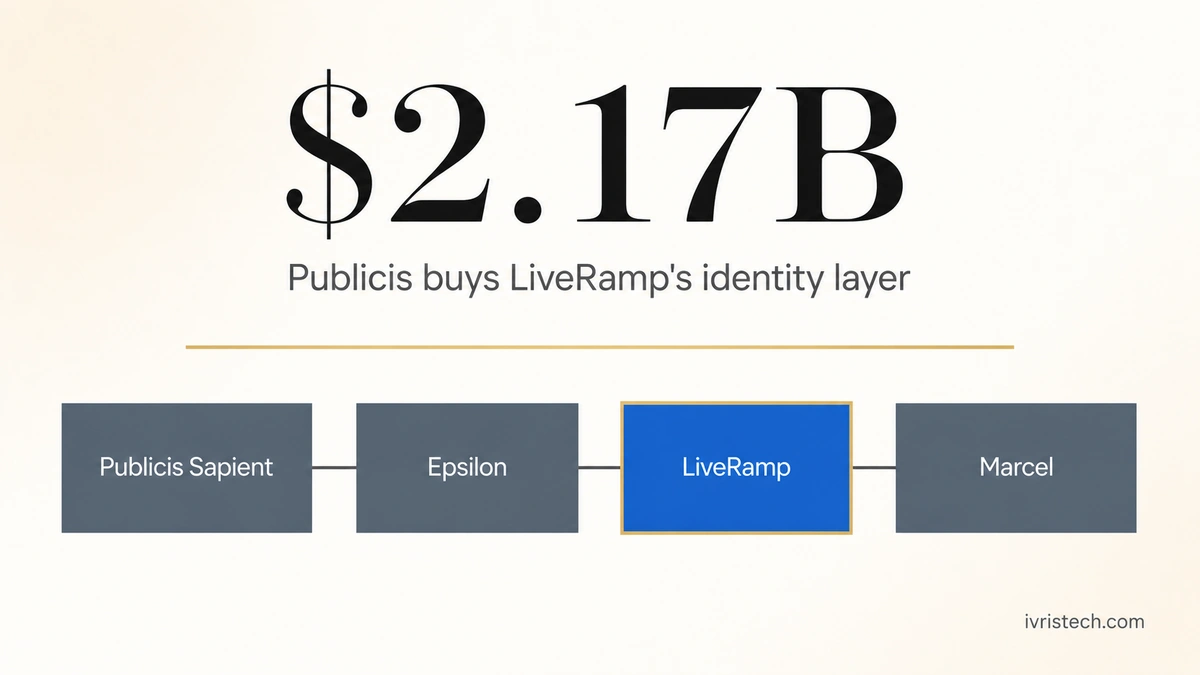
Publicis Groupe announced on May 17 it will acquire LiveRamp for $2.167 billion enterprise value in an all-cash deal, at $38.50 per share. The price represents a 29.8% premium to LiveRamp’s May 15 close and a total equity value of $2.546 billion. Close is expected before year-end 2026, subject to regulatory approval and a LiveRamp shareholder vote.
The structural read matters more than the price. LiveRamp’s clean rooms, RampID, and Authenticated Traffic Solution have served as the neutral identity layer underneath thousands of B2B ABM, audience-building, and attribution programs. Under Publicis ownership, the platform sits inside the agency holdco that already owns Epsilon and the Marcel agent platform, with CEO Scott Howe staying on and reporting directly to Publicis CEO Arthur Sadoun. The press release is explicit on the neutrality commitment: “LiveRamp will continue to operate as a neutral, interoperable platform and provide open access across the ecosystem.”
Our read: the on-paper neutrality promise is the right one for Publicis to make, and the B2B procurement question is whether it survives the first 18 months of integration pressure. The acquisition rationale is “data co-creation for smarter agents” — Sadoun’s own phrasing. That is the language of control, not neutrality. B2B marketers with LiveRamp dependencies in ABM, clean-room measurement, or RampID-based attribution have a planning window, not a panic window, but the window is real.
Key Takeaways
- Publicis will acquire LiveRamp for $2.167B enterprise value / $2.546B equity value at $38.50/share, a 29.8% premium to the May 15 close. All-cash transaction, expected to close before year-end 2026.
- LiveRamp will continue under CEO Scott Howe, reporting to Publicis CEO Arthur Sadoun, and will be reported inside Publicis Groupe’s Technology segment alongside Publicis Sapient.
- The press release commits to LiveRamp continuing to operate as a “neutral, interoperable platform” with “no current or prospective customer prohibited from accessing” services and “no changes to pricing outside the normal course of business.”
- Publicis raised 2027/2028 growth targets on the back of the deal: +7-8% net revenue and +8-10% headline EPS, versus prior +6-7% and +7-9% objectives.
- For B2B marketers with LiveRamp dependencies in ABM, clean-room measurement, or RampID-based attribution, the 90-day planning question is whether the neutrality commitment survives integration pressure.
What’s Actually in the Deal
The financial structure is clean. $2.167 billion enterprise value, $2.546 billion equity value, $379 million in acquired net cash. Funding via cash on hand plus debt while maintaining BBB+ / Baa1 ratings and capping the 2027 net debt-to-EBITDA ratio at 1.2x. Full debt paydown expected within two years of close. Wachtell, Lipton, Rosen & Katz advised Publicis; Sullivan & Cromwell advised LiveRamp. Both boards approved unanimously.
LiveRamp brings 1,300 employees, 25,000+ publisher domains, 500+ technology and data partners, 14 markets, and a trailing five-year revenue CAGR of 13%. The platform’s value to Publicis is the data-collaboration infrastructure layered on top of Epsilon’s identity graph (acquired 2019, anchored in deterministic transaction data) and the Marcel agentic activation platform. Sadoun’s framing is that LiveRamp completes a four-part stack — Publicis Sapient for infrastructure modernization, Epsilon for identity, LiveRamp for collaboration, Marcel for agent activation.
The deal also resets Publicis’s financial outlook. The 2027-2028 organic-growth objectives moved from +6-7% to +7-8% on net revenue and from +7-9% to +8-10% on headline EPS. Accretive to headline EPS from year one of consolidation, excluding transaction costs. The Groupe confirmed its 2026 guidance unchanged at +4-5% net revenue organic growth, slight operating margin improvement, and roughly €2.1 billion record free cash flow before WCR.
The Neutrality Question
The press release commits on neutrality in three specific ways. First, LiveRamp will continue as “neutral, interoperable” with “open access across the ecosystem.” Second, “no current or prospective customer will be prohibited from accessing, or restricted in using, its services.” Third, “no changes to pricing outside the normal course of business and standard business practices.” Data-handling commitments under existing contracts continue, and client/partner/publisher data will not be used “beyond what is expressly permitted under their agreements with them.”
The structural pressure on those commitments is real. LiveRamp serves Publicis competitors directly — WPP, Omnicom, IPG, Dentsu, S4 Capital all use LiveRamp infrastructure for client work. The same brands also work with multiple holdcos simultaneously, and the data-collaboration layer is exactly where competitive intelligence concerns get sharpest. The press release’s neutrality language is necessary because the customer base is the question; it does not by itself resolve the question.
MediaPost’s “End of the Neutral Middle” coverage and Forrester’s analyst note on the deal captured the agency-trade unease. The B2B-marketer-specific concern is narrower. A B2B SaaS company using LiveRamp ATS for clean-room measurement of paid social campaigns does not care about agency competitive dynamics; it cares about whether its measurement infrastructure continues to operate without ownership-driven data leakage to a partner who happens to be in the Publicis client portfolio. The press release commits to “no data use beyond what is expressly permitted” — the operational question is what audit trail confirms that commitment in practice.
What B2B Marketers Should Plan in the Next 90 Days
The deal will not close until late 2026, and operational changes typically lag close by another two quarters. B2B teams have a planning window, not a migration window. Four moves are defensible inside that window.
Audit current LiveRamp dependencies by use case, not by contract. A single LiveRamp contract often spans three different operational dependencies: identity resolution (RampID, ATS) for paid-media targeting, clean-room measurement for attribution, and data-marketplace access for ABM. Each has a different vendor-risk profile. Identity is the stickiest and hardest to swap; clean-room measurement has the deepest competitive overlap with Epsilon’s existing stack; data-marketplace access is the easiest to replicate elsewhere. The audit should map each use case to its post-close replacement options, not list the contract as one risk.
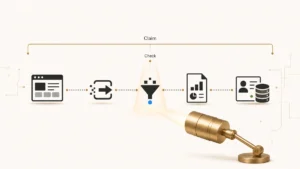
Get a data-flow attestation in writing at the next contract touchpoint. The “no data use beyond what is expressly permitted” commitment is contractual, but the audit trail that confirms it is not yet defined. Request a written attestation from LiveRamp account teams covering: which Publicis or Epsilon systems do not receive identity-linked data; what logging exists for any cross-system data access; whether the SOC 2 / ISO 27001 evidence package will be expanded to cover the holdco boundary. Vendors that decline to commit on these specifics signal where the integration friction will surface first.
Re-baseline ABM identity costs against alternatives in Q3 2026. The clean-room and identity layer has alternatives: AWS Clean Rooms, Snowflake Native Apps, InfoSum, Habu (now LiveRamp-owned), Optable. None is a drop-in replacement for the LiveRamp graph at scale, but the alternatives have matured enough that a re-baseline before 2027 budgeting is reasonable due diligence. The exercise produces negotiation room at next renewal even if the answer is “stay on LiveRamp.”
Watch for the Epsilon-LiveRamp data-graph integration timeline. The press release frames Epsilon (deterministic transaction data) and LiveRamp (collaborative identity) as complementary. Operationally, the value of the combination depends on how the data graphs merge. The timeline and governance of that merge is the single most important post-close signal for B2B marketers. A fast, opaque integration validates the agency-trade neutrality concerns. A slow, transparent integration with documented governance preserves the operational status quo.
The Pattern Behind the Acquisition
Sadoun’s “Power of One” framing positions LiveRamp inside a complete agentic stack: the AI compute consolidation we mapped on the model-provider side in April is the upstream supply story; Publicis-LiveRamp is the demand-side counterpart, where the application layer (Marcel + Epsilon + LiveRamp + Sapient) consolidates to match the compute-side consolidation. The pattern across the last 60 days has been the same on every layer: the 9.7% gross churn rate in Brinker’s 2026 supergraphic measured it at the market level, Hightouch’s $150M Series D for agentic marketing measured it at the orchestration-vendor level, and the Publicis-LiveRamp deal measures it at the agency-holdco level.
The Digiday “identity is the qualifier for AI” framing puts the strategic case bluntly: whoever controls the data owns the AI era. The Harvard Business Review Analytics Services data point Publicis cites — “93% of companies lack the right data for AI success” — is the demand-side rationale. Co-created data assets that companies cannot build alone become the proprietary input to differentiated AI agents. Whether the holdco-owned data-collaboration platform is the right structure to deliver that promise is the question the next 24 months will answer. The intent-data false-positive story we covered last month already showed B2B teams cannot trust intent layers built on weak signal density; co-created datasets fix the signal-density problem only if the governance fixes the trust problem.
For now, the operational answer for B2B marketers is the same as the operational answer for any major vendor ownership change: assume the public commitments hold, audit the dependencies that would matter most if they don’t, and use the 90-day window before close to build the negotiation room that any large renewal conversation needs.
Frequently Asked Questions
$2.167 billion enterprise value (total equity value of $2.546 billion, including $379 million in acquired net cash) at $38.50 per share. The price represents a 29.8% premium to LiveRamp’s May 15, 2026 closing share price. The transaction is all-cash and expected to close before year-end 2026, subject to regulatory approval and a LiveRamp shareholder vote.
Publicis committed in the press release to LiveRamp continuing as a “neutral, interoperable platform” with “open access across the ecosystem” and “no changes to pricing outside the normal course of business.” The structural pressure on those commitments is real because LiveRamp serves Publicis competitor holdcos and their shared brand clients. The operational question is what audit trail confirms the commitment in practice once Epsilon and LiveRamp data graphs begin to integrate.
Four moves before close: audit current LiveRamp dependencies by use case (identity, clean-room measurement, data marketplace) not by contract; get a written data-flow attestation at the next contract touchpoint covering holdco-boundary logging; re-baseline ABM identity costs against alternatives like AWS Clean Rooms, Snowflake Native Apps, InfoSum, and Optable in Q3 2026; watch for the Epsilon-LiveRamp data-graph integration timeline as the post-close signal that matters most.
CEO Scott Howe will continue to lead LiveRamp post-acquisition, reporting directly to Publicis Groupe CEO Arthur Sadoun. LiveRamp’s results will be reported inside the Groupe’s Technology segment, alongside Publicis Sapient. Operational continuity at the executive level is part of the public commitment, though no specific tenure or org-chart guarantee was published.