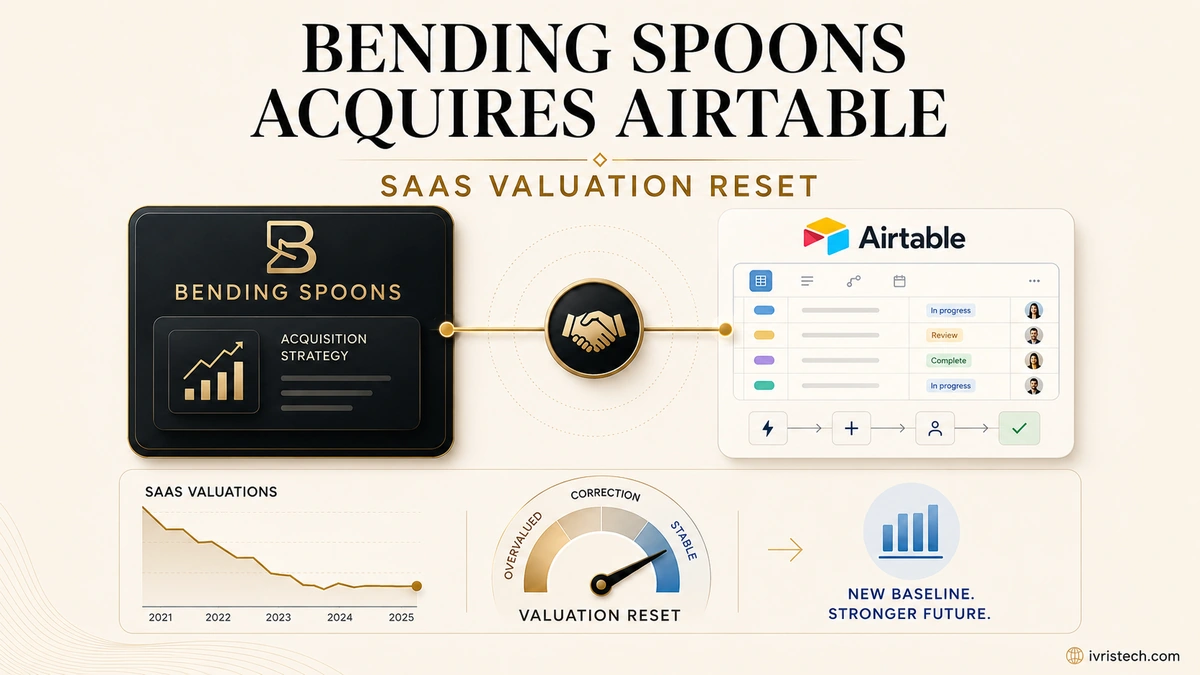
Bending Spoons agreed on August 4, 2026, to acquire Airtable in an all-cash transaction that values the operating business at $1.285 billion and implies approximately $2.25 billion of equity value after Airtable’s net cash is included. The deal is expected to close later in 2026, subject to regulatory approvals and customary conditions.
The number that matters for SaaS operators is 2.7×. Bending Spoons disclosed approximately $480 million in annual recurring revenue as of June 2026, growing more than 20% year over year. Dividing enterprise value by ARR produces a 2.68× multiple, even though Airtable serves more than 500,000 organizations, including 80% of the Fortune 100.
Our read: this is not proof that every SaaS company is now worth less than 3× ARR. It is proof that scale and double-digit growth no longer earn a premium by themselves. Buyers are pricing the quality behind ARR, while deal headlines often blur the difference between enterprise value and equity value.
Direct answer — What does the Airtable deal mean for SaaS valuations?
The Bending Spoons Airtable acquisition puts a large, still-growing SaaS business at about 2.7× enterprise value to ARR. The reset is not an 88% collapse on a like-for-like basis: $1.285 billion is enterprise value, while Airtable’s 2021 headline was an equity valuation. The comparable current equity value is about $2.25 billion, roughly 80% below the 2021 pre-money mark.
Key Takeaways
- Bending Spoons agreed to acquire Airtable at $1.285 billion enterprise value and approximately $2.25 billion equity value.
- The $965 million gap is Airtable’s implied net cash, not a second purchase price.
- Approximately $480 million ARR and more than 20% growth produce a 2.68× EV-to-ARR multiple.
- The current equity value is about 80% below Airtable’s 2021 funding valuation on a like-for-like basis.
- SaaS teams should pair ARR with retention, margins, cash generation, efficiency, and AI defensibility before applying a valuation multiple.
What Bending Spoons Actually Agreed to Buy
Airtable is not changing hands at two competing prices. Enterprise value measures the operating business after net cash is removed. Equity value measures the value attributable to shareholders. The announcement gives both: $1.285 billion of enterprise value and approximately $2.25 billion of equity value.
The difference is $965 million of implied net cash and cash equivalents. In practical terms, Bending Spoons acquires the shares and receives the cash balance with the company. Analysts use the lower enterprise value when comparing the price of the operating business with ARR because cash is not recurring software revenue.
The 2021 Markdown Is About 80%, Not 88%
Airtable’s December 2021 Series F announcement said it raised $735 million at an $11 billion pre-money valuation. That implies an approximately $11.735 billion post-money value after the new capital was added.
Compare the current $2.25 billion equity value with the old $11 billion pre-money value and the decline is 79.5%. Compare it with the implied post-money value and the decline is 80.8%. The widely repeated 88% figure comes from comparing today’s $1.285 billion enterprise value with the old equity valuation. That mixes two different measures and exaggerates the like-for-like reset.
The corrected comparison is still severe. Revenue grew, Airtable kept a large enterprise footprint, and substantial cash remained on the balance sheet, yet the value attributable to shareholders fell by roughly four-fifths from the 2021 financing mark.
Why 2.7× ARR Is the Real SaaS Reset
The more useful signal is the price of the operating business. At $1.285 billion divided by approximately $480 million ARR, Airtable cleared at 2.68×. Software Equity Group’s 2Q26 SaaS market report put the median disclosed SaaS M&A multiple at 4.0× EV to trailing revenue. ARR and trailing revenue are not identical denominators, but the comparison shows Airtable landed on the low side of an already reset market.
That does not reveal why the buyer chose 2.7×. The announcement does not disclose net revenue retention, gross margin, free cash flow, customer concentration, CAC efficiency, or the precise ARR methodology behind the $480 million figure. Assigning the discount to one cause would be speculation.
It does show what no longer works: applying a premium multiple to scale and growth without testing revenue quality. In our earlier analysis of Parloa’s 150% NRR, the retention metric was the missing second half of the ARR story: whether the installed base expands after churn and contraction. The same buyer-price pressure appeared when Intuit said it could not find an acceptable price for Mailchimp and chose to run the asset for profitability.
What SaaS Operators Should Do Now
- Model exits from enterprise value, not the last funding round. Build 3×, 4×, and 5× ARR cases, then add net cash or subtract net debt to estimate equity value. This prevents a board from treating an old preferred-stock valuation as a current market price.
- Put quality metrics beside ARR. Report NRR, gross retention, gross margin, free cash flow, CAC payback, and customer concentration. A buyer needs to know how much of the run rate is durable and how much capital it takes to sustain growth.
- Prove workflow depth and AI defensibility. Customer logos and integration counts establish reach, not switching cost. Show which critical workflows live in the product, how usage expands, and where proprietary data or execution makes substitution harder.
- Separate operating value from balance-sheet value. Cash can protect shareholder proceeds, but it does not increase the multiple paid for the software business. Use enterprise value for operating comparisons and equity value for ownership outcomes.
The agreement is a market-pricing signal, not a forecast of Airtable’s product roadmap. Neither company announced layoffs, pricing changes, or product shutdowns. What the disclosed numbers establish is narrower and more useful: a $480 million ARR business growing above 20% can still sell at 2.7× EV-to-ARR when buyers demand more proof than scale.
Frequently Asked Questions
The agreement values Airtable’s operating business at $1.285 billion enterprise value. Adding approximately $965 million of implied net cash produces about $2.25 billion of equity value. The two figures are not rival purchase prices: one values the operations, while the other values the shareholders’ interest.
Bending Spoons disclosed approximately $480 million ARR as of June 2026. Dividing the $1.285 billion enterprise value by that figure gives 2.68×, conventionally rounded to 2.7×. The calculation uses enterprise value because net cash is not part of the recurring software operation being valued.
The current $2.25 billion equity value is 79.5% below the $11 billion pre-money valuation and 80.8% below the implied $11.735 billion post-money value. Calling it an 88% decline compares enterprise value with an old equity valuation, so it is not a like-for-like calculation.
No. A multiple depends on growth durability, retention, gross margin, cash generation, customer concentration, strategic fit, and competitive risk. Airtable is one disclosed transaction, not a universal benchmark. Its value is as a downside case showing that scale and 20% growth do not guarantee a premium.