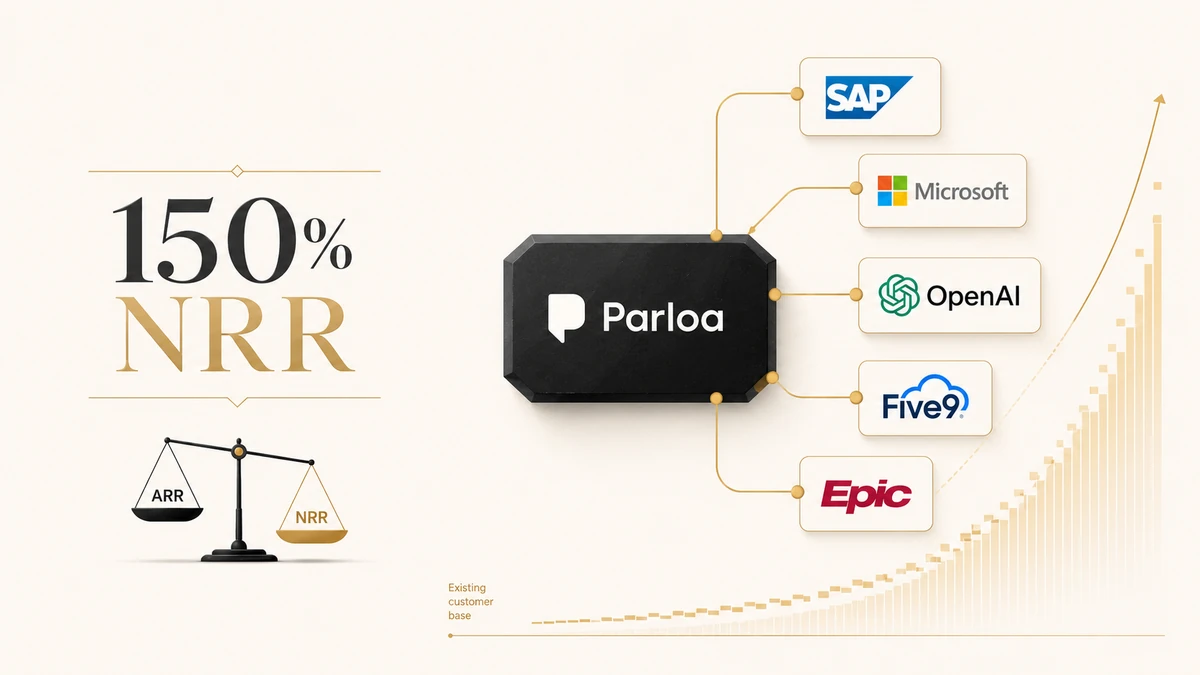
Parloa’s May 29 expansion update is not a fresh annual recurring revenue milestone. It is the deployment plan behind the milestone. In a company announcement, the Berlin-based AI agent platform said it is putting its $350 million Series D to work through partnerships with SAP, Microsoft, OpenAI, Five9, and Epic, alongside new research and global expansion. The release also restates the number that makes those moves worth watching: Parloa surpassed $50 million in ARR with 150% net revenue retention.
That 150% NRR figure matters more than a long partner list. It means Parloa’s existing customer cohort expanded revenue by 50% after churn and contraction were accounted for. Our SaaS marketing metrics guide treats NRR as the test of whether a SaaS business is attracting customers that keep buying. Parloa’s update gives B2B SaaS teams a timely example of why retention quality belongs beside ARR in every growth story. Freshworks’ Q2 AI demand signal shows why: a 71% Copilot attach rate on new enterprise deals measures initial-sale momentum, while Freshworks’ 104% companywide net dollar retention is a separate cohort-expansion measure.
When we covered Salesforce’s $1.2 billion Agentforce ARR, the hidden question was how much revenue sat inside a narrow set of enterprise accounts. Parloa creates a useful comparison. Our read: the important signal is not that another AI vendor signed more partners. It is that a company with 150% NRR is using fresh capital to widen the systems around an already-expanding customer base.
Key Takeaways
- Parloa announced its expansion plan on May 29, 2026, five months after a $350 million Series D valued the company at $3 billion.
- The company said it had previously surpassed $50 million in ARR and reached 150% NRR.
- Parloa’s partner set now spans SAP, Microsoft Azure, OpenAI, Five9, and Epic.
- The B2B SaaS lesson: ARR shows scale, while NRR shows whether the installed base is compounding.
What Parloa Actually Announced
Parloa is expanding on several fronts at once. Its January 2026 Series D gave the company $350 million to invest after reaching a $3 billion valuation. The May 29 release connects that capital to an enterprise distribution plan: deeper SAP work, Microsoft Azure infrastructure, OpenAI model access, Five9 contact-center integration, and Epic integration for healthcare workflows.
The SAP relationship is the clearest example. In a May 22 SAP partnership update, Parloa said its AI agents and SAP Service Cloud would work together to bring more contextual interactions into enterprise customer operations. The SAP deployment matters because it moves Parloa closer to the operational systems where customer-service workflows already live.
Parloa’s Five9 partnership announcement adds a second route into enterprise contact centers. The company is not selling a standalone AI layer and asking buyers to rebuild around it. It is trying to sit inside the platforms that customer-service teams already use.
Why 150% NRR Matters More Than the Funding
NRR measures revenue retained from an existing customer cohort after expansion, churn, and contraction. At 100%, a SaaS company is holding its base flat before new customer sales. At 150%, the same cohort is producing 50% more revenue. That does not prove profitability, and it does not tell us how Parloa defines ARR. It does show that the platform is finding more spend inside current accounts.
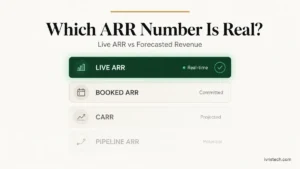
The distinction is easy to miss in AI funding coverage. A large round can fund hiring, international offices, and product work. NRR shows whether customers are already expanding usage. Our live ARR explainer separates recurring revenue scale from the reporting choices that can inflate a headline. Read together, ARR and NRR give a cleaner view: how large the installed base is, and whether that base is growing on its own. Horizon3.ai’s Series E metrics add a second funding-stage example: Horizon3 disclosed 120% year-over-year ARR growth and said it protects more than 7,000 organizations, while TechCrunch reported that ARR approached $100 million in 2025 and put the customer count at roughly 7,200 to 7,300. Airtable’s 2.7× EV-to-ARR sale provides the inverse case: approximately $480 million ARR and more than 20% growth were paired with a low transaction multiple, while NRR and margin data were not disclosed.
For AI-agent vendors, that retention signal is especially useful. Buyers are still sorting durable deployments from pilots that never reach production. Parloa’s 150% NRR does not settle that question account by account, but it is a stronger commercial signal than a product demo or a partnership logo wall. GoDaddy’s $50 million Airo bookings run rate shows the complementary limit: fast contract velocity can lead the story before a vendor discloses repeat use or cohort retention.
The Hidden Catch: Partnerships Are Not Deployment Proof
The caution is straightforward. Integration breadth can lower deployment friction, but it cannot fix a weak workflow or poor customer data. Gartner’s 40% cancellation forecast for agentic AI projects still applies. B2B buyers need evidence that the agent can complete a measurable customer-service task inside their stack, not just connect to it.
Parloa’s product update page points to the practical evaluation areas: integrations, voice automation, workflow control, and operational visibility. That is where procurement teams should spend their time. The partner announcement earns attention because it may shorten deployment. The buying decision still depends on accuracy, containment rate, escalation quality, and cost per resolved interaction.
This is the same implementation filter we use in our guide to AI agents for RevOps. The workflow needs a defined owner, clean source data, and an outcome that can be reviewed before autonomy expands. The partner network helps only after those basics are in place.
What B2B SaaS Teams Should Measure Now
- Pair every ARR update with NRR. ARR gives the scale. NRR shows whether customers expand after the initial sale. A funding story without the cohort metric is incomplete.
- Ask which integrations are live in production. A signed partnership and a production deployment are different milestones. Request a workflow-level case study tied to your CRM, service platform, or contact-center stack.
- Define the operational scorecard before buying. Track containment rate, escalation accuracy, cost per resolved interaction, and time to resolution. The API-readiness issue in SaaStr’s 144-API report card is a useful reminder that the surrounding stack can limit the agent.
- Watch for the next cohort disclosure. Parloa’s next useful update is not another integration logo. It is a customer-count, expansion, or production-usage number that shows whether the 150% NRR pattern continues as the platform broadens.
Frequently Asked Questions
Parloa said it had reached 150% net revenue retention. That means revenue from its existing customer cohort grew by 50% after churn and contraction were included. The figure was restated in the company’s May 29, 2026 expansion announcement rather than introduced as a new milestone on that date.
No. Parloa’s May 29 announcement says the company had previously surpassed $50 million in ARR during a landmark year. The new event is how Parloa plans to deploy its $350 million Series D through partnerships, research, product work, and international expansion.
Parloa’s May 29 release names SAP, Microsoft, OpenAI, Five9, and Epic. The set covers enterprise service software, cloud infrastructure, AI models, contact-center platforms, and healthcare workflows. For buyers, the next step is confirming which integrations are live for the specific workflow they want to deploy.