SaaStr’s AI Agent API Report Card now grades 144 B2B software APIs on one question: how easily can an autonomous AI agent actually use each one? The running average is 71 out of 100, a C+, and the tools B2B marketers depend on clustered near the bottom.
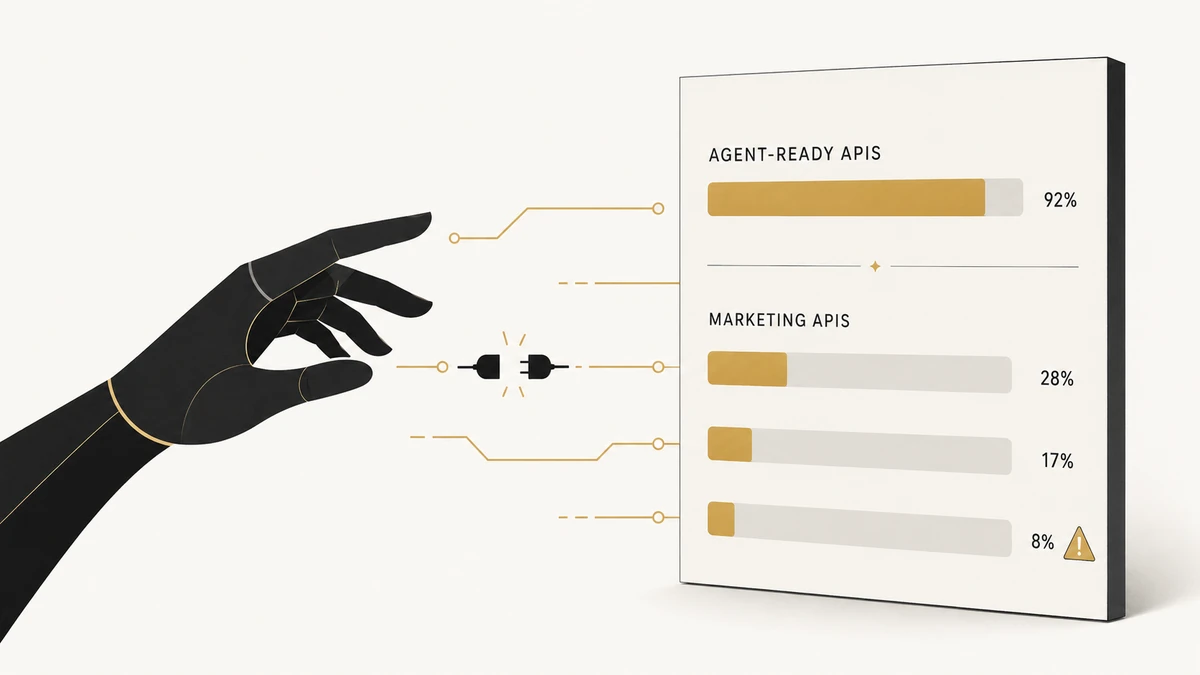
The scores worth reading are not the winners. Stripe took the top mark at 95 and Slack reached 87, but the revenue stack came in soft: HubSpot 70, Gong 60, Marketo 50, Gainsight 48. In MarTech’s May 28 analysis of the same report, the marketing-API average worked out to 63.6 out of 100, against 80.8 for AI and LLM APIs.
Here is why that gap is a buying problem and not a developer footnote. As agentic workflows move from demo to production, the thing your AI agent touches is the API, not the dashboard your team logs into. A platform that is hard for an agent to call will quietly cap what you can automate, no matter how strong its roadmap slides look. Agent-readiness just became a procurement criterion, and most marketing software is not ready for it. The product-side version of that test is now live: Mailchimp’s new Analytics AI agent turns campaign, audience, and revenue data into recommendations, making data quality and architecture visible to the marketer using the feature. Cresta’s synthetic-customer testing layer adds the behavior-side check: can the agent handle representative conversations and edge cases before launch?
Key Takeaways
- SaaStr’s AI Agent API Report Card, analyzed by MarTech on May 28, 2026, grades 144 B2B APIs on agent-readiness; the running average is 71/100 (C+).
- Marketing and revenue tools scored low: HubSpot 70 (B), Gong 60 (B), Marketo 50 (C), Gainsight 48 (C). Stripe led all B2B at 95 (A), with Slack at 87 (A).
- Per MarTech’s analysis, marketing APIs averaged 63.6/100 versus 80.8 for AI and LLM APIs, the widest gap between any two categories in the report.
- Each API is scored 0-10 on six criteria: API design, events and streaming, auth and security, rate limits, SDKs and docs, and agent readiness.
- Founder Jason Lemkin argues a headless, agent-grade marketing-automation platform could take 30% of Marketo’s base within 18 months of shipping at scale.
What SaaStr Actually Graded
The report card scores each API on six criteria worth ten points apiece: API design, events and streaming, authentication and security, rate limits, SDKs and documentation, and agent readiness. The list started at 75 APIs a few weeks ago and has grown to 144. The framing is the part that matters. SaaStr is not grading the product a human buys. It is grading how cleanly an autonomous agent can authenticate, call, retry, and stream against the platform with no human babysitting it. MoEngage’s Merlin AI Custom Agents launch is the product-side version of that test, because the useful feature is not the agent label but the permissions, logs, and marketer-defined rules around it. HubSpot’s new Agent Hub operating layer is a direct product response, centralizing agent status, access, performance, and usage controls on top of the CRM.
That reframe is the whole story. “The age of picking your vendor based on what your humans need is ending,” Lemkin wrote. When we covered the martech landscape hitting 15,505 products and its first real plateau, the growth that survived was concentrated in integration, governance, and the agentic rebuild of existing categories. The report card is that same shift measured one level down, at the API: the platforms that win the next cycle are the ones an agent can drive. ZoomInfo’s GTM.AI move into Codex is the sales-data version of that test, because the buyer now has to ask whether the graph is built for agents as well as reps.
Where the Marketing Stack Landed
The top of the leaderboard is payments and infrastructure, not marketing. Stripe (95) and Slack (87) set the bar, and the tools B2B revenue teams actually run sit well beneath it. The contrast is sharper because Stripe is also the platform powering the first wave of agent-initiated payments in B2B, where an API built for machines was the point from day one.
| Vendor | Score (/100) | Grade |
|---|---|---|
| Stripe | 95 | A |
| Slack | 87 | A |
| Linear | 80 | A- |
| HubSpot | 70 | B |
| Gong | 60 | B |
| Marketo | 50 | C |
| Gainsight | 48 | C |
| Workday | 38 | D |
The category math is worse than any single row. Marketing APIs averaged 63.6 while AI and LLM APIs averaged 80.8, so the tools generating your campaigns are measurably harder for an agent to operate than the models doing the generating. The weakest single dimension across the whole report was agent readiness itself: the sandbox, retry, and error-handling behavior that decides whether an agent can run unattended without duplicating records or stalling in a polling loop.
Why Agent-Readiness Is Now a Buying Criterion
Lemkin’s sharpest claim is about Marketo. The day a genuinely headless, agent-grade marketing-automation platform ships at scale, he argues, Marketo loses 30% of its base inside 18 months, because the thing holding that base is switching cost, not API quality. Marketo’s 50 is the cleanest example of a platform built when the human interface was the product and the API was an afterthought.
That risk is already visible in how vendors are repricing. Salesforce’s $1.2B Agentforce ARR sitting inside roughly 6% of its base showed that agentic revenue concentrates in customers who fixed their data and architecture first. The report card adds the supply-side half of that equation: the vendor’s own API has to be agent-grade for any of it to scale. And Adobe’s repricing of its Marketo-powered AJO B2B tier for mid-market reads differently once you know the underlying engine scored a 50 for agent-readiness.
What B2B Marketing Teams Should Do Now
Our read: this report is a procurement checklist wearing a leaderboard’s clothes. Four moves hold up against the data.
- Add an agent-readiness line to your next renewal. Ask each vendor for public API docs, a sandbox environment, webhook and event support, and its rate limits. SaaStr’s six criteria are a usable scorecard you can run yourself. HighLevel’s free-tool and trial split adds another renewal question: which AI capabilities remain usable after the promotional window ends?
- Stop assuming your marketing-automation platform is agent-ready. The 63.6 category average says it probably is not. Test one real agent workflow against it before you budget for a fleet of them.
- Weight the API, not the roadmap. Vendor decks promise agents; the API score tells you whether those agents can run unattended today. Buy the present-tense capability and treat the roadmap as a hope.
- Watch the bottom of the table. Platforms under 55 (Marketo, Gainsight) are the most exposed the moment an agent-native challenger ships, which is exactly the squeeze the martech plateau is already producing.
Frequently Asked Questions
It is a running scorecard from SaaStr founder Jason Lemkin that grades B2B software APIs on how usable they are for autonomous AI agents. As of late May 2026 it covers 144 APIs, scored 0-10 across six criteria for 100 points total, with letter grades from A+ to F. The current average is 71/100, a C+.
Each API earns up to ten points on six dimensions: API design, events and streaming, authentication and security, rate limits, SDKs and documentation, and agent readiness. Agent readiness covers sandbox environments, error handling, and retry safety, and it was the weakest dimension across the whole list, the part that decides whether an agent can run without a human watching it.
Most marketing platforms were built when the human dashboard was the product and the API was a secondary export channel. Per MarTech’s analysis, marketing APIs averaged 63.6/100 versus 80.8 for AI and LLM APIs. Marketo (50) and Gainsight (48) anchored the bottom, while HubSpot (70) and Gong (60) sat mid-table, all below the payments and developer tools that lead the report.
It tells you what you can safely automate. A low score means an AI agent will struggle to operate the tool without errors, so the platform caps your automation regardless of its marketing claims. Treat it like a buying criterion: ask vendors for their API docs, sandbox, and rate limits, and weight agent-readiness alongside price and features at renewal, as our coverage of HubSpot’s agent build-out shows the leaders already doing.