Search “best B2B ecommerce platforms” and most of the first page is written by the platforms themselves. Useful, but not neutral. This guide ranks 12 platforms the way a buyer would: by the use case each one fits, with honest pricing as of Q2 2026, the real tradeoffs, and a verdict on who each platform is actually for.
The stakes keep rising. The U.S. B2B ecommerce market was worth roughly $1.95 trillion in 2024 and is projected to reach $4.6 trillion by 2030, a 15.4% compound annual growth rate, per Grand View Research. The platform you choose decides how much of that shift you can capture without breaking the sales process you already run.
What follows: a one-screen comparison table, 12 platform reviews, five use-case verdicts, pricing benchmarks, and the migration timeline most buyers underestimate. Updated Q2 2026.
Key Takeaways
- Google’s AI Overview for this query names five platforms first: Shopify Plus, BigCommerce, Adobe Commerce, Salesforce B2B Commerce, and Sana Commerce. All five are reviewed below, alongside seven more.
- There is no single best platform. The right pick is set by your use case: DTC-going-B2B, enterprise B2B, manufacturers, distributors, or a composable build.
- Most enterprise B2B platforms quote custom. Public starting prices exist for Shopify Plus and BigCommerce; Adobe, SAP, Salesforce, and Optimizely cost is mostly licence plus a build that often exceeds the licence.
- The hidden cost is migration. A mid-market replatform runs 6 to 12 months, and the ERP and data phases, not the front-end build, are where projects slip.
- Composable platforms (commercetools, Spryker) trade turnkey speed for flexibility. They need engineering resources you may not have in-house.
What Sets a B2B Ecommerce Platform Apart
A B2B ecommerce platform is software that lets businesses sell to other businesses online, with the account structures, pricing rules, and approval workflows that B2B buying needs and consumer carts do not. The mechanics look familiar (catalog, cart, checkout), but almost every layer behaves differently once the buyer is a company rather than a person.
Four capabilities separate a real B2B platform from a consumer store with a wholesale plugin: customer-specific catalogs and contract pricing, multi-user company accounts with roles and approval limits, quoting and bulk or repeat ordering, and live integration with the ERP that holds inventory and pricing. Those are the baseline we describe in our B2B ecommerce best practices guide, and every platform here has to deliver them.
There is a buyer-behavior reason this matters. A B2B purchase typically involves six to ten decision-makers, according to Gartner’s B2B buying research, and those buyers want to self-serve before they ever talk to sales. A B2B store is also a lead engine, so every quote request and account signup feeds the same pipeline your lead generation tools manage. The platform either supports that motion or quietly works against it.
This list is the shortlist, not the selection method. If you want the scoring framework that sits behind it, our guide on how to choose a B2B ecommerce platform walks through the eight weighted criteria and the total-cost-of-ownership math, and the picks below map onto that framework rather than replacing it.
How We Chose These 12 Platforms
Every platform here had to clear four tests. Miss one and it was cut.
1. Genuinely B2B, not B2B-as-a-feature. The platform markets a real B2B product with account hierarchies, contract pricing, and quoting, rather than a consumer plan with a wholesale add-on bolted on.
2. Active and supported in 2026. Current product, current releases, named customers. Anything sunset or quietly de-prioritized was dropped.
3. Honest about cost. Either public pricing or a clear pricing model. We do not publish invented numbers; where a vendor only quotes custom, we say so.
4. Measurable fit to a use case. Each platform earns a clear “best for” rather than a generic claim to suit everyone. Success is judged against the B2B marketing metrics that matter, pipeline influenced and cost per qualified order, not raw traffic.
Worth naming what we left out. We dropped Znode despite it being a legitimate B2B platform, because its market and analyst visibility trail the 12 picks for a general shortlist. We also kept multi-vendor marketplace builders out of scope: running many third-party sellers on one storefront is a different software category, covered separately in our forthcoming guide to B2B marketplace software. If you have not yet settled on evaluation criteria at all, start from the platform selection framework first, then come back to this shortlist.
The 12 Best B2B Ecommerce Platforms in 2026
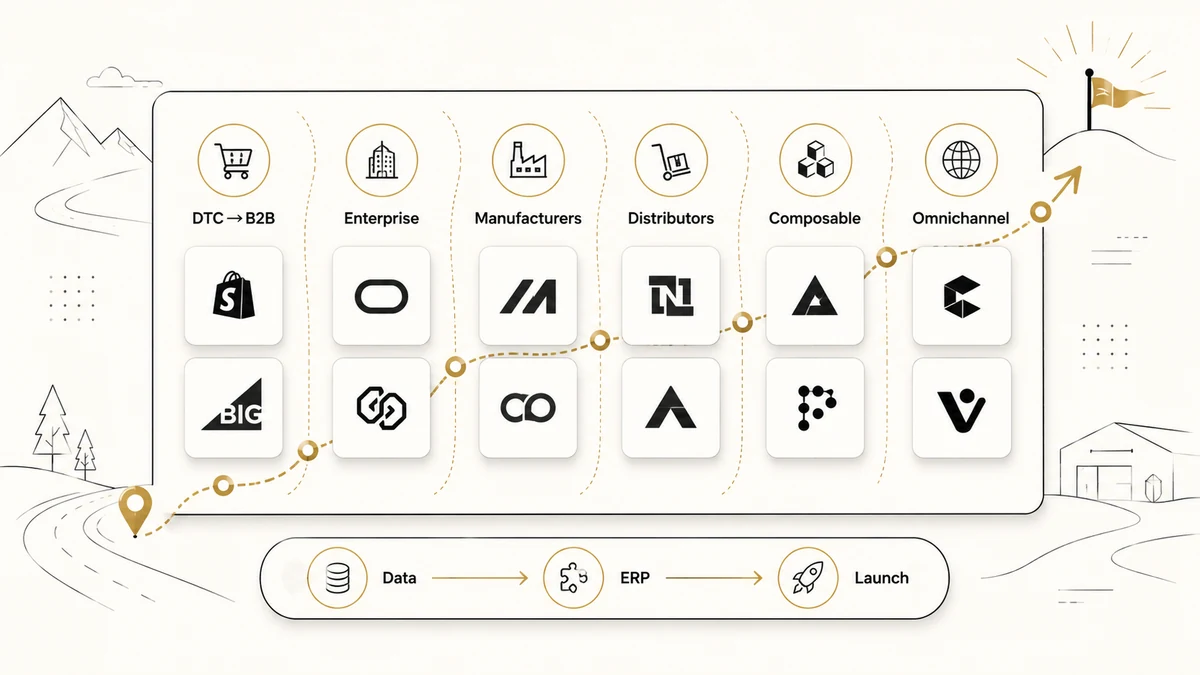
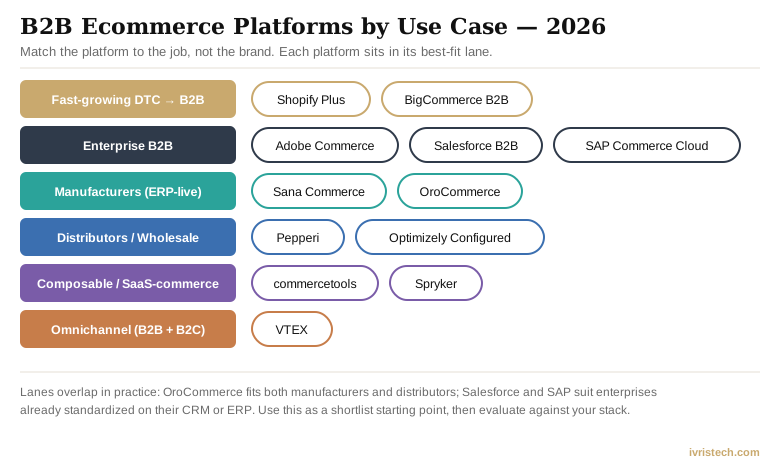
Each platform below gets the same structure: who it suits, the standout that separates it, and a starting price as of Q2 2026. The order runs by use-case fit for a typical mid-market buyer, starting with DTC brands moving into B2B and ending with omnichannel. Match the platform to the problem you have, not to whoever ranks first on a list. One problem buyers rarely test is SEO control, how each platform builds filter URLs, handles canonicals, and survives a replatform, all of which an ecommerce SEO audit exposes before they become a traffic loss. If organic search is a channel you count on, weigh that control before you sign, because the honest answer to which platform is best for SEO comes down to how much command it hands you over URLs, canonicals, and filters.
1. Shopify Plus: Best for Fast-Growing DTC Brands Adding B2B
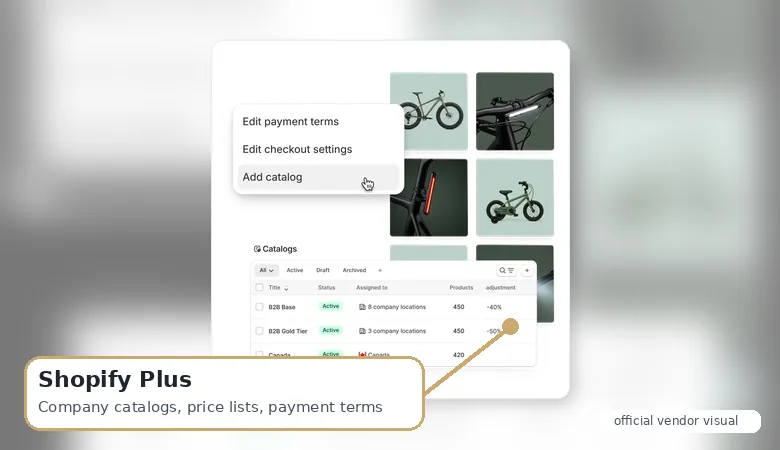
Shopify Plus is the fastest route from a strong direct-to-consumer operation to a working B2B channel. B2B is built into Plus rather than sold separately: company profiles, customer-specific catalogs, price lists, quantity rules, and net payment terms run on the same admin and checkout your team already knows. The app ecosystem is the largest in commerce, which fills most gaps without custom code. Because B2B here is a channel layered onto your consumer store, anchor the move to your B2B go-to-market strategy before you switch it on. That same convenience can hide implementation risk, so skilled Shopify developers should be able to explain which B2B features are native, which require apps, and where custom code becomes risky. Shopify’s latest results add a current adoption signal without settling the fit question: B2B GMV grew 76% in Q2 2026, but the company did not disclose B2B GMV dollars or merchant-level ROI.
Best for: brands with a proven DTC store opening a wholesale or B2B buyer channel, and teams that value speed to launch over deep configurability.
Standout: launch speed and ecosystem. You can stand up a B2B store on familiar tooling in weeks, not quarters, and extend it through apps.
Starting price (as of Q2 2026): custom quote, typically from around $2,500/month on an annual Plus contract; B2B features are included in Plus, with no separate B2B licence.
2. BigCommerce B2B Edition: Best for Mid-Market B2B Without Heavy Development
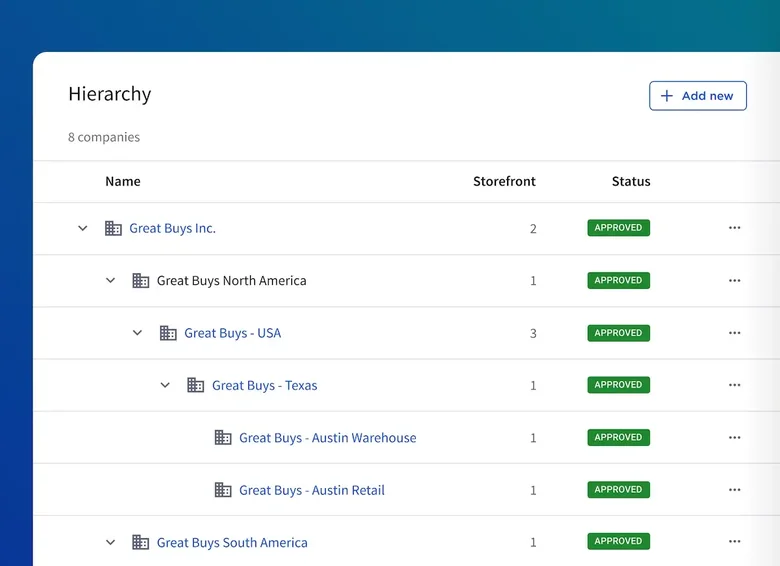
BigCommerce B2B Edition gives mid-market sellers native B2B features without the build cost of an enterprise suite. The B2B Edition layer adds buyer portals, quote management, company accounts with multiple buyers, shared shopping lists, and granular price lists on top of BigCommerce’s open SaaS core. Because it is API-friendly and avoids licence fees tied to revenue, total cost of ownership usually sits well below Adobe or SAP.
Best for: mid-market manufacturers, wholesalers, and brands that want B2B features working out of the box, and that prefer SaaS over a self-hosted build.
Standout: native B2B feature depth at SaaS economics, with open APIs for the integrations you do need.
Starting price (as of Q2 2026): custom Enterprise quote; B2B Edition layers onto the BigCommerce Enterprise plan, priced by catalog size and order volume rather than a public flat rate.
3. Adobe Commerce (Magento): Best for Enterprises That Need Deep Customization
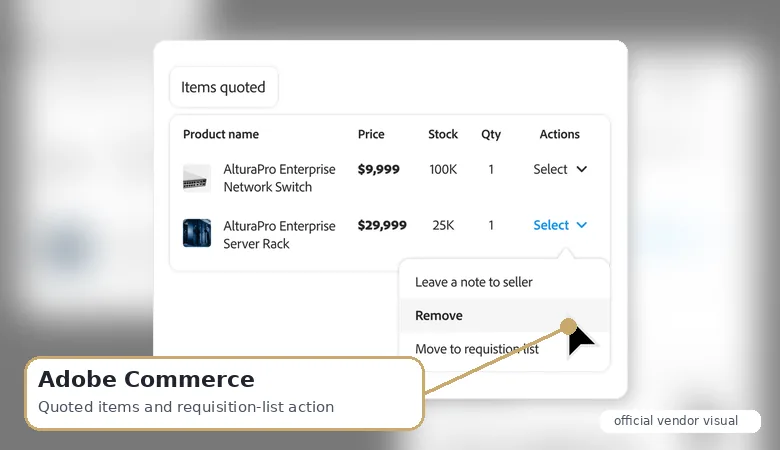
Adobe Commerce, still widely known as Magento, is the platform for enterprises that need to model complex catalogs and bespoke workflows. Its native B2B module covers company accounts, shared catalogs, requisition lists, and quoting, and the extension marketplace plus open codebase mean almost anything is buildable. That power is the catch: it expects a capable development team and a real implementation budget.
Best for: large B2B sellers with intricate catalogs, multi-region operations, and the engineering resources to own a heavily customized platform.
Standout: near-unlimited customization through a mature ecosystem, with a B2B module that has been refined over many release cycles.
Starting price (as of Q2 2026): licence roughly $22,000 to $125,000 per year by GMV tier per published industry estimates, plus a build that frequently costs more than the licence itself.
4. Salesforce B2B Commerce: Best for Teams Already Standardized on Salesforce
Salesforce B2B Commerce, now folded into the Agentforce Commerce line, makes the most sense when your CRM is already Salesforce. Commerce data lives next to sales and service records, so account hierarchies, contract pricing, and reorder flows draw on the same customer model, and the platform’s AI features act on that shared data. The payoff is tightest when commerce feeds the same revenue stack, the kind of RevOps software that ties pipeline to fulfillment.
Best for: enterprises running Salesforce CRM that want commerce, sales, and service on one data layer rather than stitched together.
Standout: native CRM and AI integration. Customer, order, and service history inform pricing and personalization without a separate sync.
Starting price (as of Q2 2026): priced as a share of GMV, roughly 1% on the Growth edition and 2% on Advanced, before enterprise discounts and implementation.
5. SAP Commerce Cloud: Best for Large Enterprises Running SAP ERP
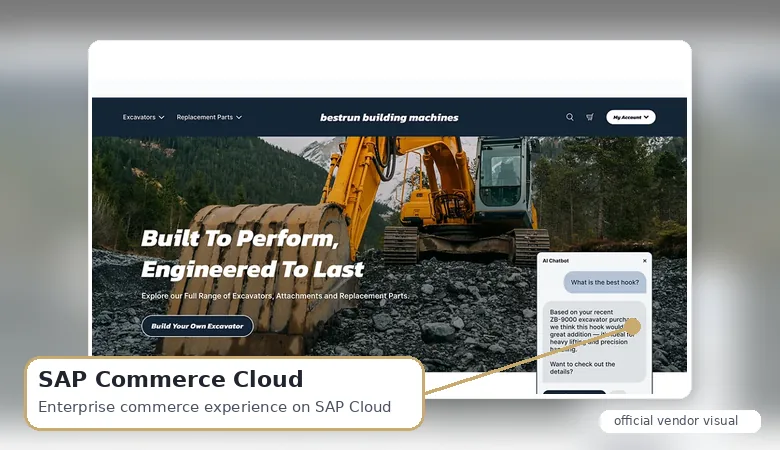
SAP Commerce Cloud, the platform once called Hybris, is built for large enterprises whose business already runs on SAP. Its strength is native ERP integration: pricing, inventory, and orders draw on SAP in real time instead of through a brittle middleware sync, which matters when catalogs are huge and pricing rules are complex. The cost and complexity are equally large, so it is overkill for smaller sellers.
Best for: global enterprises on SAP ERP with high order volumes, complex pricing, and the resources for a major implementation.
Standout: deep, native SAP integration that keeps commerce and the back office on a single source of truth.
Starting price (as of Q2 2026): custom quote, typically $150,000 or more per year for mid-to-large deployments per published industry estimates, with implementation often exceeding the licence.
6. OroCommerce: Best for Manufacturers and Distributors
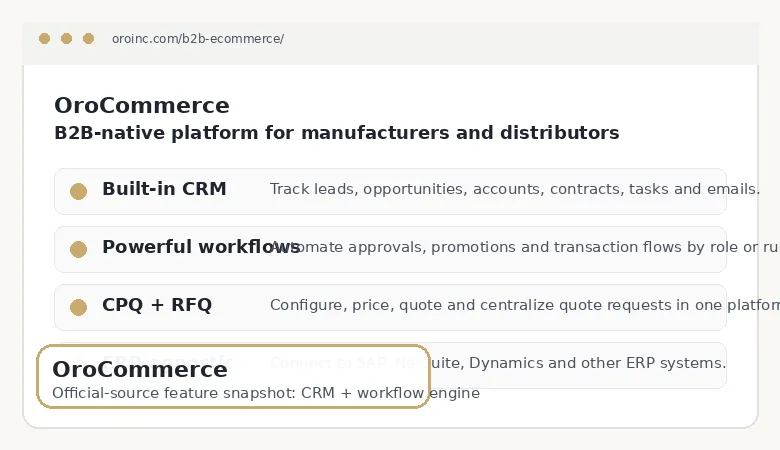
OroCommerce was built B2B-first, which shows in how little you have to bend it to fit a manufacturer or distributor. Multi-organization structures, a built-in CRM, a workflow engine, quoting, and configure-price-quote come standard, and an ERP-agnostic approach means it integrates with whatever back office you run. An open-source Community edition lets technical teams trial the platform before committing to Enterprise. The distributor and manufacturer patterns it suits are the same ones catalogued in our B2B ecommerce examples.
Best for: manufacturers, distributors, and wholesalers with complex org structures and approval chains that want a purpose-built B2B platform.
Standout: B2B-native depth out of the box, including a built-in CRM, without forcing you onto one ERP vendor.
Starting price (as of Q2 2026): free open-source Community edition; OroCommerce Enterprise runs roughly $45,000 to $250,000 per year by GMV band per published industry estimates.
7. Sana Commerce: Best for ERP-Driven Manufacturers and Distributors
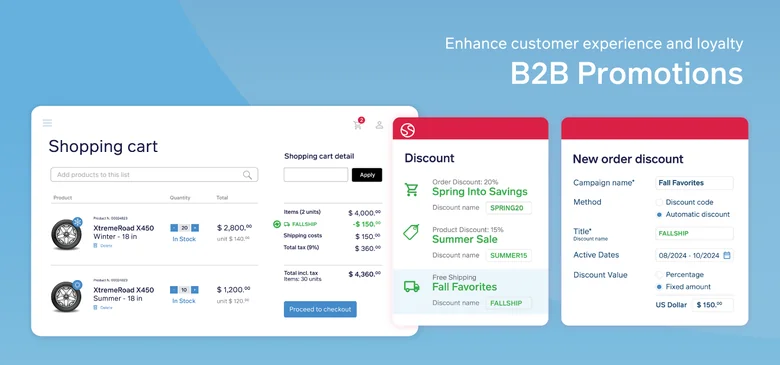
Sana Commerce takes a sharper position than most: the store runs directly on your ERP. For sellers on SAP or Microsoft Dynamics, that means pricing, stock, and order data come straight from the system of record rather than from synced copies that drift. The result is fewer pricing errors and accurate availability, which matters in machinery, automotive, and industrial supply. The flip side is that the value is tied to that ERP fit.
Best for: manufacturers and distributors on SAP or Microsoft Dynamics that want the store to reflect ERP truth in real time.
Standout: ERP-integrated architecture rather than an ERP connector, so the store and back office stay in lockstep.
Starting price (as of Q2 2026): custom quote, not published; priced by deployment and ERP scope.
8. commercetools: Best for Composable, API-First Builds
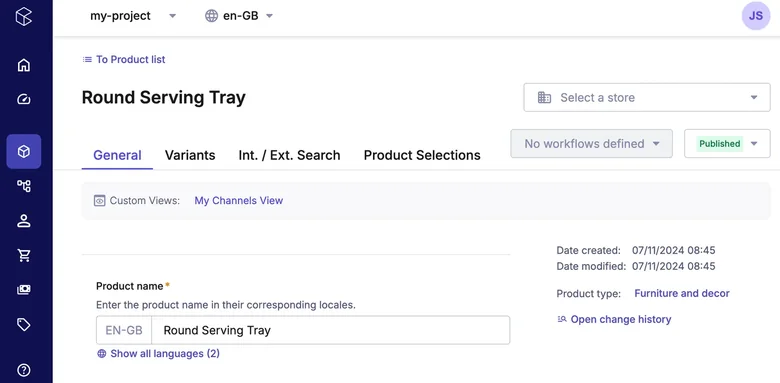
commercetools is the reference point for composable, API-first commerce. Rather than a fixed storefront, it gives you headless services you assemble into the exact experience you want, with native B2B constructs like business units, associate roles, quotes, and approvals. That flexibility suits teams running fast-moving roadmaps across web, app, and embedded commerce. It also assumes you have engineers, because nothing here is turnkey. A headless build also hands you the rendering decision, and if the storefront paints product data in the browser it needs server-side rendering to stay visible to Google, one of the tradeoffs behind making a headless catalog crawlable and indexable.
Best for: SaaS and commerce-hybrid companies with strong engineering that want to build a custom, future-flexible stack.
Standout: a pioneer of the composable approach, with deep APIs and the freedom to swap any layer.
Starting price (as of Q2 2026): custom quote, not published; a free developer trial is available to evaluate the APIs.
9. Spryker: Best for Sophisticated and Unconventional B2B Models
Spryker is composable commerce aimed at businesses whose model does not fit a template. It handles transactional complexity well, supports B2B, B2B2X, and marketplace patterns, and gives engineering teams the building blocks to model unusual catalogs, pricing, and fulfillment. Industry analysts have recognized it for sophisticated B2B, and that is the right read: it rewards complexity rather than simple storefronts, which means it is more than smaller sellers need.
Best for: industrial, manufacturing, and enterprise sellers with complex or hybrid B2B models and the team to build on a composable platform.
Standout: flexibility for unconventional commerce, including marketplace-ready patterns alongside core B2B.
Starting price (as of Q2 2026): custom quote, not published; priced by scope and modules.
10. Pepperi: Best for Wholesalers With Field Sales
Pepperi solves a problem the big platforms treat as an afterthought: sellers whose orders come through field reps as much as through a website. It unifies a B2B web store, a mobile order-taking app for sales reps, and direct-store-delivery flows, so the same catalog and pricing serve self-service buyers and the team in the field. For wholesalers and brands with route sales, that single system is the draw. It is a focused tool rather than a broad enterprise suite.
Best for: wholesalers, distributors, and consumer-goods brands that combine online ordering with field sales and direct-store delivery.
Standout: one platform for web, mobile rep app, and order-to-cash, built around how reps actually sell.
Starting price (as of Q2 2026): custom quote, typically seat-based; no public pricing.
11. Optimizely Configured Commerce: Best for Out-of-Box Manufacturer B2B
Optimizely Configured Commerce, built on the platform formerly known as Insite, is purpose-built B2B that arrives closer to ready than most enterprise suites. Catalog management, quoting, configure-price-quote, and customer-specific pricing come configured for manufacturers and distributors, and the tie-in to Optimizely’s wider experience and experimentation tools lets teams test and personalize without a separate stack. It carries less brand visibility than the giants, which can mean a smaller partner pool.
Best for: manufacturers and distributors that want strong native B2B features quickly, with personalization and testing attached.
Standout: out-of-box B2B depth combined with Optimizely’s experimentation and content tooling.
Starting price (as of Q2 2026): custom quote, typically $100,000 or more per year per published industry estimates.
12. VTEX: Best for Unified B2B and B2C on One Platform
VTEX earns its place for companies that need to run B2C, B2B, and marketplace models on a single platform. The unified approach means one system for direct consumer sales, business buyers, and third-party sellers, with strong roots in retail and a large Latin American footprint. The honest caveat is positioning: B2B is a genuine capability here, not the core focus, so a pure-B2B seller may find a purpose-built platform deeper on B2B-specific workflows.
Best for: retailers and brands selling across B2C and B2B (and marketplace) that want one platform rather than separate stacks.
Standout: true unified commerce across consumer, business, and marketplace selling.
Starting price (as of Q2 2026): custom quote, typically GMV-based; no public pricing.
B2B Ecommerce Platform Comparison Table
The full shortlist at a glance. Scroll the table sideways on mobile to see every column.
| Platform | Best for | Starting price (Q2 2026) | Free trial / demo | Standout | Verdict |
|---|---|---|---|---|---|
| Shopify Plus | DTC brands adding B2B | From ~$2,500/mo (annual) | Free trial | Launch speed + app ecosystem | Fastest path from DTC to B2B |
| BigCommerce B2B | Mid-market B2B | Enterprise quote | Demo | Native B2B at SaaS cost | Best value mid-market pick |
| Adobe Commerce | Enterprise, complex catalogs | ~$22k-$125k/yr licence | Demo | Near-unlimited customization | Power if you have a dev team |
| Salesforce B2B Commerce | Salesforce CRM shops | ~1-2% of GMV | Demo | Native CRM + AI | Best if you live in Salesforce |
| SAP Commerce Cloud | Large enterprises on SAP | $150k+/yr (custom) | Demo | Native SAP ERP integration | For SAP-run global sellers |
| OroCommerce | Manufacturers, distributors | Free CE; Ent. ~$45k-$250k/yr | Open-source trial | B2B-native + built-in CRM | Best purpose-built B2B |
| Sana Commerce | ERP-driven sellers | Custom quote | Demo | Runs on your ERP live | Best for SAP/Dynamics shops |
| commercetools | Composable builds | Custom quote | Free dev trial | API-first, swap any layer | Best composable, needs devs |
| Spryker | Complex / hybrid B2B | Custom quote | Demo | Models unconventional commerce | For sophisticated B2B |
| Pepperi | Wholesalers with field sales | Custom quote (seat-based) | Demo | Web + mobile rep app + DSD | Best for route / field sales |
| Optimizely Commerce | Manufacturer B2B | ~$100k+/yr (custom) | Demo | Out-of-box B2B + testing | Ready B2B with personalization |
| VTEX | Unified B2B + B2C | Custom quote (GMV-based) | Demo | One platform, all models | Best for true omnichannel |
Use-Case Verdicts: Which Platform Wins for You
Strip away the feature lists and the decision usually comes down to which lane you are in. Five verdicts cover most buyers.
Best for fast-growing DTC going B2B: Shopify Plus. If you already run a strong consumer store, Plus turns on a B2B channel on tooling your team knows, with the shortest path to a live store. The platform should follow your sales motion, not lead it, so confirm the channel fits how you already sell.
Best for enterprise B2B: Adobe Commerce, Salesforce, or SAP. Pick by your existing stack. Standardized on Salesforce CRM, choose Salesforce; running SAP ERP, choose SAP; needing maximum customization with a development team, choose Adobe Commerce.
Best for manufacturers: Sana Commerce or OroCommerce. If the store has to mirror ERP pricing and stock in real time, Sana is purpose-made; if you want B2B-native depth with a built-in CRM and ERP-agnostic integration, OroCommerce fits. Both keep the store and the back office on one source of truth, which is the part manufacturers most often underestimate.
Best for distributors and wholesale: Pepperi or Optimizely Configured Commerce. Pepperi wins when field reps and direct-store delivery sit alongside the web store; Optimizely wins when you want strong out-of-box distributor features with personalization attached.
Best for SaaS and commerce hybrids: commercetools or Spryker. Both are composable and reward engineering teams that want to build a flexible, future-proof stack rather than accept a fixed storefront.
B2B Ecommerce Platform Pricing Benchmarks (2026)
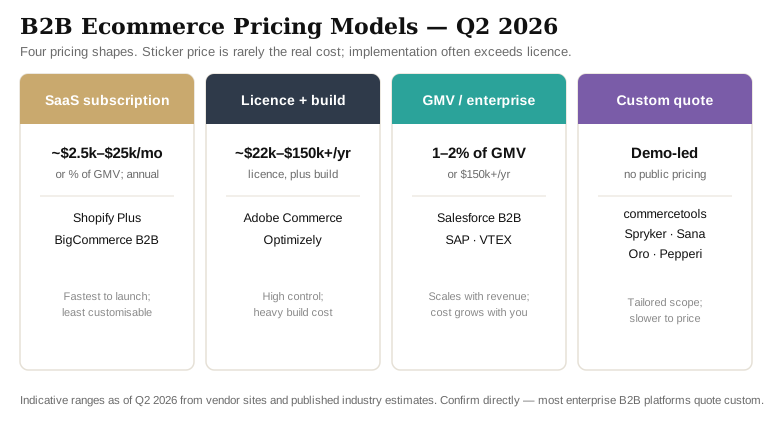
B2B platform pricing falls into four shapes. Knowing which shape you are buying matters more than any single sticker number, because the model determines how cost scales as you grow.
| Pricing model | Typical range (Q2 2026) | Platforms | Best fit |
|---|---|---|---|
| SaaS subscription | ~$2,500-$25,000/mo or % of GMV | Shopify Plus, BigCommerce | Fast launch, predictable cost |
| Licence + build | ~$22k-$150k+/yr licence | Adobe Commerce, Optimizely | High control, dev team on hand |
| Percentage of GMV | ~1-2% of GMV or $150k+/yr | Salesforce, SAP, VTEX | Enterprise scale |
| Custom quote | Demo-led, no public price | commercetools, Spryker, Oro, Sana, Pepperi | Tailored scope |
Two things shape the real number. First, the platform has to execute the B2B pricing strategy you already run, customer-specific price lists, contract pricing, and volume breaks included, and richer pricing logic can push you up a tier. Second, these vendors price the way the software industry does, so our breakdown of SaaS pricing models is a useful lens for reading a quote, whether it is a flat subscription, a GMV share, or a licence.
IMPORTANT
The licence or subscription is rarely the full cost. Implementation, integration, and ongoing support often exceed the platform fee, especially on Adobe Commerce, SAP, and any composable build. Ask every vendor for a three-year total cost of ownership, not a monthly headline, before you compare.
Implementation and Migration: The Hidden Cost
The line item buyers underestimate most is not the platform. It is moving onto it. A mid-market B2B replatform typically runs 6 to 12 months, and the slips happen in the integration and data phases, not the front-end build.
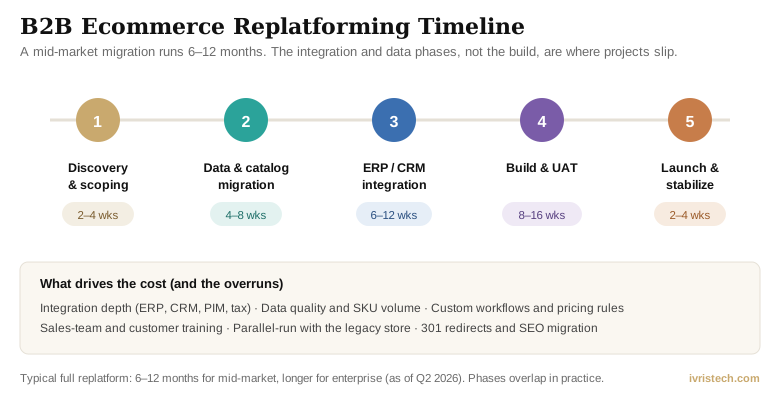
A realistic sequence runs through five phases: discovery and scoping (2 to 4 weeks), data and catalog migration (4 to 8 weeks), ERP and CRM integration (6 to 12 weeks), build and user-acceptance testing (8 to 16 weeks), then launch and stabilization (2 to 4 weeks). The phases overlap in practice, but the order of risk does not change: dirty product data and deep integrations cause more overruns than design ever does.
A replatform is also the moment to protect organic traffic, not an afterthought once the new store is live. Fold your B2B SEO strategy into the migration plan, and run a full crawl before and after launch with one of the best technical SEO tools so broken redirects and lost URLs surface before Google finds them.
PRO TIP
Run the new store in parallel with the legacy one for a defined period before you cut over. Migrate a single product category and a small set of accounts first, confirm pricing and ERP sync are correct on real orders, then expand. A staged cutover costs a little more time and saves far more in emergency fixes.
Frequently Asked Questions
There is no single best platform. The right one depends on your use case: Shopify Plus for DTC brands adding B2B, Adobe Commerce or SAP for enterprises, Sana or OroCommerce for manufacturers, Pepperi for distributors with field sales, and commercetools or Spryker for composable builds.
Shopify Plus, BigCommerce B2B Edition, Adobe Commerce, and OroCommerce are all examples of B2B ecommerce platforms. Each lets businesses sell to other businesses with company accounts, contract pricing, and quoting. Real brands using them are catalogued in our B2B ecommerce examples guide.
As of Q2 2026, SaaS platforms start around $2,500 per month, licence-based platforms run roughly $22,000 to $150,000 or more per year, and many enterprise platforms quote custom. Implementation often costs more than the licence, so budget total cost of ownership across three years.
Sana Commerce and OroCommerce lead for manufacturers, and Pepperi and Optimizely Configured Commerce suit distributors. The deciding factor is ERP integration: if the store must reflect live ERP pricing and stock, choose a platform built around that, like Sana for SAP or Dynamics shops.
Your Shortlist in One Move
Skip the long list. Find your lane in the use-case verdicts above, take the one or two platforms named there, and book demos with both. Bring the same test to each: your real catalog, your actual pricing rules, and a sample order that has to reach your ERP. The platform that handles your messiest pricing scenario cleanly, at a three-year cost you can defend, is the right pick. Everything else is a feature list.