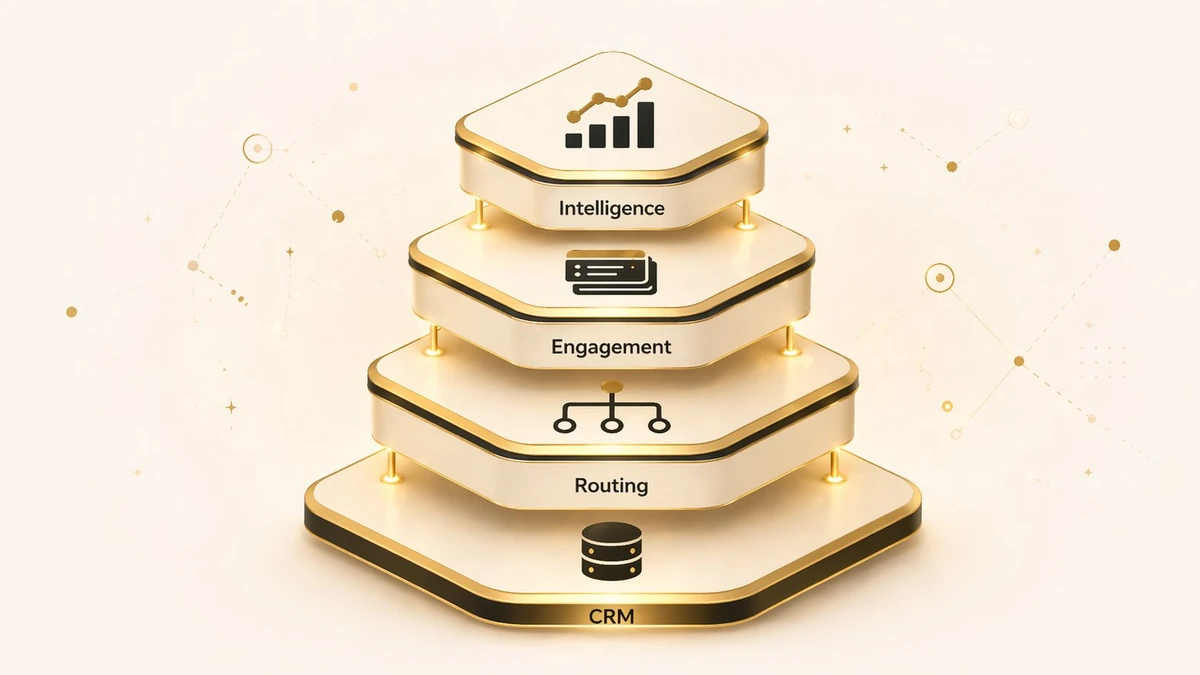
Most “best RevOps software” lists treat the category like one job: pick a tool, plug it in, run RevOps. That framing breaks the moment you actually try to buy. RevOps software splits into four functional areas, and the right tool for forecasting is the wrong tool for outbound. A 12-rep startup chasing inbound shouldn’t buy what a 200-person sales floor uses.
This article maps 10 platforms to the four RevOps functions they actually serve, with current Q2 2026 pricing, “best for” guidance by team size, and a 90-day rollout sequence for putting them in place. If you’re earlier in your RevOps journey, start with our complete guide to RevOps best practices first, then come back here to pick the stack.
Key Takeaways
- RevOps software splits into four functional categories: revenue intelligence, sales engagement, CRM foundation, and lead routing/data enrichment.
- No single “RevOps platform” exists. Every team builds a stack of two to four tools.
- The right stack depends on revenue motion (inbound vs outbound), team size, and CRM choice.
- Mid-market budget for a working RevOps stack: roughly $1,500-$5,000 per user per year, fully loaded.
- Don’t buy everything on day one. Start with CRM + intelligence, add engagement and routing later.
What Is RevOps Software?
RevOps software is a category of B2B platforms that align marketing, sales, and customer success operations around a single revenue model, typically by integrating CRM data, automating handoffs between teams, and surfacing pipeline intelligence in one place. The goal is predictable revenue growth — fewer leaks between teams, faster lead-to-revenue cycles, and a forecast you can trust.

The category emerged because traditional sales tools (CRMs, dialers, sequencers) only solve the sales side. They don’t help marketing measure pipeline contribution, don’t give CS visibility into renewal risk, and don’t give the CFO a clean revenue picture. RevOps software fills those gaps either by extending the CRM or by sitting on top of it.
Gartner has predicted continued consolidation around revenue platforms through 2026, with more vendors collapsing the old “marketing automation + CRM + sales engagement + analytics” stack into integrated revenue clouds. We’re seeing this play out in real procurement decisions: mid-market buyers increasingly pick a small number of integrated platforms over a sprawling 12-tool stack.
The 4 Categories of RevOps Software
Before evaluating individual tools, you need the mental model. RevOps software splits into four functional categories, and most teams need at least one tool from each.

Revenue intelligence platforms ingest call recordings, CRM activity, and historical deal data to predict pipeline outcomes and surface deal risk. Best examples: Gong, Clari, BoostUp.ai. These are the “is the deal really going to close?” tools.
Sales engagement platforms orchestrate outbound and follow-up sequences across email, phone, LinkedIn, and SMS. They also score sequence performance so RevOps can kill what’s not converting. Best examples: Salesloft, Outreach. These engagement tools are one slice of the rep-level automation that sits inside a RevOps stack, where sequencers, dialers, and AI SDRs automate the individual seller’s motion that this org-wide layer then reports on.
CRM foundation platforms are the source of truth that everything else writes to. RevOps doesn’t function without a clean CRM. Best examples: HubSpot Sales Hub + Operations Hub for SMB and mid-market, Salesforce Sales Cloud for enterprise. For the broader CRM landscape beyond the top two, our guide to CRM software examples maps 12 platforms by company stage and sales motion.
Routing, data, and pipeline-hygiene tools handle the connective tissue: lead-to-rep assignment, account enrichment, scheduling, and CRM data quality. Best examples: Default, Clay, Weflow.
PRO TIP
If you’re under 25 reps, you don’t need one tool from every category. Start with a strong CRM (HubSpot covers categories 3 and 4 reasonably) and add engagement only when outbound becomes a real motion. Forecasting tools at that scale are usually overkill.
Revenue Intelligence Platforms
Revenue intelligence platforms turn pipeline reporting from a rep-submitted opinion into a data-backed prediction. They’re the single biggest fix for RevOps teams whose forecasts miss target by 20% or more every quarter.
1. Gong
Gong is the conversation intelligence platform that records sales calls, transcribes them with AI, and flags deal risk based on what reps and prospects actually said on the line. Originally a call-coaching tool, it’s expanded into full revenue intelligence: deal health scoring, forecast inputs, and competitive insights pulled from calls.
Best for: Mid-market and enterprise sales teams (50+ reps) where call quality and forecast accuracy directly impact pipeline reliability.
Standout feature: Deal scoring based on call sentiment and customer language, not just CRM activity.
Pricing: Custom; commonly $1,500-$2,500 per user per year (as of Q2 2026, verify on gong.io/pricing).
If your reps run lots of calls and your forecasts depend on call signals, nothing else matches Gong. The catch: it’s heavy. You need a team that actually listens to call snippets and changes behavior. If your reps don’t run five-plus calls per day, the ROI doesn’t show up.
Skip Gong if you have under 20 reps or if your motion is mostly written outbound. In that case prioritize Salesloft or Outreach instead.
2. Clari
Clari is a revenue platform built around forecasting. It pulls deal data from your CRM, layers AI on top to predict close dates and amounts, and gives leaders a forecast view that doesn’t depend on rep-submitted commits.
Best for: Companies where forecasting is the #1 RevOps pain. Typically B2B sales orgs with $20M+ ARR running multi-stakeholder enterprise deals.
Standout feature: Forecast accuracy reporting that compares AI predictions to actuals over time, so RevOps can prove the model works.
Pricing: Custom; typically $1,000-$1,800 per user per year (as of Q2 2026, verify on clari.com).
For pipeline forecasting, Clari is widely regarded as best-in-class. Several Fortune 500 RevOps teams have publicly discussed retiring custom-built BI dashboards because Clari’s forecast accuracy beat what their analysts produced manually. Forecasting and attribution answer different questions, though: Clari predicts which deals will close, while the question of which marketing touches built that pipeline in the first place belongs to the marketing attribution software that explains it.
Skip Clari if you’re under $5M ARR. At that stage your forecast problems are about pipeline volume, not predictive analytics. A spreadsheet still wins.
3. BoostUp.ai
BoostUp.ai is an AI-driven revenue intelligence platform that competes head-on with Clari and Gong’s forecasting features. Newer, leaner, and often cheaper.
Best for: Mid-market RevOps teams who want Clari-level forecasting without enterprise pricing or a six-month implementation.
Standout feature: Pre-built deal warning engine that flags slipping deals two to three weeks before close, giving managers time to intervene.
Pricing: Custom; typically $800-$1,200 per user per year (as of Q2 2026, verify on boostup.ai).
BoostUp is the value play. If you’ve evaluated Clari and Gong and budget is the blocker, this is the alternative most procurement teams approve. Implementation is faster too, typically two to three weeks versus Clari’s six to eight.
Skip BoostUp if you have an in-house data team that already builds forecast models in dbt and Hex. Their value drops when you’ve solved forecasting yourself.
Sales Engagement Platforms
Sales engagement platforms run the cadences, sequences, and touch logic that drive outbound velocity. They live closer to the rep’s daily workflow than any other RevOps tool, which means adoption is everything. A great engagement tool reps don’t use beats nothing; a perfect engagement tool reps refuse to use is a $200K write-off.
4. Salesloft
Salesloft is a sales engagement platform with cadence builder, dialer, email tracker, and analytics for outbound and follow-up motion. It also acquired Drift, so it now covers conversational marketing alongside outbound.
Best for: Outbound-heavy teams running 5,000+ touches per week. SDRs and AEs who live in cadences day-to-day.
Standout feature: AI-driven cadence performance scoring that surfaces which sequences convert and which burn pipeline.
Pricing: Approximately $125-$165 per user per month, billed annually (as of Q2 2026, verify on salesloft.com).
For outbound velocity, Salesloft and Outreach are the two-horse race. Salesloft tends to win for teams that prioritize pipeline reporting and out-of-the-box cadence logic over deep customization. The Drift acquisition also makes it a stronger pick if you want chat and outbound under one contract.
Skip Salesloft if you’re under 10 reps and run more inbound than outbound. The ROI on a $1,500/user/year engagement tool requires real volume to justify.
5. Outreach
Outreach is the other major sales engagement platform, a direct competitor to Salesloft with broader workflow surface and more enterprise-leaning architecture.
Best for: Larger sales orgs (100+ reps) where engagement workflows need to integrate with custom CRM objects and forecasting models.
Standout feature: Kaia, the AI assistant, layers conversation intelligence on top of engagement, eliminating the need for a separate Gong subscription in some setups.
Pricing: Approximately $130-$180 per user per month, billed annually (as of Q2 2026, verify on outreach.io).
Outreach’s edge is workflow flexibility. Where Salesloft prefers structure, Outreach lets RevOps engineers customize cadence logic, automation rules, and CRM writebacks deeply. That makes it the better pick for teams that have a dedicated RevOps engineer.
Skip Outreach if your team is under 50 reps. The configurability becomes overkill, and Salesloft will get you to value faster.
CRM-Based RevOps Platforms
The CRM is the foundation. Every other RevOps tool reads from and writes to it, so the CRM choice constrains the rest of the stack. Two platforms dominate the B2B RevOps conversation, and each fits a different stage of company. Agencies and service businesses weighing that foundation work from a different shortlist, since the CRM has to carry client retainers and project profitability rather than pure deal forecasting, which is what CRMs built for agency operations are designed around.
6. HubSpot Operations Hub (with Sales Hub)
HubSpot Operations Hub is the RevOps add-on to HubSpot CRM. It handles data sync, programmable automation, data quality, and workflow extensions. Paired with HubSpot Sales Hub, it’s a full RevOps stack on a single platform: CRM, sequences, reporting, and operations layer in one.
Best for: SMB to mid-market companies (under $50M ARR) using HubSpot as their primary CRM, especially those tired of Zapier-stitching everything together.
Standout feature: Native two-way data sync between HubSpot and 100+ apps without middleware.
Pricing: Operations Hub Pro from $720/mo (5 users included), Enterprise from $2,000/mo (as of Q2 2026, verify on hubspot.com/pricing).
For HubSpot-native shops, Operations Hub is a no-brainer. It handles roughly 70% of what RevOps teams build with custom scripts on other CRMs. The integrated CRM + Sales Hub + Service Hub stack also means RevOps owns one source of truth from day one rather than reconciling three systems.
Skip Operations Hub if you’re committed to Salesforce. It doesn’t replace Salesforce-native tooling, and the data sync workflows are designed around HubSpot as the primary system.
7. Salesforce Sales Cloud
Salesforce Sales Cloud is the enterprise CRM backbone. For RevOps purposes, it’s not just a CRM. It’s the foundation layer that other RevOps tools (Clari, Gong, Salesloft) plug into more deeply than they do anywhere else.
Best for: Mid-market to enterprise (100+ reps), companies with complex deal structures (multi-product, multi-region, partner channels).
Standout feature: Customizability. Every RevOps team eventually builds custom objects, validation rules, and Apex triggers to fit their motion. Salesforce supports that depth.
Pricing: Sales Cloud Enterprise from $165/user/mo, Unlimited from $330/user/mo (as of Q2 2026, verify on salesforce.com/pricing).
Salesforce isn’t here because it’s the best out-of-the-box RevOps software. It’s here because for any sales org over 100 reps, it’s the de facto standard. Every RevOps platform on this list integrates more deeply with Salesforce than with anything else, which is itself a strategic reason to pick it. The CRM underneath that stack is a separate decision, and teams weighing whether to move off HubSpot before layering RevOps tools on top can compare the field in our breakdown of HubSpot alternatives by use case.
Skip Salesforce if you’re SMB or early mid-market. HubSpot delivers more out of the box at lower TCO until you hit the complexity ceiling, which usually shows up around 75-100 reps. For a deeper comparison, see our HubSpot vs Salesforce CRM comparison.
Lead Routing, Data Enrichment, and Pipeline Hygiene
For the broader prospecting and capture layer around routing and enrichment, compare this RevOps stack with the dedicated lead generation tools guide.
This is the connective-tissue category: the tools that make sure leads reach the right rep, accounts have clean data, and Salesforce records actually reflect reality. They’re often skipped at first, then bought urgently when the gaps cause measurable pipeline loss. Buying urgently is also how teams end up comparing a scheduling tool against an enterprise router, so settle which of the four categories you are actually shopping in before you sit through a single demo. Keeping those accounts clean is where tooling hands off to service: software prevents some decay, and the rest usually needs a periodic managed data cleansing sweep that software alone won’t reach.
8. Default
Default is a lead routing, scheduling, and pipeline automation platform built for modern RevOps teams. It replaces the older Marketo + Salesforce + Chili Piper + Calendly stack with a single workflow layer. That pitch is really about consolidating three layers into one, and it only pays back if you already know which of those layers your stack was missing.
Best for: B2B teams with high inbound volume where lead-to-meeting speed materially affects conversion.
Standout feature: Custom routing logic that combines firmographic, intent, and rep-availability data in real time.
Pricing: Custom; typically $80-$150 per seat per month (as of Q2 2026, verify on default.com).
Default is the new entrant most worth watching. The “single workflow layer for routing, scheduling, and enrichment” pitch resonates with RevOps teams tired of duct-taping LeanData, Chili Piper, and Calendly into a fragile pipe. We’ve seen mid-market teams cut lead-to-meeting time by 40-60% after consolidating on Default.
Skip Default if your inbound volume is under 50 leads per week. At that scale, manual routing or HubSpot’s built-in workflows are sufficient.
9. Clay
Clay is a data enrichment and outbound prospecting platform that pulls from 100+ data providers, runs them through AI workflows, and pushes clean data into your CRM or sequencer.
Best for: RevOps teams that want to replace Apollo + ZoomInfo + a separate AI prompt with one unified workflow tool.
Standout feature: GPT-powered “research agents” that enrich leads with custom signals (e.g., “is this company hiring SDRs right now?”).
Pricing: Pro tier from $149/mo, higher tiers scale with credit usage (as of Q2 2026, verify on clay.com/pricing).
Clay redefined what enrichment means. Where ZoomInfo gives you static B2B data, Clay lets you build dynamic enrichment workflows that pull from any source, including the open web. For RevOps teams running ABM or intent-driven outbound, this is genuinely category-defining.
Skip Clay if your team isn’t comfortable with workflow tools (think Zapier plus spreadsheets). Clay’s learning curve will frustrate teams that want a click-and-go enrichment tool.
10. Weflow
Weflow is a Salesforce productivity layer designed to speed up CRM updates, enforce deal hygiene, and surface coaching opportunities. It sits on top of Salesforce, not next to it.
Best for: Salesforce-heavy sales orgs with chronic CRM hygiene problems like missing close dates, stale next steps, and incomplete deal data.
Standout feature: One-click deal updates from a unified inbox-style interface, eliminating the constant Salesforce tab-switching reps complain about.
Pricing: From approximately $30-$50 per user per month (as of Q2 2026, verify on getweflow.com).
Weflow solves a specific problem most RevOps teams have but ignore: reps hate updating Salesforce, so the data is always two weeks stale. In our work with one B2B SaaS client running 30 reps, Weflow cut Salesforce update friction by roughly 70% within the first month, which moved forecast accuracy from “guesswork” to “directional.”
Skip Weflow if you’re not on Salesforce. The product is purpose-built around the Salesforce data model and doesn’t translate to HubSpot or other CRMs.
How to Choose the Right RevOps Software
The list above gives you the universe of tools. The question is which one to buy first. Most teams overspend by buying in the wrong order. They grab a forecasting tool when their CRM is broken, or buy enrichment when their reps aren’t even sequencing.
The right starting category depends on your most urgent pipeline gap. Diagnose the gap first, then map it to the category.
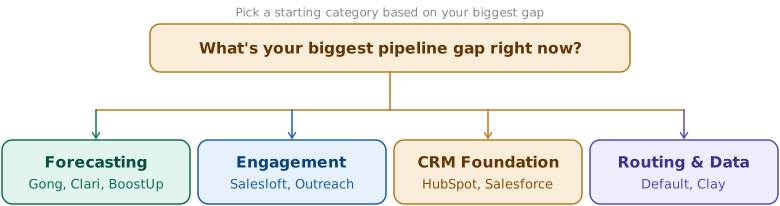
Once you’ve identified the starting category, narrow within it using these four questions:
1. What CRM are you on? Your CRM constrains everything. HubSpot users are best served by Operations Hub plus a lightweight engagement tool. Salesforce users have wider integration depth but pay for it in implementation cost.
2. What’s your team size? Under 25 reps: stay lean (HubSpot + maybe Salesloft starter). 25-100 reps: add a forecasting tool (BoostUp typically). 100+ reps: full stack (Salesforce + Clari + Outreach + Gong becomes defensible).
3. What’s your revenue motion? Inbound-heavy: prioritize routing (Default) and CRM hygiene. Outbound-heavy: prioritize engagement (Salesloft/Outreach) and enrichment (Clay). Mixed: both, in that priority order.
4. What’s your data maturity? If your CRM data is messy, no forecasting tool will save you. Fix data hygiene first (Weflow if on Salesforce, Operations Hub if on HubSpot). Buying Clari on top of dirty data produces dirty forecasts.
IMPORTANT
The most common RevOps software mistake we see: buying a $50K/year forecasting tool when reps aren’t logging activities consistently. The tool will produce a forecast. It just won’t be accurate. Fix the data input layer first.
90-Day RevOps Software Implementation Roadmap
Buying the tools is the easy part. Most RevOps software ROI is lost in implementation, when teams try to roll out four platforms in a month and end up with three half-configured systems and angry reps. The fix is sequencing: three phases over 90 days, with each phase building on the previous one.
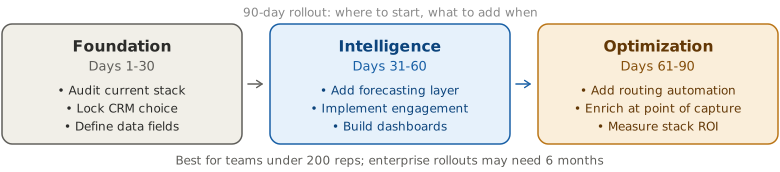
Phase 1 — Foundation (Days 1-30). Audit what you already have, lock in the CRM choice if it’s not yet final, and define the data dictionary. This means agreeing on what counts as a “qualified opportunity,” what fields are required at each pipeline stage, and who owns data quality. Skip this phase and the rest of your stack rests on sand. For a deeper handoff framework, see our guide on MQL vs SQL handoff.
Phase 2 — Intelligence (Days 31-60). Add the forecasting layer (Clari, BoostUp, or Gong, depending on team size). Implement engagement (Salesloft or Outreach) if outbound is part of your motion. Build the leadership dashboards that consolidate pipeline, forecast, and rep activity into one view. By end of Phase 2, your forecast accuracy should be measurably better than spreadsheet baseline. Decide how you will prove that before the tools go in, because measurably better needs a named category and a fixed snapshot date to mean anything against the baseline you started from.
Phase 3 — Optimization (Days 61-90). Layer on routing automation (Default), enrich data at point of capture (Clay), and start measuring the stack’s ROI against its cost. This is also when you sunset overlapping tools that the new stack replaces, capturing budget back. For RevOps teams using AI to accelerate this phase, see our piece on AI agents for RevOps.
If you’ve never run a RevOps software rollout before, expect Phase 2 to take longer than 30 days. That’s normal. The 90-day target works for teams under 200 reps with a dedicated RevOps owner. Enterprise rollouts (1,000+ reps) typically need six months minimum, and outsourcing the implementation to a RevOps-experienced operator often shaves weeks off the timeline.
Frequently Asked Questions
RevOps software is a category of platforms that align marketing, sales, and customer success operations around a single revenue model. It typically integrates CRM data, automates handoffs between teams, and surfaces pipeline intelligence so revenue leaders can forecast accurately and reduce leakage between functions. Most teams use a stack of two to four tools, not a single platform.
A CRM is the system of record for customer and deal data. RevOps software either extends the CRM (HubSpot Operations Hub) or sits on top of it (Clari, Gong, Default) to add forecasting, engagement automation, routing, and pipeline intelligence. Every RevOps stack starts with a CRM, but a CRM alone isn’t a RevOps stack.
HubSpot’s full suite (Marketing Hub + Sales Hub + Service Hub + Operations Hub) qualifies as a RevOps platform for SMB and mid-market companies. Operations Hub is the layer that adds RevOps-specific functionality: data sync, programmable automation, and data quality tools. Larger orgs typically pair HubSpot with specialist tools or move to Salesforce + best-of-breed.
Mid-market RevOps stacks typically run $1,500-$5,000 per user per year fully loaded, covering CRM, engagement, intelligence, routing, and enrichment combined. SMB teams can run a working stack on HubSpot Pro plus a starter engagement tool for $500-$1,000 per user per year. Enterprise stacks (Salesforce + Clari + Outreach + Gong) often exceed $6,000 per user per year.
For a 50-rep team, the typical winning stack is HubSpot Sales Hub Enterprise or Salesforce Sales Cloud, plus Salesloft for engagement, plus BoostUp.ai for forecasting, plus Default for routing. That covers all four RevOps categories at mid-market pricing without the enterprise tax of Clari or Outreach. Total cost typically lands at $2,500-$3,500 per user per year.