For most of B2B’s history, a sale had a buyer, one person you had to convince. That person is gone. Today a purchase of any real size runs through a group, and that group is the reason your deal speeds up, stalls, or quietly dies.
The awkward part is what to call it. Forrester and most revenue-operations vendors say buying group. Sales teams and LinkedIn say buying committee. Academics have said buying centre since 1972, procurement texts say decision-making unit, and LeanData sells an opportunity motion. Reading two studies side by side means first working out whether they are even describing the same people.
This page does that job. It maps every term to a sourced definition, says which ones genuinely mean something different, then covers who sits in the group, how large it gets at different kinds of deal, how it forms, and how it agrees. It is the definitional guide to the “what” and the “who,” not a playbook for closing. Where the selling motion belongs, we point to it.
Direct answer — What is a buying group, and is it the same as a buying committee?
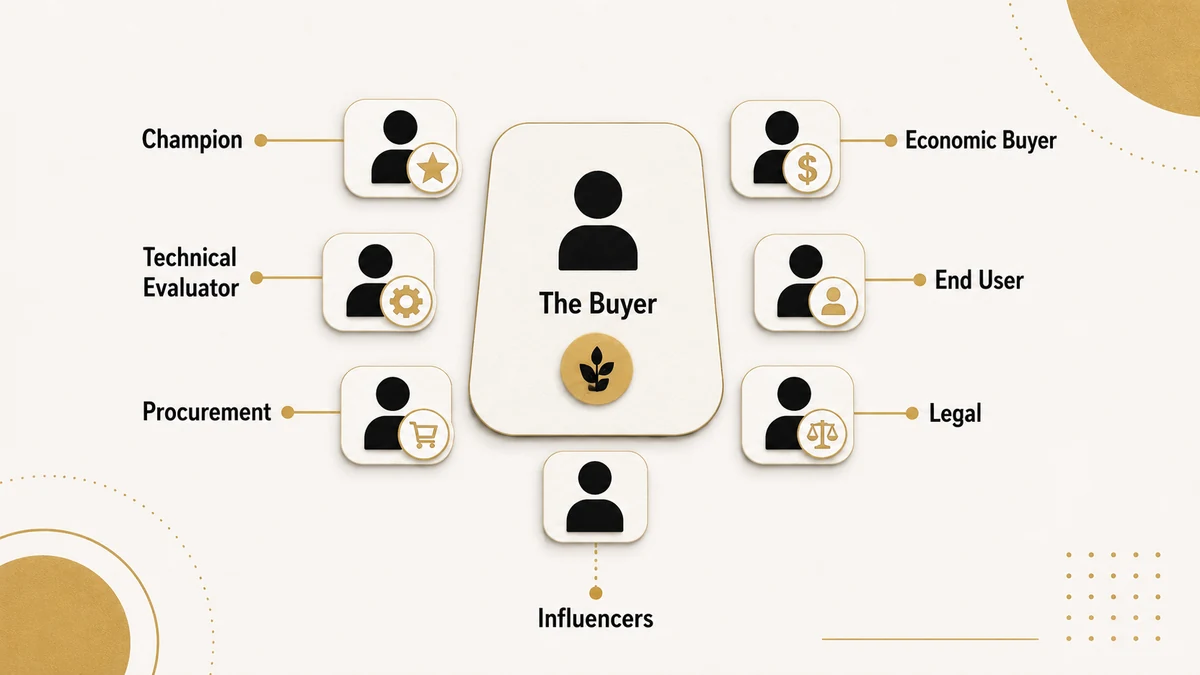
A buying group is the set of people inside an organisation who jointly research, evaluate, and approve a business purchase instead of one buyer deciding alone. Buying committee, buying centre, and decision-making unit name the same object in different vocabularies, so the terms are interchangeable in practice. It usually contains a champion, an economic buyer, a technical evaluator, end users, procurement, and legal. Published size figures differ because each study counted a different population.
Key Takeaways
- Buying group, buying committee, buying centre, and decision-making unit describe one object under four vocabularies. Only two terms in common use mean something genuinely different.
- The same decision functions recur across most purchases even when titles don’t: a champion, an economic buyer, a technical evaluator, end users, procurement, and legal. Which of them are actually required, and how many people share each one, varies by purchase.
- The group forms around a problem, not an org chart. Members join as the decision starts to touch their budget, their systems, or their risk.
- There is no defensible universal group size. Published figures range from 4.8 to 17 because each study measured a different population with a different membership rule.
- Consensus is the hard part, and the real competitor is “no decision.” A group’s default is inaction, not a rival vendor.
- Knowing the anatomy is step one; working the group is a separate skill, covered in our guide to selling to buying committees.
Buying group, buying committee, DMU: one object, several names
Buying group and buying committee are the same thing. Every vendor glossary that defines both says so directly, and the academic term that predates them both describes the same set of people. The vocabulary split is a marketing artefact, not a conceptual distinction, and it matters mainly because it makes two pieces of research look incompatible when they are not.
The table below gives each term with the definition its own source published, so you can check the claim rather than take it on trust. The last column is the part worth citing: it says whether the term names the same object, a narrower or broader one, or something else entirely.
| Term | Who uses it | Definition, as published | Source and year | Same object? |
|---|---|---|---|---|
| Buying group | Forrester | “the internal players driving the buying decision,” sitting inside a wider buying network | Forrester, Who’s In Your Buying Group?, 2025 | Same object, internal members only |
| Buying group | Madison Logic | “A collection of individuals within a company who are involved in the purchase decision-making process. Also called a buying committee” | Madison Logic B2B marketing glossary, undated page accessed 1 August 2026 | Same object |
| Buying group | LeanData | “Buying groups are buying committees… A buying group is connected to a specific deal moving through a sales cycle” | LeanData, 8 June 2026 | Same object, scoped to one live deal |
| Buying committee | Sales and marketing practice | Used by Madison Logic and LeanData as an explicit synonym for buying group; no competing definition published | As above, 2026 | Same object |
| Buying centre / buying center | Academic organisational-buying theory | “all those members of an organization who become involved in the buying process for a particular product or service” | Webster and Wind, Journal of Marketing 36(2), April 1972 | Same object, and the original |
| Decision-making unit (DMU) | Procurement and marketing texts, common in Europe | Treated throughout the literature as an alternative label for the buying centre rather than a separate construct | Same 1972 lineage; no distinct canonical definition located | Same object |
| Buying network | Forrester | The wider set of parties involved in a purchase, of which the buying group is the internal part | Forrester, 2025 | Broader. Includes external advisers |
| Opportunity motion | LeanData | “an Opportunity-centric motion, also known as a buying group motion,” where marketing qualifies the group and places it into a CRM Opportunity record | LeanData, 19 March 2024 | Different frame. Names a go-to-market process, not the people |
| Buying group (retail sense) | Retail and procurement | Independent businesses pooling purchasing volume to negotiate better supplier terms | Group purchasing literature, ongoing | Different object. Unrelated to B2B deal roles |
Two rows carry the actual finding. Forrester’s own vocabulary separates the buying group from the wider buying network, which is why its headline figure reads “13 internal stakeholders and nine external influencers” as two counts rather than one. They describe different populations and should never be added together into a group of 22. And LeanData’s opportunity motion is not a synonym at all: it names a way of running pipeline around the CRM Opportunity object, so a sentence about adopting an opportunity motion is about process, while a sentence about the size of a buying group is about people.
Which term should you use? Use buying committee with sales teams, where it is the established word. Use buying group in marketing and revenue operations, and when citing Forrester, 6sense, Demandbase, or LeanData, because it is the word their research uses. Use buying centre or DMU when you are drawing on academic work or writing for a procurement audience. Then pick one and keep it, because switching between them mid-deal mostly just confuses your own team. There is now a practical reason to prefer the vendors term in revenue operations: the same vendors now ship buying group as an actual record in your CRM, with its own roles, scores and owner, so the word has quietly become a field name as well as a concept.
The other buying group: purchasing co-operatives and group buying
Search “buying group” and a good share of the results are about something else. In retail, distribution, hospitality, and healthcare, a buying group is an organisation of independent businesses that pool their purchasing volume so they can negotiate supplier terms none of them would reach alone. Group purchasing organisations and purchasing co-operatives are close relatives, differing mainly in who owns the entity and how much say members have in choosing suppliers.
That is a different object from everything else on this page. One is a group of companies buying together across many purchases; the other is a group of colleagues inside one company deciding a single purchase. This page covers the second sense throughout. If you arrived looking for how to join a retail buying group or how one earns its money, this is not the page for that.
What a B2B buying group is
A B2B buying group is the group of people inside an organisation who jointly research, evaluate, and approve a major purchase. Instead of one manager signing off, several stakeholders in finance, IT, the end-user team, procurement, and legal each weigh the decision against their own priorities, and the purchase only proceeds when the group agrees it’s worth the risk.
That spread of authority is deliberate. The bigger the check and the deeper the change to how a company works, the more the organisation wants shared ownership of the call. A group decision also diffuses risk: if six people vetted the vendor, no single person carries the blame if it goes wrong. Forrester found that 94% of buyers in groups of six or more say the larger group delivers real benefits, from broader perspective to easier budget approval.
The table below is the fast version of who those people are, before we take each role one at a time. The last column matters if you are reading across sources, because the same function appears under different names depending on whose framework you are in.
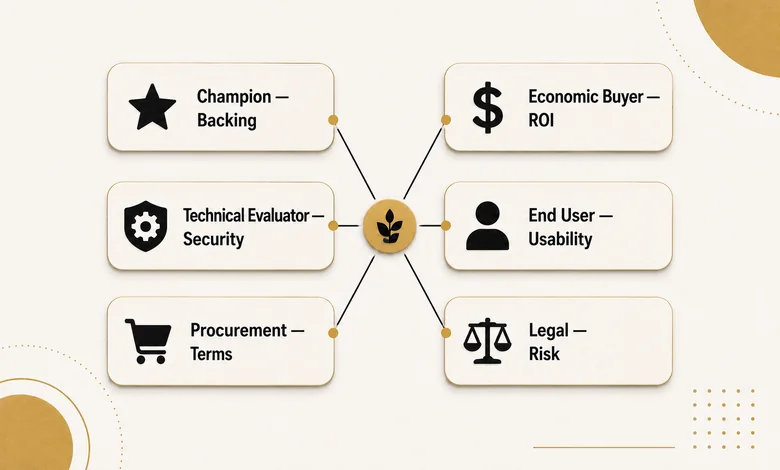
| Role | What they own | What they fear | How they judge a vendor | Also called |
|---|---|---|---|---|
| Champion | Driving the purchase internally and looking right for backing it | Championing something that fails and costs them credibility | “Can I sell this to my own committee when you’re not in the room?” | Mobiliser, initiator, advocate |
| Economic buyer | The budget and the business case | Overpaying, or missing the return entirely | “What’s the ROI, and how fast do we see it?” | Approver, financial ratifier, decider |
| Technical evaluator / blocker | Security, integration, and feasibility | A tool that breaks the stack or fails review | “Does it meet requirements and pass security?” | Technical gatekeeper, influencer |
| End user | Daily use and adoption | More work, another login, no real gain | “Will my team actually use this on day one?” | User, practitioner |
| Procurement | Terms, pricing, and vendor risk | A weak contract or a risky supplier | “Are the terms and pricing defensible?” | Buyer, commercial buyer |
| Legal / security review | Contracts, data, and compliance | Liability, a data breach, a regulatory gap | “Does this expose us to unacceptable risk?” | Gatekeeper, risk reviewer |
Who sits on a buying group: the roles
The people on a buying group fill six recurring roles, and the same role can be one person or a small team depending on the size of the deal. Titles vary by company; the roles rarely do. Webster and Wind’s original 1972 model named a similar set (user, influencer, decider, buyer, and gatekeeper), and most vendor frameworks in use today are variations on it.
The champion
The champion is the internal advocate who wants the purchase to happen and spends their own credibility to push it forward. They’re usually the person who felt the problem first and went looking for a fix. On most deals, the champion is not the most senior name in the room, and that’s fine, because their value isn’t authority.
The research behind The Challenger Customer draws a hard line here: an effective champion is a “Mobilizer” who can build consensus and drive change, not a “Talker” who is friendly and responsive but cannot move the group. Backing a Talker instead of a Mobilizer is one of the quietest ways to lose a committee deal.
Their value is access and advocacy. The champion does the selling you never can: they carry your case into the meetings you’ll never attend. That’s also why generic materials fail them. A champion needs a story and numbers they can repeat without you, which is one reason the exact words you hand each stakeholder matter as much as the product itself.
The economic buyer
The economic buyer controls the budget and signs off on the spend. This is a CFO, a VP of Finance, or a senior leader who owns the number the purchase comes out of. They think in payback and opportunity cost, not features, and they often enter the process late, after a favorite has emerged, to pressure-test the business case. That late arrival is the reason frameworks that record the economic buyer as a named role beat the ones that collapse the whole question into a single authority checkbox.
Reaching them is its own discipline. The criteria that qualify a genuine executive conversation are stricter than most reps assume, and a champion who can’t state the business case in a sentence rarely earns you that meeting. To the economic buyer, “we like it” is not a reason; a defensible return is.
The technical evaluator (and the blocker)
The technical evaluator judges whether the solution actually works: security, integration, data handling, and fit with the existing stack. On software deals this is IT, security, or a systems architect. On services deals it might be an operations lead who has to make the thing run. Forrester’s role vocabulary, and the AI summaries built on it, often call this person the technical gatekeeper.
They rarely have the authority to say yes, but they almost always have the power to say no. LinkedIn’s own framing of buying committees is blunt: not everyone can approve the purchase, yet every stakeholder can slow it down. That’s the blocker dynamic, and it’s why a failed security review kills more deals than a lost feature comparison ever does. It is also the clearest reason authority and observed influence are separate measurements rather than two words for seniority, and scoring them together hides exactly the person who can stop you.
The end user
The end user is whoever lives inside the product after the contract is signed. They care about one question: does this make my day better or worse? A tool the buying group loves on paper can still die if the team expected to use it senses more work and no payoff.
End-user resistance is quiet, and it’s lethal. A group rarely approves a purchase the people who have to adopt it clearly don’t want, because leaders know an unused tool is wasted budget they’ll answer for later. Increasingly, those users are also younger; the manager running hands-on research often shapes the shortlist before any executive weighs in.
Procurement
Procurement owns terms, pricing, and vendor risk. They usually enter late, once a favorite has emerged, to negotiate the deal down and stress-test the supplier: security posture, references, financial stability, contract language. Their job is to protect the company from a bad agreement, not to fall in love with your product.
Treating procurement as an obstacle is a mistake. A procurement lead who trusts your paperwork and sees clean, standard terms can accelerate a signature the champion has already won internally. A messy or aggressive contract, by contrast, hands a late-stage blocker every reason to stall.
Legal and security review
Legal and security are the final gate: contracts, data processing, compliance, and liability. On enterprise deals they can add weeks, and on regulated purchases they can veto outright. They aren’t evaluating your product at all; they’re evaluating your risk to the organisation.
The cleaner your standard terms, your data-processing agreement, and your security documentation, the less this stage costs everyone. This is the role sellers most often forget to plan for, and the one most likely to surface a surprise in the last mile of a deal that looked closed.
Two cautions on the roster. First, roles aren’t seats: one person can be champion and economic buyer on a small deal, while a large enterprise may split the technical role across IT, security, and data teams. Second, the org chart lies. An executive sponsor may hold the title while a manager doing the hands-on research quietly sets the shortlist, so map influence, not just seniority. Both cautions point at the same discipline, which is to record the evidence behind each classification, field by field, so a guess about who controls budget never gets stored as a fact.
PRO TIP
Before your next deal review, write each group member’s name next to the role they actually play, not their title. The empty roles are your blind spots, and the seat you can’t fill is usually the one that stalls the deal.
How big a buying group gets, and what changes the number
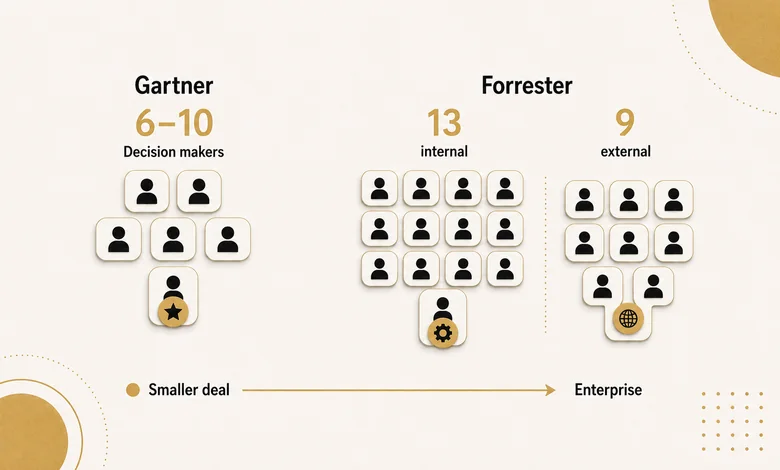
There is no defensible universal buying group size. Published figures run from 4.8 people to 17, and the spread is not researchers disagreeing with each other. Each study measured a different population under a different rule about who counted as a member, so the numbers answer different questions and cannot be averaged into one benchmark.
Gartner’s benchmark for a complex B2B solution is six to 10 decision makers. Forrester’s January 2026 research counts 13 internal stakeholders and nine external influencers per decision, drawing on roughly 18,000 global business buyers. Those nine externals belong to Forrester’s wider buying network rather than the group itself, so the two counts sit side by side and never sum to 22. The spread is a definitions problem before it is a research problem, since an influence network and an approval body are different units.
What travels better than a headcount is composition: which functions tend to be in the room at a given kind of decision. The table below is keyed on how broad the decision is rather than on a price band, because no two studies segment on comparable dollar thresholds, and inventing one would manufacture exactly the universal benchmark this page argues against.
| Decision context | Functions usually in the room | Usually absent, or arriving late | Nearest published figure, and what that study counted |
|---|---|---|---|
| Single-team tool, one budget owner | Champion, end users, one approver | Legal, procurement, security | TrustRadius 2025: 4.8 average, 79% five or fewer. Technology buyers, 72% of purchases under $50,000 |
| Cross-departmental platform | Champion, economic buyer, technical evaluator, end users from each affected team | External advisers | Gartner: five to sixteen people across up to four functions. A range, not an average |
| High-value or multi-vendor evaluation | All six roles, with security and procurement active early | Rarely anyone; the group is usually complete | 6sense 2025: about 10 internal members. Minimum $25,000 spend, median purchase $200,000 to $300,000 |
| Broad organisational or enterprise buying | All six roles, often several people per role, plus outside advisers | Nobody | Forrester 2026: 13 internal stakeholders, and separately nine external influencers. Roughly 18,000 buyers |
This table reports which functions tend to be in the room, not a benchmark for how many people to expect. Each figure in the last column is one study’s result for one population, and they are not comparable with one another. Where those counting rules came from, and why the published figures cannot be averaged, is set out in our buying group statistics source ledger.
Three forces push the number up: deal value, perceived risk, and how many departments the purchase touches. A $5,000 tool for one team might need three people; a platform that changes how finance, sales, and operations all work will pull in a dozen. Forrester also found that when a purchase includes generative-AI features, the buying group roughly doubles in size, at 14 people against seven, as more teams demand a say in the evaluation.
Those external influencers are easy to overlook and hard to reach: industry analysts a buyer trusts, consultants running the process, and peers at other companies who’ve used your product. You never meet most of them, yet they shape the requirements before you arrive. A group is bigger than the names on your call list.
Bigger isn’t automatically worse for you, even though it feels that way from the outside. The same larger groups that slow a decision down also make it stickier once it’s made, because more people own it. The practical consequence is about timing: the more stakeholders a deal carries, the earlier it should enter a deliberate, multi-touch process instead of a single-thread sprint, which is exactly how a well-staged enterprise sales funnel is built.
It also changes what “engagement” means. Once a decision involves eight or twelve people, working one relationship and hoping it spreads stops being viable; the account itself becomes the unit you engage. That shift is the idea behind a coordinated account-based experience, where the group, not the individual contact, is what you plan around.
How a buying group forms and reaches consensus
How the group assembles
A buying group forms around a problem, not an org chart: people join as the decision starts to touch their budget, their systems, or their risk.
It usually starts with one person, a project sponsor or the eventual champion, who feels a problem sharply enough to go looking for a fix. At that point the “group” is a party of one. As the search gets serious and money comes into view, the circle widens by necessity, and each new person brings a new set of questions the group now has to answer.
Gartner frames the underlying work as a set of “buying jobs” the group has to complete, in no fixed order: identifying the problem, exploring solutions, building requirements, selecting a supplier, validating the choice, and creating consensus. The group loops through these rather than marching in a straight line, looping back whenever a new stakeholder reopens a question everyone thought was settled.
Each job pulls in new people. Requirements-building brings in the technical evaluator; validation brings in security and legal; the budget conversation summons finance. By the time you’re discussing price, the group is usually complete, and anyone you still haven’t met is a risk you can’t see. Most of this happens before a seller is ever engaged, which is why the group often knows what it wants before you get a say in shaping it.
How the group agrees
A buying group reaches consensus when enough members agree the risk of changing is lower than the risk of standing still, not when one person is finally convinced.
This is the hardest part of the entire process, and the place most deals fail. Harvard Business Review’s analysis of 2.5 million sales conversations found that 40% to 60% of deals are lost to “no decision,” meaning buyers who wanted to act but couldn’t get their own group over the line. The same research found the stall is usually fear rather than preference: most groups that fail to decide actually want to move but cannot commit to the risk. The group’s real competitor usually isn’t another vendor at all. It’s the safety of the status quo.
A group’s default answer isn’t “no.” It’s “not now,” and “not now” is where most B2B deals quietly go to die.
Consensus doesn’t mean everyone is enthusiastic; it means no one with the power to block is still objecting. Getting there takes visible agreement across roles: the economic buyer satisfied on ROI, the technical evaluator cleared on security, procurement comfortable on terms, all surfaced in the same room rather than assumed. A single champion’s excitement can’t manufacture that, no matter how genuine it is.
IMPORTANT
Running a group deal through a single contact is the most common way to lose it. If only one person can describe your value, the outcome rests on whether that one person shows up, stays employed, and wins every internal argument alone. Consensus needs more than one voice carrying it.
Building that consensus is a skill in its own right: mapping every stakeholder, keeping a live thread with each, tailoring the message to what each role values, and arming your champion to make the case when you’re not there. That’s the selling motion, and it’s involved enough to deserve its own playbook. Our guide to selling to a B2B buying committee, role by role, covers how to actually work the group this page has mapped.
What has changed in how buying groups buy
How the group behaves has shifted, and each shift moves when a vendor can actually influence it. Whether the group itself has grown over time is a separate question, and the public evidence does not answer it: the available studies measured different populations in different years, so a rising series cannot be assembled from them.
First, buyers arrive late and already leaning. 6sense found that 94% of buying groups rank their shortlist before they contact a seller, and the pre-contact favorite goes on to win about four out of five deals. Most of the group’s evaluating happens before you ever get the meeting, which is why measuring influence across the whole group, not just the last click, is the job of account-based marketing attribution.
Second, AI joined the group. Buyers now run their own research through generative tools, yet Gartner found that 69% of B2B buyers now turn to sales reps to validate AI-generated insights. The machine speeds up the research and seeds doubts the group then asks a human to settle.
Third, the preference for buying without a rep kept climbing. Gartner’s March 2026 release put it at 67% of B2B buyers, from a survey of 646 buyers fielded in August and September 2025. Its release a year earlier, drawing on the equivalent fieldwork from 2024, put the same preference at 61%. That is a rise rather than a reversal, and it is not a rejection of salespeople: the same buyers still pull in a rep once the choice gets expensive, preferring self-service for general information and human help for judgment. Response speed inherits that problem, because reaching one form filler quickly is not the same as reaching the group, and no public response-time study records whether the reply ever found a decision maker.
Methodology, limitations and how to cite this page
The terminology table above was built by taking each term to the organisation that uses it and quoting the definition that organisation published, rather than paraphrasing a secondary summary. Nine definitions were collected from six sources, spanning a 1972 academic paper through vendor material published in 2026. Where a source states a date, it is given; where a glossary page carries no date, the table says so and records the date we accessed it.
Three limitations are worth stating. First, “buying circle” appears in some practitioner writing, but we could not locate a definition published by a named organisation with a date, so it is absent from the table rather than filled in with a plausible guess. Second, Gartner uses both “buying group” and “buyer team” without publishing an operational rule for who counts as a member, so its figures are quoted as ranges rather than treated as averages. Third, the composition table reports which functions tend to be present, and its last column carries one study’s figure for one population; those figures were never designed to be compared with each other, and this page does not combine them.
IVRIS did not conduct any of the studies cited here. Each figure belongs to the organisation that produced it, and each is presented with the population and period its own publisher stated. The contribution here is the reconciliation: mapping the vocabularies to each other, and separating the terms that name the same object from the two that do not.
Suggested citation. IVRIS. “What Is a Buying Group (or Buying Committee)?” Updated August 2026. Terminology reconciliation based on nine published definitions from six sources. https://ivristech.com/b2b-buying-committee/. Original data sources are listed within the article.
Revision history. v2.0 (1 August 2026): added the sourced terminology concordance and the composition-by-decision-context table; corrected the rep-free figure, which previously described a rising preference as having peaked and reversed; removed an unsupported claim that the group has grown over time; removed an unsourced committee-size figure; added the retail-sense disambiguation and this methodology section. v1.0 (22 July 2026): first publication.
Frequently Asked Questions
There is no real difference. Madison Logic’s glossary defines a buying group and then says “also called a buying committee,” and LeanData states plainly that buying groups are buying committees. Buying group is the more common word in marketing and revenue operations; buying committee is more common in sales. Both name the people inside one company who decide a purchase together.
Buying centre is the original academic term, defined by Webster and Wind in 1972 as all those members of an organisation who become involved in the buying process for a particular product or service. It describes the same object as buying group and buying committee. Decision-making unit, or DMU, is used in the literature as another label for the same concept.
Collectively, the committee researches the problem, defines requirements, evaluates vendors, validates the choice against risk, and approves the purchase. Individually, each member represents a function’s stake: finance owns the budget, IT owns security and integration, end users own adoption, procurement owns terms, and legal owns contract and compliance risk.
There is no single defensible answer. TrustRadius reported an average of 4.8 in a technology sample where most purchases were under $50,000; 6sense reports about 10 for high-value global purchases; Forrester counts 13 internal stakeholders on broad business buying, and Demandbase models 13 to 17. Each measured a different population under a different membership rule, so the figures should be quoted with their scope rather than averaged.
No one formally leads most buying groups, because authority is shared by design. In practice a champion drives day-to-day momentum, while an executive sponsor or economic buyer holds final approval. The most influential person is often not the most senior, but whoever is doing the hands-on evaluation and shaping the shortlist.
A buyer is one person with purchasing responsibility; a buying group, or buying committee, is the set of stakeholders who decide together. The distinction matters because you can’t win a group by convincing a single buyer. Every member evaluates the purchase through a different lens, and any one of them can slow it down or stop it.
The B2B buying journey is the path a buying group follows to a purchase. Gartner describes it as six “buying jobs” completed in no set order: problem identification, solution exploration, requirements building, supplier selection, validation, and consensus creation. Groups loop through these repeatedly rather than moving in a straight line.