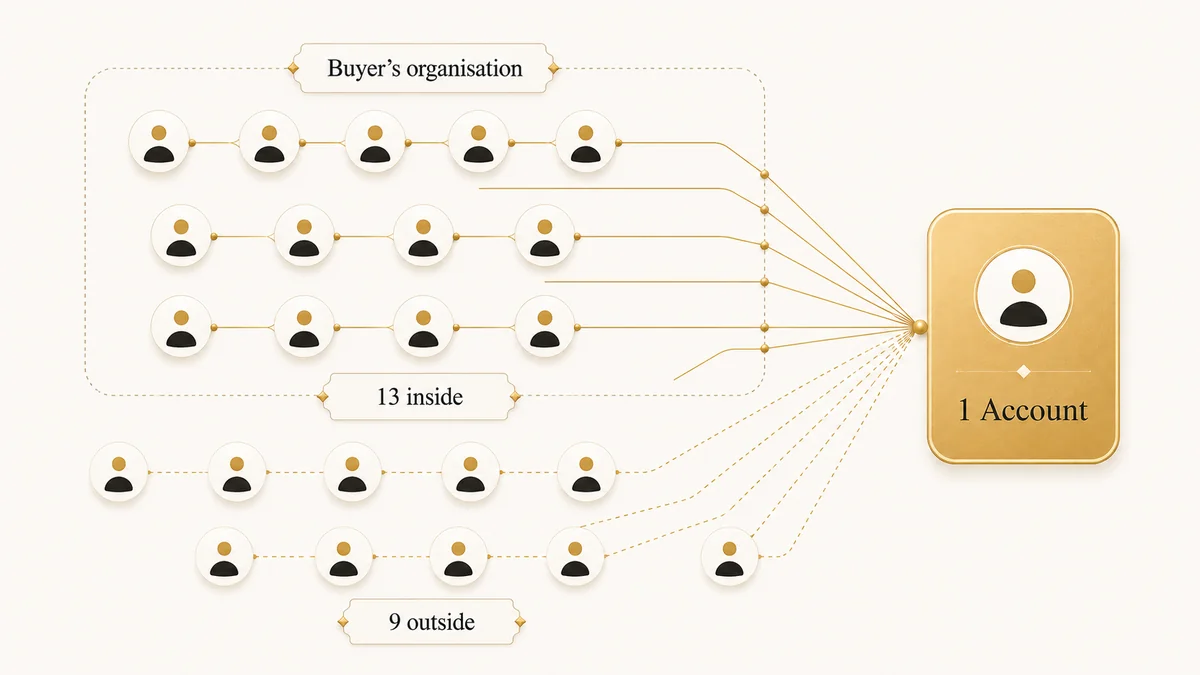
Most attribution models were built for a buyer who doesn’t exist in B2B: one person, one journey, one form fill. Forrester’s State of Business Buying, 2026 puts the typical buying decision at 13 people inside the buyer’s organization and nine more outside it. Twenty-two people, one purchase, and your CRM hands the credit to whichever one of them clicked last.
Account-based marketing attribution changes the unit. It credits the company instead of the contact. That sounds like a reporting tweak and it isn’t: before you can weight a single touchpoint, you have to decide which of those 22 people belong to the same account, and which of their touches belong to the same deal. That’s an identity problem, and it’s the part most ABM measurement skips.
Direct answer — What is account-based marketing attribution?
Account-based marketing attribution assigns revenue credit to an account rather than a lead, by resolving every contact in the buying group to one company record, merging their touchpoints into a single account timeline, and weighting that timeline with a model such as W-shaped, U-shaped, full-funnel, or algorithmic. It measures the account, not the person who filled the form. It differs from lead attribution, which credits one contact’s journey, and from ABM metrics, which count engagement without assigning credit.
Key Takeaways
- The account is the unit of credit. Lead attribution asks which touch converted a person; account attribution asks which touches, across the whole buying group, moved a company. Those are different questions with different plumbing.
- Account attribution is harder than lead attribution because of identity, not modelling. You have to resolve many people to one company and merge their touches into one timeline before any model has something to weight.
- Nine of the roughly 22 people in a buying decision sit outside the buyer’s organization. They don’t share the account’s email domain, so domain matching cannot see them by design.
- Account matching is the step that decides whether the rest works. A model trained on bad matching produces confident, wrong answers, and nothing in the report tells you it happened.
- Buying group coverage is the one ABM attribution metric that names what you’re missing rather than counting what you caught. Track it before you argue about models.
What account-based marketing attribution is (and what it credits)
Account-based marketing attribution is the practice of assigning credit for pipeline and revenue to an account, by combining the touchpoints of every contact in that account’s buying group into a single timeline and weighting it with an attribution model. The output is a statement about a company, not about a person.
That distinction does more work than it looks like. Lead attribution has a clean subject: a contact exists, they clicked things, they converted, and you argue about which click deserves the credit. Account attribution has no such subject. Nobody named “Acme Corp” filled in a form. The account is an abstraction you have to assemble out of people first, and the assembly is where the errors live.
It also sits in a specific place in your measurement stack. It is downstream of the broader B2B marketing attribution methodology, which sets how credit works across your whole funnel. It is a sibling of the full ABM metric set, which counts engagement, pipeline, revenue, and retention but never assigns credit to a channel. Attribution is the layer that turns those counts into a claim about cause.
| Question | Lead attribution | Account attribution |
|---|---|---|
| What gets the credit? | One contact’s journey | One company’s timeline |
| Who is the buyer? | The person who converted | 13 people inside, nine outside |
| The hard part | Which touch to weight | Which touches belong together |
| What it needs first | A tracked form fill | Contact-to-account resolution |
| Where it breaks | The buyer never fills the form | Matching silently drops part of the buying group |
| Reports in | Leads, MQLs, conversions | Accounts, buying groups, influenced pipeline |
Read the bottom row as the tell. If your ABM reporting still counts leads, you have lead attribution with an account filter on top. That’s a dashboard change, not an attribution change, and it will keep crediting the last person to convert. Making the account the unit of credit is the same move, one stage further along, that measuring the account across its whole lifecycle asks of every team, not just the reporting layer.
Why account attribution is harder than lead attribution
Account attribution is harder because the unit of credit doesn’t match the unit of tracking. Every tool you own tracks people: cookies, email addresses, form fills, contact records. The thing you need to credit is a company, and no company ever clicks anything.
So the work happens before the model. You resolve many people to one account, merge their touches into one timeline, then credit an entity that never converted. Three failure modes stack up in that order, and each one is invisible in the final report. Working out which people should have been in that group in the first place is a separate prerequisite, which is where a rubric that scores buying authority and seniority earns its keep well before any model runs.
The first is resolution. Contacts arrive with personal Gmail addresses, subsidiary domains, agency domains, and typos, and your CRM has to decide which company each one belongs to. The second is aggregation. Even with clean matching, you must decide which touches count as the same buying cycle. An account that evaluated you in March and again in November is one account and two deals. The third is the one Forrester makes concrete: 73% of purchases involve three or more departments, with nine of the influencers sitting outside the buyer’s organization entirely.
IMPORTANT
Those nine external influencers don’t share the account’s email domain. Consultants, agency partners, peers in a private community, and the analyst the CFO trusts are all outside the company you’re matching on. Domain matching cannot see them, and no amount of model tuning recovers a touch you never attached to the account.
This is a different argument from the familiar one about B2B attribution being hard because cycles are long and committees are large. That’s true of contact-level journey attribution too. The account-specific problem is narrower and more mechanical: you are crediting a record that is itself a guess. Get the guess wrong and every downstream number inherits the error while looking perfectly precise.
It’s also why third-party intent signals from in-market accounts are so often mis-measured. Intent arrives at the account level with no contact attached at all, which is exactly the shape your lead-based plumbing can’t store.
The four ABM attribution models, applied at the account level
Four attribution models show up in almost every ABM stack: W-shaped, U-shaped, full-funnel or linear, and custom algorithmic. The mechanics are the same as in any multi-touch model. What changes at the account level is what each model assumes about who the buyer is.
| Model | How it splits credit | Use it when | The account-level catch |
|---|---|---|---|
| W-shaped | 30% first touch, 30% lead creation, 30% opportunity creation, remaining 10% spread across the middle | You have reliable stage timestamps and a clearly defined opportunity | “Lead creation” assumes one lead. With eight engaged contacts you have to decide whose creation counts as the account’s |
| U-shaped (position-based) | 40% first touch, 40% lead conversion, 20% across everything between | First contact and conversion carry the weight and the middle is noise | The same problem one stage earlier: which contact’s conversion anchors the account? |
| Full-funnel / linear | Equal credit to every touch in the account timeline | The committee is large and you want coverage rather than a verdict | The most account-safe of the four, because it never has to nominate a hero contact |
| Custom / algorithmic | Weights learned from your own closed-won history | You have enough closed deals to train on and stable data | It learns from whatever matching you already have. Bad matching trains a confident, wrong model |
Notice what the catch column has in common. Three of the four models need to nominate a single decisive contact, which is precisely the thing an account doesn’t have. W-shaped is the ABM default in most vendor documentation, and it’s also the model that inherits the most identity risk, because two of its three anchor points are person-level events. That risk is structural rather than model-specific: person, account and opportunity are three separate identities that a single customer ID quietly collapses, and the collapse happens well upstream of any attribution choice you make.
Full-funnel is the quiet winner for teams that haven’t yet earned trust in their matching. It’s a blunter instrument and it will never tell you which touch was decisive, but it degrades honestly: an unmatched contact costs you a slice of credit rather than the whole anchor. Start there, and graduate to W-shaped once your coverage numbers hold up.
If you want the mechanics of each model on their own terms, including first-touch, last-touch, and time-decay, that’s the job of the seven attribution models and when to use each. This page assumes you’ve picked one and are asking what it does to an account.
Account matching: the step that decides whether any of it works
Account matching, sometimes called account auto-matching or identity resolution, is the process of linking every contact, email address, IP address, and CRM record to the right parent company. It is the foundation the entire account timeline sits on, and it is the least-discussed part of most ABM attribution guides. How reliably that link gets made comes down to the exact, domain, and fuzzy matching methods doing the work underneath, and where their confidence thresholds are set. When the match falls back to the company name, the string comparison underneath it decides your account boundaries, and one metric will happily score a parent and its own subsidiary as a perfect match.
The reason it gets skipped is that it looks like an IT chore rather than a marketing decision. It isn’t. Every matching rule you set is a claim about who counts as part of the account, and those claims propagate straight into the revenue report that your CFO reads.
An attribution model can only argue about touches you successfully attached to an account. Everything matching drops doesn’t show up as an error. It shows up as a channel that looks less effective than it is.
Four cases break naive domain matching, and they’re common enough to matter. Free email domains, where a genuine buyer signs up with a personal Gmail. Subsidiaries and holding companies, where acme-uk.com and acme.com are the same customer to sales and two accounts to your CRM. Agencies and consultants, who evaluate on the buyer’s behalf from their own domain. And shared corporate IPs, VPNs, and home networks, which make reverse-IP lookup confident and wrong in equal measure.
Workflow · 30 min
How to audit your contact-to-account matching
A five-step desk audit that tells you how much of your buying group your account attribution is actually seeing, using data already in your CRM.
Export every contact created in the last 90 days
Pull contact email, created date, source, and the account it resolved to. Filter to contacts whose account appears on your target list.
Count contacts per matched account
Sort descending. Any target account showing one contact is a red flag, not a win. Real buying groups do not have one member.
Pull the unmatched pile and read it
Sort unresolved contacts by domain. Free-mail addresses, subsidiary domains, and agency domains will cluster immediately. Name the top five patterns.
Re-check anything matched on IP alone
Isolate accounts whose only evidence is a reverse-IP hit with no contact record. Treat those as unconfirmed until a person corroborates them.
Score coverage and rank the gaps
Divide engaged buying-group roles by expected roles per account. Fix the pattern that costs the most accounts first, not the one that annoys you most.
Most ABM platforms automate the first pass of this, and the category has consolidated around doing it well. The pills below are the tools whose account-identification layer does this work; for a like-for-like breakdown of what each one actually models, the B2B attribution software comparison with current pricing does the vendor-by-vendor pass.
Make the campaign data survive the form
Account matching can only work on data that reached the lead record. If the UTM parameters and click IDs die at the form, the touch that created the contact has no campaign attached, and the account timeline gains a member with no origin story.
This is where most teams assume the worst about themselves, and the assumption is usually wrong. IVRIS submitted real test leads to 20 B2B demo forms and hand-inspected each submission payload. Seventeen of the 20, about 85%, carried the campaign data into the actual lead. An automated scanner reading the same forms detected only 29%, undercounting real capture by roughly three times. The full method and the per-form results are in the IVRIS study of what 20 B2B demo forms really capture.
The reason for the gap matters more than the headline. Most forms capture at the instant of submission, which is exactly where a read-only scan cannot look. Four of the 17 captured via JavaScript injected at submit or a cookie forwarded server-side. A scanner reading the page source sees no hidden field and reports a failure that isn’t real.
PRO TIP
Trust a form scanner when it says “captured” and distrust it when it says “not captured”. Precision was 100% and recall was 47% across the tested sample, so a clean bill of health is meaningful and a failure verdict needs a hand check before you rebuild anything.
The practical order is: confirm capture, then fix matching, then argue about models. Teams routinely do this backwards, rebuilding their attribution model to explain a number that was really a broken hidden field on one form. Checking it belongs at launch rather than at the quarterly review, which is how the operational playbook for running ABM campaigns treats tracking QA: a gate the campaign passes before it ships.
Buying group coverage: the metric that names what you’re missing
Buying group coverage is the percentage of the expected decision-making roles at an account that you have actually engaged. It’s the only common ABM attribution metric that reports on absence rather than presence, which is why it’s the one worth instrumenting first.
Buying Group Coverage = Engaged Buying-Group Roles ÷ Expected Buying-Group Roles × 100The denominator is the hard part and it’s a judgment call, not a lookup. You define the roles a deal in your category needs before it can close: economic buyer, technical evaluator, end-user champion, and whoever owns security or procurement review. That role map is the same artifact your qualification work already depends on, so most teams have already written it down somewhere and forgotten that measurement needs it too.
Coverage earns its place because it’s diagnostic. An account at 20% coverage with strong engagement is not a hot account, it’s one enthusiastic champion with no air support, and it will stall at procurement. An account at 80% coverage with mild engagement across every role is closer to closing than the scoreboard suggests. Reading those two the same way is how forecasts go wrong.
Coverage is also the metric that exposes bad matching fastest. If your average buying group is 1.4 contacts against a Forrester baseline of 13 people inside the organization, the problem isn’t that nobody’s interested. The problem is that your matching is dropping people on the floor. Before you set that target, check what that baseline actually measures: Forrester counts 13 internal stakeholders and nine external influencers separately, and only the internal figure is the one domain-based matching should be chasing.
Account engagement score and influenced pipeline value
Account engagement score and influenced pipeline value are the two metrics ABM attribution produces once the timeline is assembled. Engagement score composites the volume and depth of activity across every contact at an account. Influenced pipeline is the total pipeline value where marketing touched the buying group before the opportunity was created.
Both are outputs of attribution rather than inputs to it, and both are only as trustworthy as the matching underneath. An engagement score is a sum over the contacts you resolved to that account, so it silently understates every account whose buying group you only half-see. Influenced pipeline has the same dependency with higher stakes, because it’s the number that ends up in a board deck.
The formulas, the stage-by-stage benchmarks, and the dashboard that holds them are the job of the 12 ABM metrics organized by funnel stage. The attribution-specific point is narrower: treat both numbers as claims that inherit your matching error, and report them with a coverage figure next to them so the reader knows how much of the account you actually saw.
Influenced pipeline in particular deserves a guardrail. It’s generous by construction, since any qualifying touch counts, which makes it excellent for showing marketing’s reach and useless for deciding budget on its own. Pair it with a sourced number and read the two together, because the gap between them is usually the more interesting figure.
Align marketing and sales on one ICP and one target list
Account attribution breaks when marketing and sales disagree about which accounts are in the program. Two target lists produce two denominators, and every coverage, engagement, and influenced-pipeline number computed from them is unreconcilable by construction.
The fix is procedural rather than technical. Both teams agree on one ideal customer profile and one target account list before campaigns launch, and the list gets a version and an owner. Attribution then reports against that list rather than against whatever each team believes the list to be.
This is also the point where attribution stops being a reporting exercise and starts changing what you do. Coverage gaps tell you which roles to go after next. Model output tells you which channels reach which roles. That feedback loop is what separates a measured ABM program from the ABM campaign examples that built real pipeline, where the tactics are visible but the measurement is left as an exercise.
Frequently Asked Questions
Account attribution assigns revenue credit to a company rather than to an individual lead. It merges the touchpoints of every contact in the buying group into one account timeline, then applies an attribution model to that timeline. The unit of credit is the account, which is why contact-to-account matching has to happen before any model runs.
A deal closes at $60,000. First touch was a paid search ad, lead creation was a webinar, and opportunity creation followed a sales email. A W-shaped model credits each of those three stages 30%, or $18,000, and spreads the last 10% across every other touch. Lead attribution credits one person; account attribution credits the account.
ABM picks a finite list of target accounts, agrees that list between marketing and sales, then runs coordinated campaigns at the buying group inside each one rather than at individual leads. Measurement follows the same unit: you report on accounts engaged and pipeline influenced, not on lead volume.
W-shaped is the common ABM default because it credits first touch, lead creation, and opportunity creation. Full-funnel is safer when your contact-to-account matching is unproven, because it never has to nominate a single decisive contact and an unmatched person costs a slice of credit rather than a whole anchor point.
Lead attribution credits one contact’s journey and needs a tracked form fill. ABM attribution credits a company’s timeline and needs contact-to-account resolution first. The hard part moves: lead attribution argues about which touch to weight, while account attribution has to work out which touches belong together before weighting anything.