
Search “ideal customer profile” and you will meet the same number on almost every page: companies with a strong ICP win 68% more often. It is a good number. It is also a number almost nobody citing it can take you back to. Follow it far enough and it lands on an account-based benchmark report from TOPO, a research firm Gartner announced it was acquiring in October 2019. The report is not sitting on a public URL waiting for you to read the methodology.
That is not a scandal. It is a symptom. The ideal customer profile has become a topic where everyone repeats the same borrowed evidence and the same four-step outline, and almost nobody shows you the artefact at the end. You finish the article knowing an ICP matters and still holding a blank page.
So this piece skips the case for having one. The question here is narrower and more useful: what does a finished ICP actually look like, in a form your CRM can filter on tonight? The answer is roughly a dozen fields, each with an operator, a threshold, a source, and a disqualifier. Getting there takes your own closed-won data, not somebody else’s benchmark.
Direct answer — What is an ideal customer profile?
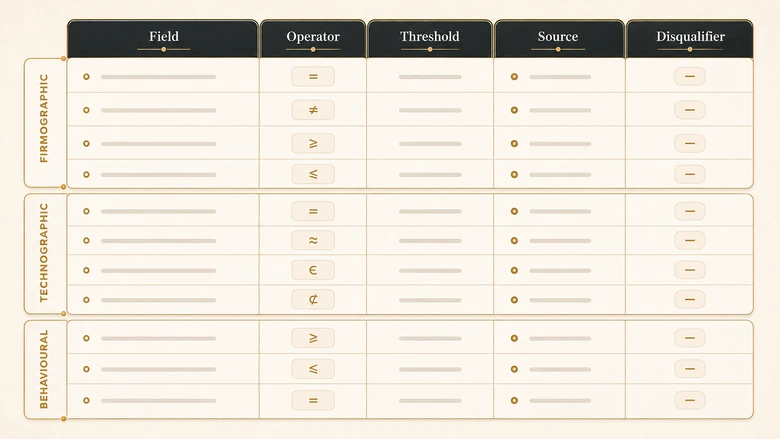
An ideal customer profile is a description of the companies most likely to buy, succeed, and stay, expressed as filterable attributes rather than prose. A working ICP has three tiers: firmographic (industry, employee band, revenue band, geography), technographic (the tools an account already runs), and behavioural (what the account does that signals a live need). Each attribute carries a threshold and a disqualifier. An ICP describes an account. A buyer persona describes a person inside it.
Key Takeaways
- An ICP is an account-level filter, not a narrative. If you cannot paste it into a CRM list builder, you have written a description, not a profile.
- Three tiers carry the whole thing: firmographic, technographic, behavioural. Psychographics belong in your persona work, because no CRM has a field for “values innovation.”
- Every attribute needs a threshold and a source system. “Mid-market” is not a threshold. “Employee count between 200 and 2,000, from enrichment” is.
- The disqualifier register does more work than the inclusion list. Most teams can name the accounts they should never have sold to, and almost none write it down.
- Build it from your own closed-won cohort. Borrowed win-rate benchmarks cannot tell you which industry code converts for you.
- Behavioural attributes decay in weeks and firmographics in months, so the review cadence is a data-quality decision rather than a calendar habit.
What Is an Ideal Customer Profile?
An ideal customer profile is a definition of the company you should sell to, built from the attributes your best existing customers share. It operates at the account level, describing organisations rather than individuals, and its job is to decide which companies enter your pipeline at all.
The word “ideal” misleads people. An ICP is not an aspiration or a dream logo. It is an empirical claim about which accounts have historically bought, onboarded, renewed, and expanded. That makes it falsifiable, which is the property that separates a profile from a positioning statement.
Two failure modes follow from misreading that. The first is writing the ICP you wish you had, usually a larger and more prestigious version of your actual customer base. The second is writing something so broad it excludes nobody. Both produce a document that never changes a single targeting decision.
Ideal Customer Profile vs Buyer Persona vs Total Addressable Market
These three answer different questions and get confused constantly. Your total addressable market is how big the opportunity could be. Your ICP is which slice of it you should pursue. Your buyer persona is who you talk to once you are in.
| Concept | What it describes | Unit | Use it when | Do not use it for |
|---|---|---|---|---|
| Total addressable market | Every company that could plausibly buy your category | Market | Sizing an opportunity, board and investor planning | Building a target list, prioritising outbound |
| Ideal customer profile | The companies most likely to buy, succeed, and stay | Account | Building target lists, routing, qualification, ad audiences | Writing messaging or choosing a channel |
| Buyer persona | The people inside a fitting account who evaluate and sign | Person | Messaging, content, sales enablement, objection handling | Deciding which companies to pursue |
The practical rule: ICP decides whether to pursue an account, persona decides what to say once you do. Reach for the ICP when you are filtering a list. Reach for the persona when you are writing to a human. Reach for TAM when someone asks how big this gets, and for nothing else.
Persona work matters more than it used to, because the person is rarely alone. Forrester’s analysis of lead-centric funnels notes that over 80% of buying decisions involve a group of more than three people, and that the typical inquiry-to-closed-won rate of a lead-centric process sits under 1%. That is the arithmetic case for defining fit at the account level first and treating individuals as the second layer, which is also where lead-level scoring earns its keep rather than competing with account fit.
Why Most ICP Templates Produce Something You Cannot Filter
Download three ICP templates and you will find the same structural problem: they collect attributes no system can query. HubSpot’s widely-ranked ICP template asks for job title, age, education, social networks, communication preferences, reporting structure, and information sources. Those are excellent fields. They are also persona fields, describing a person, in a document labelled as an account profile.
The other common leak is psychographics. Google’s AI Overview for this topic lists firmographics, technographics, and psychographics as the three characteristic groups, and the third one quietly breaks the artefact. “Values sustainability” and “frustrated by manual processes” are real observations, but there is no column for them in your CRM and no filter for them in your ad platform. They belong in messaging, not in the definition that decides who gets contacted.
IMPORTANT
A useful test before you accept any ICP attribute: can a person on your team populate this field for 500 accounts without reading 500 websites? If not, it is persona or messaging research. Keep it, put it somewhere else.
Swap psychographics for behavioural attributes and the problem resolves. Behaviour is observable, timestamped, and storable. “Posted two SDR roles in the last 60 days” is behavioural. “Ambitious about growth” is a guess about the same thing with none of the properties that make it usable.
The Three Tiers of a Filterable ICP
A working ideal customer profile has three tiers, and each one answers a different question: who they are, what they run, and what they are doing right now. Together they usually come to ten or twelve fields. Anything much beyond that stops being a filter and starts being a wish list.
Tier 1: Firmographic attributes
Firmographics describe what the company is: industry, employee count, revenue band, geography, ownership structure, and growth stage. They are the most stable tier and the easiest to source, which is why every template starts here and most stop here.
The discipline is precision. “SaaS companies” is not a firmographic attribute; NAICS 513210 or SIC 7372 is. “Mid-market” is not a threshold; 200 to 2,000 employees is. If your marketing platform and your CRM disagree about what mid-market means, and they usually do, the ICP is the document that settles it.
Tier 2: Technographic attributes
Technographics describe what the company runs. They matter because a tech stack is a strong proxy for whether your product can be installed, whether a budget line already exists, and whether the buyer has already accepted the category.
This tier splits into three useful questions. What must they already have for you to function at all, such as a specific CRM or cloud platform? What indicates they have bought into the category, such as an existing tool you replace or complement? What signals a displacement opportunity, such as a competitor’s tag on the site? HG Insights argues the same point from the vendor side, describing an ideal customer technology profile as a separate layer above firmographics.
Tier 3: Behavioural attributes
Behavioural attributes describe what the account is doing that suggests a live need. Hiring for roles that imply your problem, opening a new office, publishing a compliance deadline, appointing an executive who owns your category, or researching your category in a way third-party providers can observe.
This is the tier that turns a static profile into a queue. Firmographics and technographics tell you an account belongs in the market. Behaviour tells you this quarter rather than next year. It is also the tier most dependent on external sourcing, which is where third-party intent signals and their accuracy limits become a practical constraint rather than a feature discussion.
One caution. Behavioural attributes are the most tempting to over-collect, because vendors sell them by the dozen. Two or three that you actually act on beat fifteen that produce a dashboard nobody opens.
How to Build an Ideal Customer Profile from Closed-Won Data
To build an ideal customer profile, start from the accounts that already worked and derive attributes backwards, rather than starting from a template and filling in what feels right. The sequence below assumes you have at least 20 closed-won accounts with a year of retention history.
Workflow · 4 hours
How to build an ideal customer profile from closed-won data
Derive a filterable, threshold-bearing account definition from your own retained-customer cohort instead of a borrowed template.
Pull the retained closed-won cohort
Export every account that closed won and is still a customer twelve months later. Exclude churned logos and deals closed on discount exceptions. This cohort, not your full customer list, is the evidence base.
Enrich the cohort on every candidate field
Append industry code, employee count, revenue band, geography, and detected tech stack to each account. Enrich the closed-lost cohort on the same fields, because contrast is what makes an attribute predictive.
Compare won against lost, field by field
For each field, check whether the won distribution differs from the lost distribution. A field where both look the same is not an ICP attribute, however intuitive it feels. Keep only fields that separate.
Interview eight to ten retained customers
Ask what triggered the search, what nearly stopped the purchase, and what had to be true internally for it to work. Interviews explain the pattern the data found, and surface behavioural triggers no export contains.
Write each surviving attribute as a field, operator, and threshold
Convert every finding into the form your systems accept: field name, operator, value, source system. Anything you cannot express this way goes to the persona document instead.
Test the filter against a holdout list
Run the finished filter over accounts it has never seen. If it returns your best current customers and excludes your worst, ship it. If it returns everyone, your thresholds are too loose.
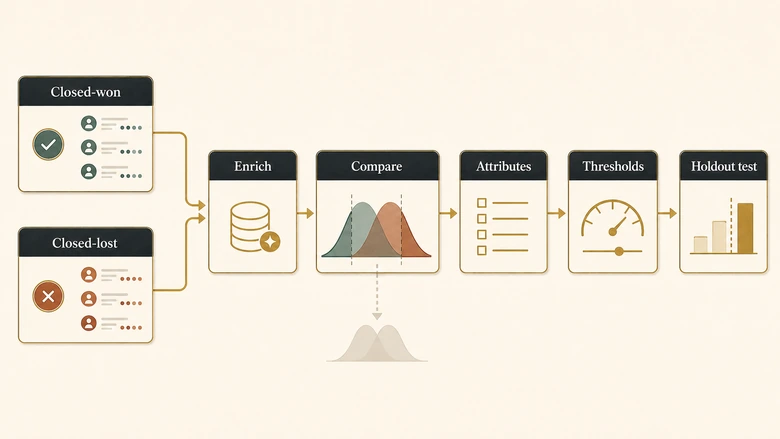
Step three is where most attempts quietly fail. Teams pull the won cohort, notice that 60% are in financial services, and write “financial services” into the ICP. If 60% of the lost cohort is also financial services, the attribute has told you about your pipeline’s composition, not about fit. The comparison is the entire method.
How to Set the Threshold That Goes in Each Field
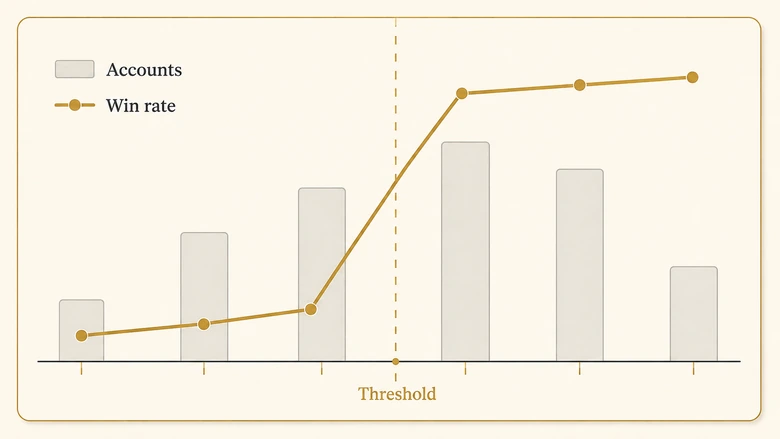
A threshold is the specific value that turns an attribute into a filter, and picking one is a judgment call the data informs rather than decides. The honest version of this section is that thresholds are always a trade between reach and precision, and the right answer depends on how much pipeline you can afford to process.
Three practical rules. Set the band where win rate visibly changes, not where the cohort is densest. Prefer bands over exact values, since enrichment data is approximate and a company with 198 employees is not meaningfully different from one with 205. And write the threshold even when you are unsure, because a stated number can be tested and a vague one cannot.
PRO TIP
Record the date and the cohort size next to every threshold. Six months on, nobody remembers whether “200 to 2,000 employees” came from 400 closed-won accounts or from a hunch in a workshop, and that difference decides how readily you should change it.
Thresholds are where this page stops and its sibling starts. Deciding which attributes belong and what values they take is the work here. Deciding how much each one is worth relative to the others, and how those weights become a single account score with tiers and routing rules, is a separate exercise laid out in the weighted rubric that converts these fields into a 0-100 account score.
The Disqualifier Register: What Your ICP Should Exclude
A disqualifier register is the written list of attributes that rule an account out regardless of how well it scores elsewhere, and it is the highest-yield part of an ICP that almost nobody produces. Ask any experienced rep to describe the customer you should never have sold to and you will get a fluent, specific answer in under a minute. That answer is not in your CRM.
Disqualifiers earn their place because they behave differently from inclusion criteria. A weak inclusion match costs you a slightly lower conversion rate. A missed disqualifier costs you an implementation that fails, a support queue that never clears, and a churned logo eighteen months later that still shows as closed-won in the export you built the ICP from.
Common ones worth checking against your own history: a regulatory regime your product cannot satisfy, an incumbent contract with multi-year lock-in, a team below the headcount needed to operate what you sell, a business model your pricing punishes, and any account where the buying decision sits with a function you have no route into.
Write each disqualifier the same way as an inclusion attribute: field, operator, value, source. A disqualifier you cannot filter on is a warning story, and warning stories do not survive the next reorg.
When to Revisit Your ICP, and What Decays First
Revisit your ICP on a cadence set by how fast each tier goes stale, not by the calendar quarter every template recommends. The tiers decay at genuinely different speeds, and treating them as one document with one review date wastes effort on the stable parts and leaves the volatile parts rotting.
Behavioural attributes go first, in weeks. A hiring signal is worthless a quarter later. Technographics shift over months as accounts migrate. Firmographics are the most durable, though not fixed: ZoomInfo’s field-level breakdown puts job-title decay at 2% to 3% a month and company-level fields well below that, which is the practical argument for refreshing your behavioural queue continuously and your firmographic bands annually.
Three events should trigger an unscheduled review regardless of cadence: a pricing change, a product capability that opens or closes a segment, and a run of churn concentrated in one attribute band. That last one is the most informative and the most ignored, because churn analysis usually lives with customer success and the ICP usually lives with marketing.
Keeping the definition current is also what makes account-level automation trustworthy, since models that score accounts against a stale profile confidently rank the wrong companies. And the profile does not stop mattering at signature: the same attributes that predicted the win predict the renewal, which is the argument for extending the definition through the post-sale stages where fit either proves out or does not.
Where ICP Definitions Go Wrong
The most common failure is not a bad ICP, it is a correct one nobody uses. If the profile exists only as a document, every targeting decision still runs on individual judgment. Encoded as a saved CRM view, an ad platform audience, and a routing rule, it starts making those decisions on its own.
The second failure is borrowing thresholds. Industry benchmark numbers are useful for arguing a budget and useless for setting a filter, for the same reason the 68% figure at the top of this page cannot help you: it describes a population that is not yours. The pattern repeats across every metric in this space, which is why published account-based benchmarks disagree with each other so sharply once you check what each one actually counted.
The third is treating one ICP as sufficient when the business genuinely runs two motions. A company selling to both a regulated vertical and a self-serve segment needs two profiles with different thresholds, not one profile broad enough to contain both. Vertical specificity is where the attribute set changes shape, as the certification and equipment attributes that dominate an industrial ICP demonstrate.
My own stance, after watching this document get written many times: the ICP is not a strategy artefact that happens to be useful operationally. It is an operational artefact that happens to have strategic consequences. Write it in the form your systems consume, and the strategy follows. Write it as prose, and you will rewrite it next year having changed nothing.
Frequently Asked Questions
An ideal customer profile describes a company: industry, size, revenue band, tech stack, and behaviour. A buyer persona describes a person inside that company: their role, goals, objections, and how they prefer to be reached. The ICP decides which accounts you pursue. The persona decides what you say once you are in the door.
Around 20 retained closed-won accounts is enough to spot real attribute patterns, and you need a closed-lost set to compare against. Below that, build a provisional profile from customer interviews and competitor positioning, mark it explicitly as a hypothesis, and revisit it after every ten new deals rather than annually.
One row per attribute, grouped into firmographic, technographic, and behavioural tiers. Each row carries five columns: field name, operator, threshold value, source system, and disqualifier. Ten to twelve rows is typical. If a row cannot be filled in for 500 accounts without manual research, it belongs in your persona document instead.
Update each tier on its own decay rate rather than one shared quarterly cycle. Behavioural signals refresh continuously because they expire in weeks. Technographics warrant a review every six months. Firmographic bands hold for a year. Pricing changes, product capability shifts, and churn clustered in one attribute band should all trigger an off-cycle review.
Yes, when you genuinely run separate motions with different economics, such as a regulated enterprise segment alongside a self-serve one. Each gets its own thresholds and its own disqualifier register. What does not work is one profile stretched wide enough to contain both, because a filter that excludes nobody prioritises nothing.