Every launch meeting has the moment. Someone reads out an open item, the room goes quiet for two seconds, and a director says “we’re comfortable with that risk.” The item closes. Everyone moves on.
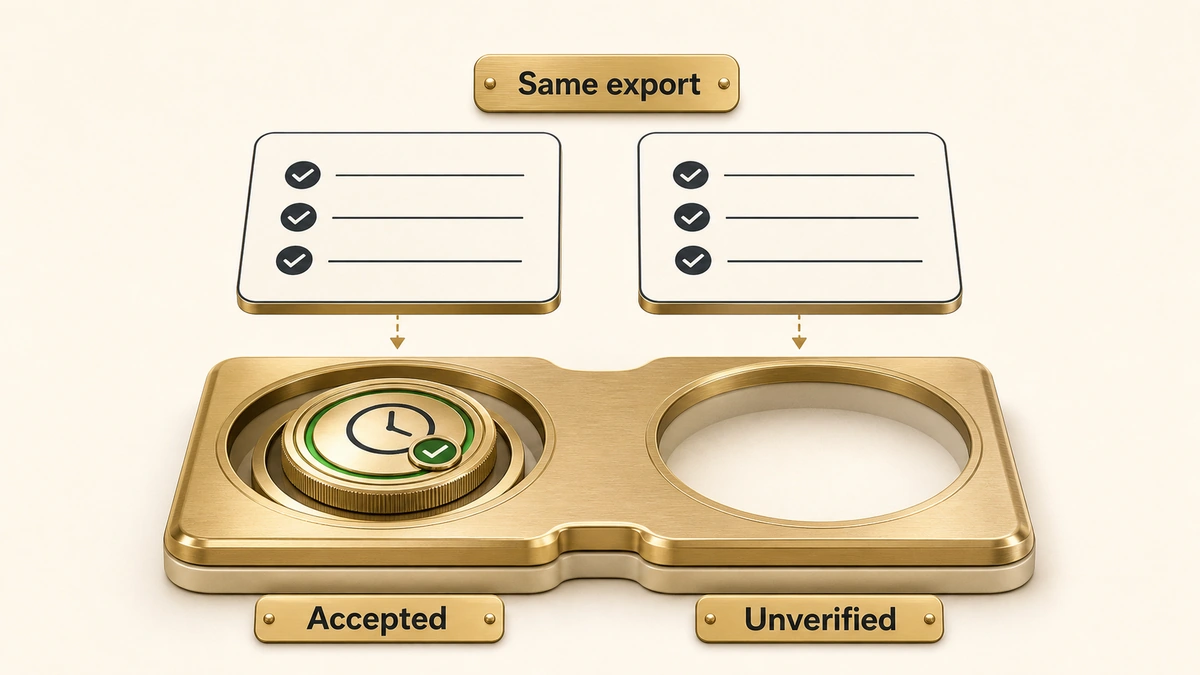
Half the time that sentence describes a real decision. The other half it describes nobody having checked. Both produce the same tidy checklist and the same launch, and they produce completely different post-mortems. Most campaign launch risk assessment templates have no way to tell them apart, because they treat risk as one substance to be scored rather than two states to be separated.
That separation is the whole job. A risk you have measured and chosen to carry is a decision with a name on it. A risk nobody looked at is not a decision at all, and calling it one is how teams end up in a review three weeks later where no individual can say who approved what.
Direct answer — What is a campaign launch risk assessment?
A campaign launch risk assessment is the pre-launch review that decides whether a marketing campaign has enough evidence behind it to ship. It sorts every open finding by two questions: has the failure mode been named, and has current behaviour been observed. Findings with named failure modes and observed evidence can be accepted by a named owner. Findings without observed evidence are unverified, not accepted, and they are the ones post-mortems trip over.
Key Takeaways
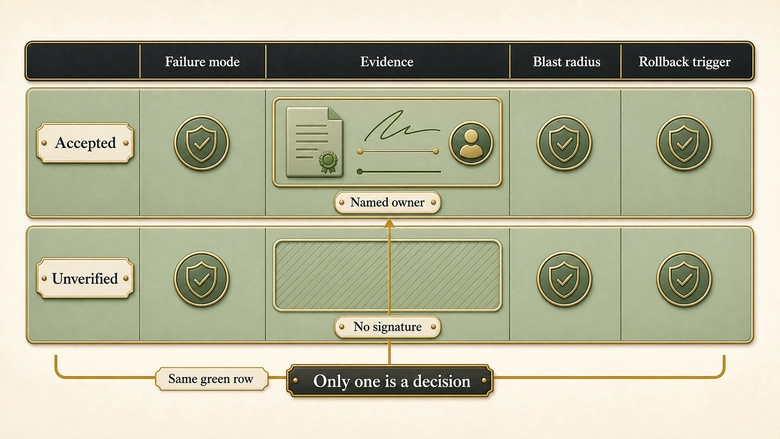
- Accepted risk and unverified risk look identical on a launch checklist. Both read “ship anyway.” Only one of them is a decision.
- A risk is only accepted when a named person can state the failure mode, the evidence it was observed, the blast radius, and the rollback trigger. Missing any one of the four, it is unverified.
- Two questions sort every open finding into four states: is the failure mode named, and has current behaviour been observed.
- Evidence expires. Verification is valid for a specific build of the system, and every deploy, form edit or CRM field change resets it.
- Automated checks report on what they can see, not on what happened. IVRIS testing found a form scanner detected 8 of 17 payload-confirmed campaign-data captures and missed 9.
- Shipping unverified risk is sometimes correct. Shipping it while calling it accepted never is.
What a campaign launch risk assessment actually decides
A campaign launch risk assessment decides one thing: whether the evidence behind a campaign is strong enough to justify launching it. It is not a scoring exercise, and the number it produces is far less useful than the record it leaves behind.
Why scoring first is the wrong move
Most templates get this backwards. They ask you to rate each risk on likelihood and impact, multiply the two, and sort the list. That is a reasonable second step. It is a terrible first step, because likelihood and impact are estimates about a failure mode you have already identified. Score a risk you have not examined and you are not measuring exposure, you are recording a guess with a decimal point on it.
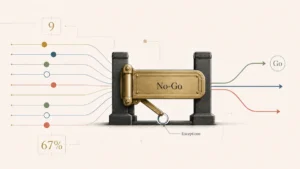
The useful output is a short written record: for each open finding, what could break, what you observed, who owns it, and what would make you pull the campaign back. That record is what the go/no-go gate consumes when it decides whether to release the launch, and it is the only artefact that survives contact with a post-mortem.
The four states, in one table
Before the detail, here is the classification the rest of this article builds on.
| State | What it means | Is it a decision? |
|---|---|---|
| Accepted risk | The failure mode is named and current behaviour was observed. Someone chose to carry it. | Yes |
| Unverified risk | The failure mode is named but nobody checked whether it happens. | No |
| Assumed-safe risk | Evidence exists but it is stale, borrowed from another campaign, or supplied by a vendor. | No |
| Unknown risk | The failure mode has not been named at all. | Not yet |
Only the first row belongs in a risk register with a signature next to it. The other three describe work that has not been done, which is a different problem with a different fix. Getting this ordering right matters more as campaigns get more moving parts, and it is the reason launch governance deserves a place in your campaign planning process rather than a checkbox at the end of it.
Accepted risk vs unverified risk
Accepted risk is exposure you have measured and chosen to carry. Unverified risk is exposure you have not measured and are carrying anyway. The distinction is not academic, and it is not a matter of degree.
Formal risk management has always assumed the first case. ISO 31000:2018 defines residual risk as what remains after treatment, then requires that remainder to be assessed against acceptance criteria before anyone signs it off. The four treatment options every risk course teaches, avoid, reduce, transfer and accept, all presuppose that identification and analysis already happened. NIST SP 800-30 makes the same assumption explicit: a risk assessment must produce threats, vulnerabilities, impact and likelihood, and document them so the decision is repeatable.
An unverified risk has entered none of that. It has no likelihood estimate because nobody observed the behaviour. It has no impact estimate because nobody traced what depends on it. There is nothing to accept, because acceptance is the last step of a process that never started.
The four-field accept test
A risk is only accepted when a named person can state the failure mode, the evidence it was observed, the blast radius, and the rollback trigger. Missing any one of the four, it is unverified.
Call that the four-field accept test, and run it out loud in the launch meeting. It takes about fifteen seconds per item and it is uncomfortable in exactly the right way, because the failure mode is usually easy, the blast radius is usually guessable, and the evidence field is where the room goes quiet.
The reason this hides so well is that both states produce the same artefact. A checklist row marked green because the tracking was tested and a checklist row marked green because the tracking was installed look identical in the export. This is why a UTM gate has to define what a pass actually requires rather than leaving each reviewer to decide privately what “checked” meant.
The four states of launch risk
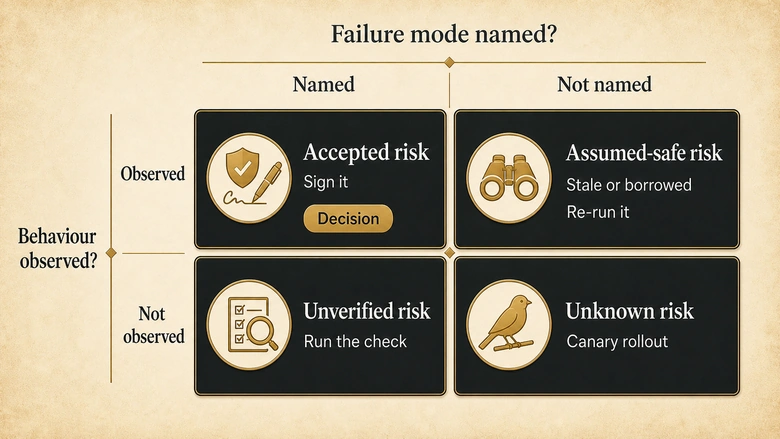
Two questions sort every open finding into one of four states: has the failure mode been named, and has current behaviour been observed. Ask them in that order, because the second question is meaningless until the first one has an answer.
| State | Failure mode named? | Behaviour observed? | Evidence you hold | Who signs | What unblocks it |
|---|---|---|---|---|---|
| Accepted risk | Yes | Yes | A test result, a payload, a log line, a screenshot with a timestamp | The campaign owner, with a technical concurrence | Nothing. It is already a decision. Record it and launch. |
| Unverified risk | Yes | No | None. A configuration, a ticket, or somebody’s recollection | Nobody should be signing this yet | Run the check. It is usually minutes of work. |
| Assumed-safe risk | No | Stale or borrowed | Evidence from a previous build, another campaign, or a vendor claim | Nobody, until the evidence is refreshed | Re-run the check against the current build. |
| Unknown risk | No | No | None, and no question has been asked | Not applicable | Staged rollout, canary segment, tight monitoring. |
Why unknown risk is not a governance failure
The fourth row deserves defending, because unknown risk is the only one of the three non-decisions that is not a governance failure. You cannot enumerate every failure mode of a campaign in advance, and pretending otherwise produces theatre. Google’s site reliability engineers are blunt about this: their published guidance notes that “it is very hard to predict from first principles how a service will react to overload,” which is why they lean on canary servers that detect dangerous effects under real user traffic rather than trying to reason their way to certainty.
That is the honest treatment for unknown risk: shrink the blast radius and watch closely. It is not the treatment for unverified risk, where the question has already been asked and simply has not been answered. Confusing the two is how a five-minute check gets deferred into a staged rollout that then reveals the problem to real prospects.
How much testing counts as observation
Sample size is where this gets slippery. A check that ran is not automatically evidence, because a routing rule tested with five leads tells you about five leads. Deciding how much testing constitutes observation is its own discipline, and the arithmetic behind a defensible test set is worth settling before the launch meeting rather than during it.
How to run a campaign launch risk assessment in six steps
To run a campaign launch risk assessment, take the open findings list, classify each item by evidence, then hand back everything that is unverified. For a standard multi-channel B2B campaign this takes about ninety minutes, and most of that is step three.
Workflow · 90 min
How to run a campaign launch risk assessment: six steps to a defensible launch record
Turns a list of open pre-launch findings into a written record that separates decisions from gaps, so the go/no-go gate has something real to act on.
List every open finding
Pull every unresolved item from QA, the tracking review, the CRM handoff test and the creative approval thread into one list. Include the items someone already waved through verbally.
Name the failure mode for each item
Write one sentence per finding describing what breaks and what the reader or the pipeline loses. If you cannot write that sentence, the item is an unknown risk, not a finding.
Ask what was observed, and when
For each named failure mode, record the specific evidence: the test lead ID, the POST payload, the log entry, the timestamp. “It was set up” is a configuration, not an observation.
Classify each finding into one of four states
Sort every item as accepted, unverified, assumed-safe or unknown using the two questions above. Do this as a group so nobody classifies their own work alone.
Attach an owner, a blast radius and a rollback trigger
For every accepted risk, name the person carrying it, state how much of the campaign is exposed, and define the observable condition that would pull it back.
Return the unverified list for checking
Send everything unverified back with a deadline, or escalate it as an explicit signed exception. Never convert it to accepted by discussing it.
Where the six steps usually break
Step six is the one teams skip, and skipping it is what makes the whole exercise cosmetic. An unverified item that gets talked about in a meeting and then marked green has not changed state. It has only acquired witnesses.
Step three carries most of the value, because it forces the difference between a system being configured and a system working. That gap is large enough to support its own diagnostic discipline, which is roughly what reconciling form submissions against CRM records after the fact exists to do.
PRO TIP
Run step three with the finding’s owner absent from the room for their own items. People answer “did you check it?” honestly in the abstract and defensively in the specific.
What counts as evidence, and how fast it expires
Evidence is a record of observed behaviour in the current build of the system. Everything else is a proxy, and proxies fail in ways that are invisible until the campaign is live.
The strongest proof of this comes from testing the tools that produce the proxies. In a June 2026 study, IVRIS ran an automated read-only scanner across 150 public B2B forms, then hand-submitted test leads to 23 of them and inspected the actual submission payloads. Of the 20 forms that produced definitive results, 17 transmitted campaign data. The scanner detected 8 of those 17 and missed 9, a sensitivity of 47%, with the misses hiding in hidden fields, JavaScript injection at submit, and cookie forwarding. The full form attribution capture dataset and method are published in the study itself.
Read that number carefully, because the lesson is not that scanners are bad. The lesson is that a tool’s verdict describes what the tool can see. Treat the verdict as the observation and roughly half your conclusions are wrong in an unpredictable direction. The only thing that settled it was the POST body.
The same pattern shows up wherever the check and the mechanism are separated by a layer, which is why hidden fields can render perfectly and still arrive empty in the CRM. The field exists. The form loads. The value is gone.
Evidence expires when its dependencies change
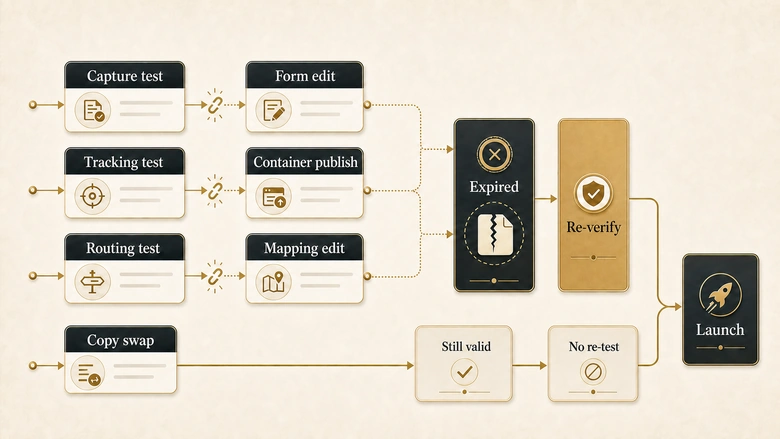
Evidence also has a shelf life, and this is the part almost no launch template handles. Verification is valid for one specific build. The moment something underneath it changes, the observation describes a system that no longer exists.
| Change event | What it invalidates | Re-verify before launch? |
|---|---|---|
| Form field added, renamed or reordered | Every capture test on that form | Yes |
| CRM field, workflow or mapping edited | Handoff and routing tests downstream of it | Yes |
| Consent banner or tag manager container published | All tracking observations on affected pages | Yes |
| New channel or ad platform added to the campaign | Nothing already tested, but adds untested paths | Test the new path only |
| Creative or copy swap with no link change | Nothing technical | No |
The practical rule: date every piece of evidence, and treat any observation taken before the last change to its dependency chain as assumed-safe rather than accepted. It sounds fussy until the first time a campaign ships on a test that predates a form rebuild.
The phrases that hide unverified risk
Unverified risk almost never announces itself. It arrives in language that sounds like a conclusion, and the tell is that none of these phrases contains an observation.
| What gets said | What it actually means | State |
|---|---|---|
| “Tracking is installed.” | The code is present. Nobody watched a value arrive. | Unverified |
| “It worked last quarter.” | A different build behaved correctly at a different time. | Assumed-safe |
| “The vendor confirmed it.” | A supplier described intended behaviour, not your instance. | Assumed-safe |
| “The scan came back clean.” | A tool reported on what it could detect. | Assumed-safe |
| “It should be fine.” | A prediction from first principles with no test behind it. | Unverified |
| “We’ve always done it this way.” | Nothing has broken loudly enough to notice yet. | Unverified |
| “We’re comfortable with that risk.” | Ambiguous. Apply the four-field test to find out which. | Unknown until tested |
| “I sent a test lead and it came through.” | An actual observation, with a scope of exactly one lead. | Accepted, narrowly |
The last row is the interesting one. It is real evidence, and it is also the smallest possible amount of it. Accepted risk with a stated scope beats unverified risk with a confident tone, but the scope belongs in the record.
Inside marketing automation platforms this language gets denser, because so much of the configuration is declarative and looks correct on screen. Smart lists, tokens, program membership and send logic all render convincingly without proving anything about runtime behaviour, which is the specific territory the in-platform marketing automation QA checklist is built to cover.
Who signs off, and what they are actually signing
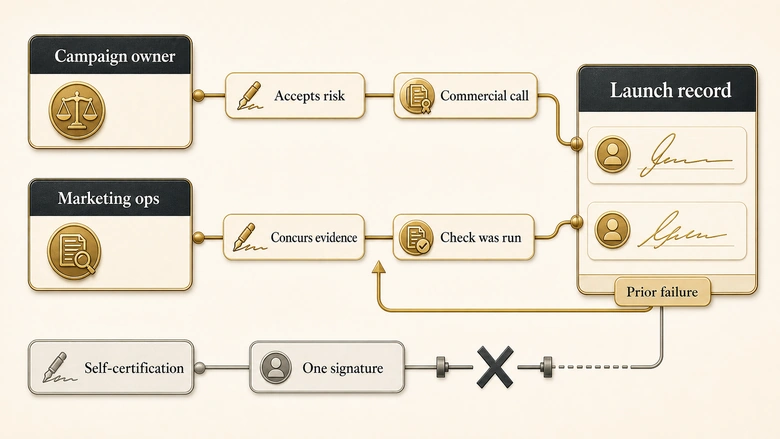
A risk acceptance needs a named accountable person, and that person is signing for the decision, not for the outcome. This is where the executive framing matters, because “the team agreed” is not an accountability model.
NASA’s agency risk management requirements draw the line more clearly than most marketing organisations manage. Under NPR 8000.4C, “programmatic authorities, e.g., project managers, have risk leadership responsibility and are accountable for risk acceptance decisions,” while technical authorities separately provide “concurrences that the risk is acceptable.” Two roles, two signatures, one for the business call and one for the engineering judgement.
The marketing translation is direct. The campaign owner accepts the risk, because they own the commercial consequence of launching. The marketing ops lead concurs that the evidence is what it claims to be, because they own whether the check was actually run. When one person does both, the concurrence quietly disappears, and it is the concurrence that catches unverified risk dressed as accepted risk.
IMPORTANT
If the same person owns the campaign and signs off the evidence, you do not have a risk assessment. You have a self-certification, and it will read that way in the post-mortem.
Google’s launch coordination engineers operate on a related principle. Their published launch checklist grew by a rule worth stealing: “every question’s importance must be substantiated, ideally by a previous launch disaster.” Nothing sits on the list because it sounds prudent. Every item earned its place by having gone wrong before, which is also the fastest way to keep a marketing launch gate short enough that people actually complete it.
When shipping unverified risk is the right call
Sometimes you launch without checking, and that is a legitimate decision. The failure is never the shipping. It is the mislabelling.
Use an explicit unverified exception when the campaign window is genuinely closing and the verification cost exceeds the exposure, when the failure mode is recoverable after the fact without losing data, or when the finding sits on a path carrying a trivial share of volume. Say so in the record, name who decided, and set a date to verify it after launch.
Do not use it when the failure mode destroys data that cannot be reconstructed, such as campaign attribution on inbound leads, because a post-launch fix cannot recover what was never captured. Do not use it when the exposure is regulatory, and do not use it on the paths carrying most of your volume. Those are the cases where an hour of checking is cheaper than any recovery.
There is a limit to how far this framework travels. It suits mid-market B2B teams running multi-channel campaigns through a martech stack with real handoffs between systems. A two-person team running one newsletter does not need four states and two signatures, and an enterprise with a formal GRC function already has this vocabulary under different names. Take the four-field test and leave the ceremony.
The point of separating accepted risk from unverified risk was never to block more launches. It is that a team which knows the difference can ship faster, because it stops arguing about items it has already measured and spends the argument budget on the ones it has not.
Frequently Asked Questions
A usable campaign launch risk assessment records five things per finding: the named failure mode, the evidence that behaviour was observed and when, the blast radius, the rollback trigger, and the named owner who accepted it. Likelihood and impact scores are optional additions once those five exist.
General risk practice names qualitative, quantitative, generic and site-specific assessments. For campaign launches the more useful four are the states a finding can be in: accepted, unverified, assumed-safe and unknown. Those four decide what happens next, which the traditional four categories do not.
Residual risk is what remains after you have treated a risk. Accepted risk is residual risk that a named person has formally decided to carry. Residual risk describes a measurement; accepted risk describes a decision about that measurement. Unverified risk is neither, because no measurement exists.
Two people. The campaign owner accepts the risk because they carry the commercial consequence. The marketing ops lead concurs separately that the evidence is genuine because they own whether checks were run. Combining both roles in one person removes the concurrence that catches unverified risk.