What Are B2B Marketing Campaign Strategies?
B2B marketing campaign strategies are structured plans that businesses use to reach, engage, and convert other businesses into customers. They combine specific channels, messaging, and tactics around a unified goal, whether that’s generating qualified leads, accelerating pipeline, or expanding into new markets. A campaign strategy coordinates multiple touchpoints across the buyer journey to move prospects from awareness to closed deal.
Here’s the problem most B2B teams run into: they pick tactics before picking a strategy. They launch a LinkedIn ad campaign, write a few blog posts, send some cold emails, and then wonder why nothing connects. The missing piece isn’t effort. It’s a campaign architecture that ties every touchpoint to a measurable business outcome.
If cold outreach is part of your campaign mix, your subject lines determine whether anyone reads the rest. Here are 25 cold email subject lines that actually get replies.
This guide breaks down eight proven B2B marketing campaign strategies, shows you how to build campaigns from scratch, and gives you the measurement framework to prove ROI. Whether you’re running demand gen at a Series B SaaS company or managing campaigns at an enterprise tech firm, you’ll walk away with a playbook you can put to work this quarter.
Key Takeaways
- The best B2B campaigns start with strategy selection, not tactic selection. Match your approach to your ICP, deal size, and sales cycle length.
- Account-based marketing, content-led demand gen, and multi-channel outbound remain the three highest-ROI campaign types for mid-market B2B.
- AI-powered personalization is shifting from “nice to have” to table stakes in 2026, with early adopters reporting 2-3x improvements in engagement rates.
- Measurement matters more than volume. Track pipeline influenced, cost per opportunity, and campaign velocity rather than vanity metrics like impressions.
- Every campaign needs a documented plan covering ICP, channels, assets, timeline, budget, and attribution before you create a single piece of content.
Why Most B2B Marketing Campaigns Fail
Before we get into what works, let’s talk about what doesn’t. According to Gartner’s CMO Spend Survey, marketing budgets dropped to 7.7% of revenue in 2024, the lowest in a decade. That means every campaign dollar has to work harder. Yet most B2B teams keep making the same mistakes.
For a deeper look at how autonomous AI systems are reshaping campaign execution, see our guide to agentic AI in marketing.
The “Spray and Pray” Problem
Running disconnected tactics across channels without a unifying strategy is the fastest way to burn budget. A LinkedIn campaign here, a webinar there, a blog post that nobody promotes. Each tactic might look good in isolation, but without a connecting thread, prospects see noise instead of a narrative. For LinkedIn-specific creative examples and 2026 cost benchmarks, see our LinkedIn ad examples guide.
Targeting Too Broadly
B2B buying committees average 6-10 decision-makers, according to Demand Gen Report research. If your campaign targets “marketing managers” without specifying industry, company size, tech stack, or buying stage, you’re competing for attention with everyone else doing the same thing.
Measuring the Wrong Things
Impressions, clicks, and MQLs feel good in a dashboard. But if those MQLs never convert to pipeline, you’re optimizing for the wrong metric. The shift in 2026 is toward pipeline-centric measurement: how much qualified pipeline did this campaign create, and how fast did it move? Campaign-level metrics roll up into the broader marketing measurement framework — see our B2B marketing metrics guide for the 15 KPIs that connect campaigns to revenue.
Ignoring the 95/5 Reality
Research from the LinkedIn B2B Institute shows only 5% of your target accounts are actively buying at any given time. The other 95% aren’t in-market yet. Campaigns that only target the active 5% miss the long game: building brand memory so you’re the first call when the other 95% are ready to buy.
8 B2B Marketing Campaign Strategies That Drive Pipeline in 2026
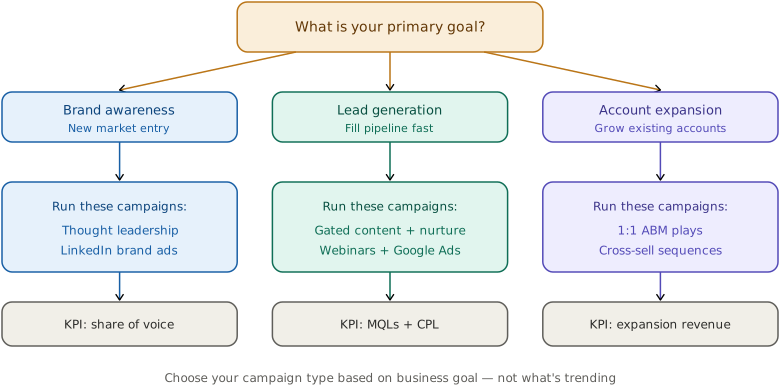
Not every strategy fits every company. Your choice depends on deal size, sales cycle length, team size, and budget. Here’s a breakdown of eight B2B marketing campaign strategies, with guidance on when each one works best.
1. Account-Based Marketing (ABM) Campaigns
ABM flips traditional demand gen on its head. Instead of casting a wide net and qualifying down, you start with a defined list of target accounts and build personalized campaigns around them.
This works best when your average deal size exceeds $50K and your sales cycle runs 3-12 months. Adobe’s ABM program targeted 1,000 enterprise accounts with personalized microsites, custom content, and coordinated outreach between sales and marketing. The result: 50%+ higher win rates and deal sizes that grew by over 40%.
To run ABM effectively, you need three things: a defined Ideal Customer Profile (ICP), intent data to prioritize accounts showing buying signals, and tight alignment between marketing and sales on account selection and messaging.
If you’re new to ABM, start with a pilot of 25-50 accounts. Build custom landing pages, run LinkedIn matched audience ads, and coordinate with sales on personalized email sequences. Track engagement at the account level, not the lead level. For deeper guidance on what to measure, check our guide to account-based marketing metrics. For operational depth on ABM specifically — campaign types, the 7-part brief, and collision management when running multiple concurrent campaigns — see our full ABM campaigns playbook.
When the ABM pilot starts pulling named accounts into your funnel, the next layer is inbound lead generation that captures the same demand without relying only on outreach.
2. Content-Led Demand Generation
Content-led demand gen uses educational content to attract, engage, and convert prospects at every stage of the funnel. It’s the backbone of inbound marketing, but in 2026, the bar is higher. Generic blog posts won’t cut it. You need content that’s specific enough to signal expertise and actionable enough that readers can apply it immediately.
HubSpot built a $2B+ business largely on this approach. Their content engine produces blog posts, templates, tools, and certification courses that bring in millions of organic visitors monthly. More importantly, that content feeds a lead nurturing machine that moves prospects through free tools to paid software.
The key to making content-led campaigns work is tying content to buyer intent stages. Top-of-funnel content (guides, industry reports) builds awareness. Mid-funnel content (comparison pages, case studies, ROI calculators) helps prospects evaluate. Bottom-funnel content (demos, free trials, pricing pages) drives conversion. For more on building this foundation, see our B2B marketing framework guide.
PRO TIP
Don’t gate everything. In 2026, buyers expect to access valuable content without filling out a form. Gate your highest-value assets (original research, ROI calculators, templates) and leave educational content ungated. This builds trust and generates higher-quality leads when people do convert.
3. Multi-Channel Outbound Campaigns
Outbound isn’t dead. But the “blast 10,000 cold emails” approach is. Modern outbound campaigns use multiple channels in a coordinated sequence: cold email, LinkedIn outreach, targeted ads, and direct mail working together to reach the same prospect across different touchpoints.
A well-structured outbound sequence might look like this: Day 1, a personalized cold email referencing the prospect’s recent funding round. Day 3, a LinkedIn connection request with a relevant article. Day 7, a follow-up email with a case study from their industry. Day 10, a retargeting ad serving a webinar invite. Each touch builds on the last. That progression is the standard to protect inside the email channel too, where cold email follow-up rules that make every next touch additive prevent a coordinated campaign from becoming the same pitch repeated across four dates.
This strategy works well for companies selling to a defined market where you can identify prospects by name. If your total addressable market is under 5,000 companies, outbound gives you control over who enters your pipeline instead of waiting for them to find you.
4. Product-Led Growth (PLG) Campaigns
PLG campaigns let the product do the selling. Instead of routing every prospect through a sales call, you offer a free trial or freemium version that lets buyers experience value before they commit. Slack’s growth from zero to $27.7 billion (Salesforce acquisition) was built almost entirely on this model.
PLG works best for B2B software with a quick time-to-value. If a user can experience your product’s core benefit within minutes, PLG can dramatically reduce customer acquisition costs. The campaign component involves driving signups through targeted content, then using in-app messaging and email sequences to activate users and convert them to paid plans.
Watch your activation metrics closely. If users sign up but don’t complete a key action within the first 48 hours, your onboarding needs work, not your marketing.
5. Thought Leadership and Brand Campaigns
Brand campaigns don’t generate leads overnight. They build the mental availability that makes every other campaign type work better. When a prospect sees your ABM ad or reads your cold email, brand recognition determines whether they engage or scroll past.
Thought leadership is the most effective brand-building strategy in B2B. It means publishing original perspectives, research, and insights that challenge conventional thinking in your space. Not recycled blog posts restating what everyone already knows. One of the highest-trust topics to own this way is sustainability, where publishing a point of view on sustainability backed by real proof separates you from vendors making vague green claims.
LinkedIn’s own research found that 65% of buyers say thought leadership changed their perception of a company, and 64% say it’s a better indicator of capabilities than product marketing. Invest in a quarterly research report, a company podcast featuring real practitioners, or a LinkedIn content program where your team shares first-hand expertise consistently.
6. Event and Webinar-Driven Campaigns
Events remain one of the highest-intent channels in B2B. Webinar attendees who stay for 30+ minutes are signaling genuine interest in your topic and, by extension, your solution.
The shift in 2026 is from standalone webinars to integrated event campaigns. A single webinar becomes the centerpiece of a campaign that includes pre-event email sequences, paid promotion, live engagement, post-event content repurposing (blog posts, clips, social posts), and follow-up nurturing. Building that ecosystem on purpose, instead of hoping registrations convert on their own, is exactly the pre-event, live, and post-event sequence that turns one session into pipeline.
Goldcast and other event platforms report that B2B companies running integrated event campaigns see 3-5x more pipeline per event compared to standalone webinars. The key is treating the event as the “lightning bolt moment” and building a content ecosystem around it.
7. Partner and Co-Marketing Campaigns
Co-marketing with a complementary (non-competing) company gives you instant access to their audience. Joint webinars, co-authored research reports, shared email campaigns, and integration partnerships can double your reach without doubling your budget.
Identify partners who serve the same ICP but solve a different problem. If you sell marketing automation, partner with a CRM vendor. If you sell RevOps software, partner with a data enrichment tool. The campaign should deliver value to both audiences while introducing each company to prospects they couldn’t reach alone.
8. AI-Powered Personalization Campaigns
AI is changing B2B campaigns from “one message to many” to “many messages to one.” Generative AI tools now enable marketers to create personalized email copy, dynamic landing pages, and custom ad creative at scale. According to a McKinsey study, companies that excel at personalization generate 40% more revenue from those activities than average performers.
Practical applications in 2026 include using AI to personalize website content based on visitor firmographics (company size, industry, tech stack), generating variant email copy for different buying personas, and automating ad creative testing across audience segments.
IMPORTANT
AI-generated content still needs human oversight. Use AI for scale and speed, but have a human review every customer-facing asset for accuracy, tone, and brand consistency. The companies getting burned by AI in marketing are the ones that removed humans from the review loop entirely.
How to Build a B2B Marketing Campaign from Scratch
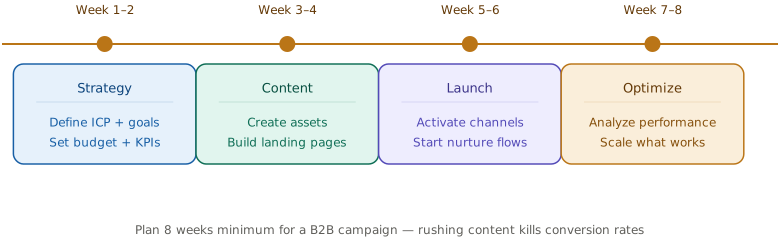
Knowing the strategy types is one thing. Actually building a campaign is another. Here’s a five-step process you can follow for any B2B marketing campaign.
Step 1: Define Your Goal and ICP
Start with one clear goal. “Generate 50 sales-qualified opportunities in Q2” is a goal. “Increase brand awareness” isn’t. Your goal determines everything else: budget, channels, content, and measurement.
Then define your ICP at the account and persona level. What industries? What company sizes? What titles are involved in the buying decision?
What problems are they trying to solve right now? The more specific your ICP, the more effective your targeting and messaging.
Step 2: Choose Your Strategy Type
Match the strategy to your situation. Selling enterprise deals over $100K? ABM. Selling $10K/year SaaS to a large addressable market? Content-led demand gen or PLG. Entering a new market segment? Outbound plus brand awareness. Most companies use two or three strategies simultaneously, but each campaign should focus on one primary approach.
Step 3: Build Your Asset Stack
Every campaign needs content. Map your assets to buyer stages: awareness content that attracts attention, consideration content that builds preference, and decision content that drives action. For a mid-funnel ABM campaign, your stack might include a personalized landing page, an industry-specific case study, a custom ROI calculator, and a tailored demo script.
Step 4: Set Up Tracking and Attribution
Before you launch anything, set up your measurement infrastructure. Tag all URLs with UTM parameters. Configure your CRM (HubSpot, Salesforce) to track campaign influence on pipeline.
Define your attribution model. First-touch? Multi-touch? Linear? Pick one and stick with it for at least two quarters so you can compare results apples-to-apples. The Madison Logic Harris Poll ROI warning makes this less optional: if the model never changes a decision, the team will keep guessing even with more campaign data. Retail media makes the same discipline unavoidable: the measurement test inside Vusion’s In-Store Media deal is whether execution logs and POS outcomes can be separated from true incremental sales lift.
Step 5: Launch, Measure, Iterate
Launch your campaign in phases if possible. Start with one channel or audience segment, validate the messaging and conversion rates, then scale what works. Review performance weekly during the first month, then shift to bi-weekly once the campaign stabilizes. Kill underperforming channels fast and reallocate budget to what’s producing pipeline. Phasing limits the damage from failure modes nobody anticipated, though it does nothing for the findings you already knew about and never verified, which need checking rather than a smaller blast radius. Phasing only teaches you something if the first phase is instrumented properly, so run the nine-domain launch gate before that first channel goes live — a phase that captures nothing tells you nothing about the messaging.
How to Measure B2B Campaign Performance
Stop measuring campaigns by leads generated. Start measuring by pipeline created, influenced revenue, and sales velocity. Here are the metrics that matter.

Pipeline influenced: Total pipeline value where the campaign was a touchpoint. This is the most important number for proving marketing’s revenue contribution.
Cost per opportunity: Total campaign spend divided by qualified opportunities generated. This tells you campaign efficiency better than cost per lead, which ignores lead quality entirely.
Campaign velocity: How fast do leads from this campaign move through the pipeline? If your ABM campaign generates opportunities that close in 45 days versus 90 days for inbound, that’s a signal to invest more in ABM.
Engagement-to-pipeline ratio: What percentage of engaged contacts become qualified pipeline? This metric connects top-of-funnel activity to bottom-line results and exposes campaigns that generate lots of engagement but no revenue.
Win rate by campaign source: Track close rates for opportunities sourced or influenced by each campaign. Over time, this reveals which strategies produce not just more pipeline but better pipeline.
Build a simple dashboard in your CRM or a tool like HubSpot Analytics that shows these five metrics for every active campaign. Review it in weekly marketing-sales alignment meetings to keep both teams focused on what’s actually moving revenue.
B2B Marketing Campaign Examples That Drove Real Revenue
Theory is useful. Real-world execution is better. Here are three campaign examples with specific outcomes you can learn from.
Adobe’s Enterprise ABM Campaign
Adobe built an ABM program targeting 1,000 enterprise accounts using Ideal Customer Profiles drawn from their top 5% of existing customers. They integrated intent data from Bombora and 6sense to prioritize accounts showing active research behavior, then deployed coordinated campaigns across email, LinkedIn Ads, webinars, and custom microsites. Results: win rates increased by more than 50%, and average deal sizes grew by over 40%.
Why it worked: Tight account selection, intent-based prioritization, and genuine sales-marketing alignment. Each account received messaging tailored to their specific use cases, not generic product pitches.
Slack’s Product-Led Freemium Campaign
Slack’s “So Yeah, We Tried Slack” campaign featured real customer testimonials from companies like Sandwich Video. The campaign directed prospects to a free product trial rather than a sales call, letting the product’s collaboration features sell themselves. Usage data triggered automated upgrade prompts when teams hit the free tier’s limits.
Why it worked: Low friction acquisition combined with in-product activation. Slack tracked specific engagement signals (number of messages sent, channels created, integrations connected) to identify teams ready for an upsell conversation.
Shopify Plus’s Intent-Driven Landing Pages
Shopify Plus used firmographic and intent signals to trigger highly personalized landing pages for their ABM program. When a target account visited their site, the page dynamically adjusted messaging, case studies, and pricing information based on the visitor’s industry, company size, and previous interactions. This approach converted at 2-3x the rate of their generic enterprise landing page.
Why it worked: Dynamic personalization made every visitor feel like the page was built specifically for them. The technical investment in real-time personalization paid off through significantly higher conversion rates.
Best Tools for B2B Marketing Campaigns in 2026
If that shortlist is specifically for capture and prospecting, compare it with the dedicated lead generation tools guide before you buy another campaign platform.
Your tech stack should support campaign planning, execution, and measurement without requiring duct-tape integrations. Here’s what the best B2B teams are using.
CRM and Marketing Automation: HubSpot Marketing Hub or Salesforce Marketing Cloud for campaign orchestration, lead scoring, and pipeline tracking. HubSpot is often the better fit for mid-market teams; Salesforce for enterprise. For a detailed breakdown, read our HubSpot vs Salesforce comparison.
ABM Platforms: 6sense, Demandbase, or Terminus for account identification, intent data, and multi-channel ABM orchestration.
Content and SEO: Semrush or Ahrefs for keyword research and competitive analysis. Clearscope or Surfer SEO for content optimization. For more on building organic traffic, see our B2B SEO strategy guide.
Sales Engagement: Outreach, Salesloft, or Apollo for coordinating multi-channel outbound sequences across email, phone, and LinkedIn.
Analytics and Attribution: HubSpot Attribution Reporting, Bizible (now Marketo Measure), or Dreamdata for multi-touch attribution and pipeline analytics.
AI and Personalization: Mutiny for website personalization, Jasper or Writer for AI-assisted content creation, and Clay for AI-powered prospect research.
Frequently Asked Questions
The four primary types are content marketing (blogs, whitepapers, videos), account-based marketing (targeted campaigns to specific accounts), digital advertising (paid search, LinkedIn ads, retargeting), and event marketing (webinars, conferences, trade shows). Most effective B2B strategies combine two or more of these types within a single campaign.
B2B companies typically allocate 6-10% of revenue to marketing, with individual campaigns ranging from $5,000 for a targeted email sequence to $100,000+ for a full-scale ABM program. Start by working backward from your pipeline goal: if you need $1M in pipeline and your average conversion rate is 20%, you need $5M in pipeline opportunities. Then calculate cost per opportunity to determine the required budget.
B2B campaigns target business decision-makers through longer sales cycles involving multiple stakeholders. Messaging focuses on ROI, efficiency, and business outcomes. B2C campaigns target individual consumers with shorter purchase cycles and emotional appeals. B2B campaigns typically use channels like LinkedIn, email, and events, while B2C leans toward social media, influencer marketing, and retail advertising.
Expect 30-60 days for initial engagement signals and 60-120 days for pipeline impact, depending on your sales cycle length. Brand campaigns and SEO-driven content strategies take longer, often 6-12 months, to show significant results. Outbound and ABM campaigns typically produce faster pipeline impact because they target prospects with existing pain points.
The 4 C’s are Customer (understanding your ICP deeply), Cost (total cost of ownership, not just price), Convenience (how easy it’s to buy and implement), and Communication (consistent, relevant messaging across all touchpoints). This framework replaces the traditional 4 P’s (Product, Price, Place, Promotion) with a buyer-centric perspective.
Start Building Your Next Campaign Today
The difference between B2B teams that hit their pipeline targets and those that don’t isn’t talent or budget. It’s having a documented campaign strategy that connects every tactic to a measurable outcome.
Pick one strategy from this guide that matches your current situation. If you’re selling enterprise deals, start with ABM. If you’re building organic traffic, go content-led demand gen. If you’re entering a new market, combine outbound with brand campaigns.
Then follow the five-step process: define your goal and ICP, choose your strategy, build your assets, set up tracking, and launch in phases. Measure what matters (pipeline, not MQLs). Cut what doesn’t work. Double down on what does.
Your next high-performing campaign starts with a plan on paper, not a post on LinkedIn. Build the plan first. The results follow.