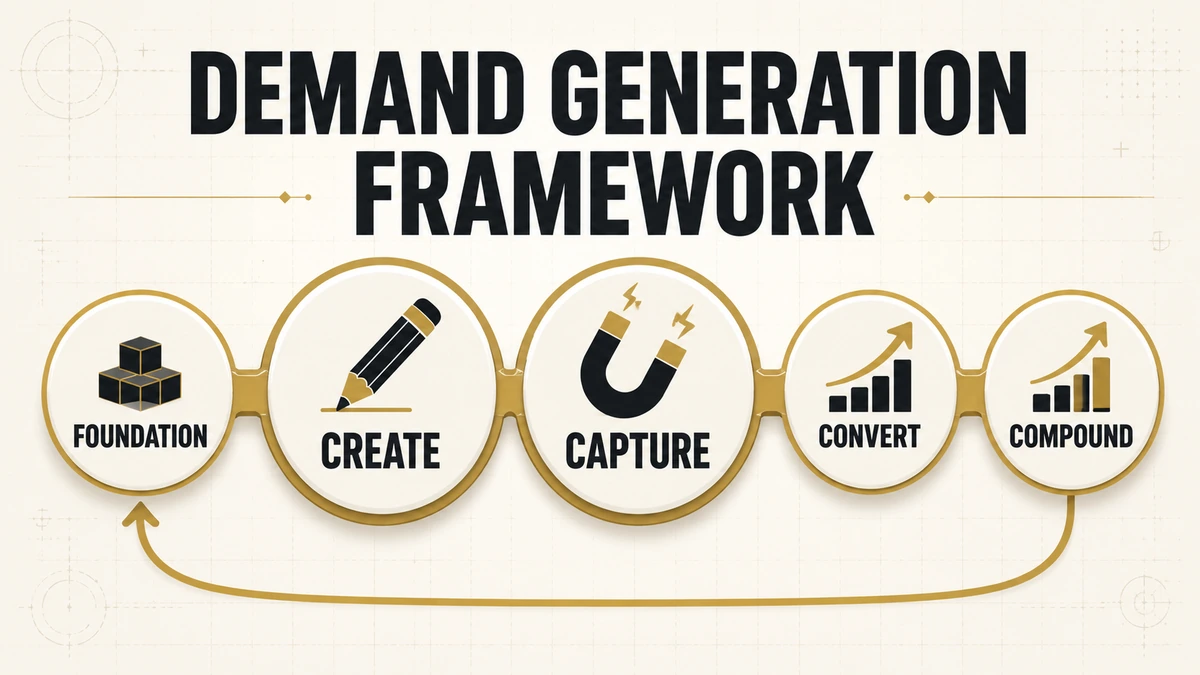
A demand generation framework is the system a B2B team uses to create demand, capture it, and convert it into revenue on purpose instead of by accident. Most teams don’t have one. They have a pile of tactics: a webinar here, a paid search campaign there, a newsletter nobody measures, and a quarterly scramble when pipeline runs dry.
That scramble has a root cause. Teams pour budget into capturing demand (forms, gated ebooks, paid search) while doing almost nothing to create it. So they fish in the same shrinking pond as every competitor and wonder why a lead costs more every quarter. A real framework fixes the imbalance by treating creation and capture as two connected engines, then wiring both to numbers a CFO will respect.
This guide hands you that system: a named five-stage model we call the Demand Engine, a stage-by-stage table you can copy, the metrics that matter at each stage, and a six-step plan to build it. If you only want the philosophical difference between demand gen and lead gen, we covered that in our breakdown of demand gen versus lead gen; this piece is about building the machine.
Key Takeaways
- A demand generation framework is a repeatable system, not a tactic list. It runs in five stages: Foundation, Create, Capture, Convert, and Compound.
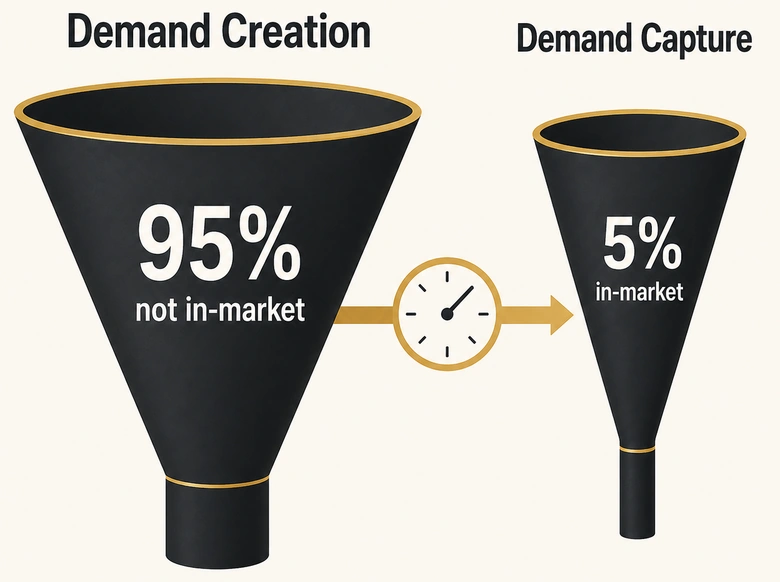
- The split that separates winners from everyone else is demand creation (making the market want you before they’re shopping) versus demand capture (converting the people already shopping). Most teams do only the second.
- Only about 5% of your buyers are in-market this quarter. The other 95% decide who makes their shortlist long before they fill out a form, so creation is what wins the deals capture closes.
- Each stage has its own goal, channels, and metric. Measuring creation with capture metrics (cost per lead) is the fastest way to kill the program that feeds your pipeline.
- Build it in six steps over a focused planning sprint, then run it for at least two quarters before you judge it. Demand compounds; it doesn’t spike.
What Is a Demand Generation Framework?
A demand generation framework is a structured operating model that defines how a B2B company generates awareness and interest, converts that interest into qualified pipeline, and measures the return at every step. It replaces scattered campaigns with a sequence of stages, each with a clear goal, a channel mix, and a metric. Your demand generation strategy decides what you want; the framework decides how the work happens and how you’ll know it worked.
The word “framework” matters because it implies repeatability. A campaign ends. A framework keeps running, taking the same inputs (your ideal customers and their buying triggers) and producing the same outputs (qualified pipeline) quarter after quarter. That’s the difference between a team that hits its number occasionally and one that compounds.
Demand generation sits inside your wider planning model rather than replacing it. If you’ve mapped your channels and stages with one of the six B2B marketing frameworks like RACE or the funnel model, demand generation is the engine that fills it. The framework below is built specifically for B2B teams with long sales cycles and buying committees, not for impulse-purchase consumer marketing.
Why Most B2B Demand Generation Stalls
Here’s the uncomfortable truth: most “demand generation” is just lead capture with a nicer name. Teams gate every asset, buy every in-market click, and call it a day. It works until it doesn’t, because you’re competing for the same tiny slice of buyers who are ready right now.
How tiny? According to the Ehrenberg-Bass Institute’s 95:5 rule, only around 5% of business buyers are in-market in any given quarter; the other 95% won’t buy for months or years. If your entire program targets in-market intent, you’re ignoring 19 out of every 20 future buyers and handing them to whoever stayed top of mind.
And those future buyers decide early. 6sense’s 2025 B2B Buyer Experience Report found that buyers fill roughly four slots on a Day One shortlist and end up purchasing from one of those vendors about 95% of the time, with the first vendor they contact winning eight deals out of ten. The same report found buyers now reach out at about 61% of their journey, earlier than the 69% mark a year before, so the window to shape that shortlist keeps shrinking. By the time someone is “a lead,” the race is mostly decided. Demand creation is how you get onto that Day One list. Capture is how you close once you’re on it.
IMPORTANT
Demand creation is not brand fluff. If you can’t tie it to a metric (branded search volume, shortlist presence, self-reported “how did you hear about us”), it will lose every budget fight to capture. The framework below gives creation its own metrics on purpose, so it survives the next planning cycle.
The Demand Engine: A 5-Stage Demand Generation Framework
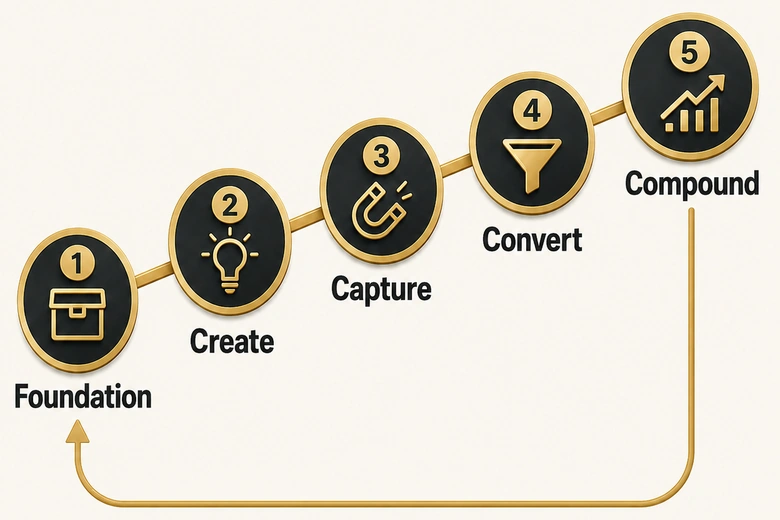
The Demand Engine is a five-stage demand generation framework that runs from defining your market to reinvesting in what works: Foundation, Create, Capture, Convert, and Compound. Stages two and three are the two engines most teams run lopsided. Foundation feeds them, Convert turns their output into revenue, and Compound sends the learnings back to the start.
Read the table as a demand gen funnel laid flat. If you think in funnel terms, Create is your top of funnel, Capture and Convert are the middle and bottom, and Foundation and Compound are the bookends most funnels leave out. The top stages create demand among the out-of-market 95%; the middle stages capture and convert the in-market 5%; the last stage tells you where to spend next. On the paid side that same split is exactly how display advertising and PPC divide the funnel, display creating demand and paid search capturing it. This is the b2b demand generation framework in one screen, and it’s the asset to keep open while you plan.
| Stage | Goal | Primary channels | Primary metric |
|---|---|---|---|
| 1. Foundation | Define who you serve and the triggers that make them buy | ICP and persona workshops, win-loss interviews, intent-data setup | % of pipeline from ICP-fit accounts |
| 2. Create (demand creation) | Make the market aware of the problem and your point of view before they shop | Organic search, LinkedIn organic, podcasts and YouTube, communities, PR, paid social reach | Branded search volume, engaged reach, share of voice |
| 3. Capture (demand capture) | Convert existing in-market intent into known, scored contacts | Paid search, comparison and bottom-funnel SEO, gated high-intent assets, demo forms, retargeting | MQLs, demo conversion rate, cost per opportunity |
| 4. Convert | Move qualified demand into pipeline and closed revenue | Lead scoring, follow-up email sequences, SDR handoff, ABM plays, sales enablement | SQLs, pipeline created, win rate |
| 5. Compound | Attribute results, learn, and reinvest in what creates demand | Multi-touch and self-reported attribution, CRM, dashboards, quarterly reviews | CAC, return on demand spend, % revenue influenced by Create |
Inside the Five Stages
The table is the map. This is the terrain. Each stage answers one question: who, what, how, who-closes, and what-next.
FREE PLANNING TEMPLATE
Map the Demand Engine before you commit the budget. Plan all five stages, separate creation from capture, calculate the spend split, and choose the quarter’s priorities. Download the Demand Engine Planning Template.
Stage 1: Foundation
Foundation defines the inputs the whole engine runs on: a sharp ideal customer profile, the personas inside the buying committee, and the triggers that move an account from “fine” to “we need to fix this.” Get this wrong and every later stage amplifies the error, spending more to reach the wrong people faster. Pull your last 20 closed-won deals and look for the pattern in firmographics, the trigger event, and who signed off. Then map the buying committee itself: a mid-market deal pulls in 6 to 10 people (an economic buyer, a champion, technical evaluators, end users), each with a different fear, so “the persona” is really a set of them.
Triggers are the underrated half. A new VP, a funding round, a compliance deadline, or a competitor migration is what flips an account into the in-market 5%. Map those signals now so Create and Capture can watch for them.
Stage 2: Create
Create is demand generation in its truest sense: you’re manufacturing awareness and preference among people who aren’t shopping yet. This is ungated, generous, point-of-view content distributed where your buyers already spend attention, not parked behind a form. Think a founder posting hard-won lessons on LinkedIn, a podcast your ICP actually subscribes to, and search content that answers the questions buyers ask before they know your category exists.
Content is the workhorse here, and it pays off slowly then suddenly. Our guide to building a content-to-pipeline system walks through the asset types that compound, from comparison pages to founder-led video. The metric is not leads. It’s whether more of the right people know you exist: branded search, engaged reach, and direct traffic climbing month over month.
In practice the Create layer is a handful of channels run consistently: founder and executive thought leadership on LinkedIn, guest spots on podcasts your buyers trust, owned organic search that ranks for the problems they Google, content syndication to reach net-new accounts, and the occasional no-pitch webinar. None of it asks for a form. The point is to occupy the top of the demand gen funnel so your name is already familiar when intent finally shows up.
PRO TIP
Before you add a single channel, audit how your current spend splits between Create and Capture. Most teams find 80% or more sitting in capture. Moving even 20 points toward creation is usually the highest-return change you can make this year, and it costs nothing but reallocation.
Stage 3: Capture
Capture converts the intent that already exists into known contacts you can work. This is where gated assets, demo requests, comparison content, and paid search earn their keep, because the person searching “best [your category] software” is telling you they’re in the 5%. Inbound is the engine that does most of this quietly; our playbook on inbound lead generation that actually works covers the channels that convert without burning trust.
The discipline in Capture is restraint. Gate the high-intent assets (the ROI calculator, the live demo) and leave the awareness content open. Gate everything and you smother the creation work that fills this stage in the first place.
The highest-converting capture assets meet obvious intent: comparison and alternative pages, pricing and ROI calculators, retargeting that follows engaged visitors, third-party review profiles on sites like G2, and product-led free trials. Each one catches a buyer who has already decided to solve the problem and is now choosing between options. The same logic governs paid media inside Google Ads, where Performance Max harvests that ready intent while Demand Gen campaigns reach net-new accounts earlier in their journey, so the campaign type you pick decides whether budget captures demand or creates it.
Stage 4: Convert
Convert is where marketing-qualified interest becomes sales-accepted pipeline. It runs on lead scoring, timely follow-up sequences, and a clean handoff to sales, plus account-based plays for your highest-value targets. When a named-account list deserves concentrated firepower, this is where ABM campaigns plug in, aiming the whole committee instead of a single lead.
The metric shifts from volume to value: SQLs, pipeline created, and win rate. A stage-four problem usually means a scoring or speed-to-lead issue, not a top-of-funnel one. If you have plenty of MQLs and little pipeline, fix the handoff before you buy more clicks. Two levers matter most: speed-to-lead (the minutes between a high-intent action and the first human reply) and a written SLA on what marketing passes and how fast sales works it. Pin down the MQL-to-SQL definition with sales in the room, or you’ll keep arguing about lead quality instead of fixing it.
Stage 5: Compound
Compound is the loop that makes a framework better than a campaign. You attribute what actually drove pipeline, learn which creation work paid off, and reinvest there. Because so much B2B research now happens in places analytics can’t see (private communities, AI assistants, peer chats), self-reported attribution (a simple “how did you hear about us?” on the demo form) often beats your dashboard for the truth. Then act on it: shift budget toward the creation work that keeps showing up in won deals, retire the channels that only ever touch buyers who never close, and feed the patterns back into your ICP and trigger list so Foundation gets sharper every cycle. Stitching those tracked and self-reported signals into one view is what spreading credit across every touch, dark channels included is built to do, so the Compound loop reinvests against the real path to revenue instead of the last click a pixel happened to catch.
How to Build Your Demand Engine
A demand generation strategy on a slide is easy; the hard part is the operating model underneath it. You can map the whole framework in a focused half-day planning sprint with marketing and a sales partner in the room. Building the full engine takes a quarter or two; mapping it (the part that prevents the most waste) takes an afternoon. Here’s the sequence.
Workflow · 4 hours
How to build a demand generation framework
Map the five-stage Demand Engine for your company in a single planning sprint, before you commit budget to any channel.
Define your ICP and buying triggers
Pull your last 20 closed-won deals, find the shared firmographics and trigger events, and write a one-page ICP plus a trigger list the team can watch for.
Audit your create-versus-capture spend split
List every active program and tag it as creation or capture. Total the budget in each column so you can see, in numbers, how lopsided the engine currently is.
Build the Create layer
Pick two or three channels where your ICP already pays attention and commit to consistent, ungated point-of-view content. Set a branded-search or engaged-reach target, not a lead target.
Build the Capture layer
Gate only your highest-intent assets, point paid search at bottom-funnel terms, and make sure every form asks how the buyer heard about you.
Connect scoring and the sales handoff
Agree on the score that makes a lead sales-ready, set a speed-to-lead target, and define exactly what sales receives and when.
Instrument attribution and set the review cadence
Stand up multi-touch plus self-reported attribution, build one dashboard with each stage’s metric, and book a monthly review to reallocate toward what creates demand.
Demand Generation Metrics: Creation vs Capture
The single biggest measurement mistake in B2B is judging demand creation with demand capture’s ruler. Creation builds future pipeline, so its metrics are leading indicators (reach, branded search, shortlist presence). Capture converts present pipeline, so its metrics are lagging and direct (MQLs, cost per opportunity). Hold creation to a cost-per-lead target and you’ll cut it right before it pays off.
| Demand creation metrics | Demand capture metrics |
|---|---|
| Branded and category search volume | Marketing-qualified leads (MQLs) |
| Engaged reach and share of voice | Demo and form conversion rate |
| Direct and dark-social traffic | Cost per opportunity |
| Self-reported “how did you hear about us” | Pipeline created and win rate |
The number that ties both engines together is return on demand spend: how much pipeline the whole framework produced for every dollar it consumed. Track it quarterly, not weekly, because demand compounds on a delay.
Return on Demand Spend = Pipeline Created from Demand ÷ Total Demand Gen Spend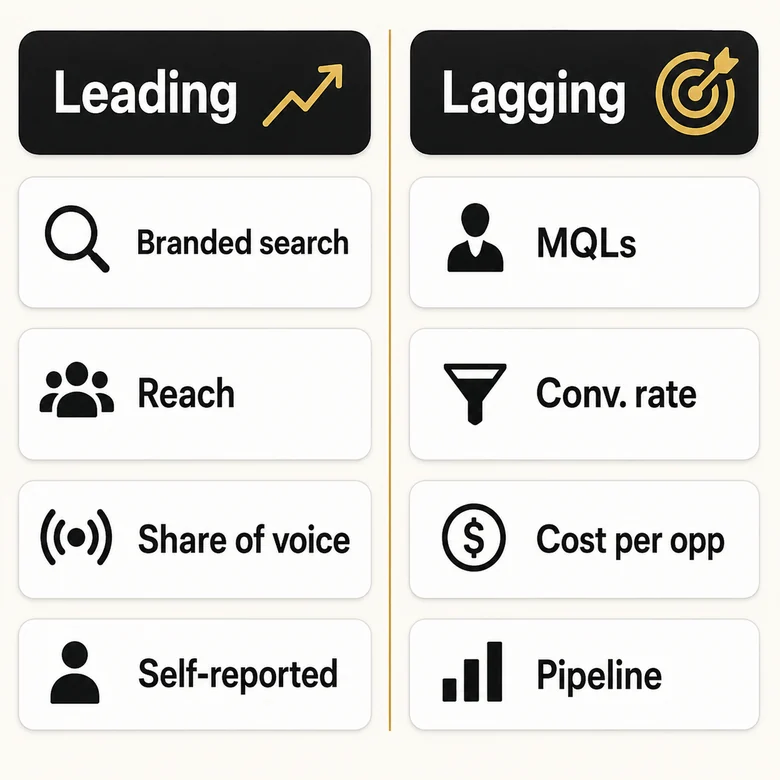
Two caveats keep you honest. First, buying committees now run 6 to 10 people deep and spend only about 17% of their time with vendors, per Gartner’s B2B buying journey research, so single-touch attribution will always undercount creation. Second, attribution is a compass, not a verdict. Use it to decide where to lean in, not to settle a debate about which channel “deserves” credit for a deal twelve people influenced.
Your Demand Generation Tech Stack by Stage
You don’t need a 30-tool stack to run this framework. You need one system of record and one tool per job. Map the tools to the stages, not the other way around, so you’re buying capability you’ll actually use.
Foundation and Convert live in your CRM and intent layer; Create and Capture live in your content, ads, and intent-data tools; Compound lives in analytics and attribution. A typical mid-market stack pairs a CRM and marketing automation platform (HubSpot, Salesforce, or Marketo Engage) with an intent provider, web analytics, and a revenue-attribution tool. If you’re still picking your core platform, our roundup of the best RevOps software compares the systems that tie marketing and sales data together.
The “one tool per job” rule is harder to apply than it sounds, because several vendors sell into two or three stages at once and a category-by-category shortlist quietly double-counts them. The tools that support this framework are mapped in our breakdown of which tool categories cover which funnel stage, and the eight places they overlap, which is the audit worth running before a renewal rather than after one.
Common Demand Generation Framework Mistakes
Most framework failures aren’t strategy problems. They’re the same handful of execution errors, repeated. Here are the four that do the most damage.
- Capture-only. Running stages three and four with no Create layer. You’ll hit your number for a while, then watch lead costs climb as you exhaust the in-market pond.
- Gating everything. Putting a form on awareness content kills reach. Gate intent, not education.
- Vanity metrics. Reporting impressions and “leads” with no line to pipeline. Every stage metric in the table should connect to revenue within two quarters.
- No Compound loop. Launching campaigns and never feeding results back into the plan. Without stage five, you repeat what’s comfortable instead of what works.
If you recognize three of these four, you don’t have a content problem or a budget problem. You have a framework problem, and the fix is sequencing the stages rather than buying more activity.
Frequently Asked Questions
A complete demand generation framework runs in five stages: Foundation (define your ICP and triggers), Create (generate awareness among future buyers), Capture (convert in-market intent into leads), Convert (turn qualified demand into pipeline), and Compound (attribute results and reinvest). The first two build future demand; the middle two work present demand; the last closes the loop.
Demand creation builds awareness and preference among the roughly 95% of buyers who aren’t shopping yet, using ungated content and reach channels. Demand capture converts the 5% who are in-market right now, using paid search, gated assets, and demo forms. Creation gets you onto the shortlist; capture closes the buyers already on it.
Measure each stage with its own metric. Creation uses leading indicators like branded search volume, engaged reach, and self-reported attribution. Capture and convert use lagging indicators like MQLs, cost per opportunity, pipeline created, and win rate. Tie the whole engine together with return on demand spend, tracked quarterly because demand compounds on a delay.
Yes. The stage-by-stage table in this guide is a working template: copy the five stages into a spreadsheet, then fill the goal, channels, and metric columns with your own programs. Add a budget tag (creation or capture) to each row so you can see your spend split at a glance and rebalance toward creation.
For a mid-market B2B SaaS team, it often looks like founder-led LinkedIn content and a podcast (Create), comparison pages and paid search (Capture), lead scoring with SDR follow-up and ABM for top accounts (Convert), and a monthly attribution review (Compound), all built on the ICP and triggers defined in Foundation.
Build Your Demand Engine This Quarter
You don’t need a bigger budget to fix demand generation. You need to stop spending all of it on the 5% who are already shopping. Map the five stages, find your create-versus-capture split, move 20 points toward creation, and give it two quarters. The teams that win the Day One shortlist aren’t the ones who captured hardest. They’re the ones who showed up first, with a point of view, long before the buyer was ready to talk.