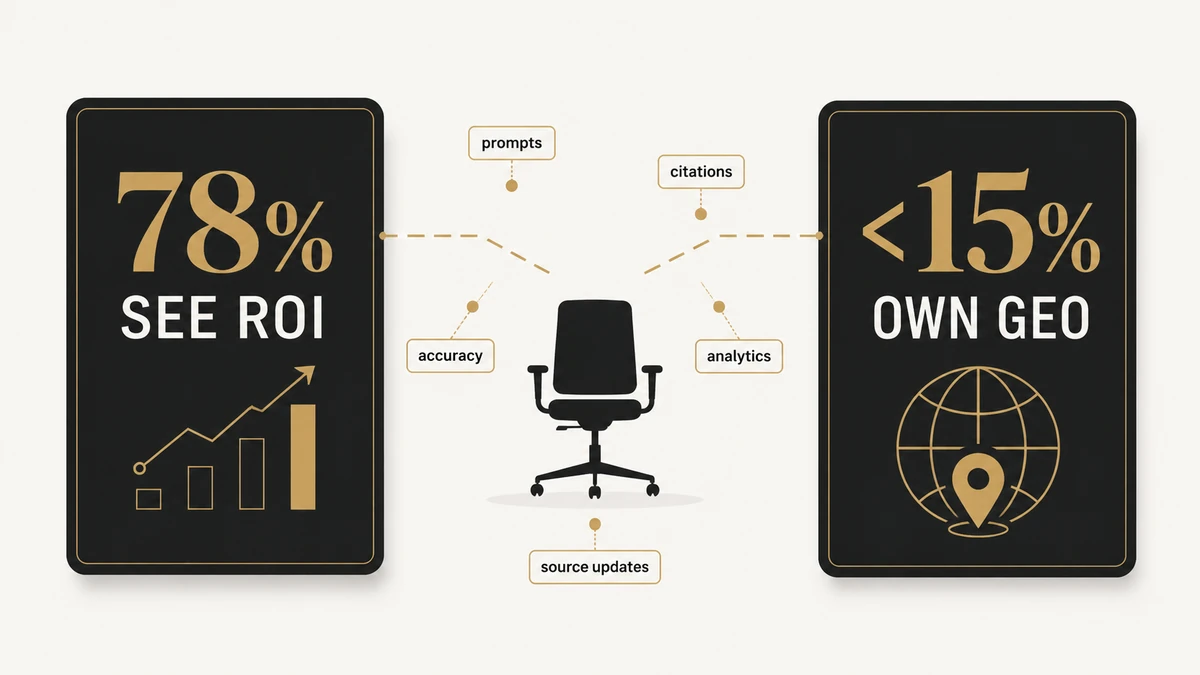
GNW Consulting and Demand Metric released their State of GEO in B2B Marketing study on June 3. The survey of 400 B2B marketing leaders found that 78% already report measurable return from generative engine optimization, or GEO. Thirty-eight percent called that return significant.
Adoption is moving faster than ownership. Ninety-two percent of respondents are experimenting with or operating GEO programs, but fewer than 15% have a dedicated GEO function or leader. Only 19% report advanced measurement, while 63% name insufficient budget or resources as a barrier.
Our read: B2B teams do not have an adoption problem. They have an accountability problem. GEO is producing enough value to survive, but often without one person owning the queries, citations, brand accuracy, analytics, and source updates that determine whether the program improves.
Key Takeaways
- GNW Consulting and Demand Metric surveyed 400 B2B marketing leaders about GEO adoption and results.
- Seventy-eight percent report measurable GEO ROI, including 38% reporting significant ROI.
- Ninety-two percent are experimenting with or operating GEO, but fewer than 15% have a dedicated GEO owner.
- Only 19% have advanced measurement, leaving many teams unable to explain what produced the return.
- The next B2B GEO advantage is clear ownership across search, PR, content, product marketing, and analytics.
What the State of GEO Study Found
The full State of GEO report page places respondents across three practical stages. Forty-four percent are in early adoption, 28% are actively implementing GEO, and 20% describe their programs as mature. That leaves a small minority outside the category entirely.
The ROI result is unusually strong for a young marketing practice. Yet the measurement underneath it is uneven. A team may see more AI referrals, branded mentions, sourced answers, or influenced pipeline without being able to trace which content and distribution choices caused the gain. The Optimizely agent-visibility launch adds log-level behavior to that measurement mix, making shared definitions even more important.
The report also found that 83% of respondents see the strongest performance from content with a clear expert stance. That favors B2B teams with real subject-matter access. A generic rewrite can cover a topic, but it rarely gives an answer engine a distinct claim, useful evidence, or named expertise to cite.
Why ROI Without Ownership Is a Warning
GEO crosses existing job lines. SEO teams understand queries and technical discovery. PR teams earn third-party mentions. Product marketers control category language. Content teams publish source material. Analytics teams decide what counts as a result. When nobody owns the combined outcome, each team can report activity while the brand’s AI visibility stays inconsistent. Jasper’s closed-loop GEO system is notable because it packages that cross-team loop as a monitored, prioritized, and executed workflow rather than a shared spreadsheet. The channel AI-search ownership problem is even wider because partner pages, local listings, and review surfaces may sit outside the core web team.
That inconsistency already has a cost. Our coverage of how AI misrepresents B2B brands showed why a mention alone is not enough. A brand can appear in an answer with the wrong category, dated capabilities, or a weak description. Someone needs authority to find those errors and coordinate the source corrections.
The same issue appears in measurement. Ghost citations can make a page look successful inside an SEO report even when the answer does not name the company. An owner must separate citations, mentions, sentiment, referral traffic, and pipeline influence instead of combining them into one visibility score. The IAB directional-versus-decision-grade test now gives that owner a way to separate early signals from data fit for budget, agency, or executive decisions.
What a B2B GEO Owner Should Measure
The starting dashboard does not need to be elaborate. It needs a fixed prompt set, named competitors, a weekly collection cadence, and definitions the wider marketing team accepts. Google’s own AI features guidance says normal SEO fundamentals still apply to AI Overviews and AI Mode. GEO ownership should therefore extend the search program, not create an isolated content queue. The 37%-versus-32% AI-search split makes the ownership deadline concrete, because daily AI users increasingly begin research before a conventional result page appears. Adobe’s 300-million-prompt Brand Visibility system raises the same ownership question at enterprise scale: prompt selection, approval gates, and outcome reporting still need one accountable operator. The crawl-policy side now belongs in that same ownership model, because Cloudflare AI traffic controls can change which bots reach ad-supported content before a ranking report shows the loss.
- Visibility: Does the brand appear for category, problem, comparison, and validation prompts?
- Citation: Which owned and third-party pages are used as sources?
- Accuracy: Are the category, product claims, pricing status, and differentiators correct?
- Competitive share: Which named competitors appear more often, and for which buyer questions?
- Business response: Do AI referrals and assisted journeys create qualified engagement or pipeline?
Google’s AI Performance Insights points toward the same reporting model: benchmark visibility by query, competitor, and buyer stage. Teams should also preserve referral-source detail in analytics. Google’s GA4 traffic-source documentation explains the source and session dimensions needed to keep AI referrals from disappearing into broad channel totals.
What B2B Marketing Leaders Should Do Next
First, assign one accountable owner for a 90-day GEO program. The owner does not need to produce every asset. They do need permission to set the prompt set, request source updates, coordinate PR and content work, and report results with a consistent method.
Second, write down the operating boundary. GEO should not become a label placed on every SEO task. Define the answer surfaces, buyer questions, competitors, and business result the program will cover. Exclude anything the team cannot inspect or connect to a decision.
Third, establish a correction loop. When an answer is wrong, log the prompt, engine, claim, cited source, responsible team, and follow-up date. When visibility improves, record which source or expert contribution changed. That evidence turns a promising practice into a repeatable program.
The study’s central contradiction is useful: B2B marketers are seeing GEO return before most have built GEO accountability. The teams that resolve that ownership gap can turn early results into a durable reporting and publishing discipline.
Frequently Asked Questions
It is a June 2026 study from GNW Consulting and Demand Metric based on responses from 400 B2B marketing leaders. It measures GEO adoption, ownership, ROI, barriers, and measurement maturity.
Seventy-eight percent of respondents report measurable GEO ROI, and 38% report significant ROI. The study does not say every team uses the same ROI definition, so leaders should document their own measurement method.
One accountable marketing owner should coordinate the program across SEO, content, PR, product marketing, and analytics. The reporting line matters less than having authority over prompts, source corrections, measurement, and follow-up.
No. Search fundamentals still support visibility in AI search features. GEO adds answer-level monitoring, citation analysis, brand-accuracy checks, and cross-team ownership to the existing search and content program.