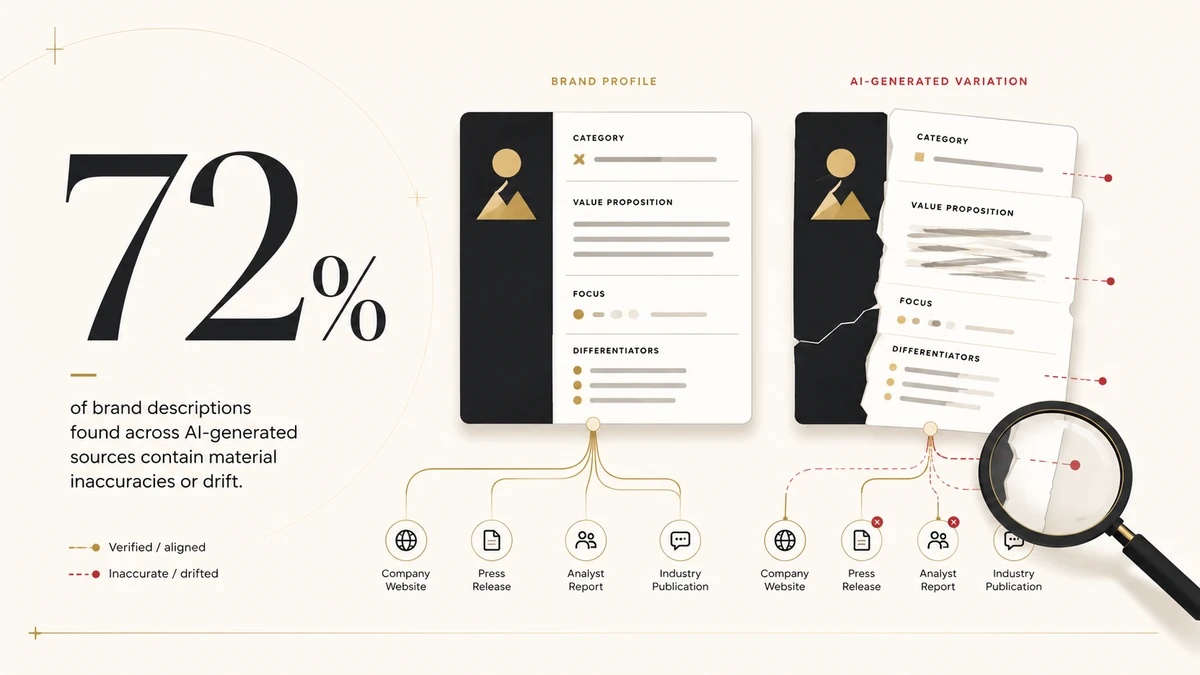
Seventy-two percent of B2B tech marketers have seen AI engines describe their company, category, or value proposition in ways that are inaccurate, outdated, or incomplete. The figure comes from Corporate Ink’s GEO and AI Visibility 2026 research, released May 27 after a survey of 150 US B2B tech marketing professionals. Of the marketers who have seen the problem, 29% are not addressing it.
The readiness gap is wider than one statistic. Corporate Ink found that only 34% of marketers have a defined AI visibility strategy, 43% know the buyer-centric prompts they want to appear for, 26% know which media outlets AI engines crawl in their market, and 17% know which third-party credibility sources LLMs trust. Meanwhile, 88% of CMOs and VP-level marketers are already being asked by leadership or the board what they are doing about AI visibility.
When we covered Google’s native AI Share of Voice metric, the question was whether a brand appears in AI answers. Corporate Ink’s data adds a harder question: is the description accurate when the brand appears? Our read: B2B teams need a brand-description audit beside the visibility dashboard. A visible but outdated category label can damage a shortlist before a buyer reaches the website.
Key Takeaways
- Corporate Ink surveyed 150 US B2B tech marketers and released the findings on May 27, 2026.
- 72% have seen AI engines describe their company, category, or value proposition inaccurately, incompletely, or with outdated details.
- Only 34% have a defined AI visibility strategy, while 88% of CMOs and VP-level marketers face leadership questions about the issue.
- B2B teams should audit brand-description accuracy across buyer prompts, not report AI visibility as a single score.
What Corporate Ink’s Research Actually Found
The report is useful because it separates board pressure from operational readiness. AI visibility is already an executive question, but most teams have not mapped the prompts, sources, and credibility signals that shape an answer. Corporate Ink CEO Greg Hakim argues that the marketers seeing results have done that intelligence work first.
The pipeline data makes the issue harder to dismiss. Corporate Ink says 40% of marketers report a 5-10% increase in qualified inbound pipeline from AI visibility during the past year, while 19% report pipeline growth above 10%. Among the marketers reporting pipeline growth, 55% know which channels have the highest influence over LLMs in their market, compared with 15% of teams reporting no or declining pipeline impact.
Those figures do not prove that GEO work caused every pipeline gain. They do show that the teams seeing results are more likely to understand the source environment around their brand. That is the part B2B teams can act on without waiting for a perfect attribution model.
The Hidden Risk Is Description Drift
AI visibility dashboards often count mentions, citations, or a share-of-voice score. That is not enough. Our earlier report on ghost citations in AI search showed why citations and named mentions need separate tracking. Corporate Ink adds a third column: description accuracy.
A B2B vendor can appear in an answer and still lose the buyer. The summary may use an old product name, place the company in the wrong category, repeat an expired positioning line, or omit the differentiator that matters to the current buyer. Corporate Ink’s CMO guide warns that LLM signals may lag by 12-18 months. For a company that changed pricing, positioning, or product scope during that period, drift is not a minor brand issue. It is an active pipeline risk.
This is also why proof-led positioning matters. A current product page with a checkable claim, a dated customer result, and a consistent category description gives buyers and answer engines better material than a collection of adjective-heavy pages that disagree with one another.
The 30-Day B2B Brand-Description Audit
- Build a 20-prompt baseline. Include category queries, comparison queries, use-case questions, and buyer-stage questions across ChatGPT, Gemini, Perplexity, AI Mode, and AI Overviews where available. Log whether your brand is named, cited, and described accurately.
- Create a drift log. Mark each incorrect statement as outdated product detail, wrong category, missing differentiator, unsupported claim, or conflicting source. Assign one owner and one correction path.
- Fix the owned-page foundation. Update the homepage, about page, product pages, comparison pages, and customer proof pages so the name, category, and core claim match. Google’s Organization structured data guidance says the markup can help Google understand and disambiguate an organization. Treat that as a Google-specific baseline, not a promise that every LLM will update immediately.
- Map the third-party source layer. Find the review pages, analyst pages, media coverage, partner pages, and directories that repeat the stale description. Prioritize sources that appear in your prompt audit.
- Recheck after the correction cycle. For updated owned pages, use Google’s recrawl workflow. Re-run the same prompt set after 30 days and record which descriptions changed.
The audit belongs inside a broader B2B SEO strategy, not in a separate GEO spreadsheet nobody owns. Search, PR, product marketing, and web teams all contribute signals. One team should maintain the drift log and route corrections to the right source. That ownership gap is now measurable: fewer than 15% of B2B organizations have a dedicated GEO function, even though 78% report ROI.
What B2B Teams Should Report to Leadership
Do not collapse the audit into one visibility score. Report three measures: named mention rate, citation rate, and accurate-description rate. Add a short correction queue showing the top five drift issues, the source that appears to reinforce each one, and the owner responsible for fixing it.
Then separate what you control from what you influence. Owned pages, structured data, and internal consistency are controllable. Third-party coverage and model refresh timing are influenceable. That distinction makes the report credible and keeps the team focused on corrections it can actually ship. Skyword’s external-validation finding shows why the influenceable layer still matters: 54% seek outside proof when AI and brand information conflict.
Frequently Asked Questions
Corporate Ink’s May 27, 2026 survey found that 72% of B2B tech marketers had seen AI engines describe their company, category, or value proposition inaccurately, incompletely, or with outdated details. The survey covered 150 US B2B tech marketing professionals.
Track named mentions, citations, and description accuracy separately. Run a fixed prompt set across the AI engines buyers use, log incorrect descriptions by type, identify the source pages reinforcing each error, and rerun the same prompts after corrections ship.
No. Google says Organization structured data can help it understand and disambiguate an organization in Search. It is a useful owned-page baseline, but it does not guarantee an immediate correction across every AI engine. Teams still need consistent product pages and third-party source cleanup.