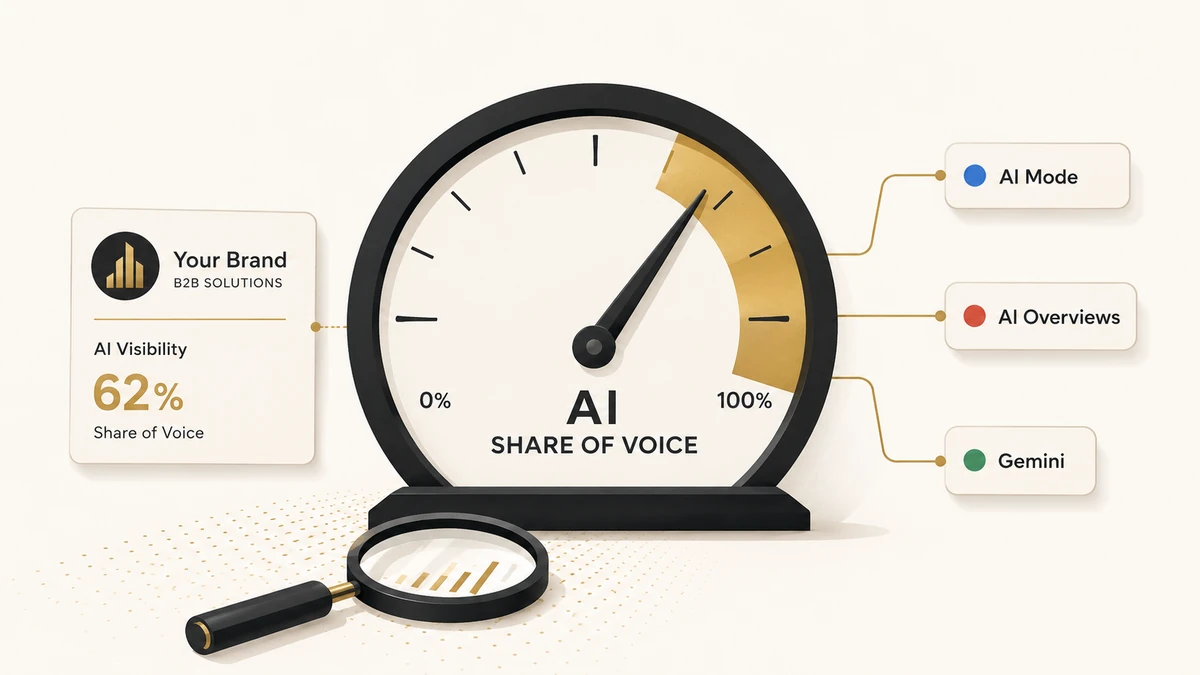
Google has started rolling out AI Performance Insights and Conversational Attributes in Merchant Center, the package it unveiled at Google Marketing Live on May 20 and detailed in the days after. The headline feature is a Share of Voice metric: for the first time, Google itself will tell a brand how visible it is inside AI-powered answers.
AI Performance Insights bundles four reports. Share of Voice benchmarks your visibility across Search and Gemini against similar brands, for shopping journeys that begin in AI Mode, AI Overviews, or the Gemini app. Shopping Funnel Performance splits that visibility across discovery, evaluation, and purchase. Product Term Insights shows the terms buyers actually use and your share of them, and Product Attributes Insights flags missing structured data with an attribute completeness score. The reports roll out across the US, Canada, Australia, India, and New Zealand in the coming months; the companion Conversational Attributes go global.
For B2B, the significance is not the Merchant Center plumbing. It is that Google has made AI Share of Voice a native metric. For two years, “are we visible in AI answers?” was a question only third-party AEO tools tried to answer, with methods nobody could audit. Now the platform that owns the surface is publishing the number. That moves AI visibility from a vendor pitch toward a board-level KPI, and it sets the measurement template every B2B team will be judged against next.
Key Takeaways
- Google is rolling out AI Performance Insights in Merchant Center, unveiled at Google Marketing Live 2026 (May 20), led by a Share of Voice metric for AI surfaces.
- Share of Voice benchmarks brand visibility across Search and Gemini for journeys that start in AI Mode, AI Overviews, or the Gemini app, measured against similar brands.
- Three more reports ship with it: Shopping Funnel Performance (discovery, evaluation, purchase), Product Term Insights, and Product Attributes Insights with an attribute completeness score.
- Conversational Attributes let sellers add conversational product data so Google’s AI matches it to natural-language queries; that piece rolls out globally.
- AI Performance Insights reaches the US, Canada, Australia, India, and New Zealand in the coming months. It is the first time Google itself quantifies AI-answer visibility.
What Google Shipped
The package is built for retailers, but the design is worth reading closely because it defines how Google thinks about AI visibility. Share of Voice is the centerpiece: a benchmarked read of how often your products surface in AI-mediated shopping journeys versus comparable brands. Shopping Funnel Performance then breaks that down by stage, so a seller can see whether the gap is in discovery, evaluation, or purchase. Product Term Insights surfaces the natural-language terms buyers use inside AI conversations and your share of them, and Product Attributes Insights scores how complete your structured data is, naming the specific attributes you are missing.
Conversational Attributes is the input side of the same system. Sellers add conversational attributes and richer descriptions in Merchant Center, and Google’s AI uses that structured data to match products to natural-language queries across AI Mode, Gemini, and other surfaces. The two ship together for a reason: the insights tell you where you are invisible, and the attributes are one lever to fix it. This sits directly inside the AI ad and answer surfaces Google has been building all year, the same ones we mapped in our triage of the 42 GML launches.
Why AI Share of Voice Going Native Matters
The measurement of AI visibility has been a mess. When we covered the finding that most AEO dashboards overstate real visibility by four to six times, the core problem was that no one could agree on what counted as an appearance, and every tool measured it differently. Google publishing its own Share of Voice number does not end that debate, but it gives the market a reference point owned by the platform that controls the surface.
It also lands in a moment when AI visibility is fragmenting. Google’s per-user Preferred Sources control made visibility partly a function of audience loyalty, and AI Overviews routing deep queries outward changed which content earns the click. A native Share of Voice metric is Google’s answer to its own complexity: a single number that tells a brand whether it is showing up at all. Our read: once Google reports AI Share of Voice, it becomes the metric leadership asks about, and “we do not measure that” stops being an acceptable answer. Comscore’s Q1 report extends the same measurement pressure beyond Google, showing AI assistant usage and search behavior now belong in the same dashboard.
The B2B Catch
The honest caveat: this lives in Merchant Center, which is a product-feed tool. A SaaS or services company cannot switch it on, because it has no product catalog to feed. The teams that benefit immediately are B2B sellers with real catalogs, distributors, hardware and component suppliers, industrial and wholesale brands, who can turn on Conversational Attributes and start reading their Share of Voice this quarter.
For everyone else, the value is the template, not the tool. Google just defined AI visibility as a benchmarked, stage-split, query-level metric, and confirmed that AI Mode, AI Overviews, and Gemini are the surfaces where discovery now happens. A B2B team without a catalog should copy the framework manually: run your category’s questions through the AI surfaces, log where you appear against named competitors, and report it on the same cadence Google is about to normalize for retailers. The metric is coming to the rest of marketing whether or not Merchant Center is the delivery vehicle. Corporate Ink’s 72% brand-description finding adds the next measurement layer: appearing in an AI answer is not a win when the category or value proposition is wrong. The GNW and Demand Metric study adds the ownership test: 78% of B2B teams report measurable GEO ROI while fewer than 15% have a dedicated GEO owner.
What B2B Teams Should Do Now
Four moves, split by whether you run a product feed.
- If you run Merchant Center, turn on Conversational Attributes first. Fill the gaps Product Attributes Insights flags, because the attribute completeness score is the lever you control directly. Then track Share of Voice as a standing KPI, not a one-time check.
- If you do not, replicate the Share of Voice check by hand. Run your category queries through AI Mode, ChatGPT, Gemini, and Perplexity monthly, and log who gets named. It is the same metric Google is automating, built in a spreadsheet.
- Structure your data for conversational matching. Whether it is product attributes or content, the pattern Google is rewarding is explicit, natural-language, machine-readable detail. Vague descriptions lose to specific ones in AI matching.
- Brief leadership now. A platform-native AI visibility metric is the moment AI Share of Voice becomes a number executives expect to see. Get ahead of the question with a baseline before it is asked.
Frequently Asked Questions
It is a set of Merchant Center reports Google unveiled at Google Marketing Live 2026 (May 20) to show how products surface in AI-powered shopping. It includes four reports: Share of Voice, Shopping Funnel Performance, Product Term Insights, and Product Attributes Insights. It rolls out in the US, Canada, Australia, India, and New Zealand in the coming months, alongside Conversational Attributes that go global.
Share of Voice is Google’s measure of how visible your brand is inside AI-driven experiences across Search and Gemini, benchmarked against similar brands, for shopping journeys that start in AI Mode, AI Overviews, or the Gemini app. It is the first time Google itself quantifies AI-answer visibility, rather than leaving that measurement to third-party AEO tools with unaudited methods.
Not directly. The reports live in Merchant Center and require a product feed, so SaaS and services companies cannot switch them on. B2B sellers with real catalogs (distributors, hardware, industrial, wholesale) can use them now. Everyone else should copy the framework manually: track Share of Voice across AI Mode, ChatGPT, Gemini, and Perplexity by running category queries and logging where the brand appears.
If you run a feed, enable Conversational Attributes, close the gaps Product Attributes Insights flags, and track Share of Voice as a standing KPI. If you do not, replicate the check manually each month and structure your content with explicit, natural-language detail that AI surfaces can match. Either way, brief leadership now, because a Google-native metric makes AI Share of Voice a number executives will expect to see.