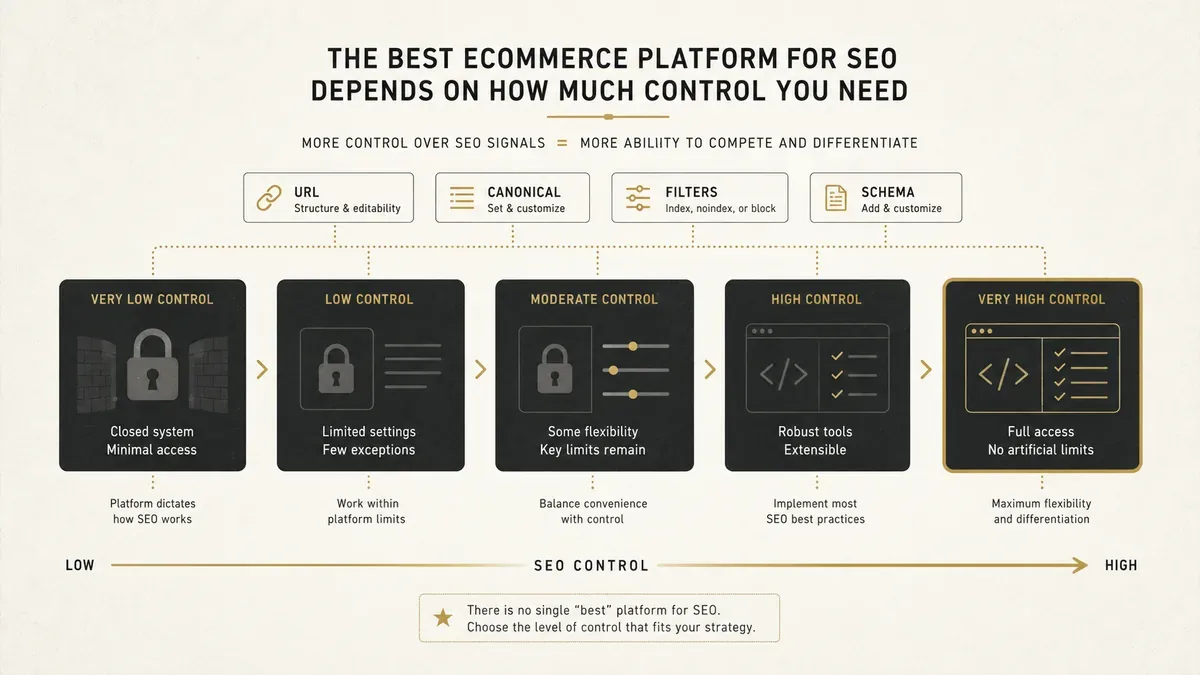
The best ecommerce platform for SEO is the one that hands you the most control over the parts of a store search engines actually judge: your URLs, your canonical tags, and how your filters generate pages. Two stores can sell the same 3,000 products and rank worlds apart, because one platform lets a merchant shape a clean, crawlable catalog while the other quietly mints tens of thousands of near-duplicate URLs before a single word of copy is written.
That is the part most “best platform” roundups skip. They rank Shopify, WooCommerce, and BigCommerce on ease, apps, and price, then bolt SEO on as one bullet near the bottom. This guide flips the order and judges every platform on a single axis: how much technical-SEO control it gives you, scored across the eight capabilities that decide whether a catalog ranks. As of 2026, WooCommerce and Shopify alone power more than 60% of the online stores whose platform can be identified, according to BuiltWith’s ecommerce technology tracking, so the odds are good your shortlist is already below.
Direct answer — What is the best ecommerce platform for SEO?
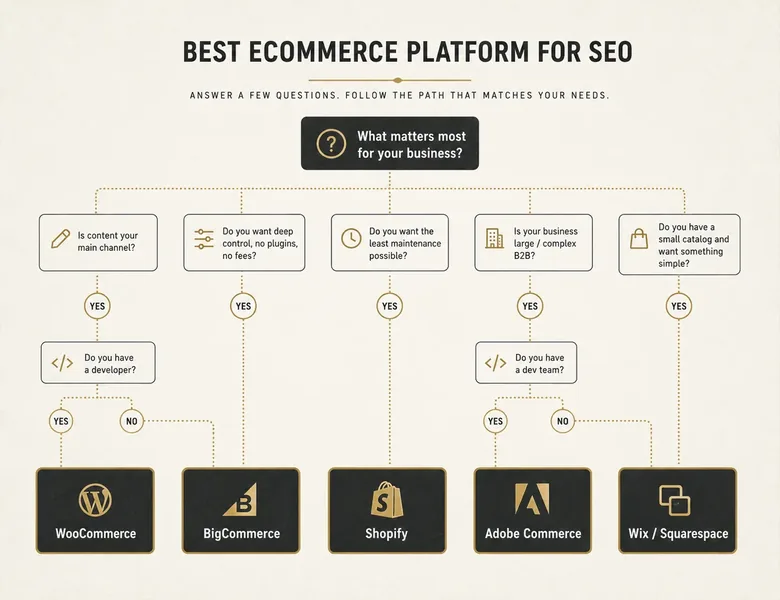
There is no single best ecommerce platform for SEO; the right pick depends on catalog size and your team’s technical skill. The strongest options for most stores are WooCommerce (full control through WordPress and plugins like Yoast), BigCommerce (deep built-in SEO controls with no plugins), and Adobe Commerce (best for large, complex B2B catalogs). Shopify wins on hands-off technical SEO and speed but limits URL and faceted-navigation control. The real determinant is how much command a platform gives you over URLs, canonicals, and filter pages.
Key Takeaways
- No platform is “most SEO-friendly” for everyone. The ranking ceiling is set by control over URLs, canonical tags, and faceted navigation, then matched to your catalog size and team.
- WooCommerce, BigCommerce, and Adobe Commerce give the most technical-SEO control. Shopify gives the strongest hands-off baseline (speed, automatic canonicals) but the least structural flexibility until you go headless.
- Wix and Squarespace have closed the gap for small catalogs, but both hit a ceiling as SKUs and filters multiply.
- The platform decides how many near-duplicate filter and variant URLs your store generates, which is the single biggest ecommerce ranking risk.
- For B2B, judge the platform on gated-pricing indexability and clean ERP-to-feed data, not just front-end features.
What Makes an Ecommerce Platform Good for SEO?
An ecommerce platform is good for SEO when it gives you direct control over the technical elements search engines use to crawl, index, and rank a catalog: URL structure, canonical tags, faceted-navigation rules, page speed, structured data, sitemaps, and redirects. The more of these you can shape without fighting the platform, the higher your ranking ceiling. “Ease of use” and “number of apps” are marketing metrics; these eight are the ones that move rankings.
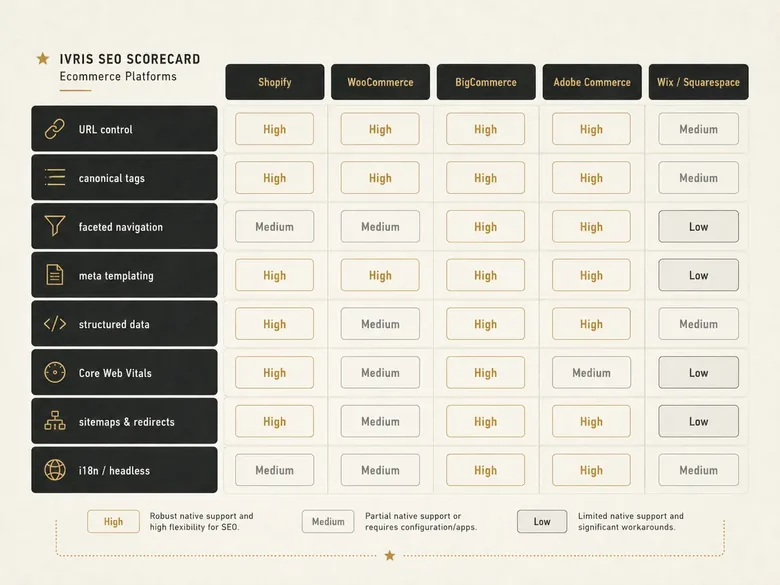
Score any platform against these eight SEO-capability axes:
- URL and slug control: can you edit paths, or are you locked into forced folders like
/products/and/collections/? - Canonical tags: can you set and override the canonical on any page, not just accept the default?
- Faceted navigation: how filters build URLs, and whether you can noindex or block the ones that create bloat, in line with Google’s faceted-navigation guidance.
- Title and meta templating: unique, rule-based titles and descriptions that stay clean across thousands of SKUs.
- Structured data: native Product, Offer, and Review schema, or dependent on a plugin you configure.
- Core Web Vitals: how fast the default templates render against Google’s Core Web Vitals thresholds, and whether performance is managed for you or your job.
- Sitemaps and redirects: control over XML sitemaps, robots.txt, and 301 or 410 rules when products move or retire.
- Internationalization and headless: hreflang support for multi-region catalogs, and an API escape hatch when you need total control.
These are the same mechanics that decide catalog rankings site-wide, so a platform choice is really a decision about which of them you get to touch. If the terminology in that list is new, the technical-SEO mechanics that sit beneath any catalog are worth reading first, because a platform only sets the ceiling. A weak platform caps what you can do; a strong one still needs a real strategy to fill that ceiling with content and structure that maps to how buyers search.
The Best Ecommerce Platforms for SEO at a Glance
Here is how the main platforms compare on SEO control, the watch-out that most affects rankings, and entry pricing as of Q3 2026. Read the “SEO control” column as the ceiling on what you can fix yourself, not as a score of how good the defaults look.
| Platform | Best for (SEO) | SEO control | Main watch-out | Starting price (Q3 2026) |
|---|---|---|---|---|
| WooCommerce | Content-driven SEO, full control | High | You own speed, security, and updates | Free plugin + hosting (~$15–30/mo) |
| BigCommerce | Built-in control without plugins | High | Smaller app and theme ecosystem | $39/mo (Core) |
| Adobe Commerce (Magento) | Large, complex B2B catalogs | High | Needs a dev team and real budget | Open Source free; Adobe Commerce quote-based |
| Shopify | Hands-off technical SEO and speed | Medium | Rigid URL paths, limited facet control | $39/mo (Basic) |
| Wix | Small catalogs, SEO on autopilot | Medium | Ceiling as the catalog scales | $39/mo (Business) |
| Squarespace | Brand and content-led small stores | Low–Medium | Limited catalog-scale SEO control | $23/mo (Core) |
| Headless (commercetools, Hydrogen, SFCC) | Total control at enterprise scale | High (you build it) | You build canonicals, sitemaps, rendering | Custom / enterprise |
Pricing and plan names shift every year, so treat the last column as a snapshot and the SEO-control column as the durable signal. Whatever you pick, the platform sets a ceiling, not a guarantee: even the cleanest build accumulates crawl waste as a catalog grows, which is why a periodic ecommerce SEO audit still finds what the platform quietly left behind.
PRO TIP
Before you commit, start a free trial and test the three things that matter most: can you edit a product URL, set a custom canonical, and create a 301 redirect? If any is locked or buried, the real SEO ceiling is lower than the feature page implies.
Shopify: Best for Hands-Off Technical SEO and Speed
Shopify is the strongest platform for hands-off technical SEO: it auto-generates canonical tags, XML sitemaps, SSL, and mobile-ready templates, and its hosted infrastructure keeps Core Web Vitals respectable without a developer on staff. For a brand that wants to sell now and not manage servers, it is the safest default, and its app store fills most gaps with a few clicks. The hiring catch is that even a hands-off platform needs careful app, theme, and analytics decisions, so vetting Shopify developers before the build protects the SEO advantages you picked Shopify for.
The tax you pay for that convenience is structural rigidity. Shopify forces every URL into fixed folders, so product pages live under /products/ and category pages under /collections/, and you cannot flatten or fully rename that structure. Collection filters and sort orders can spin up duplicate URLs, and a product that sits in several collections can appear at several paths, so canonical discipline matters more than the platform admits. Variant handling is the other quiet trap: how you expose color and size options decides whether Shopify creates one clean page or many near-duplicates, the same judgment call that product-page SEO turns into a repeatable template rule.
Shopify’s SEO ceiling lifts only when you go headless with Hydrogen and the Storefront API, which frees the front end from those URL rules but hands the SEO work back to your developers. Pricing as of Q3 2026 runs from $39/mo on Basic to $105 on Grow and $399 on Advanced, with Plus starting near $2,300/mo for larger merchants. For most stores the verdict holds: excellent defaults, real speed, limited structural control.
WooCommerce: Best for Content-Driven SEO and Full Control
WooCommerce is the most SEO-flexible mainstream platform because it runs on WordPress: you control every URL, canonical, redirect, and schema output, and you inherit the strongest content-SEO ecosystem on the web through plugins like Yoast and Rank Math. If organic content is your growth engine, nothing else comes close, because the same system that powers your store powers a genuine blog, guides, and landing pages under one clean domain structure.
That control is why WooCommerce tends to top independent tests for raw SEO capability. Because you tune hosting, caching, and templates directly, a well-run WooCommerce store can post the best Core Web Vitals of this group, ahead of Shopify’s out-of-box scores. Schema flexibility is part of the same story: full control over JSON-LD is what lets a catalog earn the structured-data depth that gets products cited in AI Overviews and ChatGPT, not just ranked in blue links.
The trade is ownership. WooCommerce is free as a plugin, but you pay for hosting, security, updates, and performance, so the real cost lands around $15–30/mo for hosting on a small store and climbs with traffic. A neglected WooCommerce site bloated with plugins can be slower than a hosted platform, so its ceiling is only as high as the team maintaining it. For content-led B2C and B2B stores with someone to own the stack, that ceiling is the highest here.
BigCommerce: Best Built-In SEO Controls Without Plugins
BigCommerce offers the deepest built-in SEO controls of any hosted platform: editable URLs, automatic 301 redirects when a URL changes, granular canonical rules, and configurable faceted navigation, all without installing a single plugin. It is the platform for a team that wants WooCommerce-level control over the technical layer but does not want to run its own hosting or manage a plugin stack.
Two things make it a quiet favorite for mid-market and B2B. First, there are no transaction fees on any plan, so the platform never taxes your growth. Second, its faceted navigation and API give real control over which filter URLs get crawled, and its B2B Edition adds company accounts, custom price lists, and quote workflows without bolting on third-party apps. Deciding which of those filter and category URLs deserve to rank and which should be blocked is the heart of category-page SEO, where you index the facets with real demand and block the rest. Before you trust any platform’s built-in claims, confirm them with your own crawl using dedicated technical-SEO tools rather than the feature list.
The catch is a smaller ecosystem. BigCommerce has fewer themes and apps than Shopify, so highly custom design or niche integrations can take more work. Pricing as of Q3 2026 starts at $39/mo on Core (renamed from Standard in the June 2026 update), $105 on Growth, and $399 on Scale, with Performance-tier enterprise pricing quoted from around $1,499/mo. Plans carry sales-volume thresholds, so a fast-growing store steps up tiers as it scales.
Adobe Commerce (Magento): Best for Large, Complex B2B Catalogs
Adobe Commerce, still widely called Magento, gives large and complex catalogs the most SEO control of any platform because its open codebase lets a developer shape URLs, canonicals, faceted navigation, hreflang, and multi-store structure to exact specification. When a catalog runs to tens of thousands of SKUs across regions and buyer types, that ceiling is the reason enterprises pick it despite the cost.
Its native B2B module is the other draw: company accounts, shared catalogs, requisition lists, and quoting ship in the box, and multi-store support lets one install serve several brands or regions with clean hreflang. The standard caveat still applies to speed. The default Luma theme is heavy, so serious teams move to a Hyva front end to hit strong Core Web Vitals, and the same crawlability and speed checks any large site needs apply here at scale. This is not a platform you run without engineers.
On price, Magento Open Source is free but fully self-hosted, so your budget goes to development, hosting, and maintenance. Adobe Commerce, the licensed edition, is quote-based and commonly lands in the six figures a year for enterprise catalogs. The verdict is narrow but firm: for a large or complex B2B catalog with a development team, nothing gives you more room to run; for anyone else, it is more platform than the SEO gain justifies.
Wix and Squarespace: Best for Small Catalogs That Want SEO on Autopilot
Wix and Squarespace are the best ecommerce platforms for SEO on small catalogs: both now ship genuinely capable built-in SEO tools, editable meta, clean URLs, automatic sitemaps, and decent Core Web Vitals, with almost no technical setup. The dated reputation that these builders “can’t do SEO” is years out of date, and for a store with dozens rather than thousands of products, either one ranks fine.
Wix has invested the most visibly. Its SEO Setup Checklist, editable canonical tags, custom 301 redirects, and structured-data controls now cover the fundamentals, which is why some 2026 roundups rank Wix first for out-of-box SEO. Squarespace leans the other way, toward brand and content-led stores where design and clean templates matter more than deep configuration, and it is the better pick for a catalog built around storytelling rather than a large SKU count.
Both hit the same ceiling. As SKUs and filters multiply, their limited faceted-navigation and canonical control cannot manage catalog-scale crawl the way BigCommerce or WooCommerce can, so neither suits a 10,000-SKU distributor. Pricing as of Q3 2026 is close: Wix Business runs about $39/mo, while Squarespace starts at $23/mo on Core and $39 on Plus, with Advanced at $99/mo. For a small catalog that values simplicity, that ceiling is high enough; for a growing one, plan to outgrow it.
Headless and Enterprise: Best When You’ll Own the SEO Layer
Headless and enterprise platforms give you total SEO control by decoupling the storefront from the commerce backend, but that control is a responsibility, not a gift: you build the canonical logic, sitemaps, rendering, and redirect rules yourself. Done well, a headless build on commercetools, Salesforce Commerce Cloud, or Shopify’s Hydrogen can outrank anything on this list; done carelessly, it ranks worse than a $39 hosted plan.
The reason is rendering. A headless front end has to serve crawlable, server-rendered HTML with correct canonicals and clean URLs, or search engines see an empty shell. Enterprise price tags do not buy speed automatically; even Salesforce Commerce Cloud and other high-end stacks routinely ship with middling Core Web Vitals until a team optimizes rendering. Headless earns its keep only at real scale, with an engineering team that treats SEO as a build requirement rather than a plugin. If that is not you, a strong hosted platform will rank higher for far less effort.
How to Choose the Most SEO-Friendly Platform for Your Catalog
To choose the most SEO-friendly platform, match the control you actually need to the team you actually have, then stop. More control you cannot use is not an advantage; it is overhead. Use this decision framework:
- Choose WooCommerce when content and organic search are your main growth channel and you have someone to own hosting and speed.
- Choose BigCommerce when you want deep SEO control without plugins or transaction fees, especially for mid-market or B2B.
- Choose Shopify when you want the strongest technical baseline with the least maintenance and can live with rigid URLs, or plan to go headless with Hydrogen later.
- Choose Adobe Commerce when you run a large, complex, or B2B catalog and already have a development team.
- Choose Wix or Squarespace when your catalog is small and simplicity beats catalog-scale control.
- Avoid switching platforms for SEO alone unless your current one blocks a fix you genuinely need.
IMPORTANT
A replatform is the single most common cause of catastrophic ecommerce traffic loss. If you move platforms, map every URL to a redirect and crawl the site before and after launch, or you will hand back the rankings the old store spent years earning.
One more discipline separates a good decision from a regret: judge the platform on the problem you have, not the demo you saw. The SEO ceiling is one input among several, and the fuller selection method weighs ERP fit, total cost of ownership, and B2B features alongside it. If you want the platforms ranked by overall business fit rather than by search control, start from a shortlist organized by use case and bring the SEO lens back to narrow it.
B2B-Specific Platform SEO Considerations
B2B catalogs add SEO requirements a consumer store never faces, and they change the ranking of the platforms above. If you sell to businesses, weigh three things the marketing pages rarely mention, because each one can quietly make a “great SEO platform” rank for nothing.
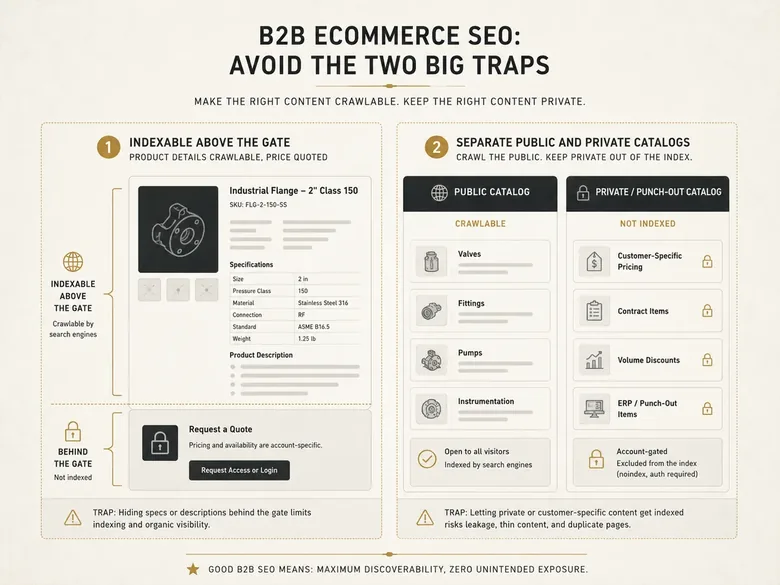
The first is gated-pricing indexability. Hiding prices behind a login is fine; hiding the whole product page from search is not. The platform has to let you expose indexable, descriptive content, specs, use cases, and compatibility, above the gate, so the URL can rank even when the price sits behind a quote form. Adobe Commerce and BigCommerce B2B Edition handle this natively; a locked-down build that shows only “Call for pricing” gives Google nothing to index.
The second is data quality, because a B2B store’s schema and Google Merchant Center feed are only as clean as the ERP and PIM behind them. When the systems that run pricing and inventory feed the site directly, the platform’s schema flexibility only matters if the upstream data is consistent, so a platform with strong ERP and PIM integration is doing SEO work you never see. The third is the split between a public, crawlable catalog and a private, account-gated one: punch-out and customer-specific catalogs should stay out of the index, but many B2B sites accidentally ship only the logged-in experience and leave nothing for search to find. Confirm the platform can serve both, or the store is invisible to every buyer who has not already signed a contract.
Frequently Asked Questions
There is no single winner. WooCommerce and BigCommerce give the most technical-SEO control, Adobe Commerce suits large B2B catalogs, and Shopify offers the best hands-off technical baseline. The right choice depends on your catalog size and whether you have a team to manage performance. Judge platforms on control over URLs, canonicals, and faceted navigation, not on ease or app count.
WooCommerce offers more raw SEO control because it runs on WordPress, giving you full command of URLs, canonicals, schema, and content through plugins like Yoast. Shopify gives a stronger hands-off baseline with automatic canonicals, fast hosting, and managed Core Web Vitals, but rigid URL paths. Pick WooCommerce for content-led control, Shopify for low-maintenance speed.
Yes. BigCommerce has the deepest built-in SEO controls of any hosted platform, with editable URLs, automatic 301 redirects, granular canonicals, and configurable faceted navigation, all without plugins. It also charges no transaction fees and has a capable B2B Edition, which makes it a strong pick for mid-market and B2B stores that want control without managing hosting.
Wix is good for SEO on small catalogs. Its built-in tools now cover editable meta, custom canonicals, 301 redirects, automatic sitemaps, and structured data, so the old “Wix can’t do SEO” claim is outdated. The limit appears at scale: its faceted-navigation and canonical control cannot manage crawl for large catalogs the way BigCommerce or WooCommerce can.
Yes, but indirectly. The platform sets your ceiling by deciding how much control you have over URLs, canonicals, faceted navigation, site speed, and schema. It does not rank you on its own; content, links, and technical execution still do the work. A weak platform caps what you can fix, while a strong one lets a good team reach its full ranking potential.