Open the same industrial sensor on ten distributor sites and you will often read the identical paragraph ten times, because each store pasted in the manufacturer’s stock description. Google now has ten near-duplicate pages competing for one buyer, and it rarely rewards the store that added nothing of its own.
Ecommerce product page SEO is the work of fixing exactly that, one page at a time, so a listing earns organic traffic and sales from buyers who are ready to purchase. It matters more in 2026 than it did a year ago: AI Overviews now appear on a growing share of shopping searches, and when one shows up, the position-one organic result loses 58% of its clicks across a 300,000-keyword study. Pages built for both classic ranking and clean machine extraction keep earning that traffic. Pages that are not built that way lose it quietly.
This guide is about the on-page layer: the titles, descriptions, images, schema, reviews, and variant handling that live on one product page. It works for consumer stores and for B2B catalogs, where hidden pricing and part-number search change the playbook. Catalog-wide crawling and category strategy are separate jobs; here the unit of work is a single product page, and the aim is to make it the best answer a shopper, a search engine, or an AI assistant can find for the product it sells.
Direct answer — What is ecommerce product page SEO?
Ecommerce product page SEO is the practice of optimizing an individual product page (the PDP) so search engines and AI answer engines can crawl it, understand it, and rank it for buyers ready to purchase. It covers the title tag and H1, a unique product description, image file names and alt text, Product schema with Offer and AggregateRating, customer reviews, and clean variant and canonical handling. The most common mistake is publishing the manufacturer’s stock description, which leaves the page competing against dozens of identical listings for the same product.
Key Takeaways
- Product page SEO is won on the page. A unique description, a keyword-aligned title, real Product schema, and genuine reviews do more for a listing than any off-page tactic.
- The manufacturer’s stock description is the single biggest drag on most product pages. It is not a penalty, but it leaves you competing against identical copy, and Google picks one winner.
- Product schema with Offer and AggregateRating is what earns the price, stock, and star rating you see in results, and it is increasingly what AI shopping answers read.
- Reviews are ranking and conversion fuel at once. A product with five reviews is 270% more likely to sell than one with none.
- Variants and multi-category placement create duplicate URLs. One canonical rule per product usually beats minting a separate page for every color and size.
- AI Overviews are spreading across shopping queries, so structure every page as a clean answer, not just a keyword target.
What Is Ecommerce Product Page SEO?
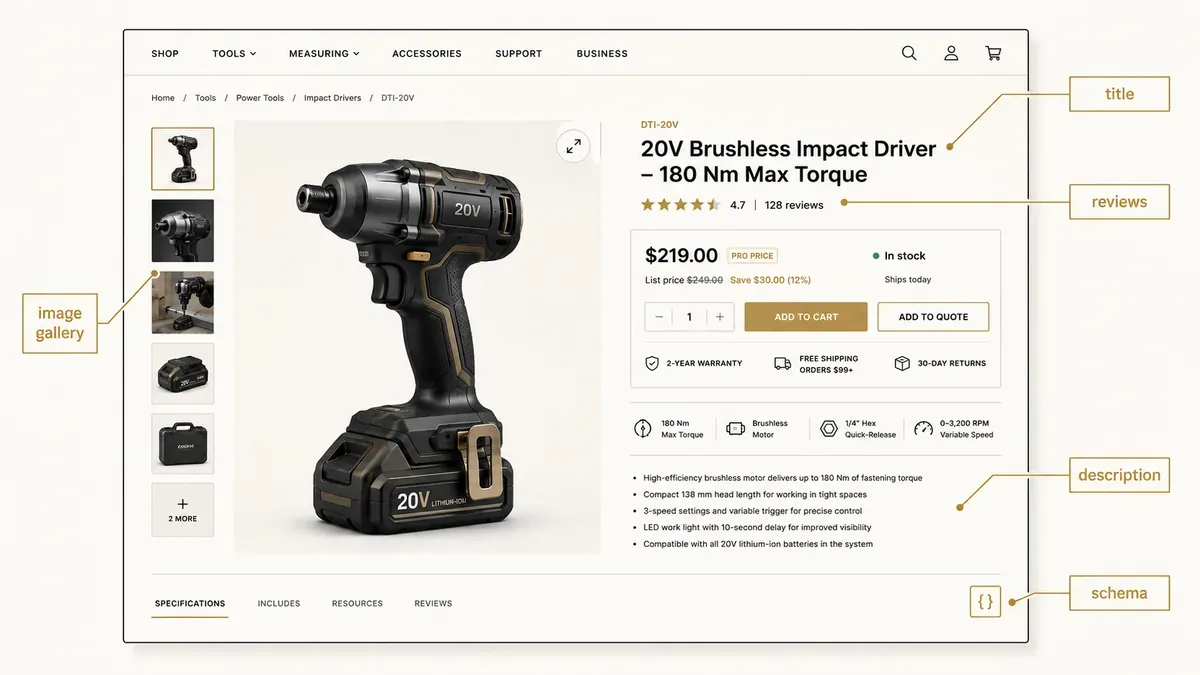
Ecommerce product page SEO is the set of on-page optimizations that help an individual product listing rank in organic search and appear in AI-generated answers. It combines a keyword-aligned title, a unique product description, optimized images, Product structured data, customer reviews, and clean canonical handling, all applied to the page that sells one specific product.
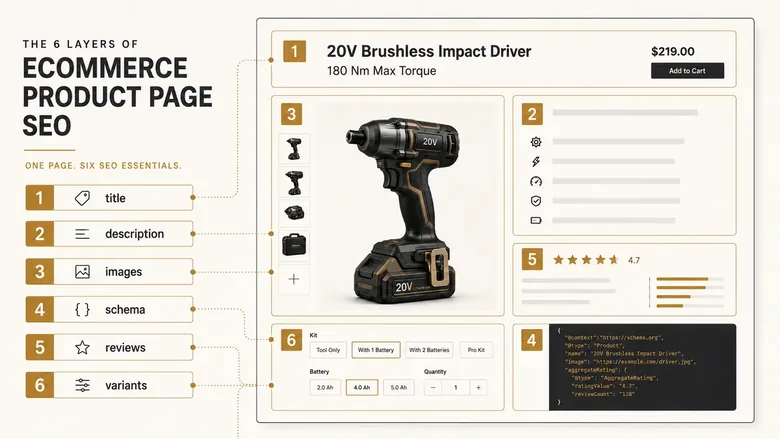
What makes the product page its own discipline is intent. A product page catches a shopper at the moment they are closest to buying, so the bar is higher than on a blog post: the copy has to convince a person and the markup has to inform a machine, at the same time, on the same page. Good SEO for ecommerce product pages is judged one page at a time, and the six layers below are where each page is won or lost.
| Layer | What to optimize | Why it ranks or converts |
|---|---|---|
| Title tag & H1 | Product name plus brand, model, or key spec, matched to how buyers search | Wins the click in results and tells Google the page’s exact subject |
| Product description | Unique, buyer-centric copy with specs and use cases, not manufacturer boilerplate | Differentiates the page from identical listings so Google has a reason to rank it |
| Images | Descriptive file names, alt text, compression, and image structured data | Feeds image and visual search, protects load speed, and lifts conversion |
| Product schema | Product, Offer, and AggregateRating in JSON-LD | Earns price, availability, and star rich results in Search and AI answers |
| Reviews & UGC | Real ratings, review text, and answered buyer questions | Adds fresh, unique content and raises purchase likelihood sharply |
| Variants & URLs | Canonical rules, variant handling, and short descriptive URLs | Consolidates ranking signals instead of splitting them across duplicates |
Match Product Titles and Meta to How Buyers Search
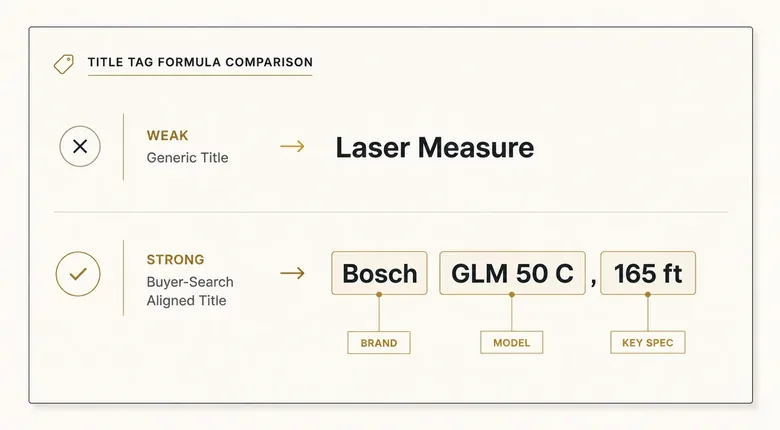
Start with the title tag and H1, because they tell both the shopper and the search engine exactly what the page sells. A strong product title leads with the product name and adds the details buyers actually type: brand, model number, size, or a defining spec. “Bosch GLM 50 C Laser Measure, 165 ft” ranks and reads better than a bare “Laser Measure,” because it matches real queries instead of hoping to catch them.
Keep the title under roughly 60 characters so Google does not truncate it, give the page one H1 that names the product, and write a meta description that sells a reason to click: a benefit, a key spec, and a differentiator like in stock, ships today, or free returns. The meta description is not a ranking factor, but it decides clicks, and clicks on a product page are pre-qualified buyers.
B2B changes the search language. Buyers look up part numbers, MPNs, and precise specs (“1/2-inch 316 stainless hex bolt DIN 933”), often more than brand names, so put the SKU or manufacturer part number and the exact spec phrasing in the title and the visible copy. A page that only says “Hex Bolt” will never meet a buyer who searched the part number they already have in hand.
Write Product Descriptions Google Hasn’t Already Indexed
Write a product description that exists nowhere else, because the fastest way to make a product page invisible is to publish the copy the manufacturer sent to every retailer. When your description matches the one on twenty other sites, you hand Google twenty identical pages and a single slot to rank them in, and it has no reason to choose yours.
To be precise about the risk, Google’s own position is that duplicate product descriptions carry no penalty. The damage is competitive, not punitive: Google simply picks the source it trusts to show, usually the retailer that is more relevant, in stock, or more useful to the searcher. That is still a reason to rewrite, because “no penalty” and “cannot rank” often describe the same thin page. Baymard Institute’s product-page research found that 52% of ecommerce sites lack descriptive text and graphics that help a buyer understand what they are looking at.
Replace boilerplate with copy that answers real buying questions: what the product does, who it fits, the specs that matter, what is in the box, and how it compares to the obvious alternative. In B2B especially, the description is where a buyer checks fit before they ever request a quote, which is why spec-rich product content shows up in every list of B2B ecommerce best practices that move revenue, not just rankings.
IMPORTANT
Copying the manufacturer’s description is not against Google’s rules and earns no penalty. It just drops your page into a lineup of identical listings and lets Google pick whichever store it trusts more, which is rarely the one that copied. Treat unique descriptions as a ranking move, not a compliance one.
Optimize Product Images for Search and Speed
Optimize every product image for three jobs at once: image search, page speed, and the shopper’s own eyes. Name the file descriptively, write alt text that describes the product, and compress the file so it does not drag down load time. “bosch-glm-50c-laser-measure.webp” tells Google what the image shows; “IMG_0423.jpg” tells it nothing.
Images are not a side detail on a product page, they are the first thing most people look at. Baymard’s testing found that 56% of users’ first action on a product page is to explore the images, so resolution, zoom, and in-scale shots directly affect whether a visitor stays. They also affect ranking through speed. In a Google and Deloitte study, a 0.1-second mobile speedup lifted retail conversions by 8.4% and average order value by 9.2%, and oversized gallery images are the most common thing wrecking a product page’s Largest Contentful Paint.
So export images as compressed WebP at the dimensions they actually display, lazy-load everything below the fold, and add image structured data so your photos are eligible for richer image results. Compression and correct sizing are not just image chores, they are the same Core Web Vitals fundamentals a technical SEO checklist works through line by line, and technical SEO for ecommerce is where product templates, rendering, and crawl behavior break most often.
Add Product Schema That Earns Rich Results
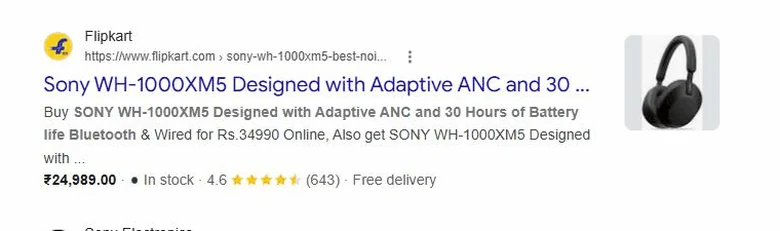
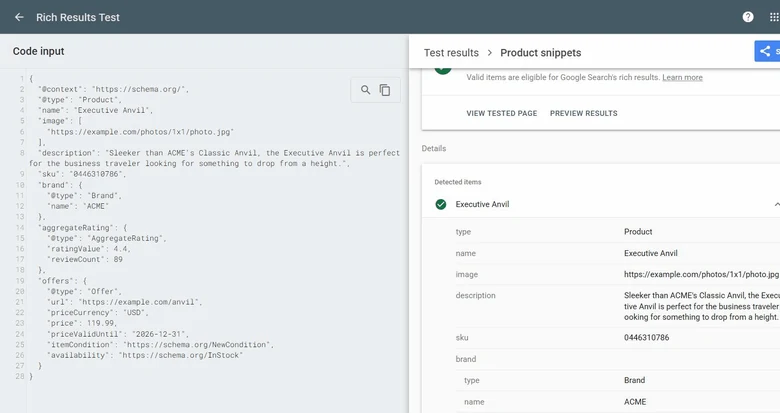
Add Product structured data so search engines can show your price, availability, and star rating directly in the results. Product schema, with its Offer and AggregateRating properties, is what turns a plain blue link into a rich result with a photo, a price, and review stars, and it is the same structured content AI shopping answers read when they decide what to cite.
At minimum, a product page’s JSON-LD should declare:
- Product with name, image, description, sku, and brand
- Offer with price, priceCurrency, and availability (in stock, out of stock, or preorder)
- AggregateRating with ratingValue and reviewCount, plus individual Review items
Google reads this in two flavors, and it is worth knowing the difference: Product structured data can produce merchant listing experiences (shopping results, driven by price and availability) or product snippets (the star ratings and review counts under an organic result). The payoff is real: Google’s documentation reports that pages shown as rich results can earn markedly higher clickthrough, with Nestlé measuring an 82% higher rate on rich-result pages. Validate every product template in the Rich Results Test, and when you run thousands of them, reconcile the markup across the catalog the way the full ecommerce SEO audit checks schema and feed alignment at scale.
🔧 Schema Markup Validator
🔧 Screaming Frog
📊 Semrush Site Audit
📊 Google Merchant Center
Turn Reviews and Q&A Into Ranking Fuel
Collect and display real customer reviews on the product page, because they add the one thing manufacturer copy never will: fresh, unique, keyword-rich content that updates itself. Reviews also feed the AggregateRating stars in your schema and push hesitant buyers toward the checkout, which is why they earn their place near the top of the fix list.
The conversion math is hard to argue with. The Spiegel Research Center at Northwestern found that a product with five reviews is 270% more likely to sell than one with none, and the lift reaches 380% on higher-priced items where buyers feel more risk. A question-and-answer block does similar double duty, capturing the long-tail phrasing real buyers use and giving you honest content to mark up.
Reviews are the only words on a product page that write themselves, stay unique, and get more valuable over time. A page that suppresses them to look tidy is throwing away its best-converting, most-crawlable content.
Two rules keep this clean. Only mark up ratings and reviews that genuinely appear on the page, since AggregateRating schema with no visible reviews is a structured-data violation that gets rich results suppressed. And in B2B, lean on verified-buyer reviews and spec-level questions, because a purchasing manager trusts “held up through two years of daily shop use” far more than a five-star emoji.
Handle Variants, Canonicals, and Product URLs
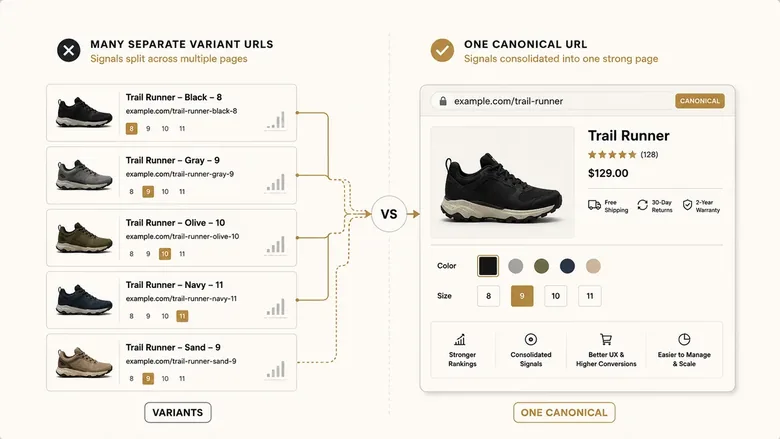
Decide how product variants and URLs resolve, because a single product in eight colors and five sizes can spawn forty near-identical pages that split your ranking signals. The rule for most catalogs is one canonical product page that holds the variants, with the selector switching options on the page instead of minting a new indexable URL for each combination. The platform decides how much control you have over those defaults, which is why platform-level SEO control belongs in the choice before the catalog is rebuilt.
Keep a variant on its own indexable URL only when it earns one: a color or size with genuinely distinct search demand, specs, or price worth ranking separately. Apply the same logic to a product that lives in several categories by choosing one canonical home, so /tools/laser-measures/glm-50c and /deals/glm-50c stop competing with each other. Keep the URL itself short, readable, and stable, with the product name in it and no session or tracking parameters baked in.
PRO TIP
Add a self-referencing canonical to every product page, even ones without variants. It is the cheapest insurance against the tracking parameters and session IDs that quietly create duplicate URLs of pages you thought were unique.
In B2B, where one SKU can sit under several customer-specific catalogs, the B2B ecommerce examples worth copying pick a single canonical home for each product and let the account layer handle pricing and access, rather than exposing a separate indexable page per contract.
Connect Product Pages With Internal Links and Breadcrumbs
Link every product page from more than its category, because a page no internal link points to is a page Google treats as unimportant. Related-product modules, “frequently bought together” blocks, buying guides, and breadcrumb navigation all pass authority into the product page and give buyers a path to it. That category layer matters because category page SEO decides how much commercial authority flows down to the products beneath it.
Breadcrumbs do this and more: paired with BreadcrumbList schema, they show the hierarchy in search results and reinforce where the product sits in the catalog. Related and complementary product links spread authority sideways across a category, while buying guides act as informational spokes that funnel both link equity and ready-to-buy readers into the commercial page. That funnel from guides into product pages is ordinary topic-cluster logic applied to a catalog, exactly how a B2B SEO strategy connects clusters to buyer intent.
In B2B, extend the same links to the assets buyers actually check before purchase: spec sheets, datasheets, compatibility charts, and installation guides. Linking a product to its datasheet is both a helpful path for the buyer and a relevance signal for the crawler, and it keeps those technical pages from becoming orphans of their own.
Optimize a Product Page for SEO: The Seven-Step Workflow
Here is the sequence to optimize a single product page from start to finish. Run it top to bottom the first time, then it becomes a template you apply across the catalog.
Workflow · about 45 minutes per page for a first pass
How to optimize a product page for SEO: the seven-step sequence
Take one product page from manufacturer boilerplate to a unique, well-marked-up listing that can rank and convert.
Match the title and H1 to real searches
Lead the title tag and H1 with the product name, add the brand, model, or spec buyers type, and keep the title under about 60 characters so it does not truncate.
Rewrite the description in your own words
Replace any manufacturer boilerplate with unique copy covering specs, use cases, compatibility, and the questions buyers ask before they commit.
Optimize and compress every image
Give each image a descriptive file name and alt text, export it as a compressed WebP at the right dimensions, and lazy-load anything below the fold.
Add Product, Offer, and AggregateRating schema
Mark up the product, its price and availability, and its rating in JSON-LD, then confirm it passes the Rich Results Test before you ship it.
Surface reviews and answer buyer questions
Show real customer reviews and a Q&A block so the page gains fresh, unique content and the star rating your schema declares.
Set the canonical and consolidate variants
Add a self-referencing canonical, point color and size variants at one product URL, and pick a single home for products that live in multiple categories.
Link the page in and check Search Console
Link the product from its category, related items, and breadcrumbs, then watch the Performance and rich-result reports to confirm it earns impressions and snippets.
When to Prioritize Which Product-Page Fix
Not every fix matters equally on every page, so prioritize by what is actually holding a page back. Use unique descriptions and schema first on large catalogs running manufacturer copy, reviews and images first on pages that rank but do not convert, and indexable above-the-gate content first on B2B pages that hide their price. The table below turns that judgment into a rule you can apply page by page.
| If your product page… | Fix first |
|---|---|
| Uses the manufacturer’s stock description | Rewrite the description; it is the biggest single lever |
| Ranks but few people click or buy | Sharpen the title, add reviews, and upgrade the images |
| Shows no price because it is quote-gated (B2B) | Add indexable specs and buying content above the gate |
| Comes in many colors, sizes, or configurations | Set one canonical and consolidate the variant URLs |
| Is temporarily out of stock | Keep it live and update availability in the Offer schema |
| Is discontinued for good | 301 to the successor product, or 410 if there is none |
The out-of-stock row is where stores lose rankings by accident. Deleting a sold-out product and returning a 404 throws away the links and rankings the page earned, so keep temporary stockouts indexed with honest availability in schema, redirect discontinued items to a successor, and reserve a clean 410 for products that are gone for good.
Measure Product Page SEO and AI Visibility
Measure product page SEO in Search Console first, where the Performance and rich-result reports show whether pages earn impressions, clicks, and the price and review snippets your schema requested. Filter Performance to product URLs, watch the merchant listing and product snippet enhancement reports for errors, and treat a drop in rich-result eligibility as an early warning that a template broke.
Then measure something the classic reports miss: whether AI answer engines cite your product pages at all. That matters because shopping is exactly where AI answers are spreading. Semrush found that commercial-intent AI Overviews grew 71% across a six-month window into 2026, and a citation there sends buyers without ever registering as a blue-link click. Track your key products in an AI-visibility tool or by spot-checking the assistants your buyers use, and judge a page on both its Search Console numbers and whether the machines recommend it.
Frequently Asked Questions
Start with a unique title and H1 that name the product the way buyers search, replace any manufacturer description with original copy, optimize and compress the images, add Product schema with Offer and AggregateRating, show real reviews, and set one canonical URL. Then link the page internally and confirm it in Search Console.
They will not earn a Google penalty, but they hold pages back. When your description matches dozens of other retailers, Google has many identical pages and one slot, and it usually favors the store that added unique specs, reviews, or buying context. Rewriting the description is the highest-return fix on most product pages.
For most catalogs, no. Point color and size variants at one canonical product page and switch options on the page, so ranking signals stay consolidated instead of split across near-duplicates. Give a variant its own indexable URL only when it has genuinely distinct search demand, specs, or price worth ranking separately.
Product structured data is the core, with Offer for price and availability and AggregateRating plus Review for stars. Add BreadcrumbList for the hierarchy and mark up any FAQ or Q&A. Only declare ratings that genuinely appear on the page, then validate everything in Google’s Rich Results Test before publishing.
Structure the page as a clean answer: a clear product name, a plain-language description, specs in a readable list or table, valid Product schema, and real reviews. AI answer engines lift the same structured, well-marked-up content that earns rich results, so the schema and clarity that help you rank also help you get cited.