Fifty-three percent of all B2B website traffic comes from organic search. That stat from BrightEdge has been floating around for years, and it’s still roughly accurate. But here’s what most B2B companies get wrong: they treat SEO as a traffic play when it should be a pipeline play. They publish blog posts, track keyword rankings, and celebrate when monthly sessions tick up. Meanwhile, the sales team is still complaining about lead quality.
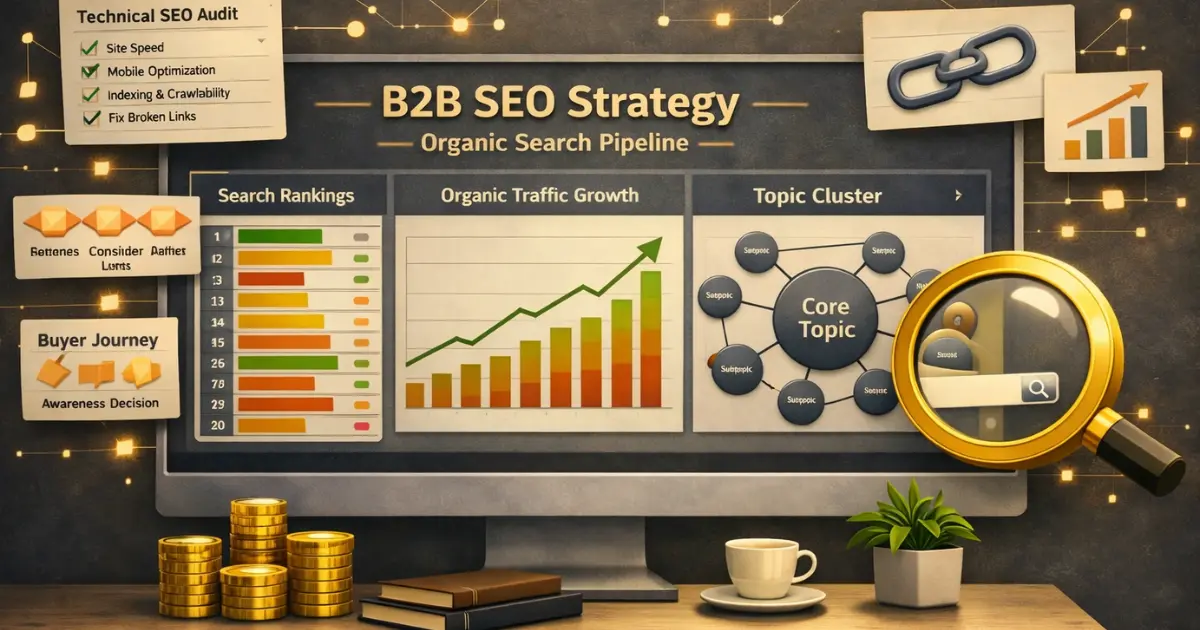
The missing piece isn’t more content. It’s a b2b seo strategy built around how business buyers actually search, evaluate, and buy.
Not a B2C playbook with “B2B” slapped on top. The gap between companies that generate pipeline from organic search and those that just generate pageviews comes down to strategy that accounts for longer buying cycles, multiple decision-makers, and search queries that reflect commercial research rather than impulse buying.
This guide walks through exactly how to build that strategy. Seven steps, from keyword research to measurement, with the specific tools, frameworks, and prioritization logic that work for B2B companies at every stage.
Key Takeaways
- B2B SEO targets longer buying cycles with multiple decision-makers. Your keyword strategy must map to every stage from awareness through vendor selection.
- Topic clusters (pillar + cluster articles) outperform isolated blog posts because they build topical authority Google rewards with higher rankings.
- Technical SEO foundations (site speed, crawlability, schema markup) are non-negotiable before investing heavily in content production.
- Target low-KD, high-intent keywords first. Early wins on easier terms build domain authority before you compete on harder keywords.
- Measure SEO success by pipeline contribution and SQLs, not just traffic and rankings. If SEO isn’t producing revenue, the strategy needs fixing.
What Is a B2B SEO Strategy?
A B2B SEO strategy is a structured plan for increasing organic search visibility specifically for business-to-business companies. It covers keyword research, technical optimization, content creation, and link building, all tailored to how B2B buyers search and make purchasing decisions over longer sales cycles with multiple stakeholders involved. For the local-SEO variant — Google Business Profile, Local Services Ads, and city-targeted content for service-area businesses — see our local lead generation guide.
For companies selling through digital channels, a B2B ecommerce strategy adds another layer to your organic acquisition model.
The mechanics of SEO are the same whether you’re B2B or B2C. Google doesn’t run a separate algorithm for business websites. But the execution differs in every way that matters: the keywords you target, the content formats you use, the conversion paths you build, and the metrics you track. A B2C searcher typing “best running shoes” might convert in the same session. A B2B buyer searching “best CRM for mid-market SaaS” is starting a process that could take three to nine months and involve a buying committee of six to ten people, according to Gartner’s B2B buying research.
Why B2B SEO Is Different from B2C
If you’ve run SEO for a B2C brand and assume the same playbook works for B2B, you’ll burn through budget fast. Here’s where the approaches diverge.
Search Volume Is Lower (And That’s Fine)
B2B keywords often have 100 to 2,000 monthly searches instead of the 50,000+ you see in consumer markets. That scares marketers who equate volume with value. But a keyword like “enterprise data integration platform” at 320 monthly searches might represent $500K+ in contract value per conversion. In B2B, a single organic lead can justify a year of SEO investment.
Buying Cycles Are Long and Non-Linear
B2B purchases involve research phases, internal approvals, security reviews, and pilot programs. Your SEO strategy needs content at every stage: educational posts for problem-aware searchers, comparison content for evaluators, and technical documentation for the procurement team running due diligence. A blog post that ranks well but only serves the awareness stage leaves money on the table. The same logic applies technically on a store, where category and product pages that engines cannot crawl or index never rank no matter how good the content is, which is the gap a focused ecommerce SEO audit for product catalogs closes.
Multiple Stakeholders Search Differently
The CMO searches “marketing automation ROI.” The marketing ops manager searches “HubSpot vs Marketo integration features.” The CFO searches “marketing automation cost.” One product, three completely different keyword sets. A strong B2B SEO strategy maps keywords to each stakeholder persona, not just one ideal buyer profile.
How to Build a B2B SEO Strategy in 7 Steps
Here’s the process that works. Not theory. The actual sequence of steps that moves a B2B site from “we should do SEO” to “SEO is generating 40% of our pipeline.”
Step 1: Map Keywords to Your Buyer’s Journey
Pull your target keywords from Semrush or Ahrefs, then organize them by funnel stage. This is the foundation everything else builds on.
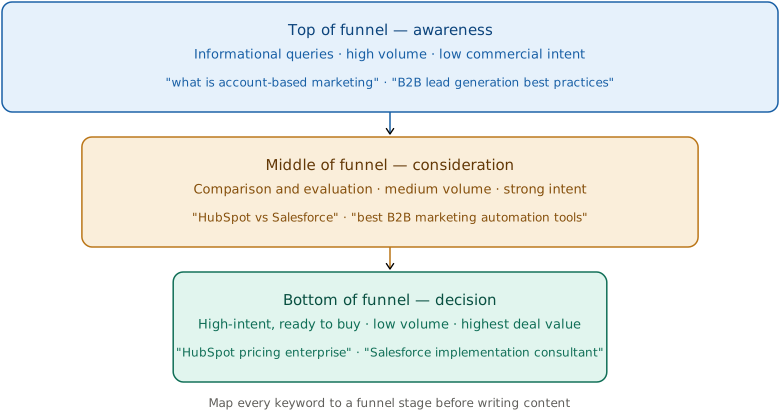
Top of funnel (awareness): Informational queries where the buyer is researching a problem. Examples: “what is account-based marketing,” “B2B lead generation best practices.” Higher volume, lower commercial intent.
Middle of funnel (consideration): Comparison and evaluation queries. Examples: “HubSpot vs Salesforce,” “best B2B marketing automation tools.” These signal active vendor research with strong commercial intent.
Bottom of funnel (decision): High-intent queries from buyers ready to act. Examples: “HubSpot pricing enterprise,” “Salesforce implementation consultant.” Lower volume, but each click is worth 10x a top-of-funnel visit.
PRO TIP
In Semrush’s Keyword Magic Tool, filter by “Intent” to separate informational (I) keywords from commercial (C) and transactional (T) ones. Export the results, tag each keyword with its funnel stage in a spreadsheet, and you’ve got a content roadmap. For a deeper walkthrough of this process, see our guide to B2B keyword research.
For a new B2B site with low domain authority (DA under 20), prioritize keywords with KD scores below 30. You can go after harder keywords later once you’ve built authority through early wins on easier terms.
Step 2: Build Topic Clusters Around Pillar Pages
Individual blog posts don’t build authority. Topic clusters do. A topic cluster consists of one pillar page (a broad, in-depth guide on a core topic) supported by several cluster pages (narrower articles on related subtopics) that all link back to the pillar.
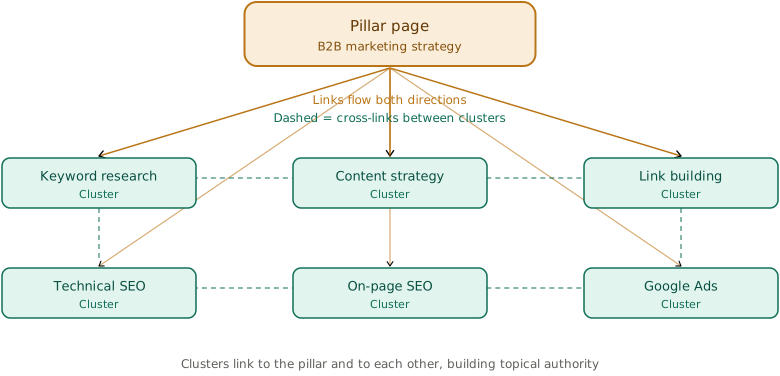
For example, a “B2B Marketing Strategy” pillar page might link to cluster pages on B2B marketing frameworks, account-based marketing metrics, content marketing templates, and go-to-market strategy. Each cluster page links back to the pillar. Google sees this interconnected structure and understands that your site has deep expertise on the topic.
Why this matters for rankings: Google increasingly rewards topical authority. A site with 10 connected articles about B2B marketing will outrank a site with one standalone post, even if that single post is longer and better written. The cluster structure signals depth and expertise that individual pages can’t.
When we built the topic cluster architecture for Ivris Tech, the pillar page moved from position 18 to page one within six weeks. The cluster pages reinforced each other faster than we expected because Google re-crawled the pillar every time a new cluster article went live with a contextual backlink to it. For B2B teams without the in-house capacity to ship this volume of cluster work in 90 days, the right move is often outsourcing to an agency that already does it at pace — our 10 best B2B SEO agencies review breaks down which agencies fit which stage.
Step 3: Run a Technical SEO Audit
Before investing in content, make sure Google can actually crawl and index your site properly. Technical issues silently kill rankings. For the full walkthrough, use our technical SEO checklist. A site with great content but slow load times, broken pages, or crawl errors will underperform a mediocre site with clean technical foundations. The checklist tells you what to inspect; the five-stage process for actually running that audit, from crawl to verified fix, is what turns the list into recovered rankings.
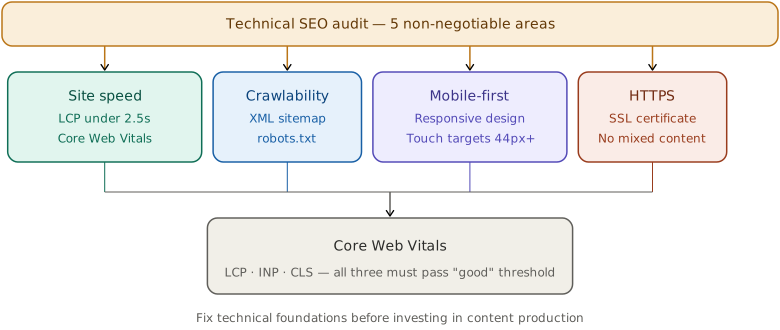
The non-negotiable technical checklist:
- Site speed: Target under 2.5 seconds LCP (Largest Contentful Paint). Run your site through Google PageSpeed Insights and fix anything flagged. Mobile speed matters more than desktop because Google’s research shows over 70% of B2B searches happen on mobile.
- Crawlability: Submit an XML sitemap to Google Search Console. Check for crawl errors weekly. Make sure important pages aren’t accidentally blocked by robots.txt.
- HTTPS: Non-negotiable. If your site isn’t on HTTPS, fix it before doing anything else.
- Mobile-first indexing: Google indexes the mobile version of your site first. If your mobile experience is broken, your rankings will suffer regardless of how good desktop looks.
- Core Web Vitals: LCP, CLS (Cumulative Layout Shift), and INP (Interaction to Next Paint). These are confirmed ranking signals. Aim for “good” scores on all three.
Use Screaming Frog (free for up to 500 URLs) to crawl your site and identify broken links, missing meta tags, duplicate content, and redirect chains. Fix the critical issues before publishing new content. Once a site outgrows that free ceiling, the upgrade path runs through the technical SEO tools that crawl past the 500-URL free ceiling. A business that also competes in a local market runs a parallel stack for citations and map-pack tracking, which is a separate local SEO toolset from the crawlers, not an upgrade of them.
Step 4: Create Content That Matches Search Intent
Google’s job is matching searchers with the content that best answers their query. If someone searches “what is lead scoring” and your page is a product demo, you won’t rank regardless of how well optimized it’s. Intent mismatch is the most common reason B2B content fails to rank.
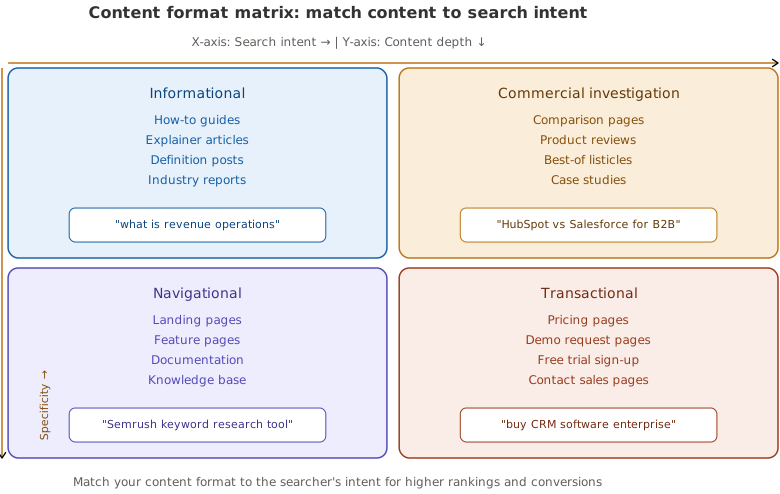
Before writing any page, Google the target keyword and study what’s already ranking. Are the top results how-to guides, comparison lists, definition posts, or product pages? Match that format. Then beat it on depth, specificity, and usefulness. On an ecommerce SERP that format is rarely a product page, it’s a category page built to rank for the head term, which is a different optimization job than a product page.
Content types that work at each funnel stage:
- Awareness: “What is X” guides, industry trend analysis, data-driven research, educational blog posts
- Consideration: “X vs Y” comparisons, “best tools for” roundups, case studies with specific results, frameworks and templates
- Decision: Pricing pages, product demos, implementation guides, ROI calculators, customer testimonials with revenue impact
One common mistake: writing everything as TOFU (top-of-funnel) awareness content. Most B2B blogs are 80% educational posts and almost nothing at the consideration or decision stage. That’s a content gap, and filling it (with comparison posts, case studies, and pricing content) often produces more pipeline than publishing ten more awareness articles.
Step 5: Optimize On-Page SEO Elements
On-page optimization is where many B2B sites leave easy wins on the table. Each page needs these elements dialed in:
Title tag: Include your primary keyword in the first 60 characters. Front-load the keyword. Add a year for freshness signals on evergreen content. Example: “B2B Lead Generation: 15 Strategies That Work (2026)” beats “The Ultimate Guide to Everything About B2B Lead Generation.”
Meta description: 150 to 155 characters. Include the keyword (Google bolds it in results). Write it as a sales pitch for the click, not a summary of the article. According to Backlinko’s CTR research, well-optimized meta descriptions can increase organic click-through rates by 5 to 10%.
Header structure: One H1 (your page title). H2s for major sections (include secondary keywords naturally). H3s for subsections within each H2. This hierarchy helps Google understand your content structure and can earn you featured snippets.
Internal linking: Link every cluster page back to its pillar. Link between related articles across clusters. Use descriptive anchor text (“our guide to B2B keyword research”) instead of “click here.” Internal links distribute page authority and help Google discover your content.
Featured snippet optimization: For any “What Is X?” section, write a clean 40 to 60 word definition paragraph immediately after the H2. Start with “[Topic] is…” Google frequently pulls this format into the featured snippet (Position 0).
These elements apply to every page type, but ecommerce templates carry extra requirements on top of them. If your B2B site sells online, product and category pages need their own on-page treatment, which ecommerce product page SEO covers in full.
Step 6: Build Authority with Strategic Link Building
Backlinks remain one of Google’s strongest ranking signals. For B2B sites, link building looks different from B2C because your content needs to earn links from industry publications, not lifestyle blogs. When earning those industry links outpaces what your team can do by hand, B2B SaaS companies move the motion to one of the specialist link building services built for SaaS rather than letting it stall.
Tactics that work for B2B link building:
- Guest posting: Write for industry publications in your space. Target sites with DA 30+ that your audience actually reads. One quality guest post per month is more valuable than ten low-quality directory submissions.
- Original research: Publish surveys, benchmarks, or data studies. “We surveyed 500 B2B marketers on their SEO budgets” is the kind of content that earns editorial links from sites that cite your data.
- Broken link building: Find broken links on industry resource pages using Ahrefs’ broken backlinks report. Email the site owner suggesting your relevant content as a replacement.
- HARO and expert quotes: Respond to journalist requests on Connectively (formerly HARO) or Quoted. Provide expert commentary in exchange for a backlink. Consistent responses can earn 2 to 4 links per month from DA 40 to 80+ publications.
Avoid buying links, participating in link exchanges, or using private blog networks (PBNs). Google’s link spam algorithms are sophisticated enough to detect and penalize these tactics. The short-term rank boost isn’t worth the long-term penalty risk. The safe alternatives run from white-hat outreach to auditing and disavowing a risky profile, which together are how you earn backlinks without a Google penalty.
Step 7: Measure What Actually Matters
Most B2B companies track the wrong SEO metrics. Rankings and traffic are leading indicators. They tell you the engine is running. But they don’t tell you if the engine is producing revenue.
Aligning your SEO metrics with RevOps best practices ensures that organic traffic translates into pipeline velocity.
For a complete guide to configuring GA4 for B2B pipeline tracking, see our Google Analytics traffic setup and reporting guide.
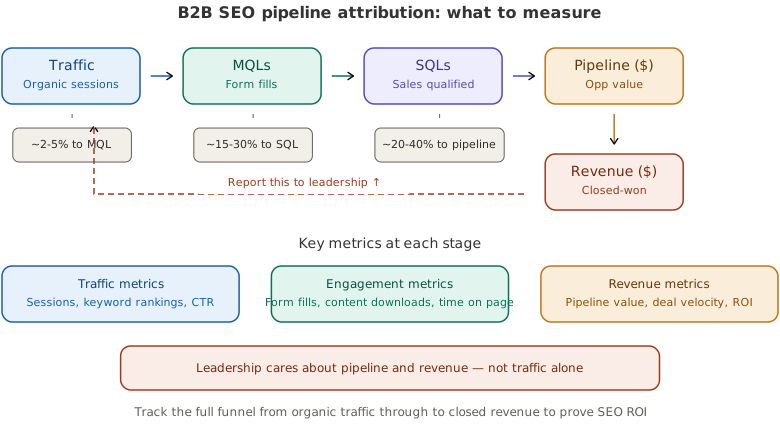
The metrics that justify your SEO budget to leadership:
- Marketing-sourced pipeline: How much pipeline value came from organic search as the first or assisted touch? Set this up in your CRM (HubSpot or Salesforce) with UTM tracking and source attribution.
- Organic SQLs (Sales Qualified Leads): Not just MQLs. How many organic leads did sales actually accept and work? This is the metric that bridges marketing and sales alignment.
- Content-to-conversion ratio: What percentage of organic visitors take a conversion action (demo request, trial signup, contact form)? If traffic is growing but conversions are flat, you have a content quality or intent mismatch problem.
- Revenue influence: Of closed-won deals, how many touched organic content at any point in the buyer journey? Multi-touch attribution (not just last-click) shows SEO’s true contribution.
IMPORTANT
Set up multi-touch attribution from day one. In B2B, the average buyer interacts with 20+ touchpoints over 3 to 6 months before purchasing. Last-click attribution will always undercount SEO’s contribution because organic search typically influences early and mid-funnel, while direct or paid gets the last click. Running that model across 20-plus touches and a full buying committee is more than GA4 will do on its own, which is the gap marketing attribution software built for multi-touch B2B journeys exists to fill.
In our experience, the teams that report SEO metrics alongside pipeline numbers get their budget renewed. The ones that only show traffic growth and keyword positions eventually lose funding because leadership can’t connect those numbers to revenue. Start with pipeline attribution, even if the data is imperfect in month one.
B2B SEO and AI Overviews: What Changed in 2025-2026
Google’s AI Overviews now appear on a significant percentage of B2B search queries. This changes the SEO game in two ways: fewer clicks on traditional organic results (because the AI Overview answers the query directly), and a new source of visibility for sites that get cited in the overview. Knowing which of those two outcomes you are getting, answered-and-skipped versus cited, is exactly what AI SEO and GEO visibility platforms are built to measure. Measuring that split is one job; closing it across both surfaces is why a growing tier of SEO agencies now deliver rankings and AI-answer citations as one engagement.
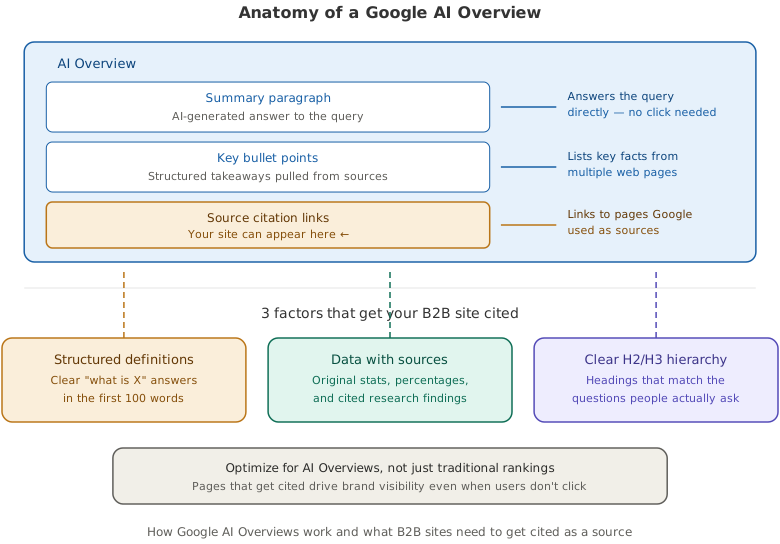
To get cited in AI Overviews, your content needs to be well-structured (clear H2/H3 hierarchy), authoritative (established E-E-A-T signals), and directly answer the search query in concise, factual language. The sites appearing in AI Overview citations are overwhelmingly the same sites ranking in the top 20 organic results. So traditional SEO is a prerequisite for AI visibility, not a competing strategy. For the specific structural and content techniques that get pages cited, see our deep-dive on how to optimize content for Google AI Overviews.
How to optimize specifically for AI Overview citations:
- Lead every H2 with a clean definition. Write a 40-50 word paragraph directly after each H2 that answers the section’s implied question in plain language. AI Overviews pull these short, factual blocks disproportionately.
- Cite data with named sources. “According to Gartner’s 2025 B2B report” gets cited. “Studies show” does not. Every stat should link to its origin.
- Use numbered lists for process steps. AI Overviews favor structured lists (1, 2, 3…) over prose when the query implies “how to.” Your H3s already do this if they’re numbered steps.
- Add FAQ schema. FAQ markup gives Google explicit question-answer pairs to reference. Sites with FAQPage schema appear in AI Overview citations at a higher rate than those without, based on early 2026 SERP studies.
The practical takeaway: don’t panic about AI Overviews killing organic traffic. Instead, make sure your content is structured for both human readers and AI extraction. Clean definitions, clear step-by-step formats, and factual claims with cited sources increase the chance Google’s AI pulls from your content. If earning those citations across ChatGPT and Perplexity becomes a priority you would rather resource externally, answer-engine optimization agencies that specialize in it do exactly this work.
B2B SEO Tools Worth Your Budget
🔧 Ahrefs ($129/mo)
🕷️ Screaming Frog (Free/£259yr)
📈 Google Search Console (Free)
⚡ Google PageSpeed Insights (Free)
Semrush is the best all-in-one option for most B2B teams. Keyword research, competitive analysis, rank tracking, site audit, and content gap analysis in one platform. Worth it for the Keyword Magic Tool alone.
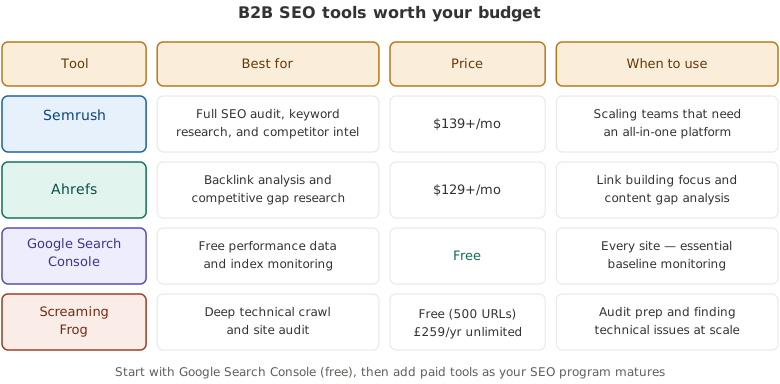
Ahrefs has the stronger backlink index. If link building is a major part of your strategy, Ahrefs’ Site Explorer and Content Explorer are the best tools for finding link opportunities and analyzing competitor backlink profiles.
Screaming Frog is essential for technical audits. Free for sites under 500 URLs. The paid version handles unlimited crawls and includes custom extraction, which is useful for large B2B sites.
Google Search Console is free and non-optional. It’s the only tool that shows you exactly which queries bring traffic, which pages are indexed, and what technical issues Google detects. Check it weekly.
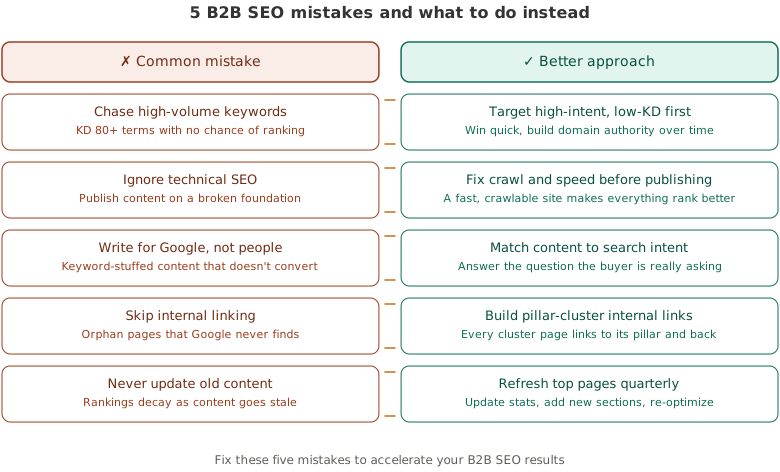
5 B2B SEO Mistakes That Stall Rankings
Targeting Keywords That Are Too Competitive
A new B2B site (DA under 20) targeting a KD 60+ keyword is a losing bet. It can take 12 to 18 months and significant link building to compete at that difficulty level. Start with KD under 25 keywords, build authority with early wins, then move to harder terms.
Ignoring Technical SEO
No amount of great content fixes a slow site, broken pages, or crawl errors. Run a Screaming Frog audit before every major content push. Fix what’s broken first.
Writing for Keywords Instead of People
If your content reads like it was written for a search engine (“B2B SEO strategy is an important B2B SEO strategy for B2B companies doing SEO”), readers bounce and Google notices. Write for the human reader first. Include keywords naturally, not mechanically.
Publishing Without Internal Links
Every new page should link to 2 to 3 existing pages, and 2 to 3 existing pages should be updated to link back to the new one. Orphan pages (zero internal links) are nearly invisible to Google’s crawler and won’t build the topical authority your cluster structure needs.
Not Updating Existing Content
SEO isn’t publish-and-forget. Google favors content that’s current and maintained. Revisit your top-performing pages every 6 to 12 months: update stats, add new sections, refresh the year in your title tag, and add links to newer content. A refreshed page often sees a ranking bump within weeks.
Frequently Asked Questions
Three to six months for initial ranking improvements on low-competition keywords. Meaningful pipeline impact typically shows at six to twelve months. The timeline depends on starting domain authority, content velocity, and keyword competitiveness. Sites publishing two to four quality articles per month with consistent link building see faster results than sporadic publishers.
Most mid-market B2B companies investing seriously in SEO spend $3,000 to $10,000 per month covering content production, tools (Semrush or Ahrefs at $130 to $200/month), and link building or outreach. In-house teams need the same tool budget plus headcount. The key is consistent investment. SEO compounds over time, so stop-start budgets produce stop-start results.
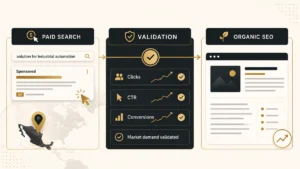
Both, for different reasons. Paid search delivers immediate visibility for bottom-of-funnel keywords and works during the 6 to 12 months while SEO ramps up. SEO builds a compounding asset: once you rank, organic clicks are free. The most effective B2B companies run paid search for transactional terms and SEO for informational and commercial terms simultaneously.
Yes. Google’s AI Overviews pull from pages already ranking in the top 20. Traditional SEO is a prerequisite for AI visibility, not a competing channel. Focus on clear definitions, structured content, and original data. Companies that abandon SEO because of AI search will lose visibility in both traditional and AI results.
Start Here
Open Semrush or Ahrefs right now. Enter the three problems your product solves, phrased the way your customers describe them (check sales call notes, not marketing copy). Pull the keyword results, filter to KD under 25, and tag each keyword by funnel stage. Pick the three easiest ones and write your first three articles targeting those terms.
That’s your quick-win foundation. Within 90 days, you’ll have a functioning SEO engine, not just a content calendar. And in B2B, that engine compounds: every article you publish makes every other article stronger.