
How did your last three customers describe their problem before they found you? Not in marketing language. In their actual words, from the first sales call, before your team cleaned up the terminology. That language is where the best B2B keywords hide. And most B2B companies never think to look there.
Standard b2b keyword research starts and ends with a tool: plug in a seed term, sort by volume, pick the biggest numbers. That approach works fine for B2C. For B2B, it misses the keywords that actually convert because the highest-intent B2B search terms often have low volume, use industry jargon your marketing team doesn’t think to search for, and reflect problems your buyers describe differently than your product team does.
This guide covers a five-step process for finding B2B keywords that drive pipeline, not just traffic. It starts with sources most teams ignore (sales calls, support tickets, competitor gaps) and ends with a prioritized keyword map you can turn into a content plan the same week.
Before mapping keywords to pages, confirm your site passes a technical SEO checklist — indexing issues can nullify even the strongest keyword strategy.
Key Takeaways
- The best B2B keywords come from sales conversations and support tickets, not just SEO tools. Your buyers describe their problems differently than your marketing team does.
- B2B keyword research must map terms to funnel stages (awareness, consideration, decision) because each stage requires different content types.
- Low-volume keywords aren’t low-value keywords. A term with 50 monthly searches and strong commercial intent can be worth more than a term with 5,000 searches and zero buying signal.
- Keyword difficulty (KD) determines your content calendar. Start with KD under 25 for early wins, then work up to harder terms as your domain authority grows.
- Group keywords into topic clusters, not isolated articles. Clusters build the topical authority that Google rewards with higher rankings across all related terms.
What Is B2B Keyword Research?
B2B keyword research is the process of identifying search terms that business buyers use when researching solutions, evaluating vendors, and making purchase decisions. It prioritizes commercial and informational queries tied to professional roles, focuses on industry-specific language, and maps keywords to a longer buying cycle with multiple stakeholders involved at each stage.
The core difference from B2C keyword research: volume matters less and intent matters more. A consumer searching “best headphones” might buy within minutes. A procurement manager searching “enterprise network monitoring tools comparison” is at the start of a six-month evaluation involving five stakeholders and a $200K budget. Your keyword strategy needs to account for that reality at every step.
Why B2B Keywords Work Differently from B2C
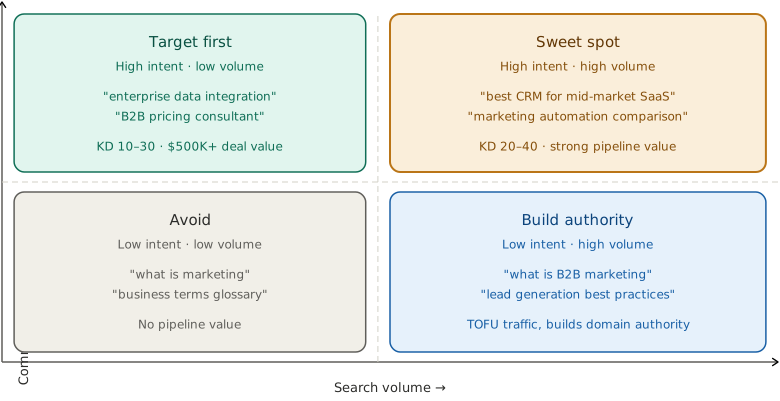
Volume Is Lower, and That’s the Point
B2B keywords rarely hit the volume numbers that make B2C marketers excited. A term like “CRM for manufacturing sales teams” might show 90 monthly searches in Semrush. That looks tiny next to “best CRM” at 40,000. But that 90-search term has specific commercial intent, minimal competition, and represents buyers with contract values in the six figures. In B2B, a single conversion from organic search can pay for your entire SEO program.
Intent Is More Layered
B2C search intent usually falls into two buckets: informational or transactional. B2B adds a third layer that matters more than both: evaluation intent. These are the “vs” keywords, “alternative to” keywords, and “best [tool] for [specific use case]” keywords where buyers are actively comparing solutions. This middle-of-funnel intent is where B2B keyword research earns its ROI, because the people searching these terms are in an active buying cycle. Once you’ve mapped the keywords, the next question is structuring content that gets cited — see our guide on how to optimize for Google AI Overviews.
Multiple Personas Search Differently
One purchase, three to five different searchers. The VP of Marketing searches “marketing attribution platform.” The marketing ops manager searches “HubSpot vs Marketo data integration.” The CFO searches “marketing technology ROI.” Each persona uses different vocabulary, asks different questions, and cares about different things. Strong B2B keyword research captures all of these angles, not just the one your marketing team would naturally think of.
How to Do B2B Keyword Research in 5 Steps
Step 1: Build Your Seed List from Real Sources
Most guides tell you to start with a keyword tool. Don’t. Start with the people who talk to your customers every day.
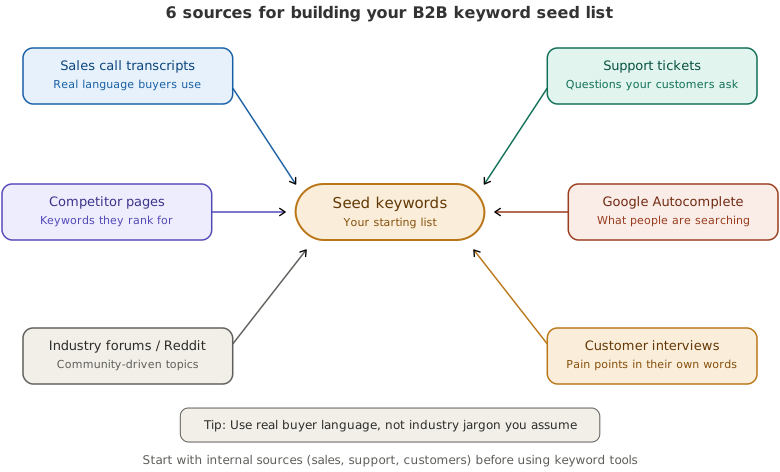
Sales call recordings. Listen to the first 5 minutes of your last 10 sales calls. Write down every phrase prospects use to describe their problem. According to Harvard Business Review’s B2B research, 70% of the buyer journey happens before a prospect ever talks to sales. The language they use on that first call reflects how they searched before they found you.
Customer support tickets. Support questions reveal exact phrasing your buyers use. “How do I set up lead scoring in HubSpot” from a support ticket becomes the seed keyword “lead scoring setup HubSpot” or “how to build a lead scoring model.”
Competitor content. Run your top three competitors through Semrush’s Organic Research tool or Ahrefs’ Site Explorer. Filter to their top-traffic pages. You’ll see which keywords they rank for and what content formats are working in your space.
Don’t copy their strategy. Use it to find gaps they missed.
Sales team vocabulary. Ask your sales reps: “What are the top five questions prospects ask in the first meeting?” and “What objections come up most often?” Each question maps to an informational keyword. Each objection maps to a comparison or decision-stage keyword.
Internal search data. If you have a site search feature, check what visitors are searching for on your own website. Google Search Console also shows queries where your site appeared but didn’t get clicks (the “Impressions” column with zero or low clicks). These are keyword opportunities you’re already close to ranking for. The queries you cannot see are the other side of the picture; Ahrefs’ February 2026 anonymization study found that about 47% of Search Console queries are hidden, and recovering the visible portion against landing pages reveals which keyword opportunities you have already partially captured.
PRO TIP
Create a shared document where sales reps log interesting phrases from prospect calls. Not full transcripts, just the specific language buyers use to describe problems and evaluate solutions. Update it weekly. After a month, you’ll have a seed list better than anything a keyword tool can generate on its own.
Go deeper with call intelligence tools. If your team uses Gong, Chorus, or any call recording platform, run a keyword search across the last 90 days of discovery calls for phrases like “struggling with,” “looking for,” “our biggest challenge is,” and “how do you handle.” Each hit surfaces real buyer language that keyword tools will never generate. One Gong search we ran returned 14 distinct phrases prospects used to describe a single pain point. Only two of those phrases showed any volume in Semrush. The other twelve had zero volume data but represented real search behavior that drove qualified traffic when we published content targeting them.
The same principle applies to G2 and Capterra reviews of your competitors. Filter to 3-star reviews (the most honest ones). Buyers describe exactly what they were searching for, what mattered, and what fell short. That language maps directly to commercial-intent keywords that sit at the bottom of the funnel.
Community mining. Search Reddit, LinkedIn comments, and industry Slack groups for discussions about your product category. The questions people ask in these spaces are often the exact long-tail queries they later type into Google. Tools like SparkToro can identify which communities your audience participates in.
Step 2: Expand and Validate with Keyword Tools
Now take your seed list to the tools. The goal here isn’t to find keywords from scratch (you already have seeds from Step 1). The goal is to expand those seeds into variations, check their volume and difficulty, and discover related terms you missed.
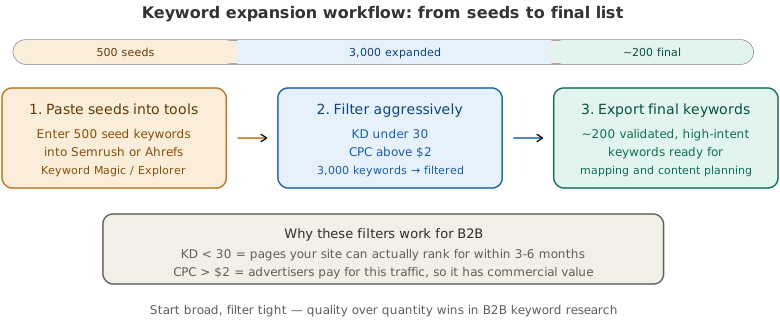
Semrush Keyword Magic Tool: Enter each seed keyword. Filter by KD (start under 25 for a new site), volume (50+ for B2B is fine), and intent type. Export the results. Semrush’s intent filter (Informational, Commercial, Transactional, Navigational) is particularly useful for B2B because it separates educational queries from buying queries automatically.
Ahrefs Keywords Explorer: Enter your seeds and check the “Also rank for” and “Questions” tabs. These surface long-tail variations that Semrush sometimes misses. Ahrefs also shows the actual SERP for each keyword, so you can see what type of content is ranking before you commit to writing.
Google Keyword Planner: Free, and useful for one thing the paid tools don’t do well: showing exact CPC data. High CPC keywords ($15+) in B2B almost always indicate strong commercial intent. If advertisers are willing to pay $25 per click for “b2b keyword research,” that tells you the keyword drives real revenue.
AlsoAsked.com: Type in your target keyword and get the full “People Also Ask” tree from Google. These questions make excellent H2 headings and FAQ sections, and they reveal what secondary information searchers want alongside your primary topic.
Step 3: Map Keywords to the Buyer’s Journey
Every keyword serves one stage of the B2B buyer journey. Tagging each keyword by stage turns a flat list into a content strategy. Here’s how to categorize them:
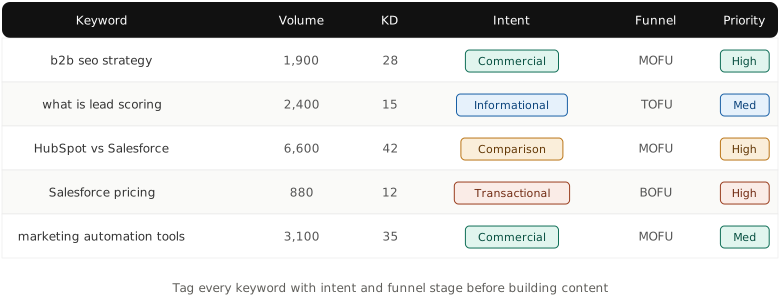
Top of funnel (awareness): Informational queries where the buyer knows they have a problem but hasn’t started evaluating solutions. Keywords include “what is,” “how to,” “best practices,” and “guide.” Examples: “what is revenue operations,” “B2B lead generation best practices.” These get the most search volume and attract the broadest audience.
Middle of funnel (consideration): Comparison and evaluation queries. Keywords include “vs,” “best,” “top,” “alternative,” “review,” or “[tool] pricing.” Examples: “hubspot vs salesforce for mid-market,” “best B2B marketing automation tools.” This is where intent gets strong and content starts influencing purchase decisions.
Bottom of funnel (decision): High-intent queries from buyers ready to buy. Keywords include “[product] pricing,” “[product] demo,” “[product] implementation,” or “[product] case study.” Volume is lowest here, but conversion rates are 5 to 10x higher than top-of-funnel content.
Tag every keyword in your spreadsheet with its funnel stage. Then look at the distribution. If 80% of your keywords are TOFU (awareness) and you have almost nothing at MOFU (consideration), that’s a gap. Most B2B companies over-index on awareness content and under-invest in the comparison and evaluation content that actually moves buyers toward a decision.
Step 4: Filter and Prioritize by Difficulty and Value
You now have hundreds of keywords. You can’t target them all. Prioritization is what separates keyword research that generates pipeline from keyword research that generates a very large, very useless spreadsheet.
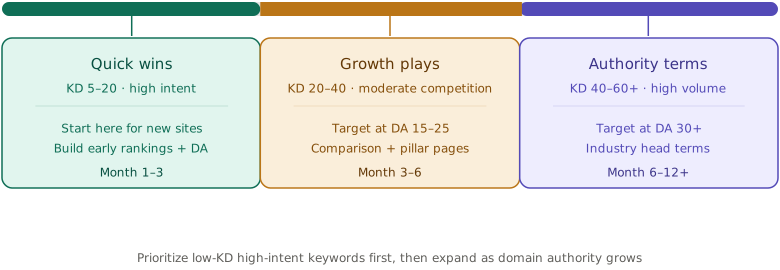
Filter by these criteria in order:
- Keyword difficulty (KD): For a new or low-authority site (DA under 20), filter to KD 25 or below. These are the keywords you can realistically rank for within 3 to 6 months. KD 30 to 50 is medium-term (6 to 12 months). KD 50+ is a long-term bet.
- Search volume: In B2B, anything above 50 monthly searches is worth considering. Don’t dismiss low-volume keywords with strong intent. A keyword with 40 searches/month and $20 CPC is more valuable than one with 2,000 searches and zero buying signal.
- Commercial intent: Prioritize keywords with CPC data above $5. High CPC means advertisers are bidding on those terms, which means those terms produce revenue. Keywords with zero CPC and zero commercial signals are often pure education with low conversion potential.
- Content gap: Check if you already have content targeting the keyword. If you do, optimize what exists before creating something new. If competitors rank but you don’t, that’s a gap worth filling.
After filtering, your list should shrink from hundreds to 30 to 50 actionable keywords. That’s your content roadmap for the next 3 to 6 months.
We prioritize any keyword where CPC exceeds $5 and keyword difficulty is under 30. That combination means real buyers are searching for it (advertisers are paying) and a newer site can realistically rank for it within a quarter. It’s a filter that eliminates 80% of the noise from any keyword export and keeps the focus on revenue-potential terms.
Step 5: Group Keywords into Topic Clusters
The final step is organizing your prioritized keywords into topic clusters. A cluster consists of one pillar keyword (broad, high-volume) supported by several cluster keywords (specific, long-tail) that all relate to the same core topic.
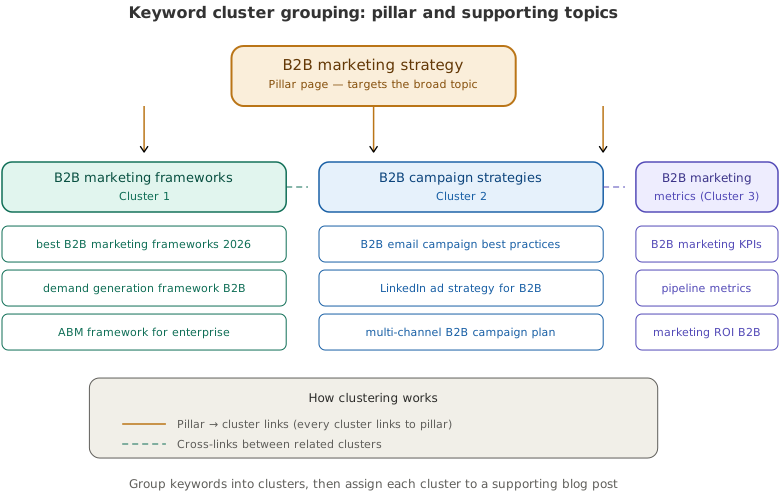
Example cluster:
- Pillar keyword: “b2b lead generation” (broad, 590 searches, the anchor article)
- Cluster 1: “lead scoring best practices” (specific tactic under the pillar)
- Cluster 2: “b2b cold email templates” (another tactic)
- Cluster 3: “account based marketing vs lead generation” (comparison within the topic)
Every cluster article links back to the pillar page. The pillar page links out to all its clusters. This structure tells Google that your site has deep expertise on the topic. For a practical example of how pillar-cluster architecture drives rankings for content strategy for SEO, see how we applied this framework to our own site, which boosts rankings across all the pages in the cluster, not just the individual articles.
For a detailed look at how to structure these clusters and build the overall framework, see our B2B SEO strategy guide.
IMPORTANT
Don’t assign two articles to the same keyword. Each page should target one unique primary keyword. If two pages compete for the same term (called keyword cannibalization), Google doesn’t know which to rank and often ranks neither well. Check your existing content before assigning new keywords.
B2B Keyword Research Mistakes to Avoid
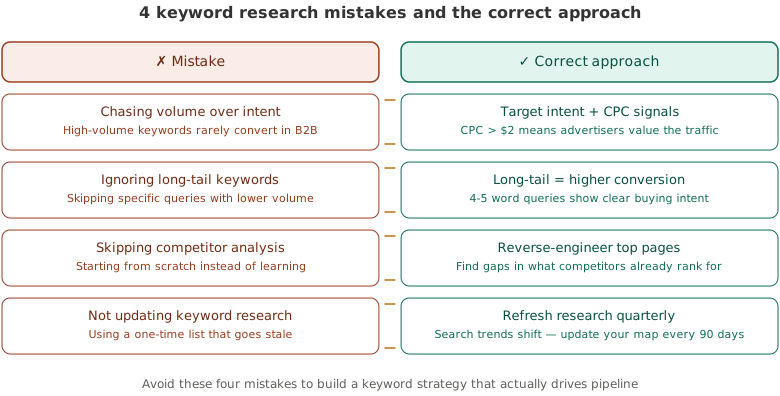
Chasing Volume Over Intent
A keyword with 10,000 monthly searches and informational intent will fill your blog with readers who never become customers. A keyword with 200 searches and commercial intent will fill your pipeline. In B2B, intent wins over volume every time. Sort by intent first, volume second.
Ignoring Long-Tail Keywords
Long-tail keywords (four or more words) have lower individual volume but higher conversion rates and lower competition. “CRM” has 450,000 monthly searches and you’ll never rank for it. “CRM for mid-market manufacturing companies” has 70 searches, zero competition, and represents a buyer with a six-figure budget. According to Semrush’s data, long-tail keywords account for 91.8% of all searches.
Skipping Competitive Analysis
If you’re not looking at what your competitors rank for, you’re doing keyword research with half the data. Run their domains through Ahrefs or Semrush, sort by traffic, and find the keywords they rank for that you don’t. Those gaps are your fastest opportunities.
Not Updating Your Research
Search behavior shifts. New competitors enter the market. Your product evolves. Keyword research done six months ago may not reflect today’s reality. Revisit your keyword map quarterly: check Google Search Console for emerging queries, run a fresh competitor analysis, and adjust your content calendar based on what the data shows now, not what it showed last quarter.
Frequently Asked Questions
One primary keyword and three to five secondary keywords per article. The primary goes in your H1, meta title, first 100 words, and one to two H2 headings. Secondary keywords appear naturally in the body and subheadings. Targeting 10+ keywords per page dilutes focus and rarely ranks well for any of them.
Start with KD under 25 in Semrush or Ahrefs. Once you’ve published 15 to 20 articles and earned backlinks, move to KD 25 to 40 for pillar content. Sites with DA under 15 targeting KD 50+ keywords are burning resources on content that won’t rank for 12 to 18 months.
Full refresh every six months. Check Google Search Console monthly for emerging queries. After every quarterly content review, add new keywords from People Also Ask changes, competitor moves, or product positioning shifts.
Google Search Console and Keyword Planner are useful for basics. For competitive gap analysis, difficulty scoring, and traffic estimates, you need Semrush (from $139/month) or Ahrefs (from $129/month). The investment pays for itself with the first article that ranks and generates a qualified lead.
Build Your Keyword Map This Week
Here’s the fastest path to a usable keyword strategy: Pull up your last 10 sales call recordings and write down every way prospects described their problem. Enter those phrases into Semrush, filter to KD under 25 and volume over 50. Tag each keyword by funnel stage. Group them into 3 to 4 clusters.
That’s your first quarter of content, built on real buyer language instead of guesswork. And that’s the difference between B2B keyword research that fills a spreadsheet and keyword research that fills a pipeline.