Search “demand gen vs performance max” and most results quietly assume you already know one thing: both are Google Ads campaign types. If you arrived thinking “demand gen” means your whole demand generation program, that is the first knot to untie.
This guide is about the campaign types. Demand Gen (the campaign formerly known as Discovery) and Performance Max are two boxes you pick inside Google Ads. They are not rival philosophies, and they are not the same thing as demand generation as a marketing strategy, which spans organic content, brand, and far more than paid ads. If your real question is strategic, the split between demand gen and lead gen is the better starting point.
Here we answer the tactical question a B2B advertiser actually types into Google: when do I run Demand Gen, when do I run Performance Max, and should I run both? The short version is that they sit at different points of the funnel and trade control for automation in opposite directions. The longer version, with the placement map, a B2B decision table, and the reporting gotchas that bite lead-gen teams, is below.
Direct answer – what is the difference between Demand Gen and Performance Max?
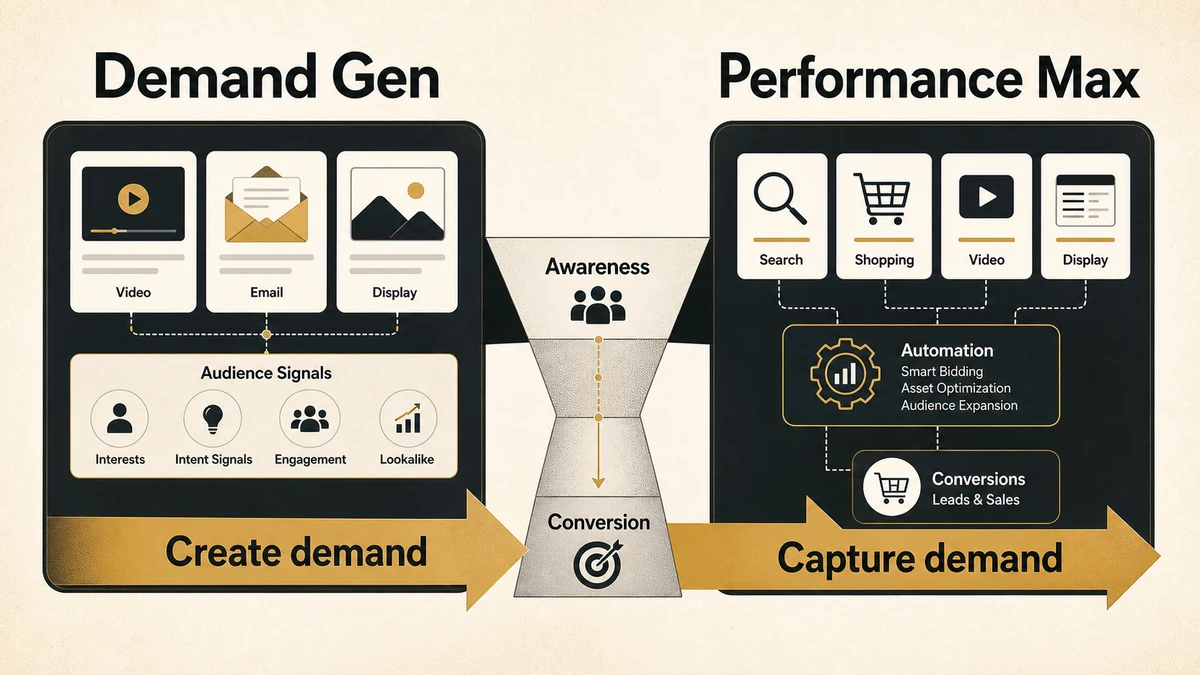
Demand Gen and Performance Max are two Google Ads campaign types, not competing strategies. Demand Gen is a visual, upper- and mid-funnel campaign that runs on YouTube, Discover, Gmail, and the Display Network, and it gives you control over audiences and placements. Performance Max is a fully automated, conversion-focused campaign that serves across every Google channel, including Search and Shopping. Use Demand Gen to create demand and Performance Max to capture it. Most B2B accounts run both.
Key Takeaways
- Demand Gen and Performance Max are Google Ads campaign types, not strategies. Demand Gen is visual and upper-funnel; Performance Max is automated and conversion-led.
- Performance Max serves every Google surface, including Search and Shopping. Demand Gen does not touch Search; it lives on YouTube, Discover, Gmail, Display, and now Maps.
- The core trade-off is control versus automation. Demand Gen lets you set audiences, placements, and read granular reports. Performance Max hands those decisions to Google.
- For B2B, Performance Max captures the roughly 5% of accounts already in-market; Demand Gen builds awareness with the other 95% and retargets long sales cycles.
- The strongest programs run both, feed Performance Max clean offline conversions so it optimizes for revenue rather than form fills, and keep brand terms under control.
Before the section-by-section breakdown, here is the whole comparison in one liftable view. Skim it, then read the parts that decide your next campaign.
| Dimension | Demand Gen | Performance Max |
|---|---|---|
| Campaign goal | Create and capture demand on visual surfaces | Maximize conversions across all of Google |
| Funnel stage | Upper and mid funnel (awareness, consideration) | Full funnel, weighted to conversion |
| Placements | YouTube, Discover, Gmail, Display, Maps, video partners | Search, Shopping, YouTube, Display, Discover, Gmail, Maps |
| Targeting control | High: you choose audiences, segments, and lookalikes | Low: you give signals, Google decides who sees ads |
| Automation | Assisted: AI helps, you keep the levers | Full: Google runs placements, bids, and channel mix |
| Reporting | Granular: placements, audiences, asset-level data | Improving: channel report exists, but no channel budget control |
| Bidding | Max Conversions or Clicks, Target CPA, Target ROAS | Max Conversions or Value, Target CPA, Target ROAS |
| Creative | Up to 5 headlines, images, video, and carousels | Asset group: 15 headlines, 20 images, 5 videos, sitelinks |
| Best B2B use | Build demand, retarget, reach net-new accounts | Capture high-intent demand and scale conversions |

What Is a Demand Gen Campaign?
A Demand Gen campaign is a Google Ads campaign type built for visual, social-style advertising across YouTube, Discover, Gmail, the Display Network, and Maps. It is designed to create interest and consideration with people who are not searching yet, using image, video, and carousel ads in feeds rather than text ads on a results page.
Demand Gen replaced Discovery campaigns in 2023 and absorbed Video Action Campaigns in 2025. Through 2025 and 2026 it gained granular channel controls and added Maps, and Google’s standalone Display campaigns are migrating into it, which makes Demand Gen the home for nearly all of Google’s visual advertising. Google’s own Demand Gen documentation lists the current surfaces and formats.
The defining trait is control. You choose audiences directly: in-market and affinity segments, your first-party data, and Lookalike segments that expand a seed list of converters to roughly 2.5%, 5%, or 10% of users in a location. You keep placement controls, and you read placement- and audience-level reports. Bidding runs on Maximize Clicks, Maximize Conversions, Target CPA, or Target ROAS. Using that control well across audiences, bidding, and reporting is a full-time job, which is why many B2B teams hand the paid account to a performance marketing agency that runs it to pipeline.
For B2B, that control is the point. YouTube is 1.7x more likely to shift brand consideration and 1.6x more likely to influence a purchase decision than social platforms, per a 2025 Google and BCG study, and Demand Gen is how you put a video in front of a defined account list at a fraction of LinkedIn’s CPMs.
What Is Performance Max?
Performance Max is a fully automated, goal-based Google Ads campaign type that serves across every Google channel from a single campaign: Search, Shopping, YouTube, Display, Discover, Gmail, and Maps. You set a conversion goal, upload an asset group, and Google’s AI decides where, when, and to whom your ads show.
Instead of audiences you set, you provide audience signals as hints, and the algorithm expands beyond them whenever it predicts a conversion. An asset group holds up to 15 headlines, 5 descriptions, 20 images, 5 videos, and sitelinks, and Google assembles the combinations. Bidding is Maximize Conversions or Maximize Conversion Value, with optional Target CPA or Target ROAS. Google’s Performance Max documentation covers the asset and channel specifics.
Reporting has improved. A channel performance report arrived in 2025, and search-term and placement reports are now available. The catch that matters for B2B is real: there is still no channel-level budget control, so you cannot tell Performance Max to spend more on YouTube and less on Display. You see where money went, not where it goes next. That single limitation drives much of the decision below.
Demand Gen vs Performance Max: The Key Differences
The two campaign types differ on six axes that decide which one fits a given B2B goal: placements, funnel stage, control, reporting, bidding, and creative. Take them one at a time.
Placements and inventory
Performance Max reaches every Google surface; Demand Gen reaches the visual ones only. The single most important gap is Search. Performance Max can show text ads against high-intent queries and product ads in Shopping, while Demand Gen never touches Search or Shopping at all. The table below maps each channel.
| Google channel | Demand Gen | Performance Max |
|---|---|---|
| Search (text ads) | No | Yes |
| Shopping | No | Yes |
| YouTube | Yes | Yes |
| Display Network | Yes | Yes |
| Discover | Yes | Yes |
| Gmail | Yes | Yes |
| Maps | Yes (added 2026) | Yes |
| Search and video partners | Yes | Yes |

Funnel stage and intent
Demand Gen plays earlier in the buying journey than Performance Max. It interrupts people who are not looking for you yet, which is most of your market and the same reason display advertising reaches buyers that paid search never will. Only a small share of B2B accounts are actively buying at any moment, and Demand Gen exists to reach the rest with a story before they start evaluating.
Performance Max leans toward intent that already exists. Because it includes Search and Shopping, it is at its best converting people who are signaling readiness, then scaling that volume. In funnel terms, Demand Gen creates demand and Performance Max captures it, which is why pitting them against each other misses the point. Both sit inside a wider B2B Google Ads account, so the task is fitting each to its funnel stage, not crowning a winner.
Control versus automation
This is the axis that separates the two campaign types more than any other. Demand Gen is assisted automation: Google optimizes inside the audiences and placements you set. Performance Max is full automation: you hand over targeting, placement, and channel mix, and the system serves wherever it predicts a conversion.
Neither is better in the abstract. Full automation pays off when your conversion signal is clean and your goal is volume. It is a liability when your conversion data is noisy, because the algorithm will optimize confidently toward the wrong thing. For B2B, where a “conversion” is often a form fill of wildly uneven value, that distinction is not academic.

Reporting and transparency
Demand Gen reports at the placement, audience, and asset level, so you can see what worked and adjust. Performance Max has closed much of its old reporting gap with a channel performance report and search-term data, but it remains the more opaque of the two, and it gives you visibility without the matching controls.
The honest take most agencies bury: for a lead-gen team that needs to defend spend line by line, Performance Max’s opacity is a real cost, not a footnote. When you need to see what the automation hides, third-party PPC reporting and bid management tools surface the placement and search-term detail the native view keeps shallow. If you live in dashboards, the gap between what Demand Gen shows and what Performance Max shows will shape your choice.
Bidding and budget
Both run on Smart Bidding, but they reward different conditions. Performance Max needs a steady flow of conversions to learn, so thin-conversion B2B accounts often starve it. A common rule of thumb is to give an automated campaign a few dozen conversions a month before judging it, and to enable Target CPA or Target ROAS only after the campaign has cleared roughly 50 conversions. Demand Gen tolerates lower volume because you are guiding it with audiences rather than waiting for the model to find them.
Creative assets
Performance Max wants breadth: up to 15 headlines, 20 images, and 5 videos so the system has combinations to test, and it will auto-generate video if you skip it. Demand Gen wants quality: a tighter set of strong images and short video that earns attention in a feed. If you have no video and little design support, Performance Max’s asset engine is more forgiving. If you have a sharp brand and real creative, Demand Gen rewards it.
When to Use Demand Gen vs Performance Max: A B2B Decision Framework
Choose by the job, not the hype. Use Performance Max when you need to capture and scale existing intent with limited hands-on time. Use Demand Gen when you need control, visual reach, and awareness with accounts that are not searching yet. Run both when you want a full-funnel engine, which is most mid-market B2B. Avoid leaning on Performance Max alone when your conversion tracking is weak, and avoid Demand Gen alone when you need to win high-intent search queries. The table turns that into specific calls.
| Your B2B goal | Run this | Why |
|---|---|---|
| Capture buyers already searching for your category | Performance Max (or Search) | Only Performance Max spans Search and Shopping, where high-intent queries live; Demand Gen has no Search |
| Build awareness with net-new accounts not searching yet | Demand Gen | Visual reach on YouTube, Discover, and Gmail to the out-of-market majority |
| Retarget engaged visitors over a long sales cycle | Demand Gen | Lower visual CPMs, audience control, and lookalikes built from closed-won accounts |
| Scale conversions fast with limited hands-on time | Performance Max | Full automation across every channel on a single budget |
| Protect tight reporting and brand-term control | Demand Gen | Placement and audience transparency; Performance Max reporting is thinner and harder to fence |
| Limited creative, no video yet | Performance Max | Auto-generates assets; Demand Gen depends on strong visuals to perform |
| Most mid-market B2B programs | Run both | Performance Max captures the in-market minority, Demand Gen creates demand in the majority |

PRO TIP
Build your Demand Gen Lookalike segments from a seed list of closed-won accounts, not all leads. The model copies whatever you feed it, so feeding it revenue, not form fills, is how you keep B2B reach pointed at accounts that actually buy.
Running Both: The Full-Funnel B2B Play
For most B2B advertisers the real answer to “demand gen vs performance max” is “yes.” Performance Max captures the small slice of your market that is in-market this quarter, and Demand Gen builds familiarity with the larger slice that will be in-market later. Run only the capture campaign and you compete on price for the same ready buyers everyone else is chasing.
The two also map cleanly onto the create-and-capture split that good demand programs already use. Demand Gen is the paid arm of demand creation; Performance Max is a paid arm of demand capture. If that framing is new, our demand generation framework walks through why creation and capture need different metrics and budgets.
Sequencing matters for the numbers. B2B intent is lopsided: branded search converts far more efficiently than non-branded because those people already know you. Dreamdata’s 2024 B2B benchmarks put branded search at roughly 1,299% ROAS on about 7% of budget, versus 78% ROAS for non-branded on 39% of budget. Demand Gen is how you manufacture more of that branded demand for Performance Max to harvest later. Google reports that advertisers adopting at least three of four Demand Gen best practices see over 40% more conversions on average, so the creation side is not a soft bet.

Measurement and Pitfalls for B2B
The fastest way to wreck a Performance Max campaign in B2B is to let it optimize toward the wrong conversion. If “conversion” means any form fill, the algorithm will happily buy a flood of newsletter signups and students downloading an eBook, because those are cheap and frequent. Fix the input before you blame the campaign.
Offline conversion tracking is the fix. Pipe your CRM stages back into Google Ads so the system optimizes for MQLs, SQLs, and closed-won revenue rather than raw leads. This is the single highest-impact upgrade for either campaign type, and it is what turns automated bidding from a gamble into a reliable source of pipeline.
IMPORTANT
Add your own brand terms as exclusions where the platform allows it. Left unchecked, Performance Max will claim cheap branded conversions that would have closed for free and report them as wins, inflating results while doing little incremental work.
Watch the reporting gap too. Performance Max shows you a channel report but no channel-level budget control, so optimization happens by changing inputs (assets, signals, conversion goals), not by reallocating spend. Treat both campaign types as systems you steer with clean data, not black boxes you set and forget.
Frequently Asked Questions
Both are Google Ads campaign types. Performance Max is fully automated and runs across every Google channel, including Search and Shopping, to maximize conversions. Demand Gen is a visual, upper-funnel campaign on YouTube, Discover, Gmail, and Display that gives you more control over audiences and placements. Performance Max captures demand; Demand Gen creates it.
Demand Gen can drive conversions, but it is built for the consideration stage, so its strength is creating and warming demand rather than capturing ready buyers. It converts best when you retarget engaged audiences or use Lookalike segments seeded from real customers. For pure bottom-funnel conversion volume, Performance Max usually does more.
Performance Max works well when your conversion tracking is clean and your goal is conversion volume across channels. For B2B it is only as good as the signal you feed it, so import offline conversions and exclude brand terms first. With noisy form-fill data, it optimizes confidently toward low-value leads, which is the most common reason teams say it underperforms.
Yes, and most strong B2B accounts do. They serve different funnel jobs, so they complement rather than compete. Use Demand Gen to build awareness and retarget long sales cycles, and Performance Max to capture and scale high-intent demand. Keep their conversion goals and audiences distinct so you can read each campaign’s contribution clearly.
Demand Gen is replacing standalone Display in Google Ads, with Display campaigns migrating into it through 2026. Demand Gen offers richer creative formats and audience controls on premium feeds like YouTube and Discover, while old Display reached the broader web network. For new B2B campaigns, build in Demand Gen rather than starting a standalone Display campaign.