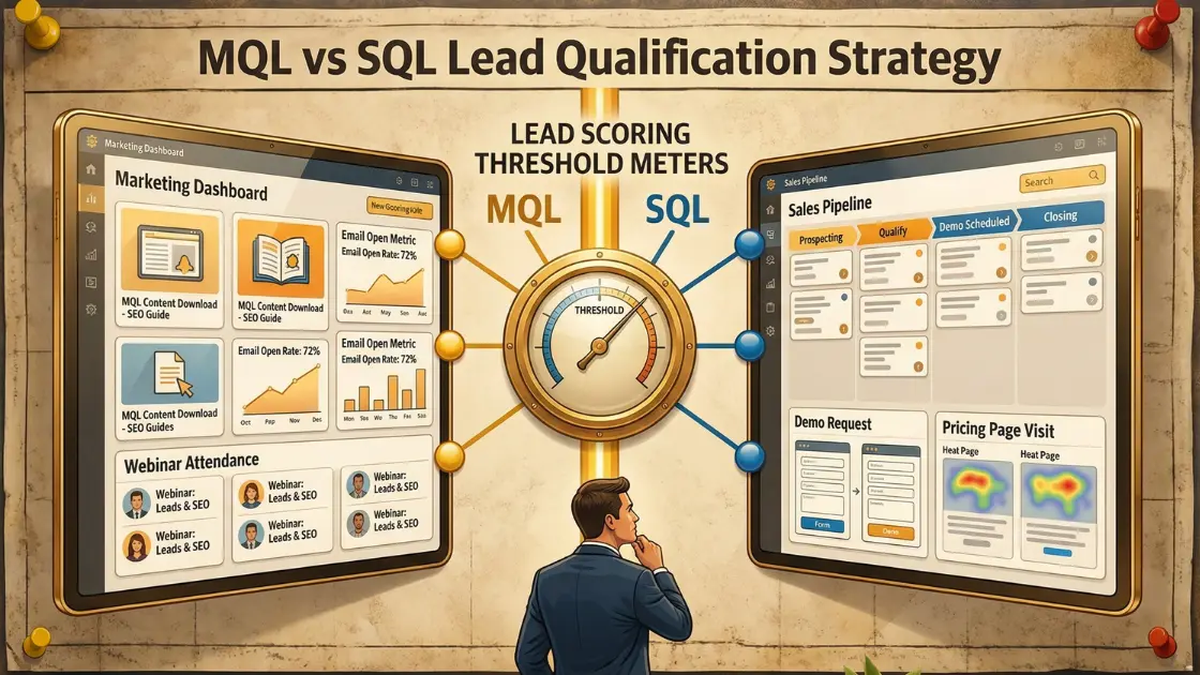
Your marketing team generated 500 leads last quarter. Sales followed up on all of them and closed… 12. The other 488? A mix of students downloading your eBook, job seekers browsing your site, and a handful of prospects who weren’t anywhere near a buying decision. The problem isn’t lead volume. It’s that nobody agreed on which leads were ready for sales and which still needed marketing’s attention.
That’s the MQL vs SQL distinction in a nutshell. Get it right, and your sales team spends time on prospects who are actually ready to buy. Get it wrong, and you burn budget, frustrate your reps, and watch real opportunities slip to competitors who responded faster.
This guide breaks down exactly what separates a Marketing Qualified Lead (MQL) from a Sales Qualified Lead (SQL), how to build a scoring system that routes leads correctly, and how to nail the handoff so nothing falls through the cracks.
Building a healthy MQL pipeline starts with effective inbound lead generation strategies that attract prospects matching your ICP.
The distinction between demand generation and lead generation directly shapes how you define and route MQLs.
Key Takeaways
- An MQL has shown interest through marketing engagement but isn’t ready to buy. An SQL has demonstrated buying intent and is ready for a direct sales conversation.
- The 13% widely quoted as the MQL-to-SQL rate is a lead-to-opportunity figure from 2014. Published MQL-to-SQL rates for B2B SaaS run 26% to 51% by acquisition channel.
- Lead scoring, BANT qualification, and a documented Service-Level Agreement (SLA) between marketing and sales are the three pillars of an effective handoff process.
- Misclassifying leads wastes sales capacity and lets warm prospects go cold while reps chase unqualified contacts.
- Tools like HubSpot, Salesforce, and Marketo can automate lead scoring and trigger real-time handoffs when a lead hits your SQL threshold.
What Is an MQL (Marketing Qualified Lead)?
A Marketing Qualified Lead (MQL) is a prospect who has engaged with your marketing efforts and matches your target audience profile, but hasn’t yet shown direct intent to purchase. MQLs sit in the awareness and consideration stages of the buyer’s journey. They’re researching, comparing, and educating themselves, not yet ready for a sales pitch.
Paid channels like B2B Google Ads can accelerate SQL generation when organic alone cannot fill the pipeline.
Think of MQLs as hand-raisers. They’ve signaled interest by taking actions like downloading a whitepaper, subscribing to your newsletter, attending a webinar, or repeatedly visiting your blog. These behaviors tell you they’re aware of their problem and exploring solutions. However, they haven’t taken steps that indicate they’re ready to evaluate your specific product or talk pricing.
Common MQL Behaviors
Not every website visitor is an MQL. The behaviors that typically qualify a lead for a marketing follow-up sequence include:
- Downloading gated content (eBooks, guides, templates, reports)
- Subscribing to email newsletters or blog updates
- Attending webinars or virtual events
- Following your company on social media and engaging with posts
- Visiting multiple blog posts or resource pages in a single session
- Filling out a form for educational content (not pricing or demo requests)
The key distinction here is that these actions show curiosity, not buying intent. An MQL might be a perfect fit for your product but still needs two or three more months of research before they’re ready to talk to a salesperson.
PRO TIP
Don’t treat all MQLs the same. Segment them by the type of content they engaged with. A lead who downloaded your “Complete Guide to CRM Selection” is further along than someone who grabbed a generic industry report. Tailor your follow-up sequences to match their stage.
What Is an SQL (Sales Qualified Lead)?
A Sales Qualified Lead (SQL) is a prospect who has been vetted and deemed ready for a direct conversation with your sales team. SQLs have moved past the research phase and demonstrated clear buying intent through their actions, their fit with your Ideal Customer Profile (ICP), or both.
Where MQLs are window-shopping, SQLs are asking for the price tag. They’ve engaged with bottom-of-funnel content like pricing pages, product comparisons, case studies, or demo requests. In many cases, they’ve been scored by marketing’s lead qualification system and passed a defined threshold that triggers the handoff to sales. The engagement signals only carry source/medium context if the form-side capture worked when the contact filled out the form — every engagement signal also depends on the form-capture step working cleanly, and HubSpot hidden fields can fail to populate in seven specific places.
That is where content marketing lead generation helps, because the asset that creates the lead should also show whether the buyer is ready for sales.
Common SQL Behaviors
The actions that typically signal SQL-level intent include:
- Requesting a demo or free trial
- Visiting pricing pages multiple times
- Engaging with product comparison or ROI calculator content
- Responding to sales outreach emails or booking a discovery call
- Asking specific questions about implementation, integration, or contracts
- Returning to your site after a sales conversation to review technical docs
An SQL doesn’t just fit your buyer persona. They’ve taken action that shows they’re evaluating your product as a serious option. When we’ve audited B2B pipelines, the difference between companies that close at 15% vs 30% almost always comes down to how well they define this threshold. A duplicate record breaks that threshold too, since one buyer’s activity split across two leads can leave both below the bar, which is why merging duplicate leads into a single record restores the full engagement picture a score reads from. Once the threshold is set, measuring that close rate in SQL is a single conditional-aggregation query: won deals over closed deals, multiplied by 100.
MQL vs SQL: Key Differences That Matter
The fundamental difference between MQLs and SQLs comes down to one thing: readiness to buy. But that single distinction plays out across several dimensions that affect how your teams prioritize, communicate with, and invest resources in each lead type. Both labels also assume the contact is genuine in the first place, which is why the criteria that decide whether a lead is even real run before the MQL stage, not after it.
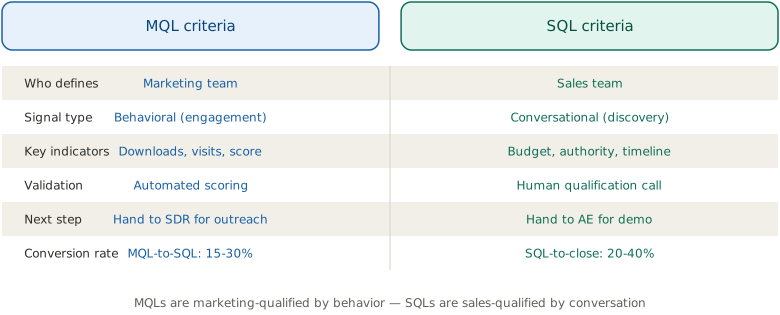
| Dimension | MQL (Marketing Qualified Lead) | SQL (Sales Qualified Lead) |
|---|---|---|
| Buyer intent | Exploring and educating themselves | Actively evaluating and ready to buy |
| Funnel stage | Top to middle (awareness/consideration) | Bottom (decision/action) |
| Owned by | Marketing team | Sales team |
| Engagement type | Content downloads, webinars, blog visits | Demo requests, pricing inquiries, discovery calls |
| Next action | Educate with staged content | Direct sales outreach and consultation |
| Cost per lead | Lower (keep spend broad at this stage) | Higher (invest more in conversion activities) |
| Typical conversion | 26% to 51% become SQLs, by channel | ~59% become opportunities (per Gartner SDR research) |
Here’s what most articles on this topic miss: the line between MQL and SQL isn’t universal. It changes based on your average deal size, sales cycle length, and team structure. A $500/month SaaS product might move a lead from MQL to SQL after a single pricing page visit. An enterprise deal worth $200K/year might need five or six high-intent signals before the handoff makes sense. Account fit shifts that line too: a lead from a green-tier account on your ICP scoring rubric can clear the SQL bar on weaker intent than a high-intent lead from an account that barely fits, because the company was already worth a rep’s time. Those thresholds are exactly what a sales reset redraws from scratch, because the cutoff that sorted accounts correctly a year ago drifts as your deal mix and buying committees change.
In our experience working with mid-market B2B teams, the #1 reason for poor MQL-to-SQL conversion isn’t bad leads. It’s that marketing and sales never agreed on what “sales-ready” actually means. That agreement has to exist as a document before it can exist as a workflow, which is why the fix starts with what each stage actually means, written down as an entry rule and an exit rule rather than with another round of scoring changes.
Why the MQL vs SQL Distinction Matters for Revenue
Skipping lead qualification doesn’t save time. It costs deals. Here’s what happens when B2B teams don’t draw a clear line between MQLs and SQLs:
Sales Wastes Time on Unqualified Leads
When every lead goes straight to sales, reps spend 60-70% of their time on prospects who aren’t ready to buy. That’s time they could spend on the 30% who are actually evaluating solutions. According to Forrester’s B2B Revenue Waterfall research, companies with mature lead qualification processes see 50% more sales-ready leads at 33% lower cost. That waste is worst at the top of the org chart, where a senior rep’s hour is scarcest, so qualifying C-suite prospects before outreach protects the most expensive selling time you have.
Warm Leads Go Cold
On the flip side, when qualification is too strict, genuinely interested prospects sit in automated follow-up sequences for too long. In the 2007 Lead Response Management study, the reported odds of qualifying web-generated leads by phone were 21 times higher at five minutes than at 30 minutes. That six-company result supports prompt routing, but it is not a current universal conversion multiplier. Letting a warm lead slide back to cold is expensive precisely because a warm lead converts five to ten times better than a cold one, so every prospect that cools off resets that math against you. That handoff is where the discipline of answering a demo request in minutes becomes operational rather than aspirational.
Marketing and Sales Blame Each Other
Without shared definitions, the finger-pointing is inevitable. Marketing says “we sent 200 qualified leads last month.” Sales says “those leads were garbage.” The truth is usually somewhere in between, and the fix is a documented agreement on what qualifies a lead for each stage. The stage that turns that agreement into a routine is the sales accepted lead, the formal accept-or-reject step a rep runs before any lead becomes pipeline. Define that step first, then automate that handoff with a guardrail, because automating an undefined accept step just routes unqualified leads into the pipeline faster.
MQL and SQL definitions only work when anchored to a clearly mapped funnel. Our B2B sales funnel guide shows how to define all six stages with the handoff criteria that prevent leads from falling through the cracks. Keep one distinction sharp as you write them down, because those criteria decide eligibility, not who ends up owning the record, and a lead can clear every stage definition while still landing on the wrong rep. That wrong-rep outcome is often a data problem, not a rules problem: a stale company or country field misroutes a qualified lead, which is why clean CRM fields sit underneath every routing rule.
Revenue Forecasting Becomes Guesswork
If your pipeline mixes MQLs with SQLs, your forecast is unreliable. A pipeline with 100 MQLs and 100 SQLs is not a 200-lead pipeline. MQLs convert at a materially lower rate than SQLs, and how much lower depends on the acquisition channel and on whose stage definitions the published figure used, so pooling the two inflates the forecast by a factor nobody can state without checking their own definitions first. The same logic applies one stage downstream — the same kind of definitional sloppiness that makes ARR reporting unreliable turns a forecast miss into a board-deck miss, because pipeline ARR and live ARR follow the exact same arithmetic trap.
How to Build a Lead Scoring Model That Works
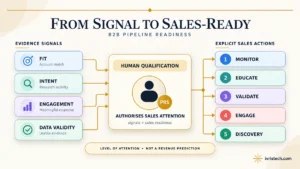
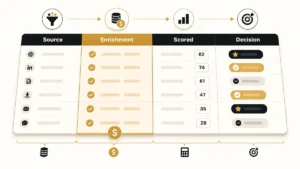
Lead scoring assigns point values to leads based on who they are (demographic/firmographic fit) and what they do (behavioral signals). When a lead crosses a predefined score threshold, they transition from MQL to SQL. For a deeper look at building scoring models, see our lead scoring best practices guide. Here’s how to build one that actually predicts buying intent. In manufacturing, the “who they are” half runs deeper than size: it is the certifications and equipment that define fit.
Step 1: Define Your Ideal Customer Profile
Start with firmographic data. Look at your last 50 closed-won deals and identify patterns. What industries, company sizes, job titles, and geographies show up most often? These attributes form the “fit” side of your score. The firmographic gate looks different in committee-driven verticals — the healthcare buying-committee version weights clinical veto-holders (CMO, CNO, CQO) at +40 because they can block deals regardless of executive sign-off, while horizontal title scoring treats all C-suite roles identically.
For example, a Director of Marketing at a SaaS company with 50-200 employees might start with 30 points just for matching your ICP. A Marketing Coordinator at a nonprofit with 10 employees might start at five.
Step 2: Map Behavioral Signals to Point Values
Not all actions are equal. Assign higher points to behaviors that correlate with purchase intent, the B2B intent signals that separate active buyers from casual browsers:
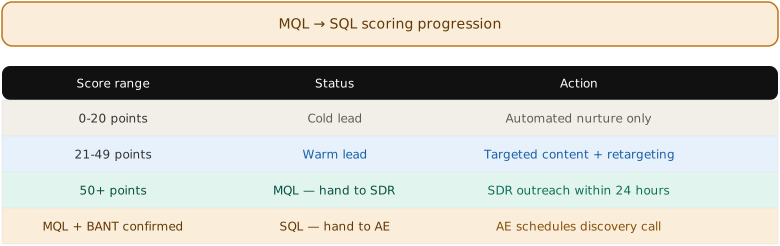
- Low intent (5-10 points): Blog visit, social follow, newsletter signup
- Medium intent (15-25 points): Whitepaper download, webinar attendance, multiple site visits in a week
- High intent (30-50 points): Pricing page visit, demo request, case study download, product comparison page
- Direct intent (50+ points): “Contact sales” form submission, free trial signup, reply to sales email
Step 3: Set Your MQL and SQL Thresholds
Based on your scoring model, define the cutoffs. A common starting point:
- MQL threshold: 40-60 points (enough engagement to indicate genuine interest)
- SQL threshold: 80-100 points (combination of fit + high-intent behaviors)
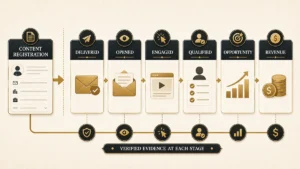
These numbers aren’t fixed. You’ll refine them quarterly based on conversion data. If 80% of leads at score 80+ convert to opportunities, your threshold is right. If only 30% convert, raise the bar or revisit your scoring criteria. Don’t expect an external benchmark to settle where the line goes, though, because MQL stops being a portable denominator the moment the endpoint is a meeting, a content registration can sit several stages below qualification, and one company’s MQL is a content download while another’s is a demo request.
IMPORTANT
Lead scores should decay over time. A prospect who hit your SQL threshold six months ago but hasn’t engaged since isn’t still an SQL. Most CRM platforms like HubSpot and Salesforce support time-based score decay. Set inactive leads to lose 5-10 points per month of inactivity. Decay alone is passive though, so the strongest models also subtract points for the negative signals that should actively push a stale lead back down below the threshold rather than waiting for time to erode the score.
Step 4: Use BANT as a Qualification Framework
Once a lead hits your SQL score threshold, your sales team can apply the BANT framework during discovery calls to validate readiness:
- Budget: Do they have the budget allocated for a solution like yours?
- Authority: Is the contact a decision-maker or influencer in the buying process?
- Need: Does their problem match what your product solves?
- Timeline: Are they looking to purchase within a defined timeframe (typically 1-6 months)?
BANT isn’t perfect for every sales motion. For product-led growth (PLG) companies, usage-based signals like feature adoption or seat expansion might matter more than a discovery call. For enterprise sales, frameworks like MEDDIC or CHAMP might be a better fit. The point is to have some structured approach rather than gut feel. The PLG version has its own qualification grade entirely — the SaaS lead scoring model around PQLs sits parallel to BANT and MEDDIC, treating activation events as the primary qualifier and merging PLG and sales-led tracks at the account level rather than the contact level. “Might be a better fit” is doing a lot of work in that sentence, so it’s worth settling with evidence rather than instinct: our framework-fit table sets out which framework fits which deal shape, and what each one systematically misses.
How to Nail the MQL-to-SQL Handoff
The handoff is where most B2B teams lose deals. Marketing generates the lead, but without a clear process, that lead either gets ignored by sales or contacted too late. It matters most on large deals, where a fumbled handoff can cost a six-figure account, and the qualification an enterprise sales funnel demands exists precisely to stop committee deals from slipping through. Here’s the playbook for a handoff that actually works, and the most reliable version runs automatically, as a workflow that hands the lead to sales the instant it qualifies.
Create a Service-Level Agreement (SLA)
An SLA between marketing and sales is a documented agreement that defines:
- What qualifies a lead as an MQL vs SQL (scoring criteria, behaviors, fit)
- How quickly sales must follow up on new SQLs (best practice: within one hour for inbound demo requests, within 24 hours for score-based SQLs)
- How many attempts sales makes before returning a lead to marketing (typically 6-8 touches over two weeks)
- What happens when sales rejects a lead (feedback loop to refine scoring)
Companies with a formal SLA between marketing and sales are 67% more effective at closing deals, according to HubSpot’s State of Marketing research. The SLA removes ambiguity and creates accountability on both sides. Writing the rule is one thing; acting on it the instant a lead qualifies is another, and it is the case for moving the handoff itself as a live, orchestrated step rather than a batch that runs overnight.
Automate the Handoff with Your CRM
Manual lead routing is a recipe for delays. Whether your CRM’s own rules can carry the logic, or whether you need a specialist router with matching and capacity logic, depends on how contested your ownership rules are rather than on how many leads arrive. On Salesforce specifically, that routing runs through lead assignment rules, a single active rule whose entries are read top to bottom until the first match sets the owner. Automating it only removes the delay if the automation fires for every lead, which is exactly what a routing audit checks when it confirms a threshold lead actually lands on a rep. Set up workflow automation in your CRM so that when a lead hits your SQL threshold:
- The lead is automatically assigned to the right sales rep (by territory, deal size, or round-robin)
- The rep gets an instant notification via email, Slack, or in-app alert
- A task is created in the CRM with a deadline for first outreach
- The lead’s full engagement history (pages visited, content downloaded, emails opened) is visible in their contact record
Build a Feedback Loop
The handoff shouldn’t be one-directional. Sales needs to tell marketing which leads convert and which don’t, so the scoring model improves over time. The most under-used signal in that loop is which meetings actually got held, because a source that books well and attends badly looks healthy right up until the pipeline review. Schedule a weekly or biweekly “lead review” between your marketing ops and sales development teams to discuss:
When that ownership split keeps breaking, compare the handoff against RevOps vs Sales Ops so reporting, routing, and follow-up do not sit in separate silos.
- Which SQLs converted to opportunities (and why)
- Which SQLs were rejected or disqualified (and why)
- Whether the MQL-to-SQL threshold needs adjustment
- New behavioral signals that should be added to scoring
Without this feedback loop, your lead scoring model calcifies. What worked six months ago might not reflect how buyers behave today. Keeping the model honest means re-checking how buyers actually move through their journey, because the point where an MQL becomes an SQL shifts as that behavior changes.
How to Improve Your MQL to SQL Conversion Rate
Improving this handoff starts with knowing which band you should be measured against, and that depends entirely on how you define an MQL and an SQL. The industry splits in wide circulation are published without either definition attached, which makes them uncomparable rather than merely approximate. The full evidence audit lives on a separate page: MQL to SQL conversion rate benchmarks by channel, with every figure’s source, sample and denominator declared. Weighing this stage against every other leak in the funnel is the job of end-to-end journey optimization. What follows is the part you control.
5 Ways to Improve Your MQL-to-SQL Rate
1. Tighten your MQL definition. If your conversion rate is below 10%, you’re likely casting too wide a net. Add firmographic filters (company size, industry, revenue) to your MQL criteria so only real prospects enter the funnel. Record the filter version and the date when you change it, because a falling disqualification rate lifts funnel yield without anyone selling better. One vendor’s published counts moved 13 points on exactly that mechanism between two annual reports.
2. Shorten your follow-up sequences. Long, drawn-out email sequences lose leads to competitors. If a lead shows three high-intent signals in a week, don’t wait for them to complete a 12-email drip. Trigger the SQL handoff immediately.
3. Align scoring with actual pipeline data. Pull a report of your last quarter’s closed-won deals. What actions did those contacts take before becoming SQLs? Weight those behaviors more heavily in your scoring model.
4. Add negative scoring. Not every engaged contact is a prospect. Subtract points for job titles that don’t buy (students, consultants, competitors), personal email domains, and geographic regions you don’t serve.
5. Respond faster to high-intent leads. If a lead requests a demo, route it immediately and track qualification by response-time band. Use five minutes as an aggressive operating target, not as a promise of a fixed lift. That hedge is doing real work, because what the five-minute studies actually measured was the odds of contact and of company-defined qualification, never a closed sale. Set up real-time alerts so your SDRs never miss a high-intent request.
Where MQL and SQL Fit in the Full Lead Lifecycle
MQLs and SQLs are two stages in a broader lead lifecycle that most B2B companies follow. Getting this lifecycle right is a core part of building a strong RevOps function. Here’s how MQLs and SQLs connect to the stages before and after:
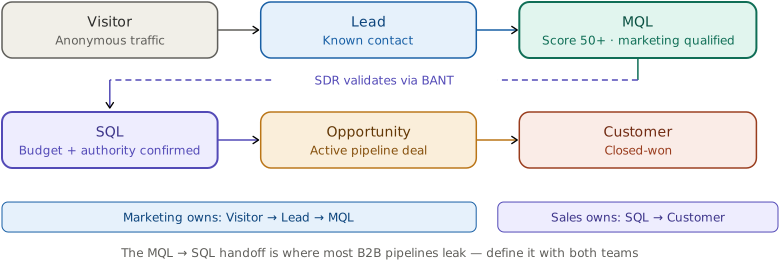
Visitor → Lead → MQL → SQL → Opportunity → Customer
- Visitor: Anonymous traffic on your site. No identifying info yet.
- Lead: They’ve submitted a form or signed up for something, giving you contact info. Not yet qualified.
- MQL: Marketing has scored them and they meet engagement + fit criteria.
- SQL: Sales has accepted the lead and validated buying intent.
- Opportunity: The lead is in active pipeline with a projected deal value and close date.
- Customer: Closed-won. Now it’s retention and expansion territory.
Some organizations add a Sales Accepted Lead (SAL) stage between MQL and SQL. The SAL step means sales has acknowledged the lead and agreed to work it, but hasn’t yet validated it as a true opportunity. This extra stage adds accountability: it forces sales to accept or reject each marketing-generated lead within a defined timeframe.
For most mid-market teams, MQL → SQL is sufficient. Add the SAL stage only if you’re seeing a pattern where leads disappear into a black hole after handoff with no feedback to marketing.
Tools for Managing MQL to SQL Transitions
The right tech stack makes lead qualification scalable and consistent. Here are the categories of tools that matter most, along with specific options for mid-market B2B teams. MQL and SQL are two of the 15 metrics every B2B marketing team should track — see our full B2B marketing metrics guide for the complete inventory.
CRM Platforms
HubSpot CRM is the strongest option for teams under 50 people. Its built-in lead scoring, lifecycle stages, and workflow automation handle the MQL-to-SQL handoff natively. For enterprise teams with complex routing needs, Salesforce Sales Cloud offers more customization but requires more admin resources. Not sure which fits your team? Our HubSpot vs Salesforce comparison breaks down the tradeoffs.
Marketing Automation
If you need advanced multi-step sequences and multi-touch attribution, Adobe Marketo Engage is the industry standard for B2B. HubSpot’s Marketing Hub covers the basics well enough for most mid-market companies. For teams on a budget, ActiveCampaign offers solid automation at a lower price point.
Lead Enrichment
Your scoring model is only as good as your data. Tools like Clearbit and ZoomInfo automatically enrich lead records with firmographic data (company size, revenue, industry, tech stack) so you can score fit without asking 15 form questions. That arithmetic gets stricter in conversation, where a chat window has fewer turns than a form has fields, so anything the email domain can return should never reach the visitor as a question.
Intent Data
For companies that want to identify leads before they even fill out a form, intent data platforms like 6sense and Bombora track anonymous buying signals across the web. If a company in your ICP is researching your product category on third-party sites, these tools surface that intent so your team can reach out proactively.
Frequently Asked Questions
MQL comes first. A prospect becomes a Marketing Qualified Lead when they engage with your content and match your target audience criteria. After further qualification through lead scoring and behavioral signals that indicate buying intent, they transition to a Sales Qualified Lead and are handed off to the sales team for direct engagement.
There is no single figure. For B2B SaaS the published range is 26% to 51% depending on acquisition channel, while the same publisher’s industry table reports 13%. Which one applies to you depends on your own MQL and SQL definitions, and on which published band those definitions actually match.
SQLs are generally categorized by how they became qualified: inbound SQLs (requested a demo or trial), outbound SQLs (qualified through sales prospecting), product-qualified leads or PQLs (demonstrated intent through free product usage), and event-qualified leads (showed strong buying signals at trade shows, conferences, or webinars). Each type requires a different sales approach and follow-up cadence.
Some revenue leaders argue that the MQL model is too linear for modern B2B buying, where 57-70% of the buyer’s journey happens before a prospect contacts sales. While the labels may evolve, the underlying principle is still valid: you need a system to distinguish between leads who need more education and leads who are ready for a sales conversation. Whether you call them MQLs and SQLs or use intent-based scoring, the function remains essential.
An SQL is a lead that sales has accepted as qualified and ready for engagement. An opportunity is the next stage, where sales has confirmed there’s a real deal in play with a projected value, timeline, and identified decision-makers. Not every SQL becomes an opportunity. The SQL-to-opportunity conversion rate averages around 59% according to Gartner’s SDR benchmarking data.