By the time a B2B buyer books a demo, the decision is usually half-made. They’ve read your pricing page, compared you against two competitors on G2, asked a peer in a private Slack group, and quietly built a shortlist, all before your sales team knows they exist. That gap between what the buyer is doing and what the vendor can see is the defining feature of the modern B2B customer journey, and it’s why so many pipelines feel like they begin in the middle of the story.
The B2B customer journey is the full arc of that experience: every step a buying organization moves through, from first realizing it has a problem to renewing and recommending you years later. It rarely runs in a straight line. A group of six to ten people loops through the same questions at different times, and most of that work happens on self-serve channels you don’t own or measure.
This guide maps the journey stage by stage, shows how it differs from the B2C version and from your own sales funnel, and hands you a specific play and metric for each phase. The goal isn’t a prettier diagram. It’s knowing where the deal is actually won, which for most B2B teams is nowhere near the parts they currently measure.
Direct answer — What is the B2B customer journey?
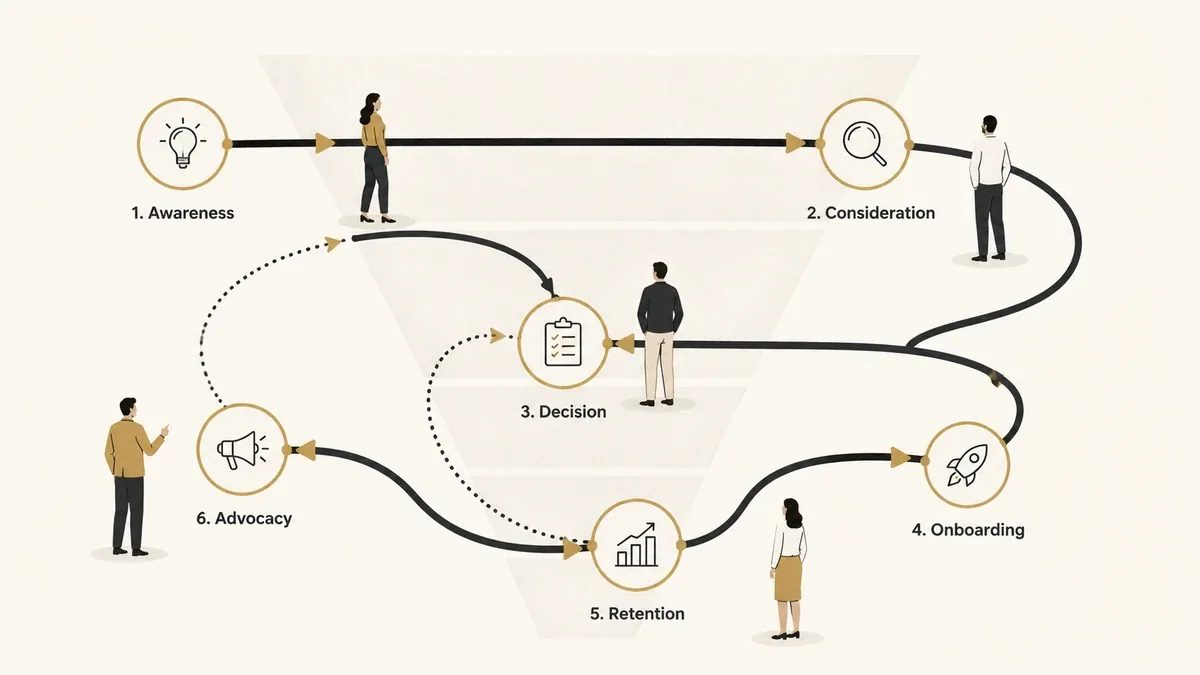
The B2B customer journey is the end-to-end experience a business buyer goes through when purchasing from another business, spanning six stages: awareness, consideration, decision, onboarding, retention, and advocacy. Unlike a consumer purchase, it runs through a buying committee of six to ten people, takes months, and is mostly self-directed; Gartner finds buyers spend only 17% of their time with any single supplier. It describes the buyer’s whole experience, not just your internal sales funnel.
Key Takeaways
- The B2B customer journey has six stages, awareness, consideration, decision, onboarding, retention, and advocacy, but buyers move through them in loops, not a straight line.
- It is not the same as your sales funnel. The journey is the buyer’s experience; the funnel is your internal view of the deal. Confusing the two is why marketing and sales end up measuring different things.
- A buying committee of six to ten people drives most B2B purchases, and each member arrives with their own research. You are marketing to a group, not a person.
- Most of the journey is invisible. Buyers finish the bulk of their research on self-serve channels before they contact you, and 67% now prefer a rep-free experience (Gartner, 2026).
- The deal is often decided before first contact: 6sense found the pre-contact favorite wins roughly four out of five deals.
- Winning the journey means showing up for the 95% of the market that is not buying yet, not only the 5% that is.
What is the B2B customer journey?
The B2B customer journey is the sequence of stages a business buyer passes through when evaluating, purchasing, and continuing to use a product from another business. It covers everything from the first sign of a problem to renewal and referral, across every channel and every member of the buying group, not just the moments a salesperson is in the room.
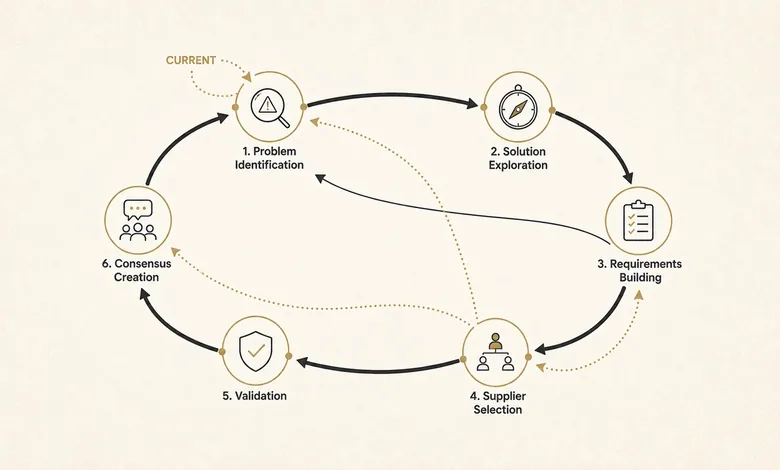
What makes it a journey and not a checklist is that buyers don’t move through it cleanly. Gartner describes B2B buying as a set of six “jobs”, problem identification, solution exploration, requirements building, supplier selection, validation, and consensus creation, that buyers revisit in loops rather than tick off in order. Someone can be validating your product and reopening the problem definition in the same week.
It also helps to be precise about three terms that get used as if they mean the same thing. They don’t, and the difference decides what you measure.
| Lens | What it tracks | Whose point of view | Use it to |
|---|---|---|---|
| Customer journey | Every stage of the buyer’s real experience, awareness to advocacy | The buyer’s | Understand what buyers actually do and need at each step |
| Sales funnel | Deal stages from lead to closed-won | The seller’s | Forecast revenue and find where deals stall |
| Customer lifecycle | The relationship after the sale, onboarding to renewal | The account team’s | Grow and retain revenue over time |
Use the journey lens when you’re deciding what content, message, or touchpoint a buyer needs next. Use the sales funnel view when you’re forecasting revenue or hunting for the stage where deals stall. The two overlap, but the journey includes everything before a lead exists and everything after the deal closes, which is exactly where the funnel goes blind.
IMPORTANT
Treating the journey as a linear pipeline is the most common modeling mistake. Buyers loop back, drop out, and re-enter months later. If your stages assume forward-only motion, your data will quietly disagree with reality.
B2B vs B2C customer journey: what actually differs
The B2B customer journey differs from the B2C version in five ways that change how you market: who decides, how long it takes, what drives the choice, how much happens without you, and what “the end” means.
| Factor | B2C journey | B2B customer journey |
|---|---|---|
| Decision maker | One person, sometimes two | A buying committee of 6 to 10 |
| Timeline | Minutes to days | Weeks to 6–18 months |
| Motivation | Emotion, identity, convenience | ROI, risk reduction, group consensus |
| Where it happens | Largely on your channels | Mostly self-serve, off your channels |
| After purchase | Often the end | The start: retention and expansion drive the profit |
Those differences compound. A consumer can regret a $40 purchase and move on; a B2B buyer who picks the wrong platform can lose their budget, their credibility, or their job, so the journey fills up with proof, references, and internal selling. The linear models built for consumer funnels, including the classics in our B2B marketing framework guide, only take you so far once a committee is in the room.
The 6 stages of the B2B customer journey
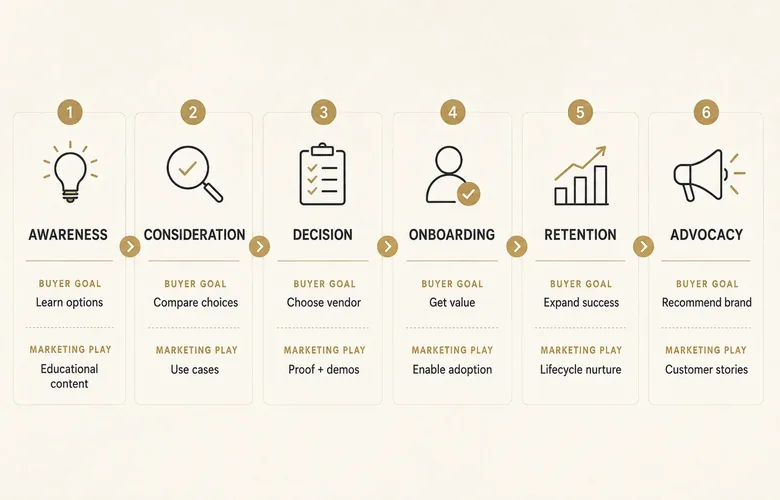
The B2B customer journey has six stages: awareness, consideration, decision, onboarding, retention, and advocacy. Each stage has a job the buyer is trying to do, a signal the buying committee gives off, a play that moves them forward, and a metric that tells you it’s working.
| Stage | What the buyer is doing | Committee signal | Your play | Metric that matters |
|---|---|---|---|---|
| Awareness | Naming a problem worth solving | Anonymous research, content reads | Educate on the problem, not the product | Category reach, branded search |
| Consideration | Comparing approaches and vendors | Repeat visits, peer reviews, demo interest | Make honest comparison easy | Qualified pipeline, engaged accounts |
| Decision | Building consensus, clearing procurement | Security, legal, and pricing questions | Arm the champion, reduce buying friction | Win rate, sales-cycle length |
| Onboarding | Getting to first value | Implementation and training requests | Fast time-to-value, a clear activation path | Time-to-value, activation rate |
| Retention | Proving value again | Usage patterns, support load, renewal talk | Drive adoption, catch risk early | Net revenue retention, churn |
| Advocacy | Recommending you to others | Referrals, reviews, reference willingness | Make advocacy easy and worth it | Referrals, expansion revenue |
Stage 1: Awareness, naming the problem
The journey starts when someone realizes the status quo is costing them. They aren’t searching for your product yet; they’re searching for the problem. This is where demand generation earns its keep, because you want to be the source that framed the problem clearly, so you’re already familiar when the buyer starts shopping. Counting leads here is premature; measure whether your category knows you exist.
Stage 2: Consideration, comparing options
Now the buyer is building a mental shortlist. They read comparisons, lurk in communities, and pull two or three vendors into open tabs. The committee starts forming, and each member weighs different things. Your job is to make honest comparison easy, because vague pages and gated everything push buyers toward competitors who show their work. The behavioral signals here are also the ones worth scoring; the guide to B2B lead scoring criteria covers which actions actually predict intent.
Stage 3: Decision, consensus and procurement
Decision is less about convincing one person and more about helping a group agree. Security reviews, legal, and procurement enter, and your champion has to sell you internally when you’re not there. This is also where the marketing-to-sales handoff happens, and getting the MQL-to-SQL handoff right keeps hard-won demand from stalling in a definitional gap. Give your champion a business case they can forward, not a brochure.
Stage 4: Onboarding, first value
The journey doesn’t end at signature; for the buyer, it restarts. Onboarding is where the promise gets tested, and a slow or confusing start is the leading cause of early churn, because the committee that approved the purchase is watching for proof it made the right call. Speed to first value beats feature depth here, and getting the right prompt to the right user at the right moment is really a customer journey orchestration problem.
Stage 5: Retention, proving value again
Retention is earned in the quiet months between renewals. Usage patterns, support load, and executive turnover all forecast risk long before a cancellation email arrives. Because expansion and renewal drive the bulk of B2B profit, this stage deserves the same rigor as acquisition, so watch the leading indicators of churn rather than reacting to the lagging one.
Stage 6: Advocacy, customers as a channel
A happy customer is your cheapest and most trusted acquisition channel. Advocacy shows up as referrals, reviews, and a willingness to act as a reference, and it feeds straight back into the awareness stage for the next buyer. The teams that win here make advocacy easy and give customers a reason worth the effort of vouching for you.
The buying committee: who is actually on the journey
The buying committee is the group of people who jointly decide on a B2B purchase, typically six to ten of them for a complex deal, according to Gartner, each arriving with four or five pieces of research they gathered on their own. That independent research is why a single, one-size message rarely lands.
Those people aren’t interchangeable. A typical committee includes an economic buyer who owns the budget, a champion who wants the project to succeed, technical and security evaluators who can veto on risk, procurement whose job is to extract concessions, and the end users who will live with the choice. The journey looks different through each set of eyes: the champion is racing toward value while procurement is slowing things down on purpose.
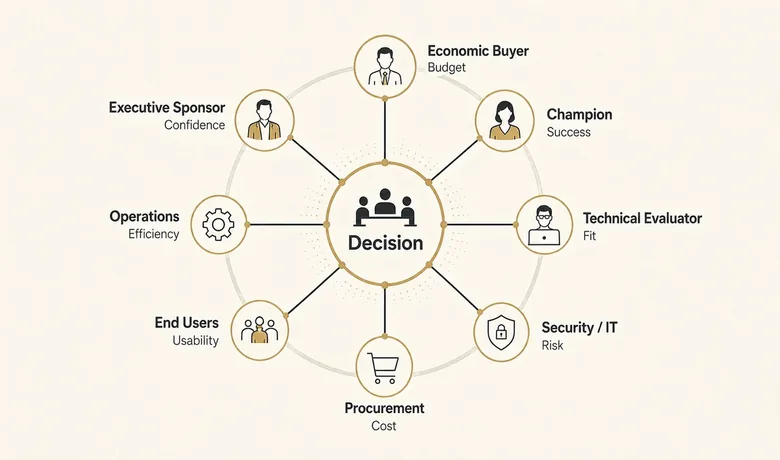
Marketing to a committee instead of a single lead is the whole idea behind account-based programs, and the breakdown of ABM campaigns shows how to reach several stakeholders in one account at once. The practical takeaway is blunt: if you only speak to one persona, you’re being out-sold to the other five people in the room.
The dark funnel: why most of the journey is invisible
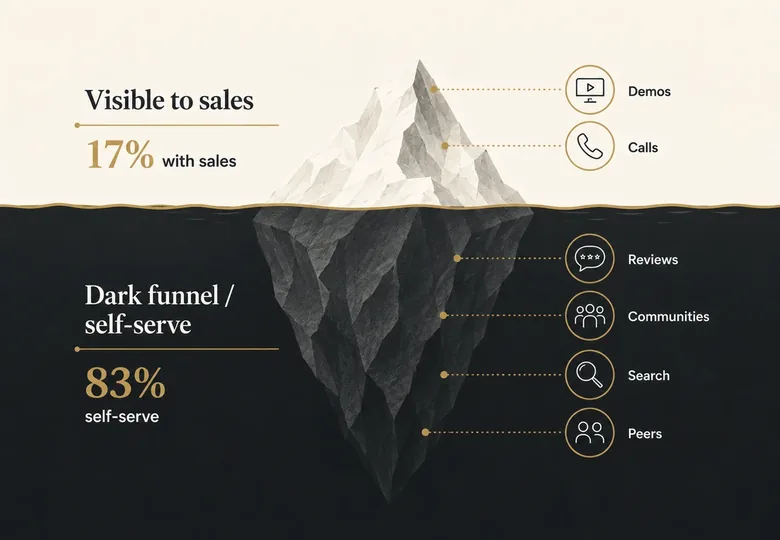
The dark funnel is the large part of the B2B customer journey that happens on channels you can’t track, including private communities, peer conversations, review sites, and self-serve research, before a buyer ever identifies themselves. It is where most of the decision now gets made.
The numbers are humbling. Gartner finds that B2B buyers spend just 17% of their total purchase time meeting with any supplier, and only about 5% to 6% with any single sales rep. By 2026, 67% of buyers say they would prefer a rep-free experience altogether. Most of the thinking is happening where you can’t watch it.
By the time a buyer raises their hand, the shortlist is usually already written, and you’re either on it or you’re not.
6sense’s 2025 research puts a hard edge on that: 94% of buying groups rank their shortlist before contacting a seller, and the pre-contact favorite wins roughly four out of five deals. First contact now lands around 61% of the way through the journey. Whoever shaped the buyer’s thinking during the invisible 61% usually wins the visible 39%. Treat that 61% as 6sense’s own journey definition rather than a market constant, because what each of those percentages is actually counting varies more between studies than the numbers themselves do.
Two ideas explain how to compete in the dark. The first is the 95-5 rule from the Ehrenberg-Bass Institute: at any moment only about 5% of your market sits in a buying window and 95% does not, so brand-building that reaches the 95% is what makes you the familiar name when they finally enter. The second is McKinsey’s rule of thirds: at every stage, roughly a third of buyers want in-person contact, a third want remote, and a third want pure self-serve, and they cross an average of ten channels to get there.
PRO TIP
You can’t track the dark funnel directly, but you can measure its shadow. Ask “how did you hear about us?” on demo forms, watch branded search and direct traffic, and treat spikes in community mentions as pipeline signals. Self-reported attribution beats a clean model that is confidently wrong. Turning those scattered signals into a defensible account of what actually earned the deal is the job of customer journey attribution.
Turning those weak signals into something you can act on is the job of customer journey analytics, where this sub-cluster goes deep on measurement.
How to put the journey to work
To put the B2B customer journey to work, map your six stages to what buyers are actually doing, then attach one play and one metric to each, so every team knows its job and how it is scored. The exercise below takes about half a day and gives you a model you can operate against, not just a poster.
Workflow · about half a day
How to build your B2B customer journey model
Turn the six-stage journey into an operating model your marketing, sales, and success teams can act on.
Map the six stages to your buyers’ jobs
List what a buyer is trying to accomplish at awareness, consideration, decision, onboarding, retention, and advocacy. Write each job in the buyer’s words, not your funnel’s labels.
Identify the buying committee and its roles
Name the six to ten people who touch the decision and what each one needs to say yes: economic buyer, champion, technical and security evaluators, procurement, and end users.
Inventory the touchpoints at each stage
For every stage, list where buyers actually go: search, communities, review sites, email, sales calls, docs. Flag which touchpoints you control and which you don’t.
Assign one play and one metric to each stage
Give each stage a single job for your team and one number that proves it is working, so no stage is judged by a metric that belongs to a different stage.
Instrument the dark funnel
Add self-reported attribution to forms, track branded search and direct traffic, and watch community mentions, so the invisible research phase leaves a measurable trace.
Review conversion and fix the weakest stage
On a set cadence, check stage-to-stage conversion, find the transition that leaks most, and fix that one before touching anything else. Repeat each quarter.
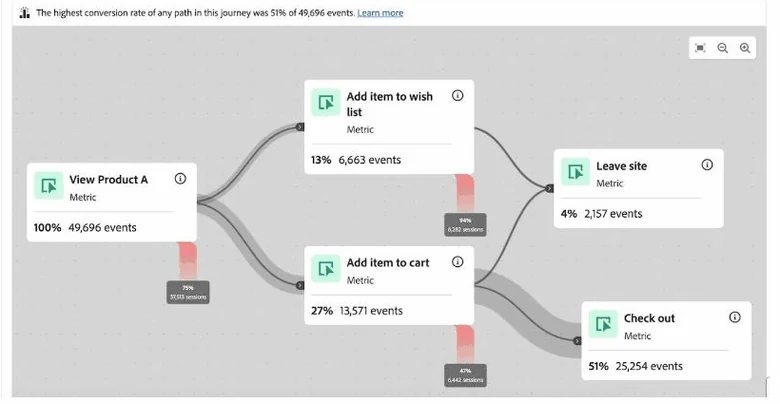
This map is the hub, not the whole system. Feeding each stage with the right program at scale is a B2B marketing automation job, and steadily lifting the conversion rate between stages is the focus of customer journey optimization. Start with the map; those disciplines are how you operate and improve it.
Frequently Asked Questions
The 95-5 rule, popularized by LinkedIn’s B2B Institute from Ehrenberg-Bass Institute research, holds that only about 5% of business buyers are in-market at any given time, while 95% are not. For the customer journey, it means most of your audience is pre-awareness, so brand-building that reaches the out-of-market 95% is what wins deals later.
The B2B customer journey has six stages: awareness (naming a problem), consideration (comparing options), decision (building consensus and clearing procurement), onboarding (reaching first value), retention (proving ongoing value), and advocacy (referring others). Simpler models compress these into five, but B2B benefits from separating onboarding, retention, and advocacy because most profit comes after the first sale.
The B2B customer journey runs through a buying committee of six to ten people instead of one shopper, takes weeks to 18 months instead of minutes, and is driven by ROI and risk rather than emotion. It is also mostly self-directed: Gartner finds B2B buyers spend only 17% of their time with any single vendor.
A mid-market SaaS buyer notices reporting is slow (awareness), compares three tools on review sites and peer forums (consideration), loops in IT, finance, and procurement to agree and sign (decision), rolls the tool out to the team (onboarding), renews after seeing adoption (retention), and refers a peer company (advocacy). The whole arc often spans six to twelve months.
No. The B2B customer journey is the buyer’s full experience from first problem to renewal and referral; the sales funnel is the seller’s internal view of a deal moving from lead to closed-won. The journey includes everything before a lead exists and after the deal closes, which the funnel does not track.