Most B2B marketing automation projects don’t fail because the software is bad. They fail because the team automated a targeting problem. Point a fast, tireless system at a fuzzy audience and you get the same weak outreach as before, only now it reaches more people, more often. That’s the blunt consensus in threads like r/b2bmarketing, and it matches what the data shows: automation is an amplifier, not a strategy.
Used well, though, this is how a five-person demand gen team covers a buying committee of ten across a nine-month deal without dropping anyone. The system captures leads, scores them by fit and intent, keeps them warm until they’re ready, and routes the good ones to sales with the full history attached. That’s the version worth building.
This guide walks through what B2B marketing automation is, how the B2B version differs from the B2C playbook, the stack that runs it, the core use cases, the lead lifecycle that ends in a clean sales handoff, and a step-by-step way to start. Where a topic deserves its own dedicated guide, you’ll find a link to it.
Direct answer – what is B2B marketing automation?
B2B marketing automation is software that runs repetitive marketing tasks – lead capture, email nurturing, lead scoring, routing, and CRM sync – automatically, based on rules and buyer behavior, so a small team can work a long, multi-stakeholder sales cycle at scale. It coordinates demand across email, ads, and the website, then hands qualified leads to sales with context. The catch: it scales whatever targeting you feed it, so weak audience definition just produces more precise noise. Unlike B2C automation, it’s built around accounts and buying committees, not individual shoppers.
Key Takeaways
- B2B marketing automation runs lead capture, nurturing, scoring, routing, and CRM sync on rules plus behavior. It amplifies your targeting; it does not fix it.
- The B2B difference is the buying committee and the clock: 6–18 month cycles and 6–10 stakeholders, ending in a sales-led close. B2C automation optimizes a fast individual purchase.
- Only about 5% of your buyers are in-market this quarter (the 95:5 rule), so most of the job is staying memorable to the other 95% until their window opens.
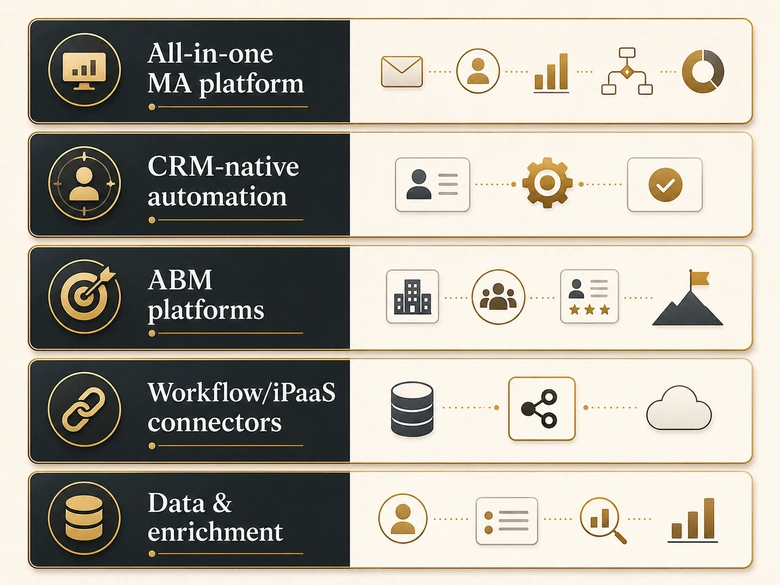
- The stack has five layers: an all-in-one platform or a CRM-native engine, ABM tools, workflow and iPaaS connectors, and a data source underneath.
- Lead scoring plus a written MQL→SQL handoff with an SLA is where automation earns or wastes its budget.
- Start by fixing targeting and mapping the lifecycle. Pick and build the platform last.
Before the sections, here’s the shape of the work. These five use cases are what a B2B system actually does day to day, and each carries a wrinkle that the consumer playbook doesn’t have to deal with.
| Use case | What it automates | The B2B nuance |
|---|---|---|
| Lead nurturing | Behavior-triggered email tracks that stay relevant over months | Sequences run across a committee, not one person, and span quarters |
| Lead scoring | Point values for fit (firmographics) and intent (behavior) | Scores decide sales handoff, so a bad model floods reps with junk |
| Sales routing & handoff | Assigning and passing qualified leads with full context | The MQL→SQL boundary needs an SLA both teams agree on |
| Lifecycle management | Moving contacts between stages as signals change | Stages map to a long funnel, not a single checkout |
| Attribution | Tying touches to pipeline and revenue | Multi-touch across many stakeholders, not last-click |
What is B2B marketing automation?
B2B marketing automation is software that runs marketing tasks for business buyers automatically, triggered by rules and prospect behavior instead of manual sends. It captures and segments leads, runs email campaigns, scores contacts by fit and intent, syncs to the CRM, and passes sales-ready leads to reps, so a small team can work a long buying cycle at scale.
The category is often shortened to a marketing automation platform, or MAP. In practice a MAP sits between your website and forms on one side and your CRM and sales team on the other. It watches what prospects do, decides what happens next, and keeps both the marketing record and the sales record pointing at the same account.
What B2B marketing automation actually automates
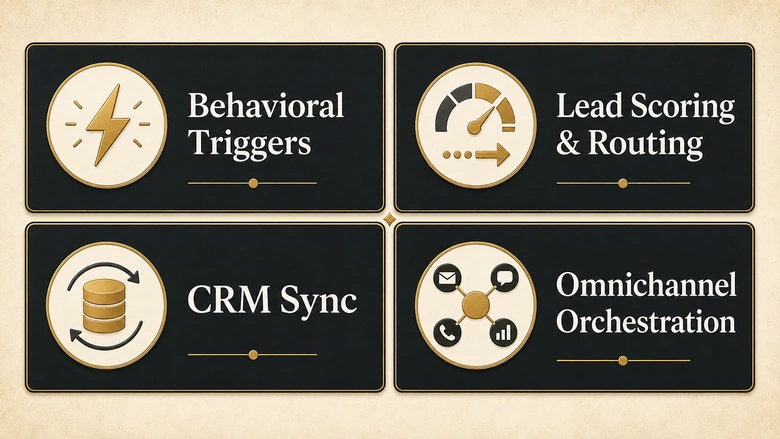
Strip away the vendor language and B2B marketing automation does four jobs. Google’s own summary of this topic lists the same four, which is a good sign they’re the durable ones.
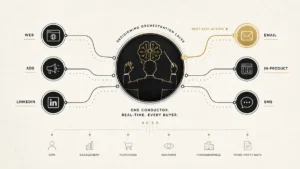
Behavioral triggers launch actions when a prospect does something meaningful: downloads a whitepaper, visits the pricing page twice, or registers for a webinar. Lead scoring and routing assign point values based on who the person is and how they behave, then move qualified leads to the right rep. CRM synchronization keeps a two-way flow so marketing and sales read from the same account and contact data. Omnichannel orchestration keeps the message consistent across email, retargeting ads, and the site so a buyer sees one story, not four.
How B2B marketing automation differs from B2C
The core difference is the buyer: B2B automation is built around accounts and buying committees, while B2C automation targets individual shoppers making quick decisions. That single fact changes everything downstream, from how you score a lead to how long a follow-up track needs to run.
A consumer flow can assume one person, one cart, one decision made in minutes or days. A B2B flow has to account for a committee of six to ten people, a cycle that often runs six to eighteen months, and a purchase that ends with a human sales conversation rather than a checkout button. Gartner found that even as buyers lean on AI, 69% of B2B buyers still turn to a sales rep to validate what they’ve researched. The machine warms the deal; a person usually closes it.
The 95:5 rule and the 95% you’re ignoring
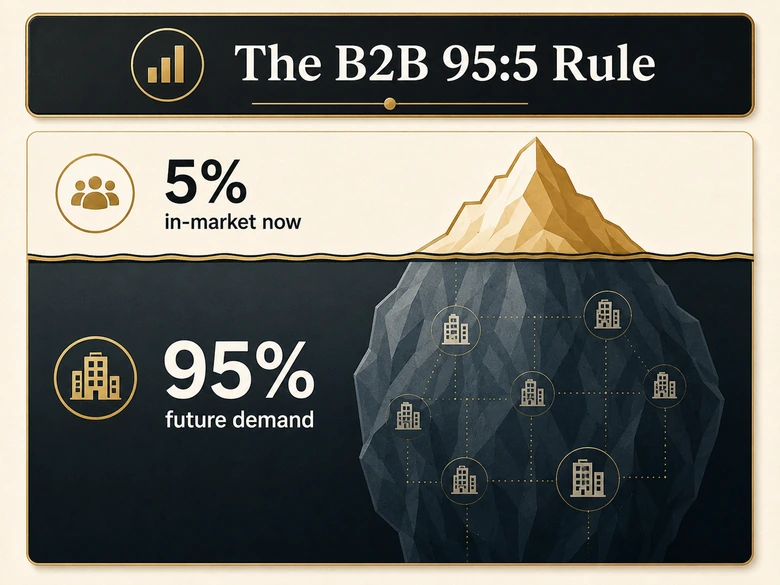
Then there’s timing, which is where most B2B programs quietly go wrong. According to the 95:5 rule from John Dawes at the Ehrenberg-Bass Institute, only about 5% of your potential buyers are in-market in any given quarter; the other 95% won’t buy for months or years. Companies switch providers roughly every five years, so at any moment most of your audience simply isn’t shopping.
If only 5% of your buyers are ready this quarter, the job of automation isn’t closing that 5% faster. It’s making sure you’re the brand the other 95% remember when their window finally opens.
That reframes what a good B2B system is for. It isn’t a closing machine pointed at ready buyers. It’s a memory machine that keeps a large, mostly-not-ready audience engaged with useful, well-timed contact until fit and intent line up. Where B2B and B2C split on tooling is a longer conversation, and the line between what the CRM owns and what marketing automation owns is the part teams most often get muddled.
The B2B marketing automation stack
A B2B marketing automation stack has five layers, from the platform that runs campaigns down to the data that feeds them. You rarely buy all five from one vendor, and pretending you can is how teams end up with an expensive tool doing 40% of the job.
The first layer is the all-in-one marketing automation platform: HubSpot Marketing Hub, Adobe Marketo Engage, or Salesforce Marketing Cloud Account Engagement (the product formerly called Pardot). These run email, landing pages, forms, scoring, and workflows in one place. The second layer is CRM-native automation, where the automation lives inside the CRM itself rather than a separate app. Pipedrive now offers a current example of that layer expanding: its Outfunnel acquisition brings the sales-marketing sync layer in-house, although the native feature set is still being rebuilt. If you’re weighing those two worlds, our breakdown of how HubSpot and Salesforce handle the marketing-plus-sales database shows why the architecture matters more than the feature list, and the wider set of operational CRMs that automate the marketing side is worth a look before you commit.
The third layer is ABM platforms like 6sense and Demandbase, which target accounts and surface buying intent before a prospect ever fills out a form. Salesforce’s 2026 State of Marketing report found 89% of B2B marketers now run an ABM platform, so this layer has gone from optional to expected. The fourth layer is workflow and iPaaS connectors that wire the tools together when native integrations fall short; if you’re choosing between them, compare how Zapier, Make, and n8n handle a multi-step B2B lead flow. The fifth and lowest layer is data and enrichment from sources like ZoomInfo and Clay, because every layer above it is only as good as the account and contact data underneath.
Core B2B marketing automation use cases
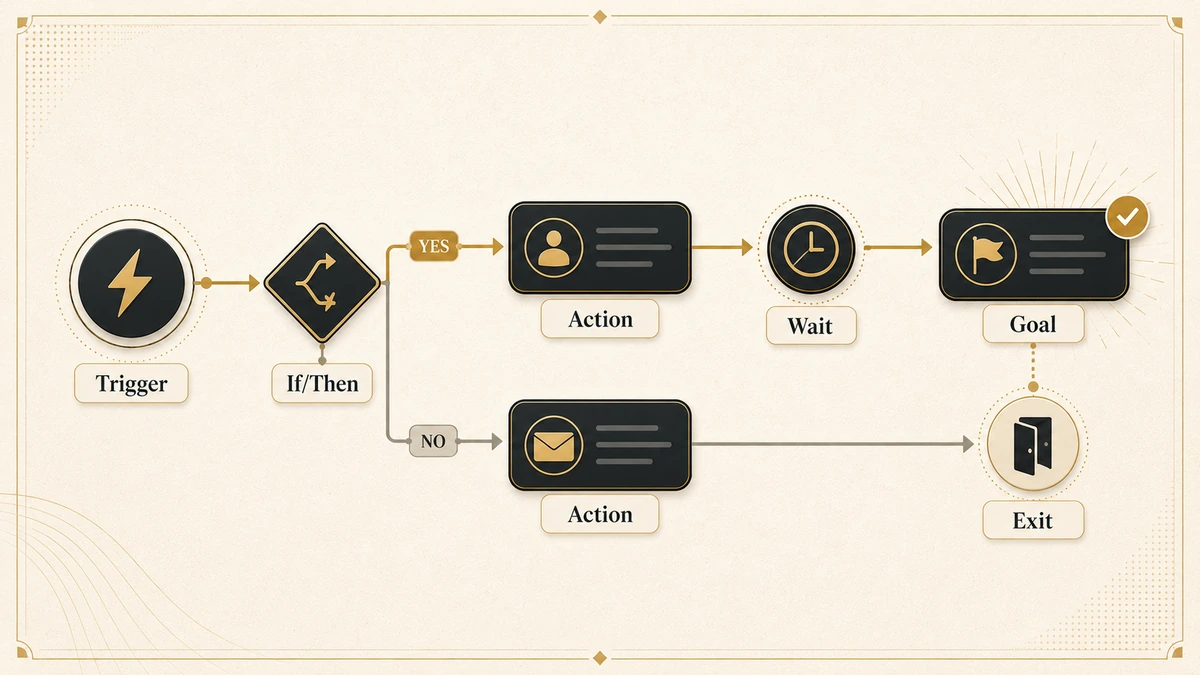
The highest-value B2B marketing automation use cases are lead nurturing, lead scoring, sales routing, lifecycle management, and attribution. Most teams start with one or two and add the rest as the model matures, which is the right instinct: a working sequence beats five half-built ones. Nurturing is the one on that list with the most ways to go quietly wrong, because the emails are the easy part and enrollment triggers, stage branching and the four ways a contact leaves are what decide whether it produces pipeline or unsubscribes.
Lead nurturing is the workhorse. Instead of a single blast, the system runs behavior-triggered email tracks that adjust to what a prospect reads and clicks over weeks or months. Sales routing takes a qualified lead and assigns it to the right rep by territory, segment, or account owner, with no lead sitting in a queue overnight. Lifecycle management moves contacts between stages as their signals change, promoting the engaged and recycling the cold back into marketing. All three assume people keep flowing through, which is an assumption worth testing rather than trusting: on every major platform a campaign runs once per person unless somebody changes a setting, so a behavior-triggered track built on the default quietly stops recruiting after its first pass.
Attribution is the use case teams reach last and regret skipping. Because a B2B deal touches many people over many months, last-click reporting credits the final demo request and ignores the year of contact that set it up. Multi-touch attribution ties each touch to pipeline and revenue, which is how you learn which tracks and channels actually move accounts forward instead of just generating opens. It’s also what turns a “marketing costs money” conversation into a “marketing sources pipeline” one. Run at the account level, that becomes assigning revenue across all the touchpoints a buying committee makes, not just the final form fill, so the credit reflects the group of people who actually made the decision.
The hardest use case to get right is the one that ties the others together: the actual sequence of steps from trigger to send to score to handoff. Designing that flow is its own discipline, and our guide to building a marketing automation workflow from trigger to sales handoff covers the branching logic and exit rules in detail. Get the workflow right and the platform choice matters far less than the vendor demos suggest.
The lead lifecycle and the marketing-to-sales handoff
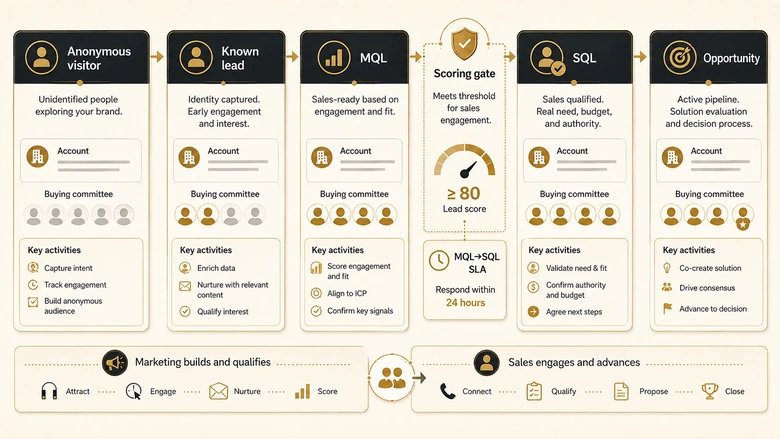
The B2B lead lifecycle is the path a contact takes from anonymous visitor to sales-qualified opportunity, with automation moving them between stages as their fit and intent change. A clean lifecycle usually runs: anonymous visitor, known lead, marketing-qualified lead (MQL), sales-qualified lead (SQL), then opportunity. Automation’s job is to promote people forward on real signals and to hand them off cleanly at the MQL→SQL boundary.
That boundary is where good programs separate from busy ones. Lead scoring decides it, and the model has two axes that should stay separate: firmographic fit (is this the right kind of account?) and behavioral intent (are they showing buying signals?). A perfect-fit account with no activity needs marketing attention, not a sales call. A high-activity but poor-fit contact needs disqualifying, not routing. The mechanics of setting those thresholds are covered in our breakdown of the fit and intent criteria that decide when a lead is sales-ready.
PRO TIP
Score fit and intent as two separate numbers, not one blended total. A blended score hides the difference between “great account, not ready” and “ready buyer, wrong account,” and those two need opposite actions.
The handoff itself needs a written agreement, not a vibe. Define exactly what an MQL is, what an SQL is, how fast sales must act on a routed lead, and what happens to leads sales rejects. A one-page service-level agreement between marketing and sales does more for pipeline than most feature upgrades. Without it, marketing ships leads sales ignores, sales complains about quality, and the automation gets blamed for a process gap.
How to choose a B2B marketing automation platform
To choose a B2B marketing automation platform, match the tool to your CRM, your team size, and how complex your sales motion really is. There’s no single best platform, only the best fit for your constraints, so the useful question is “which of these describes us?”
- Use an all-in-one MAP (HubSpot, Marketo, Marketing Cloud Account Engagement) when you want marketing, scoring, and reporting in one system and can standardize your process around it.
- Choose CRM-native automation when your sales team already lives in the CRM and you want marketing data on the same record with no sync layer.
- Add an ABM platform when you sell to a defined set of target accounts and need intent data before the form fill.
- Add an iPaaS connector when your best tools don’t integrate natively and you need to move data between them reliably.
- Avoid buying up-market when a five-person team can’t staff an enterprise platform; unused capability is just recurring cost.
Once you’ve settled on the category, the ranked, vendor-by-vendor decision is a separate exercise. If HubSpot’s pricing is the trigger for your search, our tiered guide to the platforms teams switch to when the invoice outgrows the team lays out the trade-offs by budget and use case so you’re not comparing on feature checklists alone.
How to get started with B2B marketing automation
To get started with B2B marketing automation, fix your targeting first, map the lifecycle, then build a small number of high-value workflows before you scale. The order matters more than the tooling. Teams that automate before they’ve defined the audience just industrialize their existing mistakes.
- Audit your ICP and targeting. Write down who you sell to, who’s in the buying committee, and what a good-fit account looks like. This is the step that makes or breaks everything after it.
- Map the lead lifecycle end to end. Define each stage, its entry signal, and its exit criteria, from anonymous visitor to opportunity.
- Pick the stack that fits your CRM and team. Choose the smallest set of tools that covers your five layers without overlap.
- Build two or three workflows first. A welcome-and-nurture track and a demo-request routing flow return value fast and teach you the platform.
- Set scoring and a written MQL→SQL SLA. Agree the thresholds and the handoff rules with sales before you turn routing on.
- Instrument attribution and review monthly. Tie touches to pipeline, then adjust the model against real outcomes every month for the first quarter.
IMPORTANT
Automate targeting last, not first. If your ICP and messaging aren’t tight, automation will scale the misses at machine speed. Fix the audience, prove the message by hand, then hand it to the system.
Our honest take: the platform you choose is the least important decision on this list. Fit-and-intent scoring, a real handoff agreement, and disciplined targeting will outperform a “better” tool bolted onto a vague process every time. Start small, measure against pipeline rather than opens, and let the wins fund the next workflow.
Frequently Asked Questions
B2B marketing automation is software that runs marketing tasks for business buyers automatically, based on rules and behavior. It captures leads, sends behavior-triggered email, scores contacts by fit and intent, syncs to the CRM, and routes sales-ready leads to reps. It’s built for long, multi-person buying cycles rather than quick consumer purchases.
A common example: a prospect downloads a whitepaper, which triggers a nurture email track. As they open emails and revisit the pricing page, their lead score climbs. Once the score crosses the sales-ready threshold, the system routes the lead to the right rep with the full activity history attached, all without manual handoff.
The four core functions are behavioral triggers (actions that fire on prospect activity), lead scoring and routing (ranking leads and assigning them to sales), CRM synchronization (a two-way data flow between marketing and sales), and omnichannel orchestration (a consistent message across email, ads, and the website). Most platforms bundle all four.
The 95:5 rule, from the Ehrenberg-Bass Institute, says only about 5% of your potential B2B buyers are in-market at any given time; the other 95% aren’t ready to buy. It matters for automation because most of the job is staying memorable and useful to the 95% until their buying window opens, not just chasing the ready 5%.
Yes, if you start small. A two- or three-person team gets the most value from automating lead capture, one nurture track, and sales routing rather than buying an enterprise platform. Match the tool to your team size; unused capability is just cost. The discipline of scoring and a clear handoff matters more than the size of the platform.