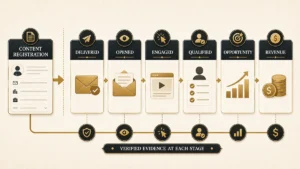
Your sales team just called 50 MQLs this week. Four were worth talking to. The other 46 were blog subscribers, students researching for a paper, and competitors checking your pricing page. That’s not a lead quality problem. It’s a lead scoring problem, and no sales lead evaluation framework fixes it, because a framework only runs after someone has already picked up the phone.
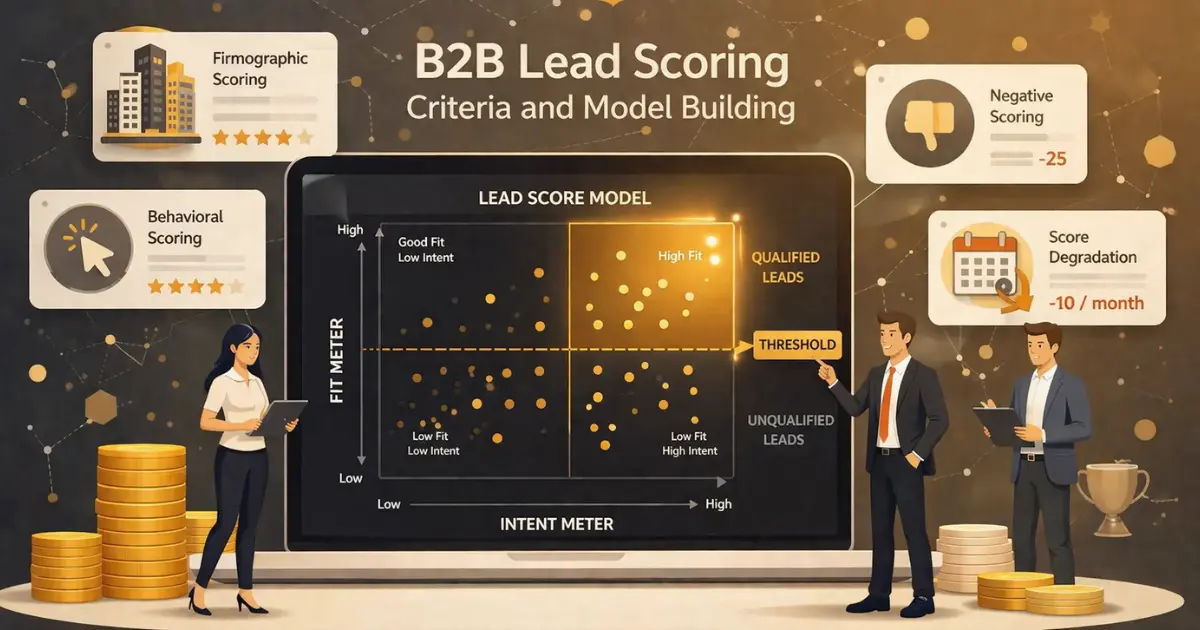
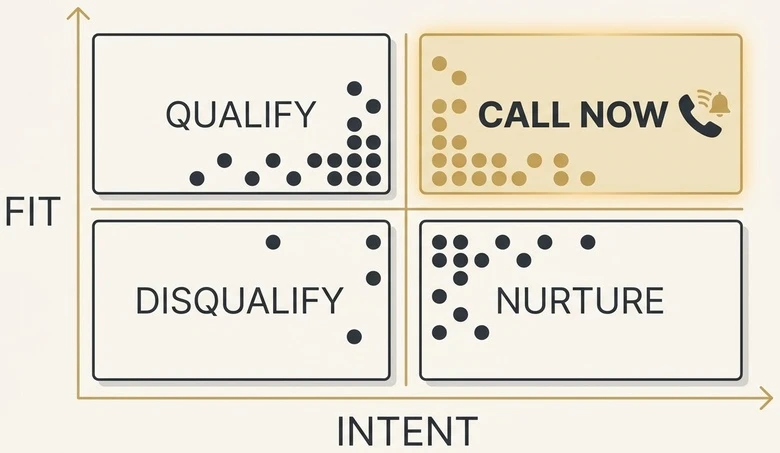
B2B lead scoring assigns numerical values to leads based on two dimensions: how well they fit your ideal customer profile (firmographic fit) and how strongly they’re signaling buying intent (behavioral signals). When both scores are high, sales should call immediately. When either is low, the lead stays in marketing warming sequences until the signals change. The figure most often quoted here, that 79% of leads never convert into sales, originates with MarketingSherpa and is repeated by later publishers rather than re-measured, and no public version of it states a sample, a date or what counted as a lead. Treat it as an illustration of the problem, not as a benchmark to plan against. Beyond the criteria themselves, the operating habits that keep a model accurate over time (sales-feedback loops, monthly recalibration, threshold tuning) sit in our guide to lead scoring best practices.
After building and refining scoring models across SaaS, MarTech, and professional services companies, we’ve found that most teams overcomplicate their first model. The best starting point isn’t a 50-attribute AI model. It’s 8-12 criteria with clear point values that your sales and marketing teams agree on before launch.
This guide gives you the exact criteria to include, a scoring model you can implement this week, and the calibration process that keeps your model accurate over time. It also settles the question the criteria alone can’t answer: which evaluation framework your reps should run once a scored lead reaches them, and why the answer depends on how many people are actually in the room.
Direct answer — What are B2B lead scoring criteria?
B2B lead scoring criteria fall into three categories: firmographic fit (job title, company size, industry, location, tech stack), behavioral intent (page visits, content downloads, email engagement, demo requests), and negative signals (personal email, competitor domain, inactivity, unsubscribes). Each criterion carries a point value calibrated against your closed-won data. Typical thresholds: an MQL handoff around 40 points for marketing follow-up and an SQL threshold around 80 points for sales. Demo or trial requests bypass scoring and route to sales immediately.
Key Takeaways
- Lead scoring uses two dimensions: firmographic fit (who they are) and behavioral intent (what they do). Both must be high for a lead to be sales-ready.
- Start with 8-12 criteria. Over-engineering your first model creates complexity that nobody trusts or maintains.
- Negative scoring is as important as positive scoring. A lead who unsubscribes, uses a personal email, or hasn’t engaged in 30 days should lose points, not just stop gaining them.
- Calibrate your model monthly for the first quarter by comparing scored leads against actual conversion data. Adjust point values based on what’s really predicting closed deals.
- Scoring and evaluation frameworks are different tools. Scoring ranks every record automatically; BANT, MEDDIC, CHAMP, GPCTBA/C&I and FAINT only run once a rep is in conversation.
- Pick the framework by how the decision is actually made, not by popularity. BANT asks who has authority as though one person holds it, and no published study of B2B buying groups has ever measured a group of one.
The Three Lead Scoring Criteria Categories at a Glance
| Criteria category | What it measures | Example signals | How it moves the score |
|---|---|---|---|
| Firmographic fit | How well the lead matches your ideal customer profile (who they are) | Job title/seniority, company size, industry, geography, tech stack | Adds points when the lead falls inside your sweet spot |
| Behavioral intent | How strongly the lead is signaling buying intent (what they do) | Pricing-page visits, content downloads, email engagement, demo requests | Adds points that scale with intent level; high-intent actions carry the most |
| Negative signals | Disqualifiers that make a good-looking lead unlikely to convert | Personal email, competitor domain, 30+ days inactive, unsubscribe | Subtracts points so weak leads fall below threshold |
What Is B2B Lead Scoring?
B2B lead scoring is the process of assigning numerical values to each lead in your pipeline based on predefined criteria that predict their likelihood of becoming a customer. The score tells sales which leads to prioritize and tells marketing which leads need more nurturing before handoff.
As Belkins’ lead scoring research shows, the most effective models balance firmographic fit with behavioral intent signals. Explicit data (also called firmographic or demographic data) measures who the lead is: job title, company size, industry, and location. Implicit data (also called behavioral data) measures what the lead does: pages visited, content downloaded, emails opened, and events attended.
The combination creates a prioritization system. A VP of Marketing at a 500-person SaaS company (high fit) who visited your pricing page three times and downloaded a case study (high intent) should be at the top of the call list. A marketing intern at a 10-person agency (low fit) who downloaded one ebook (low intent) should stay in follow-up sequences. Without scoring, both leads look the same in your CRM. The same model needs an additional source-weighting axis when you have outbound running alongside inbound — agency-sourced leads need to be reweighted against your inbound benchmarks, because their qualification rubric and intent signals are usually weaker than self-served inbound at the same lead-stage.
Lead Scoring vs Sales Lead Evaluation Frameworks
A sales lead evaluation framework is a fixed set of questions a rep answers about one deal in conversation. A lead scoring model is an automated point system applied to every record in your database. They solve different problems, they run at different moments, and most B2B teams need both.
Scoring runs continuously on data you already hold: title, company size, pages viewed, emails clicked. It answers one question, which is “of these 4,000 records, which ones deserve a call this week?” A framework runs only once a rep is on the phone. It answers a different question: “now that I’m talking to this person, is this deal real?” Scoring cannot answer the second one, because the inputs don’t exist until somebody asks them out loud.
That split is why teams who adopt BANT or MEDDIC and quietly retire their scoring model end up worse off than before. The framework has no opinion about the leads nobody has called yet, so the call list goes back to whoever filled in the form most recently. It’s also why a scoring model on its own leaves reps improvising on discovery calls.
Which Gate Each One Guards
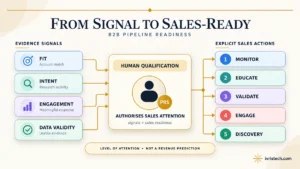
In practice the two tools sit on either side of the handoff. Scoring owns the MQL gate: it decides which records cross the threshold and get worked at all. The framework owns what happens after a rep accepts the lead, deciding whether the conversation becomes a real opportunity or gets sent back. If you want the full stage-by-stage version of that handoff, our breakdown of the lead lifecycle stages maps every gate between subscriber and customer, including the return path for leads a rep declines.
Get the division of labour wrong and you get the two most common failure patterns in B2B pipeline. Score without a framework and reps burn high-scoring leads with unstructured discovery. Run a framework without scoring and reps spend their week on whoever shouted loudest. There is a third pattern that costs just as much, which is running the right pair with the wrong framework, so match the framework to your deal size, cycle length and committee size before you roll either one out.
The Framework-Fit Decision Table: BANT vs MEDDIC vs CHAMP vs GPCTBA vs FAINT
Sales qualification frameworks are usually compared in the abstract, as though the choice were a matter of taste. It isn’t. Each one encodes an assumption about how many people make the decision, how long it takes and how much budget already exists. Pick the framework whose assumptions match your deals, and it works. Pick one whose assumptions don’t, and it disqualifies buyers who were going to buy.
Every origin claim below carries its source. Where the origin is repeated everywhere but traceable nowhere, the table says so rather than repeating it as fact.
| Framework | Where it came from | Deal shape it fits | Committee reality it assumes | Who runs it, and when | Time per lead | What it systematically misses |
|---|---|---|---|---|---|---|
| BANT Budget, Authority, Need, Timeline | Attributed to IBM in the 1950s. No primary IBM document is public; every current citation traces to secondary sources. | Transactional to lower mid-market. Short cycles, budget line already approved. | One person who holds both the budget and the final say. | SDR or BDR, on the first call. | 2 to 4 minutes | Buyers with real pain and no budget line yet, and any decision where authority is shared. Disqualifies people who would have bought two quarters later. |
| MEDDIC / MEDDICC / MEDDPICC Metrics, Economic buyer, Decision criteria, Decision process, Identify pain, Champion (plus Competition and Paper process) | Created inside PTC in 1996 by Dick Dunkel, under SVP John McMahon and with Jack Napoli, per MEDDICC’s own account. | Six figures and up. Three to twelve month cycles with procurement and legal involved. | Multi-stakeholder by design. The economic buyer and the champion are named as different people. | AE, from discovery onward, re-scored at every stage review. | 20+ minutes per opportunity, plus continuous upkeep | Lead volume entirely. It can’t rank leads nobody has called, and it’s too heavy below roughly $10K ACV. |
| CHAMP Challenges, Authority, Money, Prioritization | Widely attributed to Zorian Rotenberg and popularised through InsightSquared around 2007. We could not locate a primary account, so treat the attribution as unverified. | Mid-market inbound where the pain is real but no budget line exists yet. | Treats authority as a map to draw rather than a box to tick. Closer to reality than BANT, still a single axis. | SDR or AE, on the first real conversation. | 5 to 10 minutes | Money still arrives early enough to stall a group that hasn’t reached internal consensus. |
| GPCTBA/C&I Goals, Plans, Challenges, Timeline, Budget, Authority / Consequences and Implications | Built internally at HubSpot and published as “BANT Isn’t Enough Anymore”. | Mid-market inbound with a buyer who has already self-educated before the first call. | Its Consequences and Implications half is the only part of any framework here that prices the cost of a group not deciding. Authority is still one attribute. | AE, on a full discovery call. | 30 to 45 minutes of call time | Far too long for first-touch triage, and it still says nothing about leads nobody has spoken to. |
| FAINT Funds, Authority, Interest, Need, Timing | Developed by RAIN Group as a demand-creation alternative to BANT. | Outbound and demand creation, where no budget exists yet, so Funds replaces Budget. | Inherits BANT’s single-Authority assumption unchanged. | Seller, on an outbound or demand-creation conversation. | 5 to 10 minutes | Looser than BANT on commitment, and it carries the authority problem forward intact. |
| Numeric lead scoring The point model on this page | Marketing automation practice. No single origin claim and no methodology paper behind it. | Any deal size, but it only repays its setup cost above roughly 500 new leads a month. | Scores individual records, not groups, unless you add an account layer on top. | Nobody. It runs on every record continuously, with no conversation. | Zero per lead after setup; days of setup plus monthly recalibration | Everything that only exists in conversation. It can’t see budget, authority or timing until a person asks. |
Cite this table as: IVRIS Tech, “Framework-Fit Decision Matrix,” ivristech.com/b2b-lead-scoring-criteria/, 2026.
FREE WORKBOOK
Choose a qualification framework that matches the deal. Compare BANT, MEDDIC, CHAMP, GPCTBA/C&I, FAINT and numeric scoring, then use the selector and blind-spot register before standardising the sales process. Download the Framework-Fit Decision Matrix.
Use Each One When
- BANT or FAINT: a rep has to triage high inbound volume in under five minutes and the deal is small enough that being wrong is cheap. FAINT when no budget line exists yet, BANT when one does.
- CHAMP: the buyer has a clear problem and an unclear budget, and you’d rather find out who else has to agree than lose the deal on an early money question.
- GPCTBA/C&I: the deal justifies a 45-minute discovery call and your biggest competitor is the buyer deciding to do nothing.
- MEDDIC or MEDDICC: the deal is six figures, the cycle runs a quarter or more, and you need the same picture of it at every stage review.
- Numeric scoring: always, underneath whichever framework you pick. It’s the only tool here that works on leads nobody has called.
- Avoid running two frameworks at once. Reps fill in whichever fields are easiest to answer and the stage review stops meaning anything.
Why BANT’s Authority Question Fails Against a Buying Committee
BANT’s Authority question assumes one person can say yes. No published measurement of B2B buying group size has ever found a group of one.
This argument usually gets made with a single statistic, and it shouldn’t be. The published figures disagree sharply. TrustRadius, surveying 2,058 technology buyers in January 2025, found an average buying group of 4.8 people, with 79% reporting five or fewer. Forrester’s January 2026 release reports 13 internal stakeholders plus nine external influencers on a typical decision, and its full methodology isn’t public. Those two numbers count different objects, which is why our audit of the published buying group statistics concludes that averaging them produces a figure nobody measured.
The disagreement doesn’t weaken the argument against BANT. It’s irrelevant to it. Failing BANT’s Authority assumption takes only one number, and that number is one. The lowest published figure anywhere in that evidence base is 4.8. Nothing in the literature sits at one.
Involvement Is Not Authority
Two findings from the same evidence base sharpen the point. TrustRadius found a VP or C-level executive involved in 66% of technology purchase decisions. Involved is not the same as deciding, and BANT’s Authority box collapses exactly that distinction: a rep ticks it the moment a senior title joins the call. Forrester separately reports procurement acting as a decision-maker rather than a rubber stamp in 53% of business buying cycles.
The finding that should change how you brief reps is the third one. Edelman and LinkedIn describe hidden buyers as internal colleagues in finance, legal, compliance, procurement or operations, and found that 71% of them have little or no interaction with sales. The person answering your Authority question often can’t see the people who can stall the deal, and neither can your CRM. Our guide to the B2B buying committee maps those roles one at a time, which is what a framework needs to name if it’s going to be useful above a certain deal size.
IMPORTANT
Don’t replace BANT’s bad assumption with a bad statistic. There is no defensible single average buying group size to quote, and any page publishing one has invented it. Choose your framework from the shape of the decision, and when you cite a study, keep its scope attached.
The working rule is simple enough to hand a rep. If your Authority question is answerable by one person on one call, you’re selling something small enough that BANT is fine. The moment answering it takes two conversations, you need a framework that names roles instead of counting boxes, which is precisely what MEDDIC’s split between the economic buyer and the champion buys you.
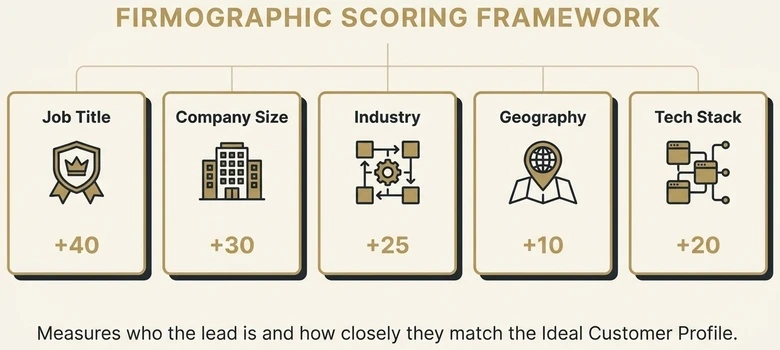
Firmographic Scoring Criteria (Who They Are)
These criteria measure how closely a lead matches your ideal customer profile. They’re typically static, meaning they don’t change frequently once captured. Assign point values based on how strongly each factor correlates with closed-won deals in your historical data. A fit score only earns its keep once something acts on it, which is the job of a system that routes high-fit leads to sales without anyone watching the queue.
Job Title and Seniority
Not all contacts have buying authority. A C-suite executive or VP-level contact is more likely to be a decision-maker than a coordinator or analyst. Score higher for titles that typically hold budget authority in your target organizations. A senior title is not the same as buying power, though, so executive buyer qualification tests whether a VP actually owns the budget or just the title before a rep spends a cold touch on them.
Example scoring: C-Suite/VP: +40 points. Director: +30 points. Manager: +20 points. Individual contributor: +10 points. Student/Intern: -15 points.
Company Size and Revenue
Your product likely works best for companies within a specific size range. A CRM built for mid-market teams (200-2,000 employees) won’t be the right fit for a 5-person startup or a 50,000-person enterprise. Score leads higher when they fall within your sweet spot. For manufacturers, size is the weakest of those signals, so it pays to score industrial accounts on certifications and installed equipment before size ever enters the model. When size does earn a place in the model, the mechanics of turning a revenue range into bracketed point values keep that signal consistent across every account.
Example scoring: Within ICP range (200-2,000 employees): +30 points. Adjacent range (50-199 or 2,001-5,000): +15 points. Outside range (<50 or >5,000): +0 points.
Industry Vertical
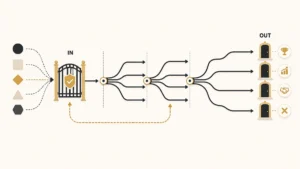
If your product has strong case studies and product-market fit in specific industries, leads from those industries deserve higher scores. A lead from a vertical where you’ve never sold successfully is a lower priority, even if other criteria look good. None of these scores mean much until the lead has cleared a validation gate first, since a perfect industry match on a fake or undeliverable record still converts at zero.
Example scoring: Primary vertical (e.g., SaaS): +25 points. Secondary vertical (e.g., professional services): +15 points. Non-target vertical: +0 points.
Geographic Location
If you only serve specific regions, or if your pricing and support model varies by geography, location matters. A lead outside your service territory should be scored down or excluded entirely. For the local service business audience, lead scoring criteria look different — see our local lead generation guide for the channel-by-CPL framework.
Example scoring: Primary market (e.g., US/Canada): +10 points. Secondary market (e.g., UK/EU): +5 points. Outside service territory: -10 points.
Technology Stack
For SaaS and MarTech companies, knowing which tools a prospect already uses is a strong fit indicator. If your product integrates with HubSpot or Salesforce, a lead using one of those platforms is a better fit than one on a custom-built system.
Example scoring: Uses complementary technology: +20 points. Uses competitor product (replacement opportunity): +15 points. No relevant tech data available: +0 points.
Behavioral Scoring Criteria (What They Do)
Behavioral signals measure buying intent. These change constantly as leads interact with your content, website, and sales team. High-intent actions (visiting the pricing page, requesting a demo) should carry significantly more weight than low-intent actions (reading a blog post, opening an email). Every one of those behavioral signals carries a source/medium tag the scoring model also reads, and scoring inputs degrade when form-side UTM data is missing before the lead ever reaches the scoring engine. Aggregate those behavioral signals across everyone at an account and you get the account-level view of who’s actively researching, which is the layer intent data adds on top of individual lead scores.
High-Intent Web Behavior
Not all page visits are equal. Someone who reads three blog posts is researching. Someone who visits your pricing page, then your case studies page, then returns the next day is evaluating. That difference between researching and evaluating is exactly what a B2B sales reset re-reads across every account at once, so a prospect who quietly crossed into evaluation last month does not stay filed under the warming track you set when they first arrived.
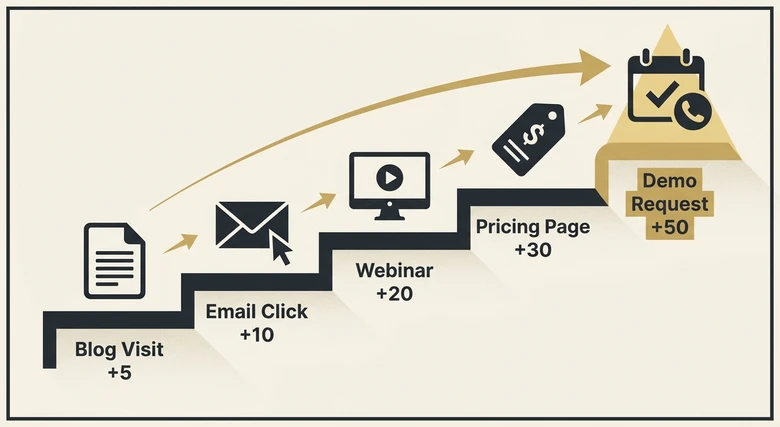
Example scoring: Pricing page visit: +30 points. Case study page visit: +20 points. Product/feature page visit: +15 points. Blog post visit: +5 points. Visited 3+ pages in one session: +10 bonus points. Whatever values you settle on, store which criteria fired alongside the number, because a rep who receives a 65 with no reason attached has to redo the qualification work by hand.
Content Engagement
What someone downloads reveals where they are in the buying journey. A “What is…” beginner guide signals early-stage research. A vendor comparison checklist or ROI calculator signals active evaluation.
Example scoring: Bottom-funnel content download (case study, ROI calculator, comparison guide): +25 points. Mid-funnel content (webinar attendance, template download): +15 points. Top-funnel content (blog subscription, ebook): +5 points.
Email Engagement
Email interactions reveal ongoing interest. Consistent opens and clicks across multiple emails indicate sustained engagement. A lead who opened your last 5 emails and clicked on 3 is more engaged than one who opened 1 of 10. Engagement ages, though, and the points should age with it, because the window in which a behavioural signal still predicts anything runs from days for a commercial page view to a full quarter for an executive hire.
Example scoring: Clicked email link: +10 points per click. Opened email: +3 points per open. Unsubscribed: -20 points.
Demo or Trial Requests
Direct requests for a demo, consultation, or free trial are the highest-intent actions a lead can take. These leads should immediately jump to the top of the sales queue regardless of their cumulative score. In Salesforce, making that jump automatic means writing the score into a lead assignment rule entry that routes high scores to a priority queue before the broader entries run. Reaching the top of the queue only helps if a rep then accepts the lead, and tracking whether sales formally accepts the leads your model flags is how you confirm the threshold is set right.
Example scoring: Demo request: +50 points. Free trial signup: +45 points. Contact form submission (“talk to sales”): +40 points. Scoring it highest is correct, and it is also where most teams stop paying attention, because a demo request still has twelve states to survive before anyone attends anything. Free-trial signups need their own scoring path though — the B2B SaaS scoring model treats the trial signup as a Product Qualified Lead trigger and decays it across the trial window so a Day-12 evaluation cohort scores differently from a Day-2 activation cohort.
Event and Webinar Participation
Attending a live event or webinar represents a significant time investment. Attendees who stay for 75%+ of the session and ask questions are showing strong buying signals. Registrants who don’t attend are still interested but less engaged.
Example scoring: Attended webinar (75%+ duration): +20 points. Registered but didn’t attend: +5 points. Asked a question during webinar: +10 bonus points.
PRO TIP
Build time decay into your behavioral scores. A pricing page visit from yesterday is more meaningful than one from three months ago. Reduce behavioral scores by 10-20% every 30 days of inactivity. This prevents stale leads from sitting at the top of your queue when their interest has cooled.
Negative Scoring Criteria (What Disqualifies)
Most lead scoring guides focus on adding points. But knowing when to subtract points is equally important. Negative scoring filters out leads that look good on paper but are unlikely to convert. If you’re sourcing leads from a third-party agency, the negative-scoring rubric below should also apply to agency-sourced leads; the 12 B2B lead generation companies in our shortlist vary widely on how rigorously they pre-qualify, and the negative signals catch agency-side qualification shortcuts.
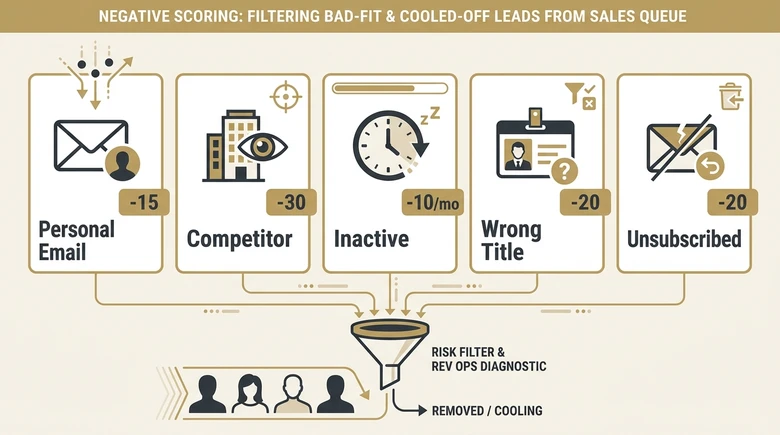
Personal email address (gmail.com, yahoo.com, outlook.com): -15 points. B2B buyers use company email. Personal addresses often signal students, job seekers, or casual researchers. The same signal carries heavier weight in regulated verticals — the HIPAA-aware scoring rules for healthcare push the personal-email negative to -25 because compliance-aware hospital buyers default to work email and the false-positive cost runs higher.
Competitor domain: -30 points (or flag for separate tracking). Competitors monitor your content, but they’re not leads.
No engagement in 30+ days: -10 points per month of inactivity. Interest fades quickly in B2B.
Job title mismatch: -20 points for titles clearly outside your buyer persona (e.g., “Student,” “Freelancer,” “Consultant” if you sell enterprise software).
Unsubscribed from email: -20 points. Active disengagement is a strong negative signal. An unsubscribe is one signal in a wider system, and the four categories of negative signals and how far each should pull a score down work better as a dedicated model than as scattered deductions inside the positive one.
Building Your Scoring Model: Step by Step
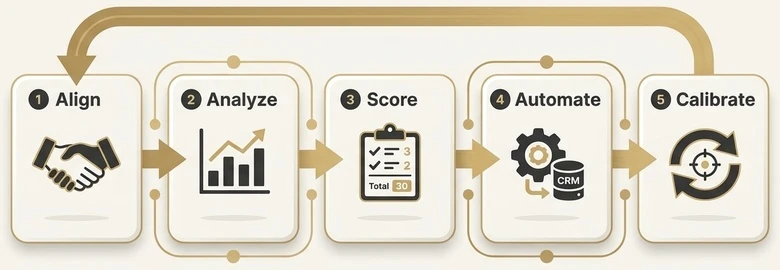
Step 1: Align Sales and Marketing on Definitions
Before you assign a single point value, get sales and marketing in the same room and agree on what makes a lead “sales-ready.” Use the MQL and SQL definitions as your framework. What score threshold should trigger a sales follow-up? What criteria are mandatory (e.g., must be a company email, must be within target company size)? Settle one more question in the same meeting, which is who owns the record once it clears the threshold, because a score decides priority while relationship and territory rules decide ownership.
Step 2: Analyze Your Closed-Won Deals
Pull your last 50-100 closed-won deals and look for patterns. What job titles appear most? What company sizes? Which content did they engage with before requesting a demo? Which pages did they visit? These patterns become your highest-weighted criteria. The same closed-won analysis sets the weights one level up at the account, where an account-level ICP scoring rubric tunes its firmographic, technographic, and intent pillars by which ones actually separated your won accounts from your churned ones.
Step 3: Set Point Values and Thresholds
Use the examples above as a starting point and adjust based on your data. Set two thresholds: MQL threshold (enough engagement to warrant marketing follow-up, typically 30-50 points) and SQL threshold (enough fit + intent for sales follow-up, typically 70-100 points). Once those point values are fixed, encoding those revenue bands as first-match rules keeps the firmographic score identical whether it runs in your CRM, a spreadsheet, or a SQL query.
Step 4: Implement in Your CRM or Marketing Automation
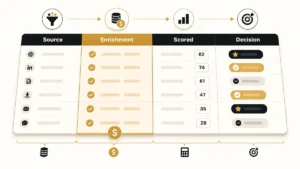
Most CRMs and marketing automation platforms (HubSpot, Salesforce, Marketo, ActiveCampaign) have built-in lead scoring. Configure your criteria, set automated alerts for leads crossing the SQL threshold, and create a notification that pings the assigned sales rep within minutes. Lists you build and enrich yourself are the exception, because they can be scored before a CRM ever sees them: an enrichment table can apply these same point values at the moment the data lands and write across only the records that clear the bar.
The scores you assign here should also feed your paid acquisition — Google’s Enhanced Conversions for Leads pushes your CRM’s SQL and Opportunity events back to Google Ads so bidding optimizes for actual pipeline quality, not just form fills. With the April-June 2026 unification into a single toggle, getting this loop set up is easier than it was twelve months ago and worth doing while your scoring model is fresh.
Step 5: Calibrate Monthly
Your first model will be wrong. That’s expected. Review scored leads against actual outcomes every month for the first quarter. Which high-scoring leads converted? Which didn’t? Adjust point values based on what your data shows. After 3 months, you’ll have a model that predicts conversions with confidence. After 6 months, consider adding predictive scoring using your CRM’s AI features to further refine the model. Track your SaaS marketing metrics alongside scoring changes to measure the real impact on pipeline quality.
IMPORTANT
Don’t skip the sales feedback loop. After every SQL that gets rejected by sales, ask why. Was the company too small? The wrong industry? The contact not a decision-maker? Each rejection is data that improves your model. Build a monthly “scoring review” meeting between sales and marketing into your RevOps cadence.
Workflow · 1 working day
How to build a B2B lead scoring model: the five-step build
Takes a team from no scoring model to a live one with agreed criteria, point values and thresholds. Budget a working day for the build; calibration then runs monthly.
Agree the sales-ready definition with sales
Get both teams in one meeting. Write down the score that triggers sales follow-up and the criteria that are mandatory regardless of score, such as a company email domain.
Analyse the last 50 to 100 closed-won deals
Export them and count which titles, company sizes, content assets and page paths repeat. The attributes that repeat become your highest-weighted criteria.
Set point values and two thresholds
Start from the point values in the model table above. Set the MQL threshold at 30 to 50 points and the SQL threshold at 70 to 100, then adjust against your own data.
Configure the model in your CRM
Enter each criterion in HubSpot, Salesforce, Marketo or ActiveCampaign. Add an alert that fires to the assigned rep the moment a record crosses the SQL threshold.
Recalibrate monthly for the first quarter
Compare scored leads against actual outcomes each month. Raise the weight on attributes that converted, cut the weight on those that didn’t, and log every change.
Lead Scoring Model Example
Here’s a complete model for a mid-market B2B SaaS company targeting marketing teams at companies with 200-2,000 employees.
| Criteria | Points | Type |
|---|---|---|
| C-Suite/VP title | +40 | Fit |
| Director title | +30 | Fit |
| Manager title | +20 | Fit |
| Company 200-2,000 employees | +30 | Fit |
| Target industry | +25 | Fit |
| Uses complementary tech stack | +20 | Fit |
| Demo request | +50 | Intent |
| Pricing page visit | +30 | Intent |
| Case study download | +25 | Intent |
| Webinar attendance (75%+) | +20 | Intent |
| 3+ pages in one session | +10 | Intent |
| Email click | +10 | Intent |
| Personal email used | -15 | Negative |
| Competitor domain | -30 | Negative |
| 30+ days inactive | -10/month | Decay |
| Unsubscribed | -20 | Negative |
MQL threshold: 40 points (enters marketing follow-up). SQL threshold: 80 points (routed to sales within 5 minutes). Auto-SQL triggers: Demo request or free trial signup bypasses scoring and goes directly to sales regardless of total score.
Manual vs AI-Powered Lead Scoring
Manual scoring (what we’ve described above) uses rules you define based on experience and data analysis. It’s transparent, easy to explain to sales, and works well for companies with fewer than 5,000 leads per month.
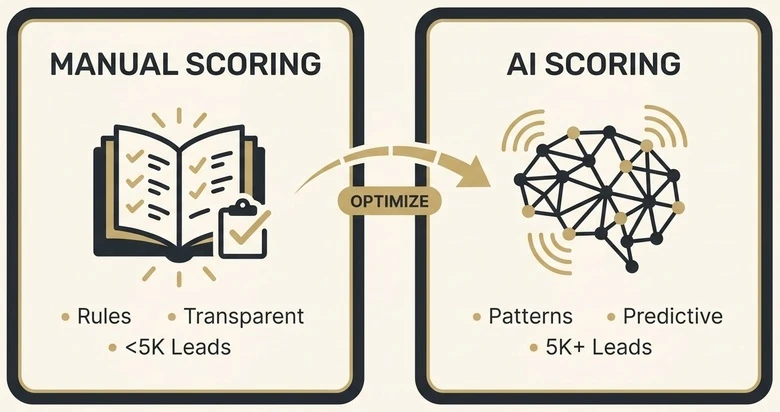
AI-powered predictive scoring uses machine learning to analyze thousands of data points and identify patterns that predict conversion. Tools like HubSpot’s Predictive Lead Scoring, Salesforce Einstein, and 6sense analyze behavioral patterns, firmographic data, and third-party intent signals to score leads automatically. The AI model learns which combinations of attributes and behaviors actually predict closed deals, often surfacing patterns humans wouldn’t catch. For the contact databases and enrichment tools that supply scorable leads, see our lead generation tools guide.
Our recommendation: Start with manual scoring to establish your baseline and build sales trust. After 6 months with enough conversion data, layer on AI scoring as a complement, not a replacement. What counts as enough is not a judgment call: every major platform publishes a minimum, and they range from 10 conversion events to 120 converted leads, so check your own number before assuming six months of history will clear it. Use the manual model as the sanity check and the AI model as the optimization layer. AI agents in RevOps can automate the scoring, routing, and follow-up sequence so high-scoring leads never wait for a human to notice them.
Methodology, limitations and revision history
IVRIS did not conduct primary research for this page. Every external figure is drawn from a named third-party publisher, and where a claim’s original source could not be located, the page says so rather than resolving it silently.
Inclusion rules
A framework was included in the decision table only if it is in documented commercial use and has a public description of its criteria. A figure was included only where the publisher named the population it measured. Claims that appear widely but trace to no retrievable original (the BANT attribution to IBM, the CHAMP origin date, and the 79% never-convert figure) are marked as unverified in place rather than dropped, because their circulation is itself part of the picture.
Limitations
The framework-fit table is editorial judgement applied to published descriptions, not a measured comparison of outcomes. No public study scores these frameworks against each other on win rate under controlled conditions, so nothing here should be read as evidence that one framework outperforms another. The committee-size argument rests on the published group-size range assembled in our buying group statistics ledger, which spans 4.8 to 17 people depending on what each study counted. The argument on this page relies only on the floor of that range, not on any single average.
Revision history and citation
Version 1.1, 2 August 2026. Adds the sales lead evaluation framework section, the framework-fit decision table, the buying-committee argument, and this methodology block. Suggested citation: IVRIS Tech, “B2B Lead Scoring Criteria: Framework-Fit Decision Matrix”, ivristech.com, 2026.
Frequently Asked Questions
B2B lead scoring criteria are the specific attributes and behaviors used to assign numerical values to leads. They fall into two categories: firmographic criteria (job title, company size, industry, location, technology stack) that measure how well a lead fits your ideal customer profile, and behavioral criteria (page visits, content downloads, email engagement, demo requests) that measure how strongly a lead is signaling buying intent. Combined, these criteria create a score that predicts conversion likelihood. Leads at Scale identifies 10 key criteria that consistently predict B2B conversions, and most overlap with the model outlined below.
A sales lead evaluation framework is a fixed set of questions a rep answers about one deal during a conversation, such as BANT, MEDDIC, CHAMP, GPCTBA/C&I or FAINT. It decides whether a specific lead is a real opportunity. Lead scoring is a different tool: it runs automatically on every record and decides which leads get called at all.
Match the framework to the deal rather than to its popularity. Use BANT or FAINT for fast triage on small deals, CHAMP when the budget is unclear, GPCTBA/C&I when your real competitor is the buyer doing nothing, and MEDDIC once deals pass six figures and a quarter-long cycle.
The best lead scoring model is one that your sales team trusts and actually uses. Start simple with 8-12 criteria across firmographic fit and behavioral intent. Set clear thresholds for MQL (marketing follow-up) and SQL (sales follow-up). Calibrate monthly using actual conversion data. The most sophisticated model in the world is useless if sales ignores it because they don’t understand how scores are calculated.
Assign positive points for attributes that correlate with closed deals (decision-maker title, target company size, high-intent web behavior like pricing page visits) and negative points for disqualifying signals (personal email, competitor domain, prolonged inactivity). Set a threshold score that triggers sales follow-up. Most B2B companies use their CRM or marketing automation platform to track scores automatically and alert sales when leads cross the threshold.
BANT stands for Budget, Authority, Need and Timeline, a qualification framework attributed to IBM in the 1950s. A rep checks whether the prospect has money, decision power, a real problem and a deadline. Its weak point is Authority, which assumes one person decides. Apply it after scoring, at the MQL-to-SQL handoff.
A common starting point is an MQL threshold around 40 points, which moves a lead into marketing follow-up, and an SQL threshold around 80 points, which routes the lead to sales. Demo and trial requests bypass scoring entirely. Treat both numbers as starting points and recalibrate them monthly against your actual conversion data.