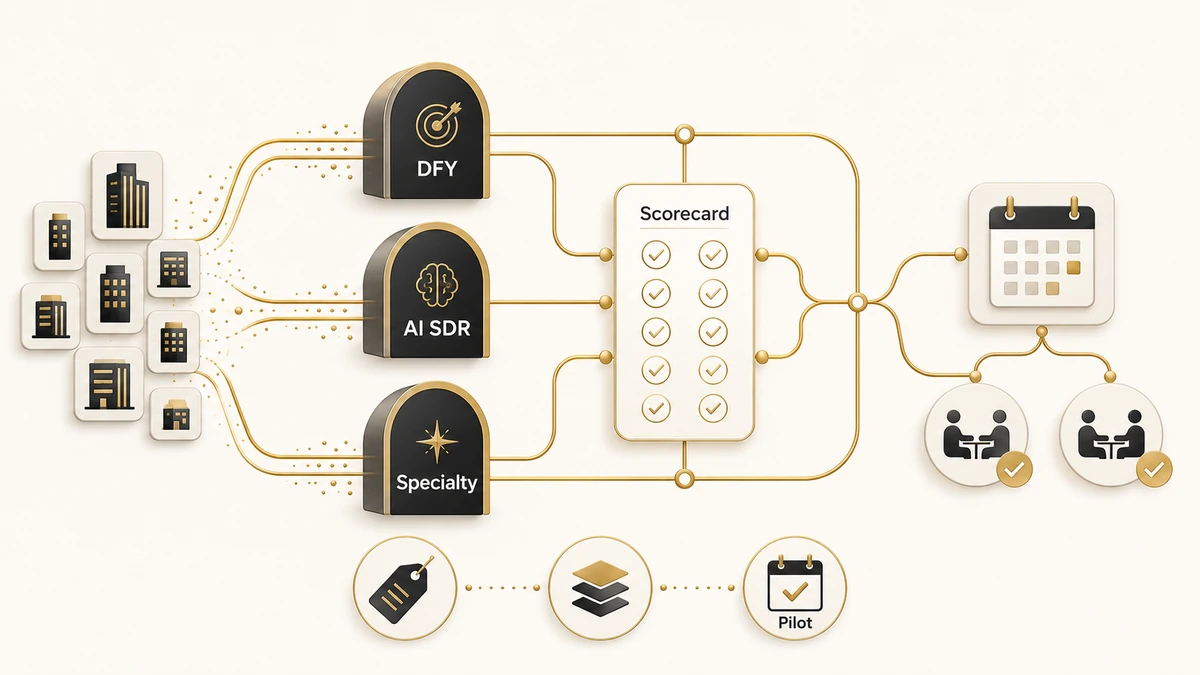
Google’s AI Overview for “best B2B lead generation companies” sorts the answer into three buckets: done-for-you agencies that run cold outbound for you, done-with-you data platforms that hand you contact lists, and AI SDR services that automate the prospecting motion entirely. That bucketing is useful, but it skips the real decision every founder and revenue leader actually faces: which type matches your go-to-market motion right now, what does it really cost in 2026, and which vendors in each category are worth a 60-day pilot instead of a 12-month lock-in.
This guide ranks the 12 best B2B lead generation companies for 2026 across done-for-you outbound agencies, AI SDR services, and specialty / niche providers. Pricing is disclosed where vendors publish it and flagged honestly where they don’t. A vendor evaluation scorecard sits at the bottom so you can apply the same 10 criteria to any vendor not on this list. The companies that hide pricing publicly are not penalized for it, but the fact that they hide it is something you should know before the first sales call. The underlying decision is also worth checking against the demand-gen vs lead-gen split you currently run, because the right vendor only matters once the demand-side question is answered.
Key Takeaways
- The 12 best B2B lead generation companies for 2026 split into three categories: done-for-you agencies (Belkins, CIENCE, Martal Group, Cleverly, SalesRoads, Callbox), AI SDR services (Artisan, 11x.ai, Qualified), and specialty / niche picks (Operatix, SalesAR, Pearl Lemon Leads).
- Most B2B lead gen agencies do not publish pricing. Of the 12 here, 8 require a custom quote, 3 publish partial pricing, and 1 (Artisan) has fully tiered public pricing. Custom-only pricing is not a red flag by itself, but it adds 1-2 weeks to your shortlisting timeline.
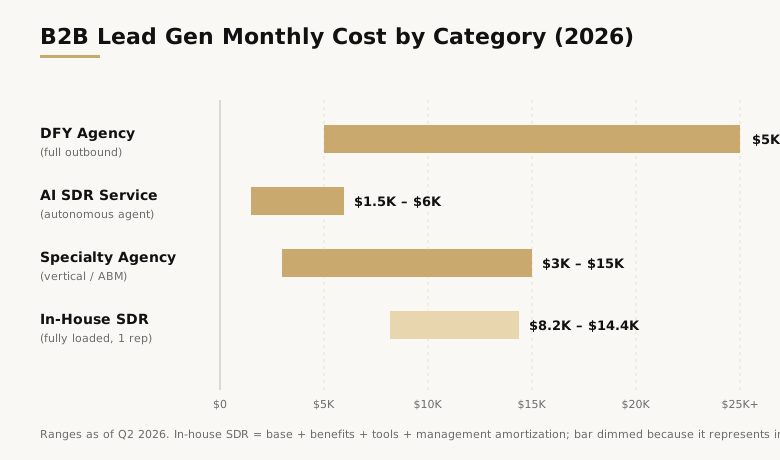
- DFY agency retainers cluster in three tiers: $2,500-$5,000/mo (shared SDR, templated outbound), $6,000-$10,000/mo (dedicated SDR, custom sequences), $11,000-$25,000+/mo (multi-channel ABM, senior strategists). Cost per qualified meeting lands at $400-$800 for competent agencies (as of Q2 2026).
- AI SDR services price below traditional agencies ($1,500-$6,000/mo as of Q2 2026) and win for high-volume top-of-funnel outbound. They lose to human SDRs on enterprise discovery, regulated verticals, and any motion where qualification depth beats reply-rate volume.
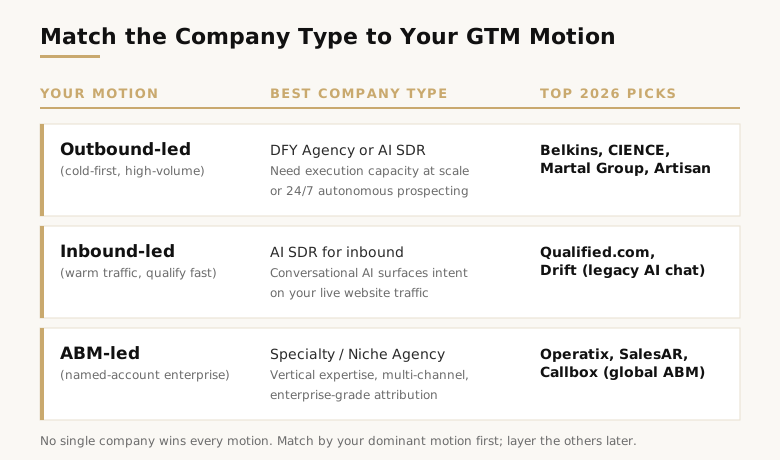
- Match by GTM motion first. Outbound-led: DFY agency or AI SDR. Inbound-led with website intent: conversational AI SDR (Qualified). ABM-led for enterprise: specialty agency with vertical depth (Operatix, SalesAR, Callbox).
- The vendor evaluation scorecard at the end (10 criteria, score out of 10) applies to any B2B lead gen company you consider, not just the 12 below. Score 8+ means green light. Score below 5 means pass.
METHODOLOGY
The 12 companies were selected from three signals: (1) presence in Google’s AI Overview for the primary query and the top 10 organic results as of May 2026; (2) market longevity (5+ years operating) for traditional agencies, or significant 2025-2026 funding and product traction for AI SDR services; (3) public reputation across LinkedIn, founder interviews, and named-author analyst coverage. Excluded: pure data-platform vendors (ZoomInfo, Apollo, Cognism, Lusha; those are tools you buy and run yourself, covered in our lead generation tools roundup), lead-mill resellers, and offshore appointment-setting shops without verified case studies. For local service businesses where the channel mix shifts to GBP + LSAs, the relevant playbook is local lead generation by cost-per-lead rather than the company list below. Updated Q2 2026.
How to Choose a B2B Lead Generation Company
A B2B lead generation company is an external service provider that finds, contacts, qualifies, or converts potential business buyers on your behalf, typically delivering booked meetings, qualified opportunities, or enriched account lists back to your in-house sales team. The category includes traditional human-led agencies (SDR-as-a-service, full-funnel demand gen, appointment setting), AI-native SDR services (autonomous agents that prospect and email), and specialty providers focused on a vertical, geography, or motion. The choice between them is not “which is best.” It is “which matches your GTM motion, deal size, and the bottleneck you actually have.”
Three filters narrow the field before you start comparing vendor pitches.
Filter 1: Match by GTM Motion
Outbound-led teams (cold-first, high-volume) need execution capacity. Either a done-for-you agency with named SDRs running your sequences, or an AI SDR service running autonomously around the clock. Inbound-led teams with traffic but weak conversion need a conversational AI SDR that engages website visitors in real time, qualifies them, and books meetings for your AEs. ABM-led teams selling enterprise need specialty agencies with vertical expertise, multi-channel campaign experience, and senior strategists who can work through enterprise procurement.
Filter 2: Match by Company Size and Deal Size
SMB and early-stage teams under $100K ACV often get more from an AI SDR or an in-house AI stack than from a $5,000/mo agency retainer. The economics tilt because agencies have a salary load to cover; AI agents do not. Mid-market teams ($100K-$1M ACV) match well with mid-tier DFY agencies and specialty providers. Enterprise teams ($1M+ ACV, multi-stakeholder buying committees) need senior strategists, custom ABM sequencing, and the kind of qualified meetings that only experienced SDRs reliably produce. Forrester’s 2026 buyer research notes the typical B2B buying decision now involves 13 internal stakeholders and 9 external influencers, which is why one-touch outbound rarely converts enterprise accounts without a multi-channel agency wrapping it.
Filter 3: Match by What You Are Paying For
Contact lists. Booked meetings. Qualified opportunities. Sourced pipeline. Each is a different unit of work and a different price point. Be specific about what you actually need delivered. A reader who downloads a whitepaper is a lead. A reader who books a 30-minute discovery call with a qualified decision-maker is a meeting. The price difference between those two units of work is 5-10x. Once that unit is defined, your MQL vs SQL threshold determines when each handoff happens and how the agency hands work back into your CRM.
12 Best B2B Lead Generation Companies in 2026 (At a Glance)
The table below summarizes the 12 picks across category, typical minimum retainer, pricing model, ideal company size, and pricing transparency. Specifics for each vendor sit in the per-company sections below.
| Company | Category | Min retainer | Pricing model | Ideal company size | Pricing disclosed? |
|---|---|---|---|---|---|
| Belkins | DFY agency | ~$5K/mo | Monthly retainer + per-meeting layer | SMB to mid-market | No (custom quote) |
| CIENCE | DFY agency | ~$5K-$10K/mo | Monthly retainer, multi-channel | Mid-market to enterprise | No (custom quote) |
| Martal Group | DFY agency | ~$5K-$8K/mo | Fractional SDR retainer | B2B SaaS / tech SMB to mid-market | No (custom quote) |
| Cleverly | DFY agency | Entry tier publicly listed | Tiered monthly retainer | SMB to mid-market | Partial (entry tier public) |
| SalesRoads | DFY agency | ~$8K-$12K/mo | Per-appointment + retainer hybrid | Mid-market US-focused | No (custom quote) |
| Callbox | DFY agency | ~$3K-$7K/mo | Monthly retainer, multi-region | SMB to enterprise, global | No (custom quote) |
| Artisan | AI SDR | Public tiers | Per-seat / per-volume subscription | SMB to mid-market | Yes (public tiers) |
| 11x.ai | AI SDR | ~$1.5K-$5K/mo (variable) | Per-agent subscription | SMB to mid-market | Partial (gated quote) |
| Qualified | AI SDR (inbound) | ~$3K-$10K+/mo | Monthly platform fee + AI usage | Mid-market to enterprise | No (custom quote) |
| Operatix | Specialty | ~$10K-$20K/mo | Retainer + per-region SDR pods | Enterprise B2B SaaS | No (custom quote) |
| SalesAR | Specialty | ~$3K-$6K/mo | Monthly retainer, multi-channel | Mid-market B2B | Partial (case-by-case) |
| Pearl Lemon Leads | Specialty | Entry tier publicly indicated | Monthly retainer | SMB boutique | Partial (starting price indicated) |
Min retainer ranges reflect typical published or commonly reported entry points (as of Q2 2026). Custom-quote vendors will work backward from your goals to a final number, which is usually higher than the published floor. Treat the table as a starting shortlist; the per-company writeups below have the substantive detail. That floor-versus-real-number gap is not unique to lead gen; done-for-you B2B email marketing carries the same custom-quote pattern, where a $1,500 published minimum rarely reflects what a full managed program actually costs.
Best Done-For-You B2B Lead Generation Agencies
Done-for-you (DFY) agencies handle the full outbound motion: ICP refinement against your input, contact data sourcing, sequence design, cold email and cold call execution, LinkedIn outreach, and meeting booking. You define the ICP and the qualified-meeting rubric. They run the work and hand back booked meetings. Of the 12 companies on this list, 6 are DFY agencies. The category is mature, the pricing is mostly opaque, and the differences come down to vertical focus, geographic strength, and how the agency structures the named-SDR relationship. For the deeper question of whether outsourcing is right for you in the first place, our outsourced lead generation analysis walks through the cost-per-meeting math and the five scenarios where it wins vs the five where it fails 99% of the time. Outbound is only one motion these companies run, so when cold outreach is specifically what you want to outsource, a tighter shortlist of outbound agencies by delivery model separates the SDR-as-a-service specialists from the full-funnel shops here.
1. Belkins: Best for SMB Outbound at Scale
Belkins is the most-cited DFY B2B lead generation agency in Google’s AI Overview for this query, and one of the few agencies with publicly visible case studies covering 100+ industries. The team focuses on appointment setting and cold outbound for SMB and mid-market clients, with a stated outcome target of qualified meetings rather than activity volume. Lead source is multi-channel: cold email primary, LinkedIn secondary, occasional cold calling depending on vertical.
Strength: long operating history, deep play of cold email infrastructure, and a research team that prepares per-account context before outreach. Limitation: SMB-oriented pricing means enterprise-grade ABM is not their sweet spot. They are better for the team that wants 10-25 qualified meetings per month at a defined cost than for the team running a 50-account named-list ABM motion. Pricing: not publicly disclosed; custom quote only (as of Q2 2026). Best fit if: you are an SMB or mid-market B2B team with a proven offer and need 10-25 qualified meetings per month without hiring 2-3 in-house SDRs.
2. CIENCE: Best for Research-Backed Enterprise Outbound
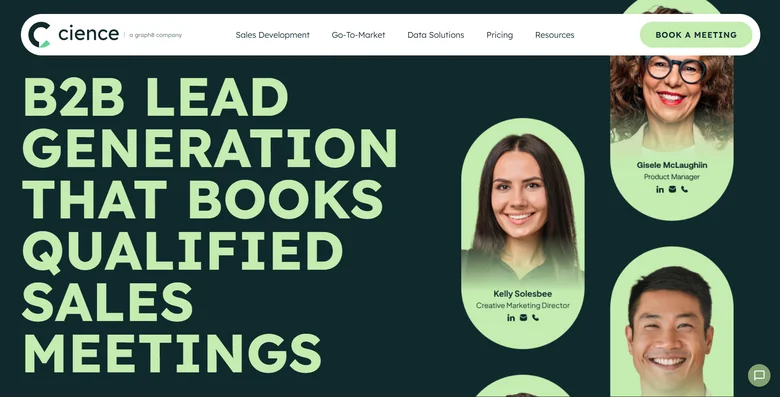
CIENCE pairs human-led outbound with a research layer that does pre-call account briefing and persona mapping before sequences go out. The agency runs cold email, LinkedIn, cold calling, and multi-channel campaigns, and is widely cited in AIO results for B2B lead generation. Lead source: research-driven cold outbound across email, LinkedIn, and phone, with vertical specialization across SaaS, manufacturing, and professional services.
Strength: the research and data layer feeds qualified-meeting rates that beat shared-SDR shops by a meaningful margin in our SERP and case-study survey. The cold call capability still matters in verticals where decision-makers do not respond to email (insurance, construction, legal). Limitation: pricing skews higher than the SMB-focused agencies because of the human research load, so very small teams may find the floor too steep. Pricing: not publicly disclosed; custom quote only (as of Q2 2026). Best fit if: you sell into mid-market or enterprise, your ICP is well-defined, and you value research-driven personalization over raw volume.
3. Martal Group: Best Fractional Sales Team for B2B Tech and SaaS
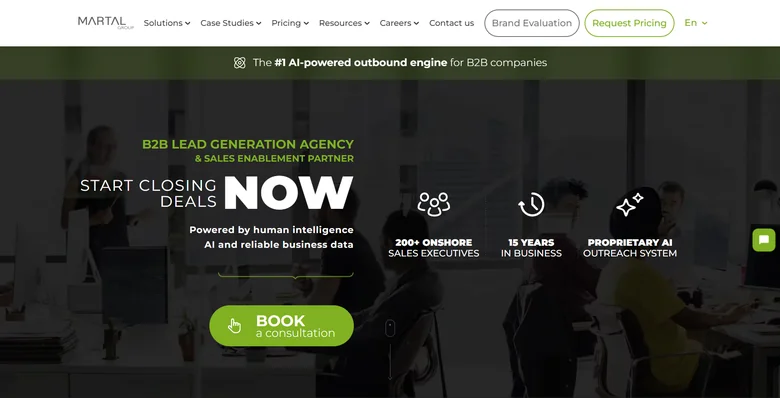
Martal Group positions itself as a fractional sales team rather than a pure outbound shop, which is a real distinction. The model layers SDRs, AEs, sales operations support, and account managers into a single retainer, so the agency can run discovery calls and even early-stage qualification beyond the meeting booking. Lead source: cold outbound across email, LinkedIn, and phone, with vertical depth in B2B SaaS, IT services, and tech companies selling into North American and EMEA mid-market.
Strength: the fractional-team structure works for early-stage B2B tech founders who do not yet have a full sales org and need the agency to act as their interim sales bench. AIO-cited and reasonably well-reviewed across founder communities. Limitation: the fractional model is a strength for the right buyer and a confusion for buyers who just want booked meetings. Be clear about which units of work you are paying for. Pricing: not publicly disclosed; custom quote only (as of Q2 2026). Best fit if: you are a B2B SaaS or tech founder pre-Series A who needs a fractional sales engine to scale into mid-market accounts.
4. Cleverly: Best for LinkedIn-Led Outbound
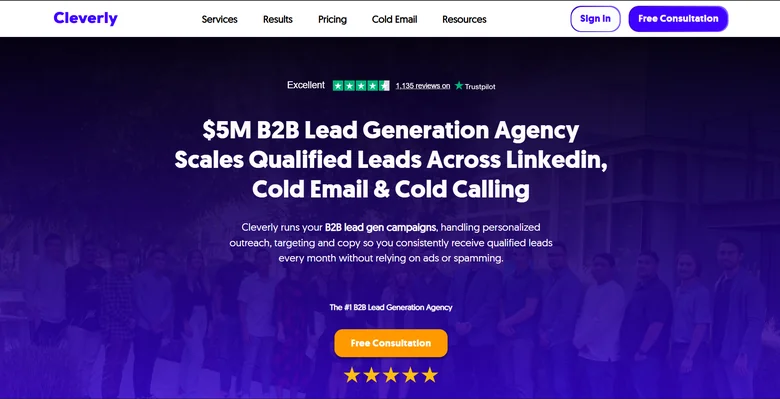
Cleverly is the LinkedIn-first agency on this list. The team specializes in LinkedIn outreach automation paired with manual personalization and reply handling, with a model designed for teams where the buyer persona lives heavily on LinkedIn. Lead source: LinkedIn outreach primary, email layered on as a secondary touch. AIO-cited as a top pick in the DFY category.
Strength: focused expertise on a single channel beats generalist agencies for buyers who actively use LinkedIn. Cleverly publishes an entry-tier price, which puts them in the small group of agencies offering some pricing transparency. Limitation: LinkedIn-only motion has a ceiling. If your ICP buyers do not engage on LinkedIn (founders in trades, certain manufacturing roles, deeply non-digital industries), the channel mismatch caps your results regardless of how good the agency is. Pricing: entry tier publicly indicated on their site; higher tiers custom (as of Q2 2026). Best fit if: your ICP is active on LinkedIn and you want a single-channel specialist rather than a multi-channel generalist.
5. SalesRoads: Best for Appointment Setting and Phone-Led Outbound
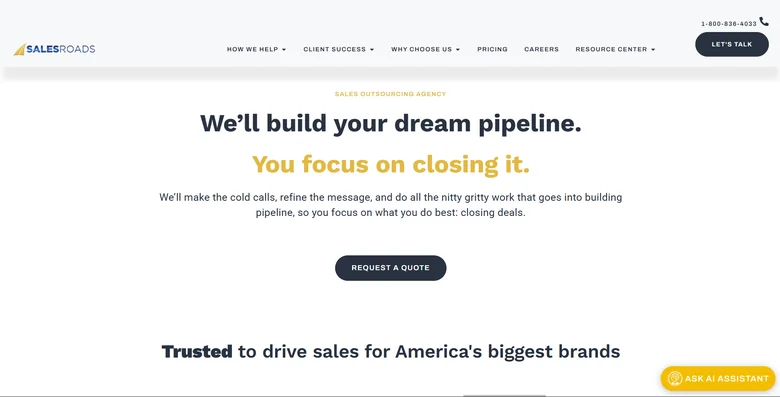
SalesRoads is the appointment-setting specialist on the list. Their model emphasizes phone-led outbound with experienced US-based SDRs, which is a structural advantage in verticals where decision-makers still take cold calls (construction, manufacturing, industrial services, insurance). Lead source: phone outbound primary, email and LinkedIn supporting. US-focused with deeper coverage of the US mid-market than offshore alternatives.
Strength: phone-led outbound remains the highest-converting channel in verticals where the buyer is over 40 and the deal size is over $50K. SalesRoads’ appointment-setting outcome model means you are paying for booked meetings, not activity. Limitation: the per-appointment cost can be high if your industry has long sales cycles or if your offer needs heavy education before a meeting is worth taking. Pricing: not publicly disclosed; custom quote only (as of Q2 2026). Best fit if: you sell into US mid-market in a vertical where phone outbound still works and you want appointment-based pricing.
6. Callbox: Best for Multi-Region and APAC Outbound
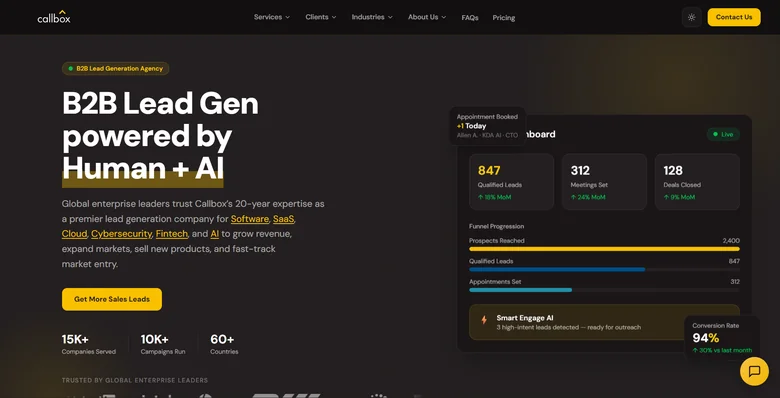
Callbox has the longest operating history on this list (20+ years) and one of the broadest geographic footprints, with delivery teams across APAC, North America, and EMEA. The agency runs multi-channel campaigns (email, LinkedIn, phone, paid) and has vertical case studies across IT, healthcare, financial services, and industrial sectors. AIO-cited as a top pick in the DFY category.
Strength: the multi-region setup is the real moat. Selling into Singapore, Tokyo, or Sydney from a US-only agency rarely works; Callbox has actual SDR capacity in those regions with local-language and timezone coverage. The 20-year track record means processes are mature and risk of fly-by-night execution is low. Limitation: the size of the operation means individual client attention can vary; be specific about senior-strategist time in your contract. Pricing: not publicly disclosed; custom quote only (as of Q2 2026). Best fit if: you are scaling into APAC, EMEA, or multiple regions simultaneously and need an agency with local-region delivery capacity.
Best AI SDR Services for B2B (2026’s Newest Category)
AI SDR services are autonomous software agents that find target accounts, enrich contact data, write personalized email sequences, send the emails, handle initial replies, and book meetings, all without a human SDR in the loop. The category is genuinely new (the first generation launched in 2023-2024 and the leading vendors raised significant funding in 2025-2026). The pricing is structurally below traditional DFY agencies because the marginal cost of an AI agent sending one more email is near zero. The honest tradeoff: AI SDRs win on volume and consistency; human SDRs still win on complex qualification, regulated verticals, and the kind of discovery conversations that lead to enterprise deals. That tradeoff is easier to judge once you know how few teams have actually reached full autonomy, because the adoption data behind autonomous prospecting is thinner than the category’s marketing, with the only independent SDR benchmark recording AI SDRs at 1% of respondents.
7. Artisan: Best End-to-End AI SDR Platform
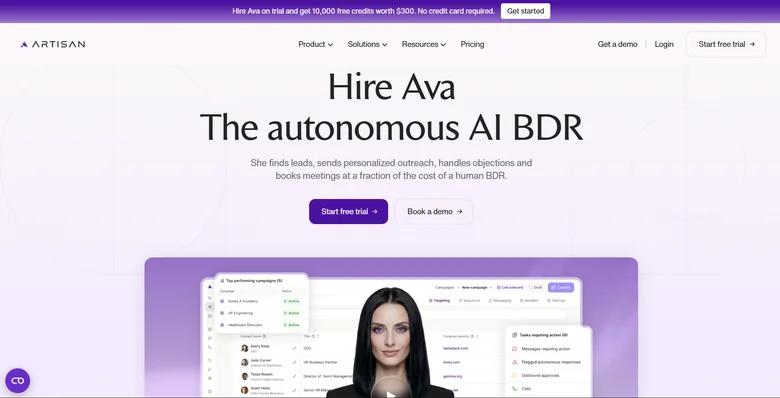
Artisan is the most-cited AI SDR in Google’s AI Overview for this query and the one with the most publicly visible pricing tiers. The product, branded as “Ava,” handles the full outbound motion: account discovery, contact enrichment from a built-in 300M+ contact database, AI-personalized email sequence writing, sending across warmed inboxes, and reply handling with meeting booking. Lead source: autonomous cold outbound, email primary, with LinkedIn integration as a secondary channel.
Strength: end-to-end coverage in one platform means you do not stitch together five tools. Public pricing is a trust signal that most agencies and most AI SDR competitors do not provide. The AI personalization is meaningfully better than templated agency sequences for top-of-funnel volume. Limitation: AI-only sequences still hit a ceiling on reply quality for enterprise discovery; you will book more meetings, and a higher percentage of them will be lower-quality than a senior human SDR would deliver. Pricing: public tiers on their site, starting in the low thousands per month (as of Q2 2026, verify current tiers at purchase). Best fit if: you want one platform to run the full outbound motion without a human SDR, and you care more about cost-per-meeting than per-meeting depth.
8. 11x.ai: Best for AI-Native Outbound at Scale
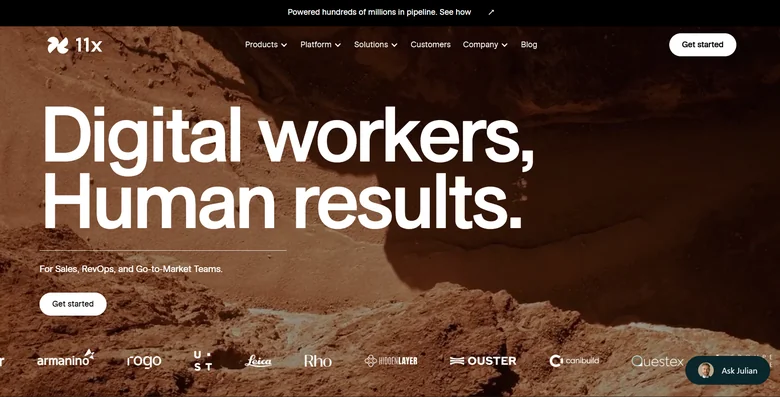
11x.ai ships two AI agents: “Alice” for inbound and outbound prospecting, and “Jordan” for AI-driven phone outbound. The company raised significant Series B funding in 2024-2025 and positions itself as building the “digital worker” layer for B2B sales orgs. The platform integrates with major CRMs and sales engagement platforms, so the AI sits alongside human reps rather than replacing them entirely. Lead source: autonomous AI prospecting and outreach across email and phone channels.
Strength: the dual-agent model (email + phone) covers more of the buyer journey than email-only AI SDRs. Phone outbound is undergoing a real reset with AI voices that no longer sound robotic, which opens up channels that have been dormant for a decade. Limitation: the cutting-edge nature of AI phone outbound means the regulatory and ethical questions are still being worked out by enterprise buyers. Some prospects react badly when they realize they spoke to an AI; some accept it as the new normal. The variance is real. Pricing: partial public information; custom quote for full deployment (as of Q2 2026). Best fit if: you want to test AI-native phone outbound alongside email, you have a phone-receptive ICP, and you accept the early-stage variance in AI voice quality.
9. Qualified: Best AI SDR for Inbound Conversion
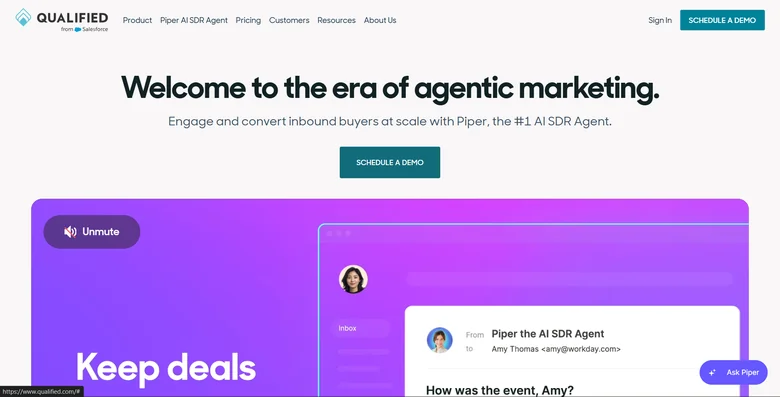
Qualified takes a different angle from Artisan and 11x.ai. Instead of automating cold outbound, the platform automates inbound conversion: an AI agent (branded “Piper”) engages visitors on your live website in real time, qualifies them through conversation, and books meetings with the right AE based on the lead’s profile and intent signals. The product is built on the assumption that you already have qualified traffic and the bottleneck is converting it. Lead source: real-time website intent surfaced through conversational AI.
Strength: Qualified is the rare AI SDR built for the inbound side of the funnel, which is genuinely underserved by automation. For B2B teams with strong content and SEO already driving traffic, the platform meaningfully lifts demo request volume by engaging visitors who would otherwise leave without identifying themselves. AIO-cited as a top AI SDR pick. Limitation: useless if you do not have inbound traffic. If your bottleneck is at the top of the funnel (not enough qualified visitors), Qualified does not solve that problem and Artisan or 11x.ai are better fits. Pricing: not publicly disclosed; custom quote only (as of Q2 2026). Best fit if: you have meaningful B2B traffic (10K+ relevant monthly visitors) and your conversion rate on demo requests is below 3%.
AI SDR CAVEAT
AI SDRs are real, they work for top-of-funnel cold outbound at meaningful scale, and the pricing economics genuinely beat traditional agencies for SMB and mid-market teams. They are not yet a replacement for senior human SDRs on enterprise discovery, in regulated verticals (healthcare, defense, financial services where compliance language is non-negotiable), or for any motion where qualification depth and account-context conversation matter more than reply-rate volume. The honest 2026 read: AI SDRs handle 60-70% of the work an SDR did in 2022 at 20-30% of the cost; the remaining 30-40% (the part that wins enterprise deals) still needs a human. The reason is structural: Forrester’s 2026 buying research reports 13 internal stakeholders and 9 external influencers in the typical enterprise buying decision, with procurement involved in 53% of cycles. That kind of multi-stakeholder qualification depth is exactly where AI agents currently underperform senior human SDRs.
Best Specialty and Niche B2B Lead Gen Companies
The specialty category covers companies that focus on a specific vertical, account size, or motion rather than the broad SMB-to-mid-market market that the DFY agencies serve. They are usually smaller, more senior on the engagement, and priced accordingly. The right specialty agency outperforms a generalist for the buyer in their exact lane and underperforms for everyone else. Three picks below cover enterprise B2B SaaS, multi-channel mid-market, and high-touch boutique work.
10. Operatix: Best for Enterprise B2B SaaS Pipeline
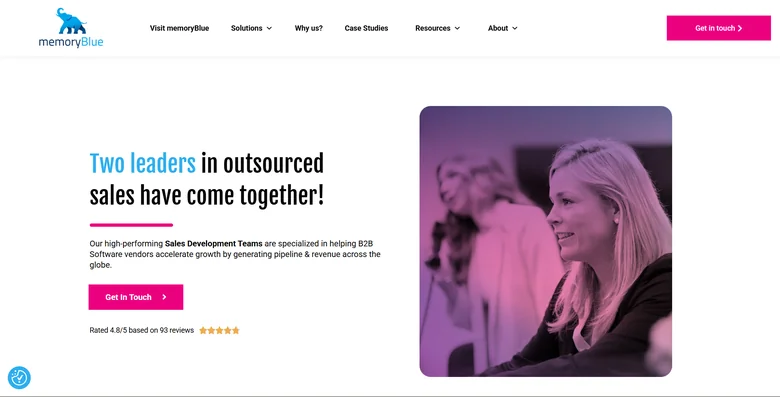
Operatix is the specialty pick for enterprise B2B SaaS pipeline. The agency runs regional SDR pods (North America, Europe, APAC) staffed with senior reps who have actual experience selling enterprise software, not generalist SDRs deployed across whichever client is paying. The model is designed for the SaaS founder or revenue leader who needs to build a serious enterprise pipeline and cannot afford the 6-9 months it takes to hire and ramp a full in-house enterprise SDR team. Lead source: senior human SDRs running multi-channel outbound into named enterprise accounts. Note: Operatix was acquired by memoryBlue in 2024, so new engagements may be contracted under the merged memoryBlue brand while the Operatix regional pod model continues.
Strength: deep B2B SaaS specialization means the senior strategists actually understand your sales motion, your buyer titles, and the procurement complexity of selling into the Fortune 1000. The regional pod model gives you EMEA and APAC SDR coverage without setting up your own subsidiaries. Limitation: pricing is enterprise-tier; not viable for early-stage or SMB teams. Pricing: not publicly disclosed; custom quote only (as of Q2 2026). Best fit if: you are a Series B+ B2B SaaS scaling enterprise pipeline and need senior SDR pods across multiple geographies.
11. SalesAR: Best for Multi-Channel B2B Outbound
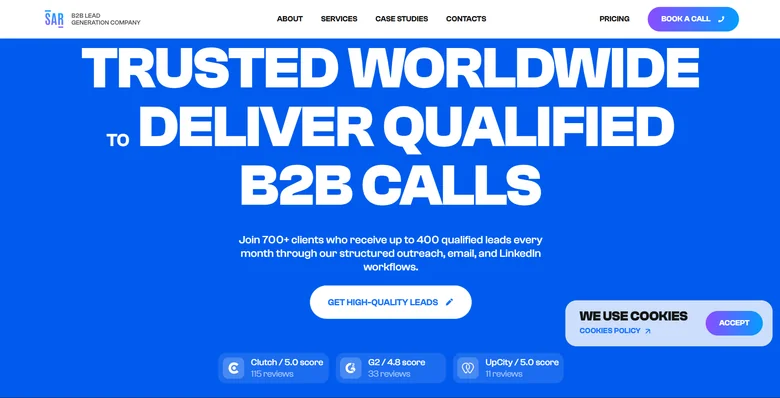
SalesAR is the multi-channel specialty pick for mid-market B2B. The agency runs email, LinkedIn, cold call, and paid layered campaigns into named target lists, with a heavier focus on qualification rigor than volume. The model fits buyers who want a real strategic partner rather than a high-volume outbound shop. Lead source: targeted multi-channel outbound into pre-defined ICP lists, with vertical case studies across SaaS, professional services, and B2B tech.
Strength: the qualification discipline is the real differentiator. SalesAR will turn away leads that other agencies would book as meetings because the disqualification rubric is tighter, which means your AE pipeline has higher show-and-close rates even with fewer raw meetings. Limitation: lower raw meeting volume means the per-meeting cost is higher than appointment-setting shops; valuable if your close rate justifies it, expensive if you want top-of-funnel volume. Pricing: partial; case-by-case quoting (as of Q2 2026). Best fit if: you value qualification quality over meeting volume and have an experienced AE team that can close the meetings booked.
12. Pearl Lemon Leads: Best for High-Touch Boutique Campaigns
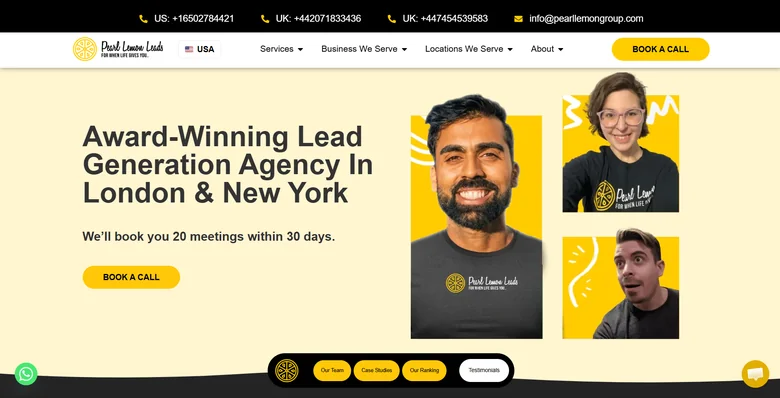
Pearl Lemon Leads is the boutique pick on this list. The agency is part of the broader Pearl Lemon group (which includes SEO, content, and other adjacent services) and is positioned for SMB and small mid-market teams that want a high-touch engagement with founder-adjacent attention rather than a productized SDR retainer. Lead source: multi-channel outbound with heavier human personalization than the volume shops, often layered with adjacent Pearl Lemon services for content and SEO support.
Strength: the boutique attention is genuine; campaigns get senior eyes, not just a junior SDR following a sequence. Useful for buyers who want strategic input on positioning and copy in addition to execution. Limitation: smaller scale means lower meeting volume and longer ramp than the big DFY agencies. Pricing: starting price publicly indicated; final pricing scoped per engagement (as of Q2 2026). Best fit if: you are an SMB founder who wants a strategic boutique relationship rather than a transactional SDR retainer.
What B2B Lead Generation Companies Actually Cost in 2026
Cost is the question every founder is actually asking. The honest answer has three layers: published pricing where it exists, typical industry ranges where it does not, and the effective cost per qualified meeting that determines whether the engagement was worth signing.
Retainer Pricing: The Most Common Model
Traditional DFY agencies overwhelmingly price in monthly retainers. The 2026 ranges cluster in three tiers. Entry-tier ($2,500-$5,000/mo) buys volume-led, templated outreach typically with shared SDRs across multiple clients. Mid-tier ($6,000-$10,000/mo) buys a dedicated SDR, custom sequences, and a strategist. Premium ($11,000-$25,000+/mo) covers multi-channel ABM, senior strategists, and full-funnel demand generation work. Output for a competent mid-tier agency lands at 10-25 qualified meetings per month, with effective cost per qualified meeting in the $400-$800 range when the agency hits volume. For context on what a benchmark in-house SDR delivers against the same retainer: Gradient Works’ compiled SDR benchmarks show median outbound SDR-generated pipeline at $3M annually and median qualified meetings of 8-15 per month, which is the floor your agency engagement needs to clear to justify the spend.
The cost-per-meeting math is the only number that matters at renewal. A $5,000/mo retainer producing 4 qualified meetings is $1,250 per meeting; the same retainer producing 12 qualified meetings is $417 per meeting. Same agency, same vendor, very different ROI. Track the per-meeting cost monthly from day one. Any agency that resists transparency on this metric is hiding from it.
Per-Lead and Per-Meeting Pricing (Performance-Based)
Performance-based pricing puts the agency’s risk in line with yours: they get paid per qualified meeting delivered or per opportunity-stage lead, not for monthly activity. SalesRoads runs a per-appointment model; some specialty agencies offer per-opportunity pricing. The structure looks attractive on paper because the agency only earns when you get what you wanted.
The catch: per-lead and per-meeting pricing only works when the agency and you agree on the definition of “qualified” in writing before the engagement starts. Without a tight 5-7 criterion qualification rubric, the agency books meetings against their definition (loose), you reject most against yours (tight), and the contract becomes a dispute. The good agencies welcome the rubric. The mediocre ones resist it. That resistance is itself a useful signal.
Hybrid Models and What They Cover
Hybrid models combine a lower base retainer with per-meeting or per-opportunity success fees. They are increasingly common in 2026 because the structure aligns incentives without putting 100% of the agency’s compensation on outcomes that depend on factors outside their control (your AE response time, your offer quality, your competitive position). Typical hybrid: $3,000-$5,000/mo base plus $200-$400 per qualified meeting delivered.
For the underlying tool stack agencies actually use to run this work (Apollo, Clay, Smartlead, ZoomInfo, Cognism), most agencies pass through the cost or wrap it into the retainer. If you are evaluating an in-house-vs-agency decision and want to understand the build-it-yourself economics, the same tool stack is what runs the in-house play; the diagnostic upstream of that buy is whether you actually have an outbound-execution gap or a demand-creation gap, because hiring an outbound agency to fix the latter is a known-fail pattern.
AI SDR Pricing: A Different Math Entirely
AI SDR services price between $1,500 and $6,000 per month for typical SMB and mid-market deployments (as of Q2 2026), structurally below DFY agencies because they do not carry SDR salary load. For reference on what the underlying paid-channel economics look like when you replace agency outbound with in-house paid acquisition: Dreamdata’s 2026 LinkedIn Ads benchmarks peg median LinkedIn Lead Gen Form CPL at $75-$110 with conversion rates around 13%, which sets a useful floor for what any outbound-replacement channel should beat on a per-meeting basis. The output trade-off: more raw outbound volume, often higher reply rates from AI-personalized sequences, but lower per-meeting quality on enterprise discovery and complex qualification. The cost-per-meeting math frequently lands below DFY agencies for top-of-funnel volume work and above DFY agencies once you discount the lower-quality meetings.
The honest read: AI SDRs are the right answer for SMB outbound and the wrong answer for $250K+ ACV enterprise deals where you need a senior human in the conversation. Most teams that try AI SDRs and conclude “they do not work” had the wrong fit problem, not an AI quality problem. Teams that keep outbound in-house rather than hand it to an agency face the same fit question one level down, in their choice of self-serve cold email software, where the SMB-friendly platforms and the enterprise-grade ones solve genuinely different problems.
The Vendor Evaluation Scorecard: 10 Questions Before You Sign
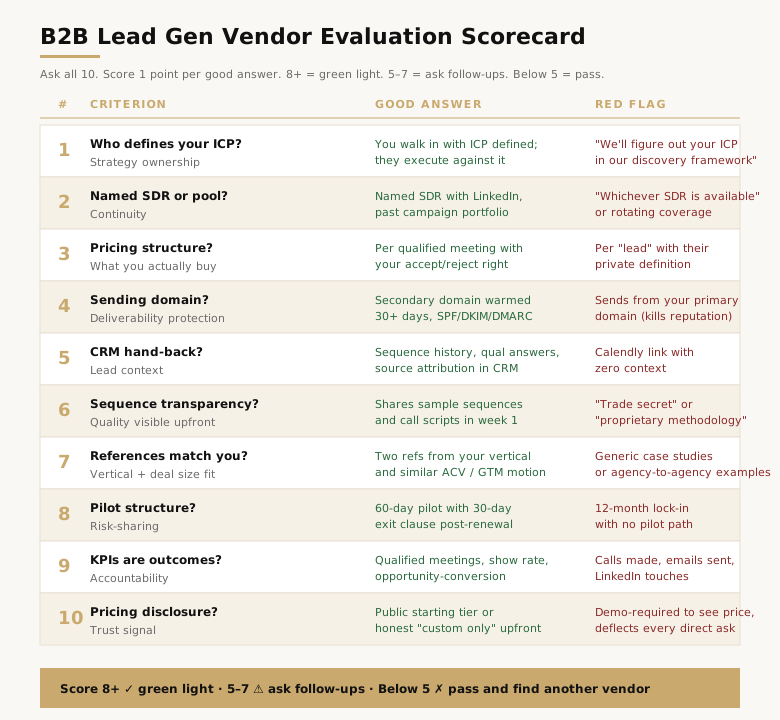
The 30-minute discovery call does not tell you whether an agency is good. The 10 questions below do. Ask them in order. Score 1 point per good answer. 8+ is a green light; 5-7 means dig further on the weak answers; below 5 is a pass. The scorecard applies to AI SDR services as well as human-led agencies, with minor adjustments for what “named SDR” means when the SDR is software.
The 10 Criteria, Explained
1. Who defines the ICP? You should walk in with your ICP defined. The agency’s job is execution against it, not redesigning your go-to-market motion. Good answer: “We refine the targeting based on your ICP, but you own the definition.” Red flag: “Our discovery framework will define the ICP for you” (which usually means they will pattern-match to whichever ICP fits their existing playbook).
2. Named SDR or rotating pool? Continuity matters because outbound work compounds: an SDR who has run your sequences for 90 days produces better results in month 4 than a rotating coverage model does in month 12. Good answer: a named SDR with a visible LinkedIn profile and a portfolio of past campaigns. Red flag: “We assign based on availability.”
3. Pricing model: per-meeting or per-lead? “Per lead” is meaningless without a written definition of what counts as a lead. Good answer: per qualified meeting with your accept/reject right and a written qualification rubric. Red flag: “$200 per lead” with their definition of lead (often “anyone who replied to an email”).
4. Sending domain protection? Cold email run from your primary domain damages sender reputation, sometimes permanently. Good answer: secondary send domain warmed for 30+ days with proper SPF/DKIM/DMARC. Red flag: “We send from your domain to ride on your sender reputation” (which sounds smart and is structurally bad). Ask too whether they keep a dedicated deliverability tool monitoring placement on the send domain, because even a warmed secondary domain degrades silently without it.
5. CRM hand-back protocol? Booked meetings are worthless if your AE walks in with no context. Good answer: written hand-back into your CRM with sequence history, qualifying answers, and source attribution. Red flag: a Calendly link drops on your AE’s calendar with no notes.
6. Sequence and script transparency? You are paying for the work; you should see the work. Good answer: shares sample sequences and call scripts during pilot week 1. Red flag: “trade secret” or “proprietary methodology” (which usually means the sequences are not actually good and they know it).
7. References from your vertical? Generic case studies from agencies-selling-to-agencies do not predict performance in your specific vertical. Good answer: two references from your vertical and similar ACV / GTM motion. Red flag: cannot produce vertical-matched references after a week of asking. Once leads come back from the agency, your in-house team should score them against the same firmographic and behavioral signals you use for inbound, with agency-source as an additional weight that often needs adjustment downward in the first 30 days.
8. Pilot structure? Real agencies offer a 60-day pilot with a 30-day exit clause because they are confident in their own work. Red flag: 12-month lock-in with no pilot path. The lock-in tells you something about how their economics work.
9. KPIs: outcomes or activity? Calls made, emails sent, LinkedIn touches: those are inputs, not KPIs. Good answer: qualified meetings booked, show rate, opportunity-conversion rate. Red flag: an agency that wants to be measured on activity volume is an agency that does not want to be measured on outcomes.
10. Pricing disclosure approach? Honest custom-quote-only is fine (“We scope every engagement individually”). Demo-required to see any number with deflection on every direct ask is not. The agencies on this list that disclose pricing publicly score 1 here; the custom-only agencies score 0 unless they tell you a real range during the first call.
PRO TIP
Build the qualification rubric collaboratively with the agency in pilot week 1, then freeze it for 60 days. Both sides have skin in the game on its accuracy, and freezing it prevents either side from moving the goalposts mid-pilot. The rubric is the single contract artifact that prevents 80% of the disputes that wreck agency engagements. Five to seven criteria is enough: title band, company size, current solution, problem statement strength, budget signal, timeframe, geography.
How to Vet Your Pick in 7 Days (Concrete Workflow)
The single biggest cost in choosing a B2B lead generation company is not the retainer. It is the 30-50 hours of founder, RevOps, or sales-leader time that goes into evaluation, plus the 60-90 days of opportunity cost if you pick the wrong vendor and have to start over. The 7-day workflow below compresses the evaluation into a defined process, which makes the decision honest and the timeline tight enough that vendors take it seriously.
Day 1-2: Write the Intake Brief and Send It to Your Shortlist
The shortlist should be 3-5 vendors, drawn from the 12 in this guide plus any specialty pick relevant to your vertical. The intake brief is one page, five sections: (1) ICP definition (titles, company size, industry, geography), (2) ACV band and current sales-cycle length, (3) GTM motion (outbound-led, inbound-led, ABM), (4) what you want delivered (qualified meetings, sourced opportunities, enriched lists), (5) the pilot constraint (60 days, 30-day exit clause, outcome KPIs not activity). Send it before the discovery call. Vendors that engage thoughtfully with the brief on the call score higher than vendors who arrive with a generic pitch deck.
Day 3-4: Discovery Calls with the Scorecard Open
30 minutes each, scorecard open in front of you. Ask the 10 questions in order, score as you go. The reason to score live is that vendors who notice you scoring sometimes change their answers mid-call, which is itself a signal. The reason to keep it to 30 minutes is that vendors who cannot answer the 10 questions concisely will run a similarly diffuse engagement. The good vendors finish in 25 minutes with time to spare.
Day 5: Request the Three Deliverables That Predict Performance
From each vendor that scored 8+ on the call: a sample sequence (3-5 email touches plus LinkedIn cadence), two vertical-matched references with contact info, and a pilot scope doc with the qualification rubric drafted collaboratively. Vendors who produce all three by end of day 6 demonstrate operational maturity. Vendors who delay, deflect, or send generic templates instead of vertical-matched sequences fail this stage regardless of how well they scored on the call.
Day 6: Reference Calls
15 minutes each, two references per vendor. Three questions: (1) what was the cost per qualified meeting at month 3, (2) what failed and how did the vendor respond, (3) would you re-sign. The third question is the most useful. Reference customers who hesitate before answering, give a qualified “yes,” or talk about “improvements we are working on with them” are usually telling you something. Reference customers who say “absolutely, we already renewed” are giving you the right signal.
Day 7: Decide, Sign Pilot Scope, Set Kickoff
The decision usually narrows to one or two vendors after the reference calls. Sign the pilot scope (not the full annual contract; the 60-day pilot scope only). Set the kickoff call for week 2. Build the qualification rubric collaboratively in pilot week 1 and freeze it for the 60-day period. From day 60 you have enough data to decide whether to renew into a longer term with the 30-day exit clause attached. The structure prevents the slow-rolling “we are still onboarding” excuse that turns a 60-day pilot into a six-month retainer with no accountability.
IMPORTANT
The 7-day workflow assumes you have ICP and offer clarity going in. If you do not, the workflow surfaces that gap fast (vendors will ask questions you cannot answer), which is useful information but means the agency engagement is not the right next move yet. Spend the time fixing ICP and offer first, then come back. According to HubSpot’s 2026 State of Marketing report, generating high-quality leads remains a top challenge for roughly 30% of marketers, and the agencies on this list cannot fix an offer problem upstream of the outreach motion.
How to Generate B2B Leads Without Hiring a Company
Hiring a lead gen company is not the only path. If your bottleneck is inbound volume rather than outbound execution, build the content engine first. The inbound system that compounds over years is detailed in our inbound lead generation guide and produces leads that close at 5-10x the rate of cold outbound. If your business is local and service-area-bound, the agency lane is the wrong lane entirely; the channel mix for service-area businesses runs through GBP, LSAs, and review systems rather than the SDR motion the 12 companies above all sell. The agency decision is a real one, but it is one of several. Run the right diagnostic before signing anything.
5 Mistakes B2B Teams Make Hiring a Lead Generation Company
The patterns below show up in nearly every B2B agency engagement audit. Each one is preventable, and avoiding them is worth significantly more than the marginal vendor-quality difference between the 12 companies on this list.
Mistake 1: Hiring Before Product-Market Fit Is Locked
The most common failure mode. You hire an agency because in-house outbound is not producing meetings, hoping the agency has some magic the in-house team lacks. The agency does not have that magic. Agencies amplify offers; they do not fix them. If your in-house close rate on demo-stage opportunities is under 15%, your offer is the bottleneck, not your prospecting capacity. Fix the offer, then hire the agency.
Mistake 2: Paying for Activity Instead of Outcomes
The retainer is structured around “1,500 emails sent and 300 calls made per month.” Six months in, you have gotten exactly that, and four qualified meetings. Activity contracts are how mediocre agencies hide. Outcome contracts (qualified meetings, show rate, opportunity-conversion) force the agency to produce work that matters. Every good agency will negotiate to outcome KPIs. The ones who insist on activity-only contracts are telling you something about their confidence in their own work.
Mistake 3: No Internal Owner for the Lead Handoff
The agency books meetings. Nobody on your team prepares for them, sends pre-meeting context, or runs disqualification before the call. Show rate craters at 40%, opportunity-conversion at 15%, and both sides blame the other. A named internal owner (RevOps lead, sales manager, or founder during early stage) running the agency-to-AE handoff is the single highest-impact fix in this category. Without it, even good agency output gets wasted on AE calendars.
Mistake 4: 12-Month Lock-In Without a Pilot
You signed a 12-month contract with no exit clause. Month three is bad; month four is worse. You are now legally obligated to pay for eight more months of work that is not producing pipeline. Every agency that resists a 60-day pilot with a 30-day exit clause is telling you how their own economics work. The pilot structure protects you and forces the agency to demonstrate competence on a defined timeline. The good agencies offer it because they know they can deliver.
Mistake 5: Letting the Agency Run From Your Primary Domain
The agency runs cold email from your primary domain. Spam complaints accumulate, sender reputation tanks, and within 90 days your CEO cannot reliably email customers. The deliverability damage outlasts the agency retainer by years and shows up as your transactional and customer-success emails landing in spam folders. Reputable agencies use dedicated send domains (yourcompany-team.co or yourcompany.io) with proper SPF/DKIM/DMARC and a 30-day warmup. Non-negotiable.
Frequently Asked Questions
B2B lead generation is the process of identifying potential business buyers, capturing their contact information, and qualifying them for sales follow-up. The methods include inbound channels (SEO content, gated assets, webinars, demo requests) and outbound channels (cold email, cold calling, LinkedIn outreach, paid ads). B2B differs from B2C lead generation because the buying decisions involve multiple stakeholders, longer sales cycles, and higher deal sizes, which makes qualification depth more important than raw lead volume.
B2B lead generation companies in 2026 typically cost $2,500-$5,000 per month for entry-tier shared SDR work, $6,000-$10,000 per month for mid-tier dedicated SDRs with custom sequences, and $11,000-$25,000+ per month for premium multi-channel ABM programs. AI SDR services price below traditional agencies at $1,500-$6,000 per month. Effective cost per qualified meeting lands at $400-$800 for competent agencies. Per-meeting and hybrid pricing models are increasingly common as alternatives to flat retainers.
There is no single best B2B lead generation company because “best” depends on your GTM motion, deal size, and bottleneck. For SMB outbound at scale, Belkins and Cleverly are strong picks. For research-backed enterprise outbound, CIENCE and Operatix lead. For AI-native autonomous prospecting, Artisan and 11x.ai are the most-cited. For inbound website conversion, Qualified is the specialty pick. The vendor evaluation scorecard in this guide applies to any company you consider and produces a more honest answer than a generic “best of” ranking.
Average cost per qualified B2B lead in 2026 varies dramatically by channel and definition. Outbound agency-sourced qualified meetings cost $400-$800 each. AI SDR services often deliver cost-per-meeting in the $200-$500 range for top-of-funnel work. LinkedIn Lead Gen Forms median CPL runs $75-$110 with conversion rates around 13%. Content-driven inbound MQLs from organic search can cost under $100 once the content compounds, but require 6-12 months to ramp. The “average” is less useful than the cost per qualified meeting in your specific channel and vertical.
Use a 10-question scorecard: (1) who defines the ICP, (2) named SDR or rotating pool, (3) pricing model and what counts as a lead, (4) sending-domain protection with proper SPF/DKIM/DMARC, (5) CRM hand-back protocol, (6) sequence and script transparency, (7) vertical-matched references, (8) pilot structure (60 days with a 30-day exit clause), (9) KPIs tied to outcomes not activity, and (10) pricing-disclosure approach. Score one point per good answer. 8+ is a green light; 5-7 means dig further on the weak answers; below 5 is a pass.
AI SDR services are worth it for SMB and mid-market teams running top-of-funnel cold outbound where volume matters more than per-meeting qualification depth. They typically deliver cost-per-meeting 30-50% below traditional DFY agencies and meaningfully better reply rates from AI-personalized sequences. They are not worth it for enterprise discovery, regulated verticals (healthcare, defense, financial services), or any motion where the buyer requires complex qualification conversation before booking time. The honest read: AI SDRs handle 60-70% of the work a 2022 SDR did at 20-30% of the cost; the remaining 30-40% still needs a human.
Your First Move
Shortlist three to five vendors from the 12 in this guide based on GTM motion fit (outbound-led, inbound-led, or ABM). Send each a one-page intake brief covering your ICP, ACV band, and pilot constraint, then book 30-minute discovery calls with the scorecard open. The vendors that engage thoughtfully with the brief and answer the 10 questions concisely are the two you put forward to pilot. The vendors that arrive with a generic pitch deck and deflect on direct questions self-select out, which is exactly what a useful shortlist process produces.
If two vendors clear the bar, run parallel 60-day pilots with a frozen qualification rubric. Compare on qualified-meeting cost, show rate, and opportunity-conversion rate at day 60. If only one clears the bar, run a single pilot but cap the engagement at 60 days before any longer commitment. If none clear the bar, the answer is not to lower the bar — it is to revisit whether outsourcing fits your stage. A founder running two hours of outbound a week often beats a $5,000-a-month agency engagement that is not yet ready to inherit a clear ICP.
The shortlist matters more than the longlist. Two well-scored discovery calls produce better outcomes than ten poorly-scoped ones, because the buyer who arrives prepared learns more in 30 minutes than the one collecting demos for a month.