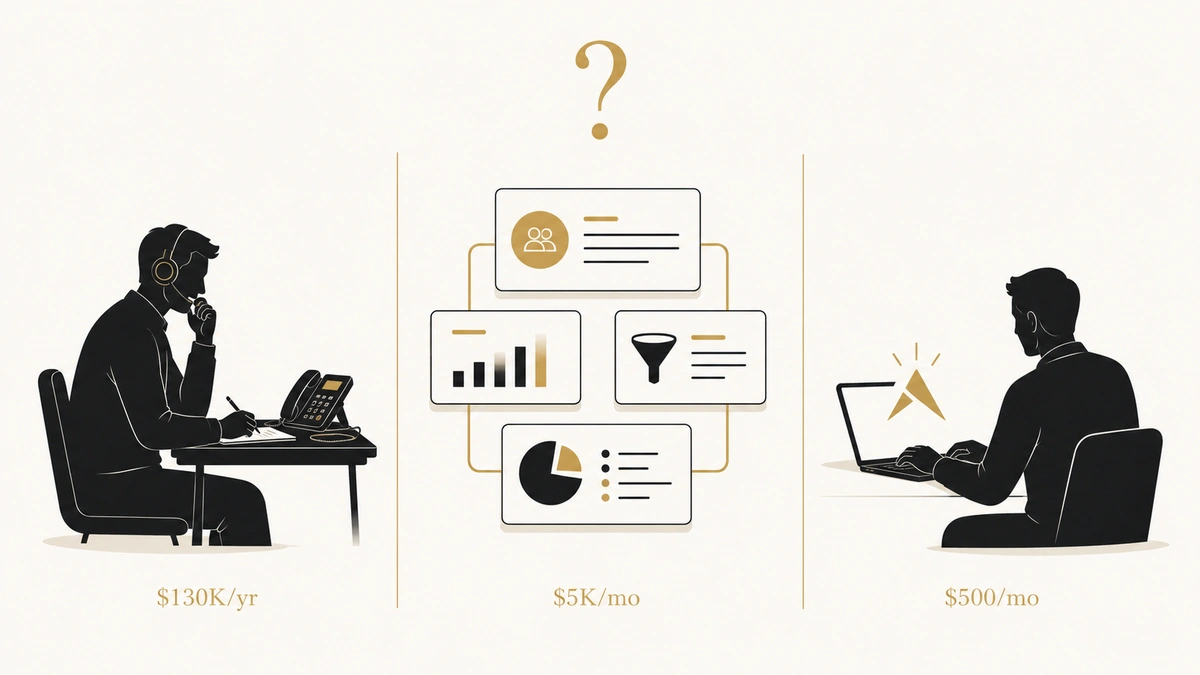
The honest case for outsourced lead generation in 2026 starts with a number most founders never run: a fully loaded in-house SDR costs $98,000 to $173,000 a year, a mid-tier agency retainer runs $36,000 to $120,000, and an in-house AI stack (Apollo + Clay + Smartlead) lands closer to $5,000 to $7,000. Three radically different cost curves, three different failure modes, and zero overlap in when each one is the right move.
Most guides on this topic are written by agencies pitching their own service. This one isn’t. After watching dozens of B2B teams burn six-figure retainers on activity reports nobody used, the pattern is clear: outsourced lead generation works in roughly five specific scenarios and quietly fails in five others. The math, the red flags, and the contract structure that protects you are below.
Key Takeaways
- An in-house SDR books 8-15 qualified meetings a month at a fully loaded cost of $98K-$173K/year. An agency at $5K/month should match that floor or you’re losing money on every lead.
- Outsourcing fails 99% of the time when the offer isn’t proven yet. If you don’t have product-market fit, no agency can manufacture pipeline you can’t close.
- The cheapest defensible setup in 2026 is in-house with AI: Apollo + Clay + Smartlead at roughly $400-600/month, plus 8-12 hours of founder or ops time per week.
- Vet agencies on outcome KPIs (qualified meetings, show rate, opp-to-close) — never on activity (calls, emails, dials). Activity reports are how bad agencies hide bad work.
- The only contract worth signing has a 60-day pilot, 3 outcome KPIs, and a 30-day exit clause. Lock-in retainers are the #1 buyer regret in this category.
What Outsourced Lead Generation Actually Is (and the 4 Service Types)
Outsourced lead generation is the practice of paying an external agency, contractor, or BPO to identify, contact, and qualify potential B2B buyers on your behalf, typically delivering booked meetings, qualified opportunities, or enriched contact lists back to your in-house sales team. The reader you’re paying for is sales-ready by the agency’s definition; whether they’re sales-ready by yours is the entire game.
Four service types dominate the category, and the differences matter for both cost and accountability:
SDR-as-a-Service
A dedicated outbound SDR (or fractional SDR pool) sends emails, makes calls, and runs LinkedIn outreach using your messaging and ICP. You own the strategy; they own the execution. Typical cost: $4,000-$8,000/month per SDR. Output: 8-15 qualified meetings/month, mirroring in-house benchmarks per SDR productivity research across 939 companies.
Appointment Setting
Volume-driven cold-call shops, often offshore, optimized for booked meetings. They’re cheaper ($2,500-$5,000/month) but trade quality for quantity. The qualified-meeting rate after your team disqualifies the noise often falls below the in-house benchmark. Useful when you need raw volume into a SDR-light or SDR-zero motion.
Full-Funnel Demand Generation
Strategy + execution: ICP definition, content, paid media, outbound, lead routing. Typically $10,000-$25,000/month, sometimes more with media spend layered on top. Useful when you don’t have a marketing function yet and need one stood up while you hire.
AI-Augmented Lead Generation
The 2026 layer: agencies running Apollo, Clay, Smartlead, and a handful of LLM-personalized email sequences. Pricing is moving below $4,000/month for SMB engagements because the underlying tool stack is now cheap. The defensibility question is whether you should just run that stack yourself.
PRO TIP
Before you read pricing, write down your own qualified-meeting target for the next 90 days. If you can’t articulate it in one sentence (“12 qualified meetings/month with VPs of Marketing at $50M+ B2B SaaS companies”), no agency can hit it for you.
The Break-Even Math: In-House SDR vs Agency vs AI Stack (2026)
Cost comparisons in this category are usually rigged. Agencies show their own retainer next to a $130,000 SDR salary and call it a day. The honest math includes ramp time, management overhead, tool stack, and qualified-meeting output, not just headline cost. Here’s the real breakdown.
Path 1: In-House SDR (Fully Loaded)
Median SDR base salary in 2026 sits at $55,000-$60,000, OTE at $83,000-$85,000. Once you add benefits (25-30% load), tools (Outreach or Salesloft, Apollo, Sales Nav, ZoomInfo: ~$300-$500/seat/month), management overhead (a Sales Manager amortized across 4-6 SDRs), and ramp time (3-4 months of sub-quota productivity per the Bureau of Labor Statistics wage data on Sales Representatives), fully loaded cost lands at $98,000-$173,000/year per SDR.
Output: 8-15 qualified meetings/month for an outbound SDR (top-quartile 12-15, median 8-10). That’s 96-180 qualified meetings/year per SDR.
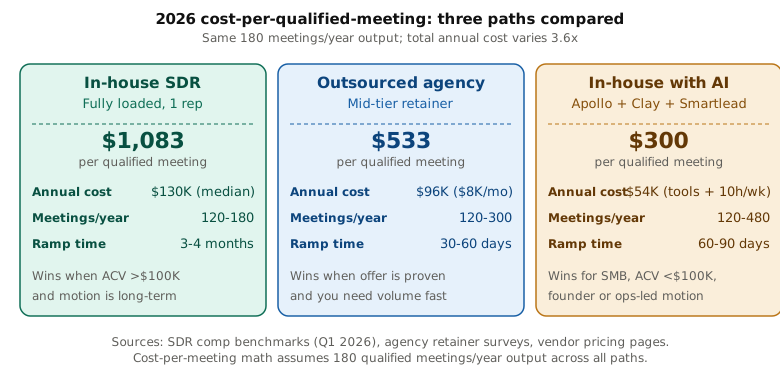
In-house cost per qualified meeting = Fully loaded SDR cost ÷ Annual qualified meetingsAt the median: $130,000 ÷ 120 meetings = $1,083 per qualified meeting. The cost looks horrifying because it is. The justification only works if those meetings convert at 25%+ to opportunities and your average deal size is north of $30,000. Part of why that number stays high is structural, since cold outreach converts at a fraction of what a warm, inbound lead does, so an outbound-only motion pays premium prices for the least-likely-to-close end of the funnel.
Path 2: Agency Retainer
Retainers in 2026 cluster in three tiers. Lower-end ($2,500-$5,000/month) buys volume-led, templated outreach with shared SDRs. Mid-tier ($6,000-$10,000) gets you a dedicated rep, custom sequences, and a strategist. Premium ($11,000-$25,000+) covers multi-channel ABM with senior talent. Whatever tier you buy, run agency-booked meetings through your own validation gate, because a “qualified meeting” on the agency’s definition is not always one on yours.
Output for a competent mid-tier agency: 10-25 qualified meetings/month if your offer is proven and your ICP is tight. Realistic floor: 6-8/month; realistic ceiling: 30/month for senior agencies with strong personalization. Plug those into the same formula:
$8,000/month × 12 = $96,000/year ÷ 180 meetings = $533 per qualified meeting. Cheaper than in-house at the median, but only if the agency hits the volume promised. The 99%-failure pattern (covered below) is when they don’t, and the retainer is locked. Picking a partner whose model matches your team is what avoids that locked-in mistake, which is exactly what a shortlist of outbound agencies grouped by model and budget is built to sort.
Path 3: In-House With AI
The 2026 stack: Apollo.io’s Professional plan at $99/month for the contact database and basic sequencing, Clay at $149-$349/month for enrichment and ICP scoring, Smartlead’s growth tier at $94/month for inbox warmup and multi-inbox sequencing. Total tooling: $342-$542/month. Add 8-12 hours of founder, ops, or part-time SDR time per week.
Output for a well-run AI stack with founder time: 10-20 qualified meetings/month after the first 60 days of inbox warmup and sequence iteration. Cost: $500/month tools + $4,000/month for ten hours/week of $100/hour ops time = $4,500/month = $54,000/year ÷ 180 meetings = $300 per qualified meeting.
This is the cheapest defensible option for SMB and early-mid-market teams in 2026. It also maps cleanly onto the in-house AI stack we ranked by job-to-be-done, where Apollo handles the database layer, Clay the enrichment, and Smartlead the sequencing.
When Outsourcing Wins: 5 Scenarios With Real Numbers
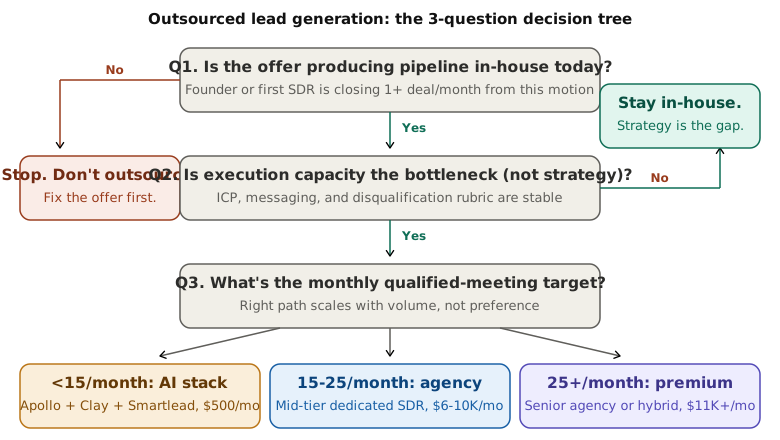
Outsourcing isn’t always wrong. It’s wrong by default, and right in five specific scenarios. The pattern across all five: the offer is already working, the bottleneck is execution capacity, and you have something measurable to feed the agency.
Scenario 1: Proven Offer, Need to Scale Volume Fast
You have product-market fit, a working in-house SDR or two, and a quarterly target that doubles your current pipeline. Hiring 4 more SDRs takes 6-9 months including ramp. An agency layered on top of your in-house team can cover the gap in 4-6 weeks. Cost premium: 15-25% above in-house, but the time-to-pipeline is what you’re paying for. The shortlist of 12 B2B lead generation companies sorted by GTM motion is the right place to start vetting candidates for that gap-coverage role.
Scenario 2: International Expansion (Timezone or Language)
You’re selling US-built SaaS into EMEA or APAC and your sales team is on US hours. An agency with native German, French, or Japanese SDRs working local timezones is faster than relocating talent. Worth the premium because the alternative (US SDRs cold-emailing Munich at 2am their time) doesn’t work.
Scenario 3: Niche Industry Expertise You Lack
Selling into healthcare, defense, financial services, or any heavily regulated vertical requires SDRs who understand procurement cycles, compliance language, and which titles actually approve budget. An agency with 5 years of HIPAA-aware outreach in healthcare will outperform your generalist SDR’s first 90 days every single time.
Scenario 4: Founder Bandwidth Is the Bottleneck
You’re 0-3 reps, your CAC math works, and the founder is the closer. Outbound is hitting a ceiling because the same person doing prospecting is also doing demos, closing, and onboarding. Outsourcing the top of funnel buys 8-15 hours/week back. The constraint is that the founder still owns ICP, messaging, and disqualification. Those don’t outsource.
Scenario 5: Talent Market Is Constrained
SDR hiring in your geography or stack is broken. Local talent costs 40% above the national median, or every senior SDR you interview wants AE in 12 months and you don’t have the AE seats. Renting capacity from an agency for 12-18 months while you fix the talent strategy is rational. The mistake is doing this for 4+ years and calling it strategy.
When Outsourcing Fails: The 5 Patterns Behind 99% of Bad Engagements
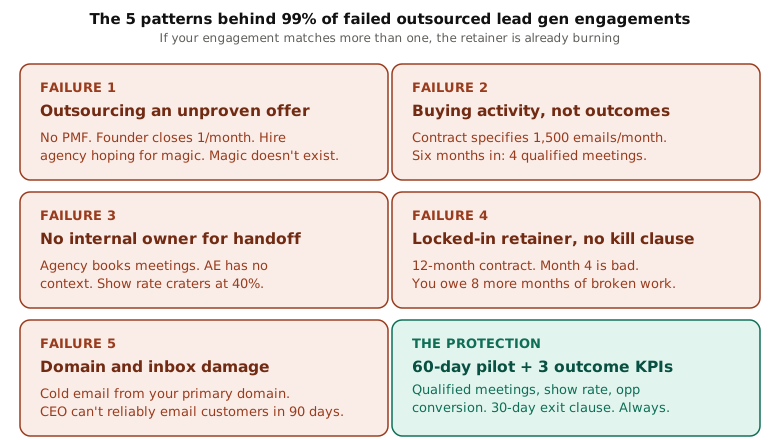
The Reddit thread that ranks third for this query is titled “Why outsourcing lead generation fails 99% of the time.” That’s not hyperbole. It tracks the failure-mode taxonomy below. If your engagement matches more than one of these patterns, the retainer is already burning.
Failure 1: Outsourcing an Unproven Offer
You don’t have product-market fit. Your in-house SDR books 2 meetings a month, none close. You hire an agency hoping they have some magic the SDR doesn’t. They don’t. Agencies amplify your offer, they don’t fix it. If your conversion math doesn’t work in-house, it definitely won’t work via a rented SDR who’s never used your product.
Failure 2: Buying Activity Instead of Outcomes
The retainer is structured around “1,500 emails sent and 300 calls made per month.” Six months in, you’ve gotten exactly that — and 4 qualified meetings. Activity-based contracts are how mediocre agencies hide. Your KPI is qualified meetings, show rate, and opportunity-conversion. Anything else is theater.
Failure 3: No Internal Owner for the Handoff
The agency books meetings. Nobody on your team prepares for them, sends pre-meeting context, or runs disqualification calls. Show rate craters at 40%. The agency points at the booking number; your AEs point at empty calendars. Without a named internal owner running the agency-to-AE handoff, even good agency output gets wasted. A scoring model your sales team will actually use is part of what closes this gap, particularly the part where agency-sourced leads get reweighted against inbound after the first 30 days.
Failure 4: Locked-In Retainer With No Kill Clause
You signed a 12-month contract with no exit clause. Month three is bad; month four is worse. You’re now legally obligated to pay for six more months of work that isn’t producing pipeline. Every agency that resists a 60-day pilot with a 30-day exit clause is telling you something about how their economics work.
Failure 5: Domain and Inbox Damage
The agency runs cold email from your primary domain. Spam complaints accumulate, sender reputation tanks, and within 90 days your CEO can’t reliably email customers. Reputable agencies use dedicated send domains (like yourcompany-team.co or yourcompany.io) with proper SPF/DKIM/DMARC and inbox warmup. If they don’t, walk away — the deliverability damage outlasts the retainer by years. The same gates apply whether the work is in-house or outsourced — the seven verification gates with the dig commands that confirm each one are what separate a sender who survives Gmail’s February 2024 rules from one who quietly stops landing in the inbox.
IMPORTANT
Per a HubSpot State of Marketing analysis cited in B2B sales-development research, roughly 87% of MQLs handed to sales never become qualified opportunities. Outsourced lead generation does not improve that rate by default — it can make it worse if the agency optimizes for booking volume over fit.
The Third Path: In-House With AI (Apollo + Clay + Smartlead)
The 2026 development that most outsourcing-vs-in-house guides ignore is that the tool stack agencies use is now affordable for in-house teams. Apollo at $99/month, Clay at $149-$349/month, Smartlead at $94/month. Total: $342-$542/month. That’s less than half of what a single SDR costs in benefits alone.
What this stack replaces: the SDR-as-a-Service tier of agency work, including outbound prospecting, contact enrichment, multi-channel sequencing, and basic LLM personalization. What it doesn’t replace: strategic ICP definition, messaging iteration, qualification calls, and meeting handoff. Those still need a human, but they need 8-12 hours/week, not 40.
The honest implementation: a part-time ops hire or a founder running the stack themselves for the first 90 days. Apollo finds and verifies contacts. Clay enriches with intent data, technographics, and AI-personalized first lines. Smartlead handles inbox warmup, sequence rotation across multiple inboxes, and reply detection.
For SMB and early-stage teams selling under $100K ACV, this stack consistently outperforms a $5,000/month agency on cost-per-qualified-meeting. The break-even tilts toward agencies once your ACV crosses $100K and qualified-meeting volume needs exceed 25/month. At that point, dedicated SDR time and senior strategists earn their retainer.
For teams that prefer compounding inbound over outbound mechanics, the parallel decision is whether the inbound engine that compounds via SEO and content is the better long-game allocation. Outbound and inbound aren’t substitutes; they’re different time horizons, and most teams need a working answer for both.
8 Red Flags When Vetting a Lead Generation Agency
The 30-minute discovery call doesn’t tell you whether an agency is good. These eight questions do. Ask them in order and watch the answers. Competent agencies handle every one of these without flinching.
Red Flag 1: They Define Your ICP for You
If the agency’s intake process starts with their ICP framework instead of yours, they’re going to run the same playbook they ran for the last 12 clients. You should walk in with your ICP defined; the agency’s job is execution, not strategy.
Red Flag 2: No Named SDR Assigned
“You’ll get whichever SDR is available” means rotating coverage with no continuity. Insist on a named SDR, see their LinkedIn, see their portfolio of past campaigns. If the agency won’t disclose the human, the human probably isn’t impressive.
Red Flag 3: Pricing Per “Lead” With Their Definition
“$200 per lead” sounds clean until you discover their definition of “lead” is anyone who clicked the email. Insist on per-meeting or per-opportunity pricing with your team’s accept/reject right and a written qualification rubric.
Red Flag 4: They Run From Your Domain
Already covered above, non-negotiable. Reputable agencies set up secondary send domains and warm them for 30+ days before sending volume.
Red Flag 5: No CRM Hand-Back Protocol
The agency books meetings into a Calendly link, your AE has no context, no notes, no enrichment, no source attribution. Demand a written hand-back protocol that loads into your CRM with sequence history, qualifying answers, and source.
Red Flag 6: They Won’t Share Sequences or Scripts
“Trade secret” is the wrong answer. You’re paying for the work; you should see the work. If sequences are bad, you find out before the retainer signs. If they’re good, you can replicate the patterns in-house later.
Red Flag 7: References Are From Their Industry, Not Yours
Agencies love showing case studies from agencies (or agency-adjacent SaaS) selling to other agencies. Ask for two references from your specific vertical, your specific deal-size band, and similar GTM motion. If they can’t produce them, they don’t have your category figured out.
Red Flag 8: 12-Month Lock-In With No Pilot
Already covered, worth repeating. The pilot structure below is what good agencies offer because they’re confident in their own work. If they’re not, they need the lock-in to survive month four.
How to Structure the Contract: Pilot, KPIs, Exit Clauses
The contract is where outsourced lead generation engagements live or die. Get this part right and a mediocre agency still produces. Get it wrong and a great agency still ends in lawyer letters. Three structural elements matter.
Element 1: 60-Day Pilot With 30-Day Exit Clause
The pilot length matches the realistic ramp curve, which lands at 30-60 days for an agency to onboard your offer, build sequences, and start producing per HubSpot’s State of Sales research on outbound ramp. After day 60, you’ve seen enough to renew or kill. The 30-day exit clause means even after renewing into a longer term, you can walk if the metrics fall off.
Element 2: Three Outcome KPIs (Not Activity)
Qualified meetings booked, show rate, and opportunity-conversion. That’s it. Calls made, emails sent, LinkedIn touches, video views: none of those are KPIs. They’re inputs the agency manages. Your contract should tie payment or retention to the three outcome metrics, with thresholds explicit in writing.
Element 3: Written Qualification Rubric Owned by You
Before the pilot starts, write down what counts as a “qualified meeting” in 5-7 specific criteria (title, company size, current solution, problem statement, budget signal, timeframe, geography). The agency uses this rubric to qualify; your AE accepts or rejects based on the same rubric. Over the first 30 days you’ll iterate the rubric (that’s normal), but the existence of the rubric prevents 80% of the disagreements that wreck engagements.
PRO TIP
Build the rubric collaboratively with the agency in the first week, then freeze it for 60 days. Both sides have skin in the game on its accuracy, and freezing it prevents either side from moving the goalposts mid-pilot.
Outsourced Lead Generation Tools and Platforms
Whether you go agency, in-house, or hybrid, the underlying tool stack is convergent in 2026. Database, enrichment, sequencer, dialer, and CRM. The names worth knowing:
The full taxonomy by job-to-be-done (database, outreach, capture, LinkedIn automation, sales engagement, AI scraping/enrichment) sits in our 18-tool breakdown organized by stack tier, including the SMB through enterprise stack recommendations and the price-vs-volume tradeoffs at each tier.
For local-business and SMB GTM motions where the buyer is a service-business owner rather than a B2B SaaS executive, the channels diverge. The local equivalent of outsourced lead generation runs through the seven local channels we ranked by cost-per-lead, and the agency-vs-in-house calculus tilts further toward in-house because GBP and LSAs reward owner-operated profiles.
For teams that built their pipeline on content and inbound rather than outbound, the longest-payoff allocation is building a content-to-lead conversion system that compounds over years. Content compounds. Outbound resets every month. Most B2B teams need both, weighted differently by stage.
Frequently Asked Questions
Outsourced lead generation in 2026 typically costs $2,500-$5,000/month for entry-tier shared SDR work, $6,000-$10,000/month for mid-tier dedicated SDRs with custom sequences, and $11,000-$25,000+/month for premium multi-channel ABM programs. Effective cost per qualified meeting lands at $400-$800 for competent agencies, similar to fully loaded in-house SDR cost-per-meeting.
Outsourced lead generation beats in-house when you have a proven offer and the bottleneck is execution capacity (scaling fast, international expansion, niche vertical expertise, founder bandwidth, talent shortage). In-house wins when ICP and messaging are still iterating, deal sizes exceed $100K ACV, or you want long-term institutional knowledge of your buyer. The AI-stack third path beats both for SMB teams under $100K ACV.
Outsourced lead generation fails when the offer isn’t proven (agencies amplify offers, they don’t fix them), when contracts pay for activity instead of outcomes, when no internal owner runs the agency-to-AE handoff, when retainers are locked without an exit clause, or when the agency damages your sender domain through reckless cold email. Five failure modes account for roughly 99% of bad engagements.
Most outsourced lead generation engagements show meaningful pipeline at 30-60 days. The first two weeks go to onboarding (offer, ICP, messaging, tooling), weeks 3-6 to sequence iteration and inbox warmup, and weeks 7-9 to consistent qualified-meeting flow. Engagements that haven’t produced clear outcome metrics by day 60 rarely recover by day 90.
B2B startups should build the first 1-2 SDR seats in-house before outsourcing. The founder or first SDR needs to ship enough outbound to validate ICP, messaging, and qualification criteria. Outsourcing before that point hands an agency a job nobody on your team has solved yet, which is the highest-failure-rate scenario in this category. Once the in-house playbook works, outsourcing to scale volume is rational.