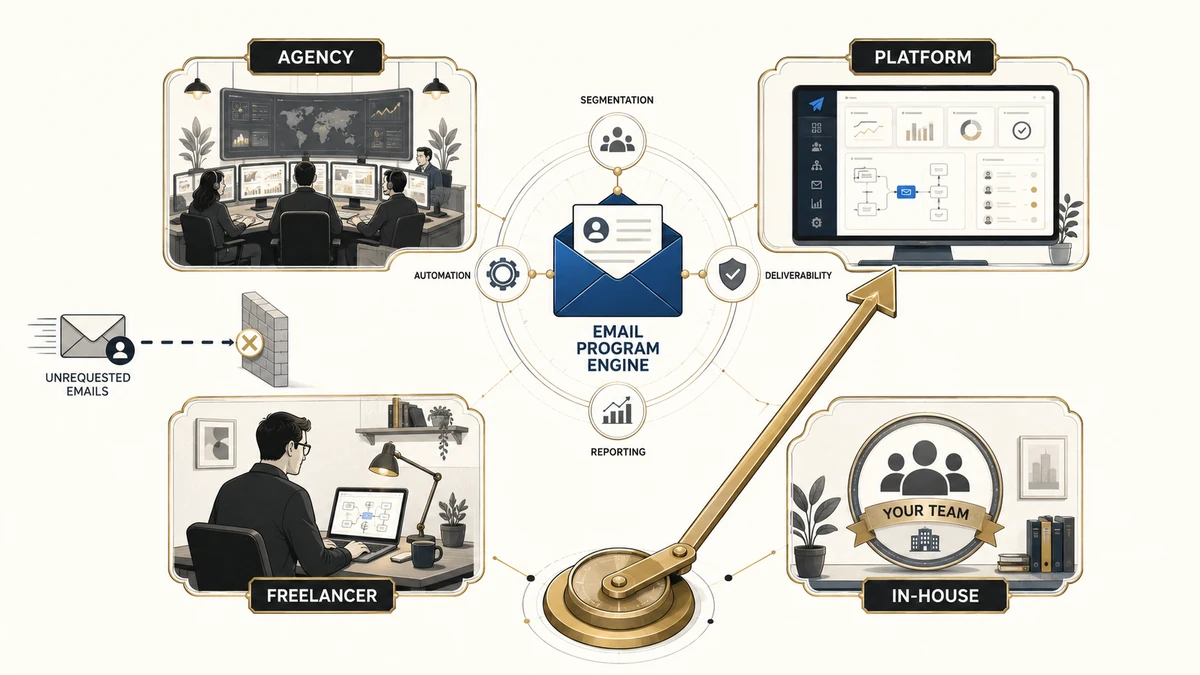
Search “b2b email marketing services” and you get a strange mix: nine pieces of software, a couple of agencies, and a Reddit thread arguing about both. Google’s own AI summary lumps Mailchimp, Apollo, and a full-service agency into one list, as if buying a $15 tool and hiring a team to run your program were the same purchase. They are not, and the gap between them is where most B2B teams overspend or under-buy.
That confusion is the problem this guide solves. B2B email marketing services split into four buckets, each with its own price, its own level of control, and its own kind of buyer. Choose the wrong one and you either pay for hand-holding you don’t need or buy software you have no time to run, then watch your sender reputation slide.
Here is the version the sales pages skip: what these services actually include, what they cost, the four pricing models you’ll be quoted, the questions that separate a real partner from a reseller, and a clear rule for choosing between in-house, an agency, a platform, and a freelancer.
Direct answer – what are B2B email marketing services?
B2B email marketing services are done-for-you offerings that plan, build, send, and report on a company’s marketing email, covering list segmentation, automated sequences, newsletters, deliverability, and analytics. They come in four forms: full-service agency, self-serve platform, freelancer or boutique, and in-house. Unlike cold-email services, which prospect strangers, marketing email works opted-in lists and existing relationships to move buyers through a long B2B cycle.
Key Takeaways
- “Services” and “software” are different purchases. An agency runs your program; a platform is the tool you run yourself. Most listicles blur the two.
- There are four options: full-service agency, self-serve platform, freelancer or boutique, and in-house. Match the option to your team’s skill, budget, and how central email is to revenue.
- Pricing follows four models: monthly retainer, per-project, platform subscription, and performance or hybrid. Managed retainers start around $1,500/mo and climb past $10,000/mo for full B2B SaaS programs.
- Vet on deliverability, B2B specialization, list ownership, sales handoff, reporting, and compliance. “Guaranteed inbox” and a B2C-heavy portfolio are red flags.
- Marketing email is not cold email. It works opted-in lists, so it answers to CAN-SPAM and GDPR, and it should be measured on pipeline, not opens.
If you are evaluating managed execution rather than comparing provider types, review the IVRIS Email Marketing & Lifecycle Campaigns service. It explains the permission, production, QA, send-control and reporting responsibilities that a proposal can include.
What B2B email marketing services include
B2B email marketing services are the strategy, production, and management work behind a company’s marketing email, delivered by an outside team or a dedicated platform rather than handled ad hoc. A full-service version touches six areas, and you can buy any subset of them.
Strategy and planning. The roadmap: which audiences to target, what to send across the buyer journey, and how email ties to wider demand programs. Without this, the rest is just sending.
List building and segmentation. Growing an opted-in list, cleaning it, and splitting it by role, industry, account stage, or behavior so the right message reaches the right buyer instead of one blast to everyone.
Automation and lead nurturing. The triggered sequences that follow a download, a demo request, or a stage change in the CRM. A long B2B cycle lives or dies on these, and a good nurture track is only as strong as the assets it sends, which is where a working content-to-lead system earns its keep.
Newsletters and campaigns. The recurring sends, product news, and one-off campaigns that keep a brand present between buying moments.
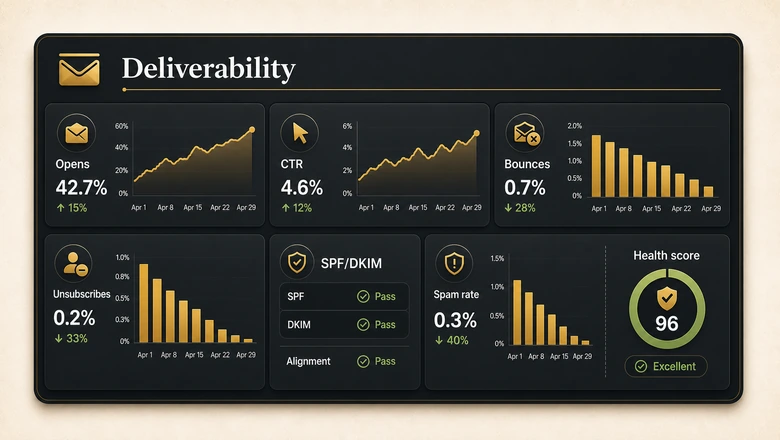
Deliverability. Authentication, list hygiene, and inbox-placement monitoring so your mail reaches the inbox rather than the spam folder. Delivered and inboxed are not the same thing.
Reporting and analytics. Dashboards that connect email to opens, clicks, and ideally pipeline and revenue, so you know whether the program pays for itself.
Marketing email vs cold email: why the difference matters
Marketing email and cold email are different disciplines, and conflating them is the fastest way to damage a sending domain. Marketing email goes to people who opted in: subscribers, leads, customers, and event registrants. Cold email goes to strangers who never asked to hear from you.
That distinction changes everything downstream. Cold outreach is a separate discipline with its own stack of tools built for cold sending, usually run on a secondary domain so a flagged campaign can’t poison your primary one. Marketing email runs on your real domain and your reputation, so it answers to consent rules and list quality in a way cold outbound does not.
When a vendor sells “b2b email marketing services” but the deliverables read like bulk prospecting to a bought list, you’re not buying marketing email. You’re buying cold outreach with a friendlier label, and the compliance and deliverability risk that comes with it.
IMPORTANT
If a provider proposes emailing a purchased list from your main domain, walk away. One spam-trap hit can drag down deliverability for every email you send, including invoices and password resets.
The four types of B2B email marketing services
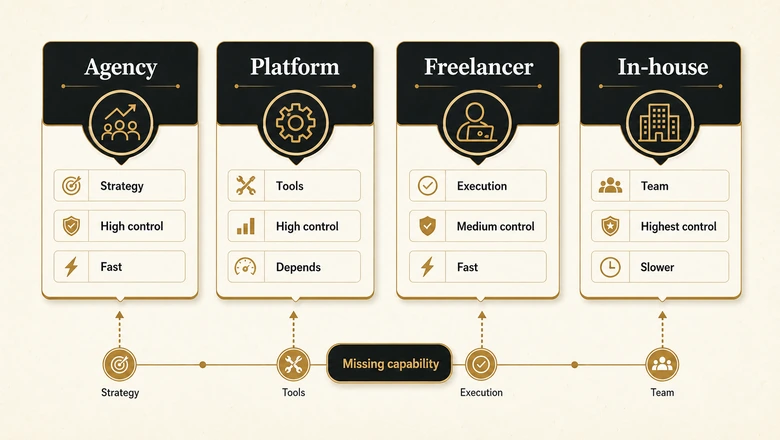
B2B email marketing services come in four delivery models, and the right one depends on how much skill and time you already have in-house. The table below compares them on what’s included, cost, control, and speed.
| Option | What’s included | Typical cost model | Control | Speed to launch | Best for |
|---|---|---|---|---|---|
| Full-service agency | Strategy, list and segmentation, copy, design, build, automation, deliverability, reporting | Monthly retainer (or project) | Low to medium; they run it | 3 to 6 weeks onboarding | Teams with no in-house email skill that want a managed program |
| Self-serve platform (ESP) | The software only: sending, automation, templates, reporting. You do the work | Subscription by contacts or volume | High; you own everything | Same day to a few days | Teams with the skill and time to execute |
| Freelancer / boutique | A slice: usually copy, build, or automation setup, sometimes strategy | Hourly or per-project | Medium; you direct, they execute | 1 to 3 weeks | A specific gap, overflow work, or a smaller budget |
| In-house team | Whatever you choose to staff: strategist, copywriter, ops, designer | Salaries plus a platform license | Highest | Months to hire and ramp | Mature programs where email is core and constant |
One caution before you shortlist: a service ranking on page one isn’t automatically a B2B fit. Klaviyo, for example, appears for this query but markets itself as a B2C platform built for ecommerce, not long B2B sales cycles. Match the tool to your model, not to its search position.
When to use which: in-house, agency, platform, or freelancer
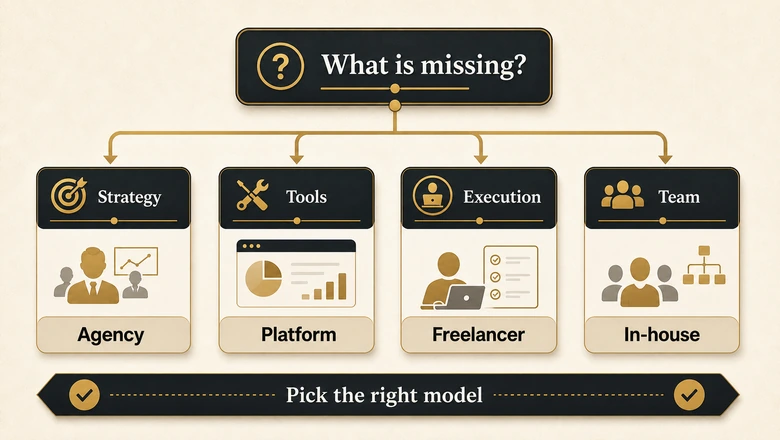
Choose your option by three variables: in-house skill, budget, and how central email is to revenue. The decision usually resolves cleanly once you’re honest about all three.
- Use a full-service agency when email matters to pipeline but you have no one to run it, and you’d rather buy a managed outcome than build a team. Expect a retainer and a 3-to-6-week ramp. This is also the option to weigh when you’re already shortlisting outside partners like the companies that run B2B lead generation, since the vetting logic is identical.
- Use a self-serve platform when you have the skill and the hours in-house and just need the software. You keep full control and pay the lowest direct cost, but the work is yours.
- Use a freelancer or boutique when you have a specific gap, a template build, an automation setup, a copy overflow, and don’t need a standing program. You direct; they execute a defined scope.
- Build in-house when email is a core, always-on revenue channel and the volume justifies salaries. Mature programs eventually pull this work inside for speed and institutional knowledge.
- Avoid an agency when your real need is one project, not an ongoing program. A retainer for occasional sends is the most common way B2B teams overspend on email.
What B2B email marketing services cost
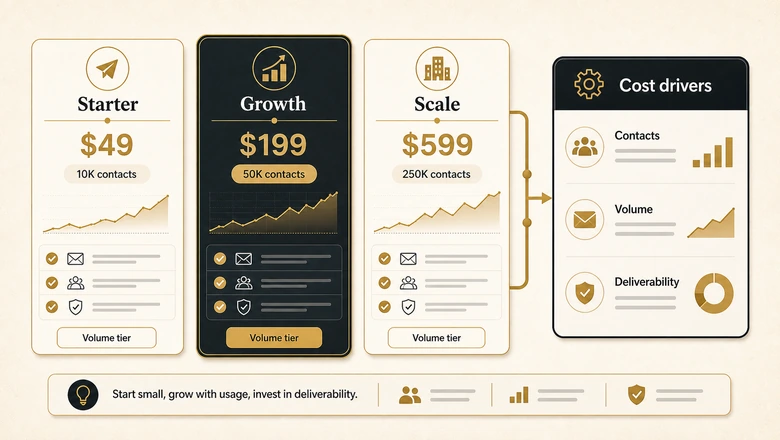
B2B email marketing services follow four pricing models, and a quote only makes sense once you know which one you’re reading. The same program can look cheap or expensive depending on whether you’re paying for software, hours, or a managed outcome.
| Pricing model | How it works | Typical range (as of Q2 2026) | Best for |
|---|---|---|---|
| Monthly retainer | Fixed fee for an agreed scope of campaigns and management | From about $1,500/mo (InboxArmy minimum); market reports cluster at $2,500 to $10,000/mo, and full B2B SaaS programs run $10,000 to $50,000+/mo | Ongoing managed programs |
| Per-project / productized | Pay per deliverable: an audit, a template, an automation build | Email Uplers lists campaign management from $395, automation from $549, and audits from $499 to $849 | One-off needs and overflow |
| Platform subscription | Software license priced by contacts or email volume | Brevo from about $9/mo; HubSpot from about $20/mo plus onboarding fees that start near $3,000; Mailchimp around $135/mo at 10,000 contacts | DIY in-house teams |
| Performance / hybrid | A base fee plus a variable tied to sends or pipeline | Rarely published; negotiate the base and the trigger before signing | Teams that want shared incentives |
The retainer figures above are reported market ranges, not a fixed rate card, so treat them as a sanity check rather than a quote. InboxArmy publishes a $1,500/mo minimum for managed services, while Email Uplers prices per deliverable. Agency retainers above that climb with the number of campaigns, the depth of automation, and how much strategy versus pure production you’re buying.
To compare a managed retainer against running a platform yourself, reduce both to a single number you can defend internally.
Cost per email = (Retainer or salary + Platform fee) ÷ Emails sent per monthThat answers the most common cost question buyers ask, “how much to send 10,000 emails,” in a way raw platform pricing hides. On Mailchimp, 10,000 contacts on the Standard plan runs about $135/mo (as of Q2 2026), because Mailchimp prices on contacts. Brevo prices on volume, so 20,000 emails sits near $25/mo. The send itself is cheap; the strategy, copy, and management around it are where the real spend lives, which is exactly what a service is selling.
How to evaluate a B2B email marketing provider
Evaluate a provider against seven criteria, each with a clear “good” signal and a matching red flag. We call it the IVRIS B2B Email Vendor Checklist, and it’s built to expose resellers and B2C shops before you sign.
| Criterion | What good looks like | Red flag |
|---|---|---|
| Deliverability track record | Shares inbox-placement data, sets up SPF, DKIM, and DMARC, and has a warm-up plan | “Guaranteed inbox” promises and no mention of authentication |
| B2B specialization | Case studies with B2B clients; understands long cycles and the sales handoff | Portfolio is mostly B2C or ecommerce; talks only about open rates |
| List and account ownership | You own the list, the ESP account, and the data, written into the contract | They keep the account “for you” or get vague about data export |
| Sales and marketing handoff | Maps email to CRM stages, MQL and SQL definitions, and lead routing | No mention of the CRM or what happens after a click |
| Reporting and attribution | Reports pipeline and revenue influence, not just opens and clicks | Dashboards stop at opens; nothing ties to pipeline |
| Compliance | Documents CAN-SPAM and GDPR basis, consent records, and suppression handling | Buys lists, ignores consent, no unsubscribe discipline |
| Contract terms | Clear scope, short or month-to-month term, a named team | Long lock-in, a junior team, and scope creep on every change |
Two criteria deserve extra weight for B2B. Reporting that stops at opens hides whether email touched a single deal, so insist on the pipeline and revenue metrics that actually matter before you agree to a dashboard. And the deliverability conversation should be specific: ask how they monitor inbox placement and authenticate your domain, the same ground the questions that separate real B2B agencies from white-label shops are designed to test.
PRO TIP
Ask a prospective provider to walk through their last deliverability incident: what happened, how they caught it, and what changed. Vendors who run real programs have a story. Resellers go quiet.
How a B2B email marketing engagement works
A managed engagement runs in five stages, and the sequence tells you whether a provider has done this before. The first 90 days set the ceiling for everything that follows.
1. Audit and access. A real partner starts by auditing your list health, authentication records, and past performance, then takes documented access to your ESP and CRM instead of spinning up an account they quietly control.
2. Strategy and segmentation. They define audiences, map sends to the buyer journey, and agree on the metrics that count before writing a single email.
3. Setup and warm-up. Authentication is confirmed, suppression and consent rules are loaded, and sending volume is ramped gradually to protect inbox placement on your domain. Loaded is not the same as applied, though: rules sitting in account settings do nothing for a send that never referenced them, which is why checking the exclusion lists are attached to the campaign itself is a separate step from loading them once.
4. Launch. Campaigns and automations go live in a tested order, usually starting with the highest-intent triggers rather than a full-list blast.
5. Report and optimize. Results come back against pipeline, not just opens, and scope adjusts from there.
If a provider wants to skip the audit and start sending in week one, that’s the tell. Speed bought at the cost of deliverability is how programs flame out by month three.
Representative B2B email marketing providers
Representative providers fall into two camps: managed agencies that run the program for you, and platforms you operate yourself. The shortlist below is illustrative, not ranked, and is meant to show the shape of each option rather than crown a winner.
Full-service and managed agencies
These run strategy through reporting on your behalf, and suit teams with little or no in-house email capacity.
Best for: Sagefrog and SmartBug Media fit B2B teams that want strategy plus execution inside a HubSpot stack. InboxArmy and Email Uplers fit teams that already have direction and need production muscle, design, build, and deliverability, across whichever ESP they use.
Self-serve platforms suited to B2B
These are the software, not the service. You bring the team; the platform brings sending, automation, and reporting.
Best for: HubSpot suits teams that want email living inside the CRM, with the trade-off of onboarding fees and steeper scaling. ActiveCampaign suits sophisticated automation across long cycles. Brevo suits budget-conscious teams that pay by volume. At the enterprise end, Marketo Engage and Salesforce Marketing Cloud Account Engagement carry heavier B2B automation, with the cost and setup to match.
What makes B2B email marketing different
B2B email marketing differs from B2C in four ways that shape every service decision: longer cycles, more touches, a sales handoff, and stricter compliance. A provider that ignores these is selling you B2C tactics with a B2B invoice.
Long, multi-stakeholder cycles. A B2B purchase can take months and involve a buying committee. Email’s job is to stay relevant across that span, not to drive an impulse buy, which is why nurture automation and segmentation matter more here than a single clever campaign.
The sales handoff. In B2B, email feeds a CRM and a sales team. The point where a marketing-qualified lead becomes sales-qualified is where most programs leak, so the service has to define and instrument that handoff, not just send and hope.
Measured on pipeline, not opens. Apple’s Mail Privacy Protection inflates open rates by auto-loading images, so opens are now a soft signal. Recent benchmarks put average open rates in the low 40s and click rates near 2% (MailerLite, 2025), but the number that matters in B2B is influenced pipeline. Email’s return is still hard to beat: Litmus pegs the channel at about $36 back for every $1 spent.
Compliance is non-negotiable. Marketing email runs on opted-in lists, so it answers to the law. Under CAN-SPAM, each violating email can draw a civil penalty of up to $53,088 (FTC, 2025 adjustment). Under GDPR, B2B senders need a lawful basis, usually legitimate interest with a documented assessment or consent, and fines reach €20 million or 4% of global turnover. Strong deliverability depends on the same hygiene, which is why the authentication and warm-up steps in our deliverability tooling guide belong in any service scope.
Is cold email legal? B2B email rules by region (2026)
Cold B2B email is broadly permitted in the US, conditional in the UK and Australia, and consent-first (and riskier) in Canada and much of the EU. The rules below govern marketing email to business contacts. Confirm the current statute for the market you send into before you press send.
| Region | Consent model | Core rules for B2B email | Penalty exposure |
|---|---|---|---|
| United States (CAN-SPAM) | Opt-out | No prior consent needed. Accurate sender and subject lines, a valid physical postal address, a clear opt-out honored within 10 business days, and the message identified as an ad. | Up to $53,088 per email (2025 FTC adjustment) |
| Canada (CASL) | Opt-in (express or limited implied) | Among the strictest, and it applies to B2B. Needs consent (express, or implied via an existing business relationship for 2 years or an inquiry for 6 months), full sender identification, and a working unsubscribe honored within 10 days. | Up to CAD $10M per violation (business) |
| United Kingdom (PECR + UK GDPR) | Soft opt-in for corporate subscribers | Email to corporate subscribers (Ltd/LLP) is allowed without prior consent under PECR, provided you identify the sender, offer an opt-out, and have a UK GDPR lawful basis for any named individual. Sole traders and partnerships need consent. | PECR up to £500,000 (UK GDPR up to £17.5M / 4% for personal-data misuse) |
| European Union (GDPR + ePrivacy) | Generally opt-in | Consent is the default; any legitimate-interest latitude for B2B is member-state dependent (Germany is notably strict). Identify the sender, provide an opt-out, and document your lawful basis. | Up to €20M or 4% of global turnover |
| Australia (Spam Act 2003) | Consent (express or inferred) | Inferred consent is allowed where a work address is conspicuously published and relevant to the role (no corporate-versus-personal distinction, unlike the UK). Identify the sender and include a functional unsubscribe. | Civil penalties up to about AUD $2.22M per day |
Bottom line: build your list and sending posture around the strictest market you actually email into. This is a summary for marketers, not legal advice, so verify the current statute before a campaign. Last reviewed: June 2026.
Frequently Asked Questions
The rules differ by country. The US (CAN-SPAM) is opt-out, so B2B cold email is broadly allowed. The UK permits B2B email to corporate subscribers under PECR, and Australia allows it with express or inferred consent, but Canada’s CASL and much of the EU require opt-in consent first. The same campaign can be compliant in one market and a violation in another, so check the by-region table above before sending across borders.
It depends on the model. Managed agency retainers start around $1,500/mo and commonly run $2,500 to $10,000/mo, with full B2B SaaS programs reaching $10,000 to $50,000+/mo. Per-project work is cheaper for one-off needs, and a self-serve platform can cost under $50/mo if you run it yourself.
No. Marketing email goes to people who opted in: subscribers, leads, and customers. Cold email goes to strangers and usually runs on a separate domain to protect your reputation. They use different tools, different rules, and different metrics, and a good provider keeps them apart.
A full service covers strategy, list building and segmentation, automation and lead nurturing, newsletters and campaigns, deliverability, and reporting tied to pipeline. You can buy any subset. The non-negotiables for B2B are deliverability management, a defined sales handoff, and compliance with CAN-SPAM and GDPR.
The send itself is cheap. On Mailchimp, 10,000 contacts on the Standard plan is about $135/mo (Q2 2026), since it prices by contacts. Volume-based Brevo covers 20,000 emails near $25/mo. The real cost of a service is the strategy, copy, and management around those sends, not the sending.
Yes, when you follow the rules. In the US, CAN-SPAM requires accurate headers, a clear opt-out, and a physical address, with penalties up to $53,088 per email. In the EU and UK, GDPR requires a lawful basis, typically legitimate interest with a documented assessment or consent. Buying lists invites trouble under both.