What the research says before the framework starts
The evidence behind this publication points in the same direction: B2B teams should be careful about treating one visible action as proof that a buying process is ready for sales. Preferences form early, content consumption can lag form submission, hidden stakeholders influence decisions, and ABM is increasingly converging with demand generation.
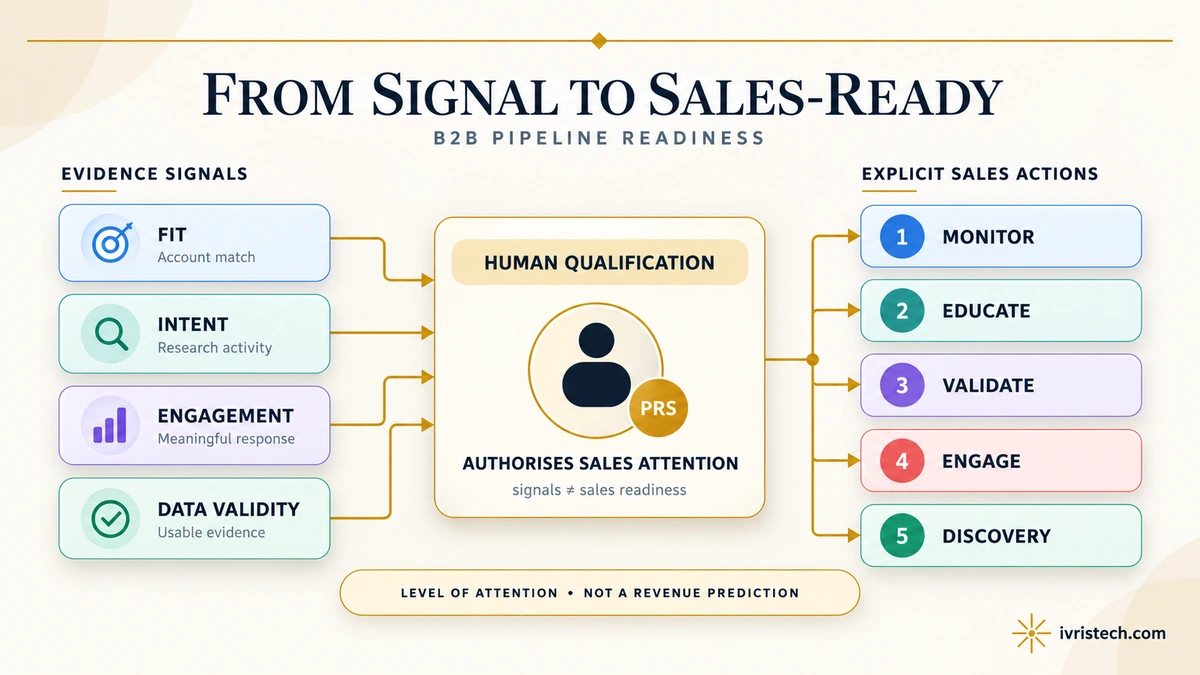
The IVRIS Pipeline Readiness Framework
The six dimensions deliberately answer different questions. A strong score in one dimension should not erase a weakness in another.
Account fitShould this organization plausibly buy from us?
Buyer intentIs research activity changing in a way that matters?
EngagementWhat did the account or contact actually do?
Data validityCan the record be trusted, used and acted on?
Human qualificationWhat has the buyer confirmed directly?
Sales actionWhat is the least aggressive action that still advances learning?
Why pipeline readiness is hard
The Buyer Readiness Gap
B2B revenue teams often compress several different events into a single label such as “hot lead.” That compression creates avoidable friction.
What the labels conceal
- An identified account may be attractive but inactive.
- An intent signal may reflect learning, competitor research or an existing customer’s activity.
- A content response may reflect interest in an idea rather than interest in a vendor.
- A qualified contact may be relevant but not empowered.
- A booked meeting may be poorly contextualized, rescheduled or unattended.
- An opportunity may exist in the CRM without a validated buying process.
The readiness gap appears when the strength of the evidence is lower than the urgency of the action.
A better question
Do not ask only, “Is this a lead?” Ask:
What do we know, how do we know it, how current is it, and what action is proportionate to that evidence?
A mature system protects the buyer from premature outreach and protects sales from context-poor handoffs.
Four principles for a defensible readiness system
Principle 1 – Treat readiness as multidimensional
No single signal should carry the full decision. Fit without timing creates wasted effort. Intent without fit creates false urgency. Engagement without validation creates operational noise.
Principle 2 – Separate evidence from interpretation
A page visit is evidence. “The account is ready to buy” is an interpretation. Record both separately so the interpretation can be challenged and improved.
Principle 3 – Match action to evidence strength
A newsletter click may justify nurture. A repeat visit from multiple stakeholders may justify account research. A direct request, verified need and agreed next step may justify immediate sales action.
Principle 4 – Make every handoff teach the system
Sales acceptance, rejection, contact, meeting and opportunity outcomes should flow back into targeting and qualification. Without feedback, the same errors repeat at higher volume.
Readiness is not a permanent property of an account. It is a time-sensitive operating decision.
The practical test
Before routing anything to sales, a team should be able to state:
- Why this account?
- Why this person or buying group?
- Why now?
- Why this action?
- What happens if the evidence is incomplete?
Shared definitions before shared dashboards
Terminology varies across companies, providers and technology platforms. The labels matter less than the written entry and exit criteria behind them.
| Stage | Recommended operating definition | Minimum evidence | Typical next action |
|---|---|---|---|
| Valid response | A usable, non-duplicate record that meets campaign and compliance rules | Verified core fields, source, consent basis where applicable | Enrich, score or nurture |
| Engaged contact | A relevant person who completed a meaningful interaction | Content, webinar, website or campaign engagement | Continue education and observe |
| MQL | A contact or account meeting documented marketing-priority criteria | Fit plus defined behavioral or intent threshold | Nurture, SDR review or validation |
| HQL | A more deeply validated lead meeting stronger fit, intent and contact criteria | Multi-step validation and/or human confirmation | Prioritized human follow-up |
| BANT-qualified | A prospect with usable information across budget, authority, need and timeline | Direct responses, with unknowns explicitly recorded | Sales review or discovery |
| SAL | A lead accepted by sales as worthy of active follow-up | Context complete and sales criteria met | Sales sequence |
| SQL | A lead sales has qualified as having a credible problem, fit and potential buying process | Discovery evidence and agreed progression | Opportunity creation or further discovery |
| Opportunity | A qualified commercial pursuit with defined value, stage and next step | CRM entry criteria met | Pipeline management |
In this research, these labels are treated as operational categories rather than universal market standards. Each organization should define the entry criteria, required evidence, permitted unknowns, owner and exit condition for every stage it uses.
Important: HQL is not a universally standardized market category. Define it contractually and operationally before using it in reporting.
The IVRIS Pipeline Readiness Framework
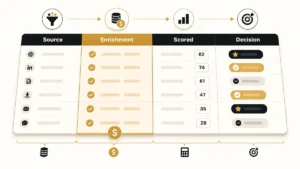
The framework is a decision architecture, not a fixed algorithm. Each dimension answers a different question.
| Dimension | Core question | Common error when used alone |
|---|---|---|
| Account fit | Should this organization plausibly buy? | Prioritizing perfect-fit accounts with no current trigger |
| Buyer intent | Is research activity changing? | Treating anonymous activity as a declared project |
| Engagement | What interaction occurred? | Treating every response as equal |
| Data validity | Can the record be trusted and used? | Routing incomplete, duplicate or stale contacts |
| Human qualification | What has the buyer confirmed? | Asking too much too early or recording vague answers |
| Sales action | What should happen next? | Applying the same sequence to every signal |
How to apply it
- Capture raw evidence.
- Score or categorize each dimension.
- Identify missing information.
- Select the least aggressive action that can still advance learning.
- Record the outcome.
- Update the criteria based on real progression.
The six dimensions of pipeline readiness
1. Account fit: should this organization buy from us?
Account fit establishes whether the company belongs in the addressable market. It is primarily a structural assessment and should be kept distinct from current buying activity.
Fit inputs
- industry and sub-industry;
- employee and revenue bands;
- geography and serviceability;
- business model;
- technology environment;
- regulatory or operational requirements;
- known use case;
- product complexity and contract value;
- similarity to successful customer profiles;
- exclusion criteria.
Recommended fit tiers
| Tier | Meaning | Default treatment |
|---|---|---|
| A – Strategic fit | High potential value and strong ICP alignment | Account plan and monitored intent |
| B – Core fit | Clear ICP alignment with standard economics | Scaled ABM or demand program |
| C – Conditional fit | Possible fit with missing or uncertain criteria | Enrich and validate before spend |
| D – Out of profile | Low likelihood of value, feasibility or retention | Suppress or low-cost awareness only |
Questions to resolve
- Is the ICP written as observable criteria rather than adjectives?
- Are exclusions as explicit as inclusions?
- Can sales explain why a recently won account fit?
- Are current customers automatically assumed to be ideal, even when they were hard to serve?
Fit tells you where to invest attention. It does not tell you when to sell.
The core framework intentionally uses fit tiers rather than a universal numeric fit score. If your organization already uses a numeric model, calibrate its thresholds against your own won, lost and disqualified accounts instead of importing vendor cut-points.
2. Buyer intent: is research activity changing?
Intent data is most useful when it changes a decision. It should help a team identify a pattern that deserves monitoring, personalization, validation or faster action.
Evaluate intent across five qualities
- Relevance – does the topic map to a real buying problem?
- Recency – how recently did activity change?
- Intensity – how strong is the increase relative to normal behavior?
- Breadth – are several related topics active?
- Corroboration – is there supporting first-party or human evidence?
Intent interpretation ladder
| Signal | Plausible meaning | Safe action |
|---|---|---|
| One broad topic | Early curiosity or category monitoring | Awareness and observation |
| Several related topics | Active education or problem exploration | Personalized content and account research |
| Topic surge plus site engagement | Evaluation may be accelerating | SDR validation or targeted outreach |
| Intent plus direct response | Known person and account activity align | Prioritized qualification |
| Intent plus confirmed need and timing | Buying process may be active | Sales discovery |
Guardrails
- Do not equate anonymous account activity with one individual’s intent.
- Review topic quality; generic topics create generic signals.
- Use intent as a prioritization input, not a legal basis for intrusive personalization.
- Record the date of the signal. Old intent should decay.
Intent answers “why now?” only when it is relevant, recent and corroborated.
3. Engagement: what did the buyer actually do?
Engagement should be assessed by depth, recency, repetition and context, not counted as a flat list of clicks.
A practical engagement hierarchy
| Engagement | Information value | Typical interpretation |
|---|---|---|
| Ad impression or social view | Low | Exposure only |
| Email open or page view | Low to moderate | Possible awareness |
| Content registration | Moderate | Topic interest and data exchange |
| Long-form consumption or webinar attendance | Moderate to high | Deeper learning behavior |
| Repeat engagement across assets | High | Sustained interest |
| Multiple stakeholders from one account | High | Possible buying-group activity |
| Direct question, demo or consultation request | Very high | Explicit desire for interaction |
Do not flatten content formats
A playbook, research report, checklist, case study, technical guide and pricing page serve different jobs. The asset’s role in the buying journey should influence the next action.
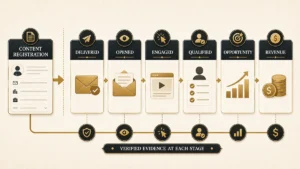
NetLine’s 2026 research reported a 47.7-hour average delay between content request and consumption. R2 This supports a two-stage response to a content registration:
- confirm delivery and offer help immediately;
- delay hard-sell outreach until the buyer has had a reasonable opportunity to engage, unless stronger signals justify speed.
Account-level view
One download may be a person learning. Three relevant contacts engaging with different evaluation assets may indicate organizational momentum. Track both contact activity and account aggregation.
4. Data validity: can the record be trusted and used?
Qualification built on unreliable data creates false precision. Data validity should be a formal stage, not an invisible back-office task.
Minimum validation controls
- business email status;
- telephone availability and verification where required;
- current company and role;
- job function and seniority normalization;
- company domain and account match;
- geography and time zone;
- duplicate and suppression checks;
- campaign-source integrity;
- applicable consent, notice and processing rules;
- timestamp and freshness.
A usable record should answer
- Who is the person?
- Which account do they belong to?
- What source or action created the record?
- When did the event occur?
- Which criteria were verified?
- Which criteria remain unknown?
- What communication is permitted?
Data quality states
| State | Meaning | Action |
|---|---|---|
| Verified | Required fields pass agreed rules | Eligible for scoring and routing |
| Partially verified | Core identity is usable but fields are missing | Enrich before escalation |
| Conflicted | Multiple sources disagree | Hold and investigate |
| Invalid | Record is unreachable, duplicate or outside policy | Suppress, replace or reject |
| Stale | Information may no longer be current | Revalidate before use |
A high score cannot rescue a low-trust record.
5. Human qualification: what has the buyer confirmed?
Human qualification converts signals into context. Its purpose is not to interrogate every respondent. Its purpose is to reduce uncertainty enough to choose the right next step.
Progressive qualification
Early-stage confirmation
- role and responsibility;
- relevance of the topic;
- current priority or learning objective;
- preferred content or next resource.
Mid-stage confirmation
- problem or initiative;
- current approach;
- impact of the problem;
- stakeholders involved;
- evaluation stage.
Late-stage confirmation
- decision process;
- implementation window;
- commercial constraints;
- authority and influence;
- agreed meeting purpose and next step.
Qualification quality rules
- Record the buyer’s words, not only a score.
- Preserve “unknown” as a valid answer.
- Separate confirmed facts from rep inference.
- Avoid forcing budget disclosure before value is established.
- Use consistent questions while allowing natural conversation.
- Capture disqualifying information without treating it as failure.
When BANT helps – and when it harms
BANT can structure late-stage information, but applying it rigidly at first touch can reject legitimate buyers who have not yet built a budget or formal timeline. Use it as a diagnostic lens, not a script that every early-stage buyer must pass.
6. Sales action: what should happen next?
Readiness should culminate in an explicit action. “Send to sales” is too vague to operate or measure.
Action categories
| Action | Use when | Owner |
|---|---|---|
| Monitor | Fit is strong but evidence is weak or old | Marketing operations / ABM |
| Educate | Buyer is learning and has not requested interaction | Content / nurture |
| Validate | Signals are meaningful but important context is missing | SDR / qualification team |
| Engage | Need, fit and interaction are sufficiently strong | Sales development / AE |
| Multi-thread | Account activity exists but buying-group coverage is weak | ABM / sales |
| Recycle | Timing is real but not current | Nurture with review date |
| Disqualify | Structural fit or permission requirements fail | Operations |
Action design principles
- Define the owner and service-level expectation.
- Attach the evidence that triggered the action.
- Specify the objective of the next touch.
- Identify the next-best action if there is no response.
- Set a review or expiry date.
A sales action should answer:
What should this person do, by when, with what context, to learn or advance what?
The action layer is deliberately explicit: scoring matters only when it changes ownership, timing, context or the next-best action.
Decision logic, timing and buying groups
The Fit-Intent-Engagement decision matrix
Use this matrix as a starting point, then refine it with your own outcomes.
High fit + strong intent + meaningful engagement
Default action: rapid human validation or sales engagement. Confirm the trigger, buying group and meeting purpose.
High fit + strong intent + weak engagement
Default action: account-level personalization, targeted content and selective outreach. Do not assume the anonymous signal belongs to a known contact.
High fit + weak intent + meaningful engagement
Default action: nurture around the engaged topic and monitor for additional account activity. The account may be strategically valuable but not in market.
Lower fit + strong intent + meaningful engagement
Default action: review the ICP and the signal. This may reveal a new segment, a partner use case or misleading intent.
Lower fit + weak intent + weak engagement
Default action: deprioritize. Do not use expensive human follow-up merely because the record exists.
The matrix prevents two common errors: overreacting to weak evidence and ignoring strong combinations because no single field crossed a threshold.
The two-clock model for content-generated leads
A content response starts two different clocks.
Clock 1 – the buyer’s consumption clock
The buyer needs time to open, read, share or evaluate the asset. NetLine’s 2026 research places the average request-to-consumption gap at 47.7 hours. R2
Clock 2 – the revenue team’s responsiveness clock
The company must still acknowledge the action quickly, preserve context and be available when the buyer is ready.
Recommended starting policy
Immediately
- deliver the asset;
- confirm the request;
- provide one related resource;
- state that help is available without forcing a meeting.
After approximately 48 hours
- use a contextual, low-pressure follow-up for long-form content;
- ask one relevant question;
- reference the problem, not merely the download.
Accelerate when stronger evidence exists
Move faster when the buyer requested contact, visited high-intent pages, engaged repeatedly, matched a high-priority account or directly confirmed a current initiative.
Speed should be proportional to expressed intent, not merely to lead capture.
Read the account, not only the form fill
6sense’s research describes typical B2B buying groups of more than 10 people in substantial purchases and finds that much of vendor selection occurs before seller engagement. R1 Edelman and LinkedIn’s 2025 work highlights hidden buyers whose influence may not be visible in early seller interactions. R4
Common buying-group roles
- business champion;
- day-to-day user or practitioner;
- technical evaluator;
- security, legal or compliance reviewer;
- procurement;
- financial approver;
- executive sponsor;
- implementation owner;
- blocker or risk owner.
Account-readiness indicators
- more than one relevant contact engaging;
- different roles consuming complementary assets;
- repeated activity over a short period;
- engagement moving from education to evaluation;
- internal sharing or referral patterns;
- direct questions from risk, finance or implementation stakeholders.
Operating response
Do not ask one contact to represent the entire committee. Equip the champion with materials that help internal alignment: business cases, technical validation, risk responses, implementation plans and role-specific summaries.
A lead becomes more valuable when it helps reveal the buying system around it.
Match content to the buyer’s readiness task
Content should help the buyer complete the next decision task – not simply describe the vendor.
| Buyer task | Typical questions | Useful content |
|---|---|---|
| Recognize a problem | Is this issue material? What changes if we ignore it? | Research, executive POV, diagnostic article |
| Define the problem | What is causing it? Which teams are affected? | Playbook, maturity model, assessment |
| Explore approaches | What are the solution categories and trade-offs? | Guide, framework, webinar, checklist |
| Evaluate options | How do alternatives compare? What evidence matters? | Case study, comparison, technical guide |
| Build internal consensus | How do we explain value and risk to others? | Business case, stakeholder brief, ROI model |
| Validate a vendor | Can this provider deliver securely and practically? | Demo, implementation plan, references, security material |
| Commit and implement | What happens next and who owns it? | Mutual action plan, onboarding roadmap |
CMI’s 2026 study found that nearly all surveyed B2B marketers produce thought leadership, but few operate mature programs. R3 Edelman and LinkedIn emphasize that strong, perspective-shifting content can influence hidden buyers and help less familiar brands gain advocacy. R4
Content-readiness test
For every asset, document:
- target role;
- buyer task;
- stage assumption;
- next-best action;
- evidence that would justify escalation.
Qualification, handoff and routing
MQL, HQL and BANT: a qualification continuum
These categories should describe increasing information depth, not automatically increasing deal probability.
| Dimension | MQL | HQL | BANT-qualified |
|---|---|---|---|
| Primary purpose | Marketing prioritization | Stronger validation and human context | Commercial qualification lens |
| Typical evidence | Fit plus behavior or intent threshold | ICP, intent, verified data and direct qualification | Budget, authority, need and timeline information |
| Unknowns allowed | Many | Some | Fewer, but still explicit |
| Typical owner | Marketing ops / nurture / SDR review | Qualification team / SDR | SDR / AE |
| Best next action | Nurture or validate | Prioritized conversation | Discovery or sales progression |
| Main failure mode | Overly broad scoring | Inconsistent human criteria | Rejecting buyers before a budget or timeline exists |
Design rules
- Define each category in one page of operational criteria.
- List required fields and permitted unknowns.
- Separate lead delivery from sales acceptance.
- Track progression by source and category.
- Do not use the labels as substitutes for buyer context.
The labels are useful only when they describe a real difference in evidence depth, operating ownership or next action. Avoid treating them as interchangeable lead-quality badges.
Progressive qualification question bank
Use the fewest questions required to choose the next action. Do not ask every question in one conversation.
Relevance and role
- What prompted your interest in this topic?
- Which part of the issue sits within your responsibility?
- Who else is affected by the problem?
Current state and impact
- How are you handling this today?
- Where does the current approach create cost, delay, risk or missed opportunity?
- What happens if the issue remains unchanged?
Priority and trigger
- Has anything changed that makes this more important now?
- Is this exploratory research or part of an active initiative?
- What would make the project move forward?
Buying process
- Which teams need to evaluate or approve a change?
- What information will those stakeholders require?
- Is there an existing decision process or procurement path?
Timing and commercial context
- Is there a target window for evaluating or implementing a solution?
- Has funding been allocated, planned or not yet discussed?
- Which constraints are most likely to affect the decision?
Next step
- What would be the most useful next conversation or resource?
- Who should participate?
- What should be true at the end of that next step?
Good qualification helps the buyer clarify the decision; poor qualification merely extracts fields.
The minimum viable sales handoff packet
A salesperson should not need to reconstruct the lead’s history from multiple tools before deciding whether to act.
Required handoff fields
| Category | Required context |
|---|---|
| Account | Company, domain, industry, size, region, fit tier and fit rationale |
| Contact | Name, role, function, seniority, verified channels and relationship to account |
| Source | Campaign, asset, event, date and original response |
| Signals | Intent topics, recency, site engagement and account-level activity |
| Qualification | Confirmed problem, current state, stakeholders, timing, constraints and unknowns |
| Readiness | MQL/HQL/BANT/SAL status plus the criteria that were met |
| Action | Recommended owner, objective, response time and channel |
| Governance | Consent or communication status, suppression checks and data timestamp |
Quality standard
The handoff should distinguish:
- observed evidence;
- buyer-confirmed information;
- system-generated inference;
- rep interpretation;
- unknown information.
Acceptance workflow
Sales should accept, reject or recycle the handoff using standardized reasons. Silence is not a valid status.
A complete handoff reduces sales research time and makes rejection data more useful.
Lead and account routing decision tree
Route to direct sales engagement when
- fit is strong;
- contact data is valid;
- the buyer has requested interaction or confirmed a meaningful initiative;
- the account shows corroborating intent or engagement;
- the sales objective is clear.
Route to human validation when
- signals are strong but need, role, timing or account context remains uncertain;
- the contact is relevant but not clearly part of the buying process;
- anonymous account activity needs a known-contact bridge.
Route to nurture when
- fit is strong but readiness evidence is limited;
- the buyer is educating themselves;
- timing is future-dated;
- the account is strategic but not yet active.
Route to enrichment or hold when
- data is incomplete, conflicted or stale;
- the account match is uncertain;
- compliance or suppression status is unresolved.
Disqualify when
- the account fails non-negotiable ICP or serviceability criteria;
- the record is invalid or prohibited;
- the use case is outside the offer;
- the buyer explicitly declines further contact.
Response policy, measurement and feedback
Design a response policy, not one universal speed rule
The right response time depends on the action that created the lead.
| Trigger | Starting response policy | First objective |
|---|---|---|
| Demo, consultation or contact request | Minutes to same business hour | Confirm intent and schedule |
| Pricing, implementation or security engagement | Same business day | Understand evaluation context |
| Repeat account engagement plus strong intent | Same business day | Validate initiative and stakeholders |
| Webinar attendance | Same day thank-you; contextual follow-up within 1-2 days | Continue the topic and identify relevance |
| Long-form content request only | Immediate delivery; low-pressure follow-up after reasonable consumption time | Learn whether the topic is active |
| Weak single interaction | Automated nurture | Build relevance without sales pressure |
SLA fields
- trigger type;
- priority tier;
- owner;
- response window;
- first-touch objective;
- maximum attempts;
- recycling rule;
- escalation path;
- accepted and rejected outcomes.
Avoid the false choice between speed and patience
Responsiveness can be immediate without being aggressive. Confirm delivery quickly. Make help available. Reserve hard-sell sequences for evidence that warrants them.
Measure progression, not only production
Core metrics and formulas
| Metric | Formula | What it diagnoses |
|---|---|---|
| Valid response rate | Valid records / delivered records | Targeting and data quality |
| Marketing acceptance rate | Records meeting campaign criteria / delivered records | Campaign execution |
| Sales acceptance rate | Sales-accepted handoffs / sales handoffs | Definition and handoff alignment |
| Contact rate | Meaningful contacts / attempted contacts | Reachability and sequence quality |
| Meeting-booked rate | Booked meetings / eligible handoffs | Calendar conversion |
| Meeting-held rate | Held meetings / booked meetings | Meeting quality and confirmation |
| SQL rate | SQLs / sales-accepted leads | Discovery quality |
| Opportunity rate | Opportunities / SQLs or accepted leads | Commercial progression |
| Multi-threading rate | Accounts with 2+ engaged contacts / engaged accounts | Buying-group coverage |
| Median time to first action | First sales action – handoff time | Operational responsiveness |
| Stage velocity | Median days between stages | Friction and delay |
| Recycle reactivation rate | Reactivated records / recycled records | Nurture effectiveness |
Reporting principles
- Report counts with percentages.
- Separate booked from held meetings.
- Segment by program, source, account tier and signal combination.
- Track contacts and accounts separately.
- Use consistent outcome windows.
- Do not claim revenue impact where attribution is incomplete.
Turn rejection into operating intelligence
A rejected lead is not automatically a bad lead. It may reveal a targeting, timing, data, handoff, capacity or sales-execution problem.
Recommended rejection taxonomy
| Category | Example | Corrective owner |
|---|---|---|
| ICP mismatch | Wrong industry, size, geography or use case | Demand / account strategy |
| Contact mismatch | Wrong role, function or seniority | Data / targeting |
| Invalid data | Unreachable, duplicate, stale or incorrect record | Data operations |
| Weak evidence | Activity did not justify sales action | Scoring / campaign design |
| No current priority | Relevant but future-dated | Nurture / lifecycle |
| No access or consent | Communication not permitted | Privacy / operations |
| Sales capacity | No owner or delayed follow-up | Sales leadership |
| Handoff quality | Missing context or unclear recommendation | Marketing operations |
| Competitive or commercial | Existing contract, budget or pricing constraint | Sales / product |
| Other – documented | Free text plus review | Governance owner |
Monthly feedback review
- Review top rejection reasons by volume and value.
- Sample accepted and rejected records for quality.
- Compare reasons across sales teams and regions.
- Identify criteria that need clarification.
- Publish changes to the data dictionary and routing rules.
- Measure whether the change improves downstream progression.
The goal is not to eliminate rejection. It is to make every rejection specific, learnable and actionable.
Maturity and self-assessment
Pipeline readiness maturity model
Level 1 – Volume-led
Primary question: How many leads were delivered?
Risk: quantity obscures validity, acceptance and progression.
Level 2 – Definition-led
Primary question: Do marketing and sales use documented stages?
Capability: shared terms, required fields and rejection reasons.
Level 3 – Signal-led
Primary question: How do fit, intent and engagement change priority?
Capability: account scoring, signal recency and tiered actions.
Level 4 – Qualification-led
Primary question: What has the buyer confirmed, and what remains unknown?
Capability: progressive qualification, contextual handoffs and stage entry criteria.
Level 5 – Pipeline-orchestrated
Primary question: Which combinations of accounts, signals, content and actions create sustainable progression?
Capability: contact and account measurement, closed feedback loops, governance and continuous refinement.
Maturity is not the amount of technology deployed. It is the consistency with which evidence becomes action and outcomes become learning.
Pipeline readiness self-assessment
Score each statement: 0 = no, 1 = partly or inconsistently, 2 = yes and consistently.
| ID | Statement | Score |
|---|---|---|
| A1 | Our ICP contains observable inclusion and exclusion criteria. | 0 / 1 / 2 |
| A2 | We distinguish account fit from current buying activity. | 0 / 1 / 2 |
| A3 | Strategic account tiers have different actions and investment levels. | 0 / 1 / 2 |
| B1 | Intent topics are mapped to actual buyer problems. | 0 / 1 / 2 |
| B2 | Intent signals include recency and decay rules. | 0 / 1 / 2 |
| B3 | Anonymous intent is not treated as a known person’s intent. | 0 / 1 / 2 |
| C1 | We classify engagement by depth, format, recency and repetition. | 0 / 1 / 2 |
| C2 | We measure account-level engagement and multiple stakeholders. | 0 / 1 / 2 |
| C3 | Content follow-up reflects likely consumption time. | 0 / 1 / 2 |
| D1 | Required contact and account fields are validated before routing. | 0 / 1 / 2 |
| D2 | Consent, suppression and data freshness are visible to users. | 0 / 1 / 2 |
| D3 | Unknown, conflicted and stale data have defined handling rules. | 0 / 1 / 2 |
| E1 | Qualification questions are progressive by buying stage. | 0 / 1 / 2 |
| E2 | Buyer-confirmed facts are separated from rep inference. | 0 / 1 / 2 |
| E3 | MQL, HQL, BANT, SAL and SQL have written criteria. | 0 / 1 / 2 |
| F1 | Every routed lead has an owner, objective and response window. | 0 / 1 / 2 |
| F2 | Sales records acceptance, rejection or recycling with a reason. | 0 / 1 / 2 |
| F3 | Outcomes are reviewed and used to change targeting or routing. | 0 / 1 / 2 |
Score interpretation
- 0-9: Volume-led
- 10-18: Definition-led
- 19-27: Signal-led
- 28-32: Qualification-led
- 33-36: Pipeline-orchestrated
Implementation roadmap and operating checklists
A 90-day implementation roadmap
ICP, lifecycle stages, data dictionary, rejection reasons, baseline metrics and governance.
Signal categories, qualification questions, routing, response policies, nurture paths and instrumentation.
Review outcomes, refine thresholds, remove low-value fields, version the rules and expand the pilot.
Days 1-30 – Define and baseline
- appoint an executive sponsor and operating owner;
- document ICP inclusion and exclusion criteria;
- define lifecycle stages and required fields;
- create a data dictionary;
- standardize acceptance, rejection and recycle reasons;
- baseline current volumes and progression where available;
- identify privacy, consent and system constraints.
Days 31-60 – Build and pilot
- configure fit, intent and engagement categories;
- create progressive qualification questions;
- design handoff packets and routing rules;
- set response policies by trigger;
- build nurture and recycle paths;
- instrument contact and account-level metrics;
- train a pilot marketing and sales team.
Days 61-90 – Learn and scale
- review accepted, rejected and stalled records;
- compare outcomes by signal combination;
- refine thresholds and questions;
- remove fields that do not change decisions;
- publish version-controlled operating rules;
- expand to additional programs or teams;
- establish a monthly governance meeting.
Day-90 deliverable
A one-page operating policy that states: stages, evidence, owners, response times, handoff requirements, outcomes and review cadence.
Pipeline readiness operating checklist
Strategy and definitions
- [ ] ICP and exclusion criteria are documented.
- [ ] Contact and account stages are separately defined.
- [ ] MQL, HQL, BANT, SAL, SQL and opportunity criteria are approved.
- [ ] Each stage has required fields, owner and exit criteria.
Signals and data
- [ ] Intent topics map to real buyer problems.
- [ ] Signal recency and decay rules are documented.
- [ ] Engagement is classified by depth and format.
- [ ] Duplicate, stale, conflicted and invalid records have handling rules.
- [ ] Consent, suppression and communication status are visible.
Qualification and handoff
- [ ] Qualification questions are progressive.
- [ ] Confirmed facts are separated from inference.
- [ ] Unknowns are preserved rather than guessed.
- [ ] Every sales handoff includes account, contact, source, signals and context.
- [ ] The recommended next action and objective are explicit.
Routing and follow-up
- [ ] Response policies vary by trigger.
- [ ] Content downloads are not treated like direct contact requests.
- [ ] Every routed item has an owner and service-level expectation.
- [ ] Nurture, recycle, enrichment and disqualification paths exist.
Measurement and governance
- [ ] Booked and held meetings are reported separately.
- [ ] Sales acceptance and rejection reasons are mandatory.
- [ ] Contact and account metrics are both reported.
- [ ] Outcome windows and attribution rules are documented.
- [ ] A monthly review changes rules based on evidence.
Demand-generation partner evaluation checklist
Use this checklist when assessing a content syndication, lead-generation, intent, ABM or qualification partner.
Targeting and methodology
- [ ] Can the provider explain how accounts and contacts are selected?
- [ ] Are fit, intent and engagement inputs distinguishable?
- [ ] Are data sources, validation steps and freshness standards documented?
- [ ] Can the provider support account-level and buying-group views?
Qualification
- [ ] Are MQL, HQL and BANT definitions written into the campaign agreement?
- [ ] Are required questions, permitted unknowns and disqualifiers explicit?
- [ ] Is human qualification recorded as structured data and notes?
- [ ] Can qualification scripts be adapted to the buyer’s stage?
Delivery and operations
- [ ] Are lead fields mapped to the CRM or marketing automation platform?
- [ ] Does each record include source, timestamp and campaign context?
- [ ] Is there a clear replacement, rejection and dispute process?
- [ ] Are service levels and delivery timing documented?
Privacy and governance
- [ ] Can the provider explain applicable consent and notice practices?
- [ ] Are suppression, opt-out and data-subject processes supported?
- [ ] Are data retention and security responsibilities defined?
Measurement
- [ ] Will the provider accept downstream feedback?
- [ ] Can performance be reviewed beyond cost per lead?
- [ ] Are booked and held meetings separated?
- [ ] Can reporting be segmented by source, account tier and qualification type?
Choose the partner that can explain its operating system, not only its volume.
Putting pipeline readiness into practice
Putting pipeline readiness into practice
The framework is most useful when it changes a real operating decision. Do not begin by rebuilding the entire funnel or replacing every existing score. Start with one high-friction handoff, one routing rule or one source of disagreement between marketing and sales.
A practical implementation sequence is:
- Choose one decision to improve. For example: when a content-generated lead should move from nurture to human validation.
- Write the evidence required for that decision. Separate fit, intent, engagement, data validity and buyer-confirmed information.
- Run the framework in shadow mode. Score or categorize records without changing live routing at first.
- Compare the recommendation with the actual outcome. Review acceptance, contact, meeting, progression, recycle and rejection reasons.
- Adjust cut-points, not the principles. Keep the evidence categories stable while calibrating thresholds to your sales motion.
- Document the rule and owner. A working system needs written definitions, response windows, exception logic and feedback.
The goal is not a more complicated lead score. It is a more explainable decision about where human attention should go next.
Research application note
The models, thresholds and examples in this publication are starting points. They should be adapted to the organization’s market, average contract value, buying cycle, sales capacity, data quality, consent requirements and observed progression.
The Pipeline Readiness Score in Appendix A is intentionally designed so that teams can test it alongside an existing routing model before replacing anything. The most useful calibration data will come from your own accepted, rejected, recycled and progressed records.
About IVRIS Tech Research
IVRIS Tech publishes practical B2B marketing research, frameworks and operating guidance designed to connect demand generation, content, lifecycle systems, CRM, analytics and sales execution.
For teams that need implementation support, IVRIS Tech’s work spans B2B marketing automation and CRM, marketing analytics and attribution, content strategy, lifecycle marketing and related growth systems.
Publisher: IVRIS Tech
Website: ivristech.com
Next step: Explore IVRIS Tech services if you need implementation support adapting the framework to your operating model.
This page is the complete canonical research publication. A downloadable PDF may be produced later, but no finding, method, scoring rule or worked scenario is withheld behind a download.
Methodology and references
Research methodology and references
Methodology
This research was prepared through desk research completed in August 2026 and editorially revised for IVRIS Tech in September 2026. It prioritizes primary studies and official source material published or updated in 2025-2026. No proprietary IVRIS Tech client dataset, original survey or customer performance benchmark is presented. The framework, score and recommended thresholds are operating hypotheses and starting points that should be validated against each organization’s market, sales cycle, systems, legal obligations and observed outcomes.
References
R1. 6sense. 2025 B2B Buyer Experience Report: How AI Is (and Isn’t) Disrupting Buying Journeys. Nearly 4,000 B2B buyer responses across regions; accessed August 22, 2026.
https://6sense.com/science-of-b2b/buyer-experience-report-2025/
R2. NetLine. Consumption Is Changing: Navigating AI and the Widening 48-Hour Consumption Gap, introducing the 2026 State of B2B Content Consumption and Demand Report. Published April 7, 2026; accessed August 22, 2026.
https://blog.netline.com/consumption-is-changing-introducing-the-2026-report/
R3. Content Marketing Institute. B2B Content and Marketing Trends: Insights for 2026. Research covering more than 1,000 B2B marketers. Published October 8, 2025; accessed August 22, 2026.
https://contentmarketinginstitute.com/b2b-research/b2b-content-marketing-trends-research
R4. Edelman and LinkedIn. 2025 B2B Thought Leadership Impact Report: Invisible Influence – Unlocking the Power of Hidden Buyers. Nearly 2,000 global professionals; published June 26, 2025; accessed August 22, 2026.
https://www.edelman.com/expertise/Business-Marketing/2025-b2b-thought-leadership-report
R5. Demand Gen Report. 2025 Account-Based Marketing Benchmark Survey. Published 2025; accessed August 22, 2026.
https://www.demandgenreport.com/resources/2025-account-based-marketing-benchmark-survey/50610/
Publication note
This document provides general marketing and revenue-operations guidance. It is not legal, privacy, financial or compliance advice. Organizations should obtain appropriate professional review for their specific obligations.
Appendix A: Pipeline Readiness Score
The Pipeline Readiness Score
This appendix specifies the method behind step 2 of the framework on page 8. Every input is drawn from criteria already defined in this research, and the model can be applied manually before it is automated.
Pipeline Readiness Score (PRS):
(Account fit + Buyer intent + Engagement + Human qualification) × Data validity = PRS (0-100)
Each scored dimension contributes up to 25 points. Data validity acts as a multiplier rather than a fifth scored dimension.
Gate 1 – Serviceability
Fit tier D (out of profile) → Disqualify. Do not score.
Gate 2 – Permission
Consent, suppression or an explicit decline prohibits contact → Suppress.
Data validity multiplier
| State | Multiplier |
|---|---|
| Verified | ×1.00 |
| Partially verified | ×0.75 |
| Stale | ×0.50 |
| Conflicted | ×0 |
| Invalid | ×0 |
Validity is a multiplier, not a scored dimension. That makes the rule on page 12 operational: a high score cannot rescue a low-trust record.
Account fit – 25 points
| Tier | Points |
|---|---|
| A – Strategic fit | 25 |
| B – Core fit | 18 |
| C – Conditional fit | 10 |
| D – Out of profile | Gate |
These point values are illustrative. Calibrate the fit model against your own won, lost and disqualified accounts before adopting it.
Buyer intent – 25 points
Score the five intent qualities from page 10 at up to five points each.
| Quality | How to score it |
|---|---|
| Relevance | Named problem on your ICP list 5 · adjacent 3 · generic 1 · unrelated 0 |
| Recency | ≤7d 5 · 8-14d 4 · 15-30d 3 · 31-60d 1 · >60d 0 |
| Intensity | ≥4× the account’s own baseline 5 · 2-3× 3 · marginal 1 · baseline 0 |
| Breadth | 5+ topics 5 · 3-4 topics 4 · 2 topics 3 · 1 topic 2 · none 0 |
| Corroboration | Buyer confirmed the initiative 5 · known contact engaged inside the window 4 · de-anonymized evaluation-page visit 3 · known activity outside the window 2 · third-party only 0 |
Corroboration is the load-bearing input. Breadth and intensity describe a pattern; corroboration asks whether a real person at the account did something you can point to.
Applying the score
- Score the account, then the record. Fit and intent are account-level. Engagement and qualification are contact-level. Keep them visible separately.
- Write down what you assumed. Record assumptions about tier, data state and attribution beside the number.
- Ship the breakdown, not the total. “PRS 68” is less useful than “68 – fit 18, intent 23, engagement 8, qualification 19; impact and timing unknown.”
- Recompute weekly. Recency should decay so an untouched record loses ground without a manual deprioritization decision.
Scoring engagement and qualification
Engagement – 25 points
| Component | Scale |
|---|---|
| Depth (0-12) | Direct question, demo or consultation request 12 · Long-form consumption or webinar 9 · Content registration 6 · Email open or page view 3 · Ad or social view 1 |
| Recency (0-6) | ≤7d 6 · 8-30d 4 · 31-60d 2 · 61-90d 1 · >90d 0 |
| Repetition (0-3) | 4+ interactions 3 · 2-3 interactions 2 · single 0 |
| Group spread (0-4) | 3+ engaged contacts in different roles 4 · 2 engaged contacts 2 · 1 contact 0 |
Score depth once, not cumulatively
Take the single highest interaction, not the sum. An account that opened six emails has not out-engaged an account that requested a consultation. Repetition already rewards volume; rewarding it twice quietly inflates engagement scores.
Spread counts contacts who have engaged, not contacts merely present in the CRM. A fully verified buying committee that has done nothing scores zero here.
Human qualification – 25 points
Award points only for what the buyer confirmed. Unknown scores zero, is recorded and is never inferred.
| Confirmed item | Points |
|---|---|
| Role and responsibility | 3 |
| Topic relevance / current priority | 3 |
| Problem or initiative, in the buyer’s words | 5 |
| Impact of the problem – cost, delay or risk | 3 |
| Other stakeholders identified | 4 |
| Evaluation stage or decision process | 4 |
| Timing window or agreed next step | 3 |
| Total | 25 |
Why “unknown” must score zero
Partial credit for reasonable inference destroys the distinction between buyer-confirmed information and rep interpretation. The number then becomes difficult to audit when the opportunity stalls or is lost.
The seven items map directly to the question bank on page 20. You do not need to ask them all in one conversation; you need to know which are still unanswered.
What the gaps are telling you
A qualification score is more useful as a gap list than as a total.
| If these are missing | Points on the table | What that means operationally |
|---|---|---|
| Role, relevance | 6 | You do not yet know whether you are talking to the right person. |
| Problem, impact | 8 | You have a topic, not yet a business case. |
| Stakeholders | 4 | The account is single-threaded. Trigger the multi-thread rule regardless of the total. |
| Evaluation stage, timing | 7 | You can hold a discovery conversation but cannot forecast. Do not create an opportunity yet. |
Bands, thresholds and override rules
| PRS | Action | Owner | Interpretation | What the score authorizes you to spend |
|---|---|---|---|---|
| 0-24 | Monitor | Marketing ops / ABM | Fit may exist; evidence is thin, old or unverified | Automated only. No human minutes. |
| 25-44 | Educate | Content / nurture | Real topic interest, no declared problem | Content cost and a nurture slot |
| 45-64 | Validate | SDR / qualification | Enough to justify a human, not enough for a sales pitch | 15-25 minutes of SDR time per record |
| 65-79 | Engage | Sales development / AE | Fit, corroborated signal and buyer-confirmed relevance | An SDR sequence and an AE calendar slot |
| 80-100 | Discovery | Account executive | Confirmed problem, stakeholders and a next step | AE discovery time and the opportunity cost of that slot |
A note on commercial impact
This research does not publish conversion benchmarks, so the bands are expressed as cost authorized, not revenue predicted. The score’s job is to decide how much human time an account has earned. After sufficient live use, replace the final column with your own observed progression rates by band.
Override rules
- Corroboration cap. If intent corroboration scores 0-2, PRS is capped at 59. Third-party intent alone can never reach Engage.
- Buyer-request floor. If the buyer asked to be contacted – demo, consultation or pricing – PRS floors at 65. The buyer asked; the score does not get a veto.
- Validity ceiling. Anything below Verified cannot route past Validate. Enrich first.
- Single-thread flag. PRS ≥65 with a group spread of 0 routes to Engage and Multi-thread in parallel. Never ask one contact to represent the committee.
- Decay. Recompute weekly. Recency scores step down on their own.
- Disqualify wins. Fit tier D, prohibited contact or an explicit decline overrides every other input.
Run the model alongside your current routing for one quarter, then move the cut-points – not the rubric. The rubric encodes the framework; the cut-points encode your sales motion.
Two calibration checks are especially useful. First, compare each record’s band with what actually happened to it. Second, review where overrides fired. If the corroboration cap affects a large share of records, the issue may be an intent feed that is not being supported by first-party evidence.
Appendix B: Worked account scenarios
Validate
Discovery
Hold & enrich
Account 1: the third-party-only account
Northwind Logistics. Tier B core fit. Third-party intent is active across five related topics at roughly 4× the account’s baseline. There is no recent website activity. Two contacts are on file from the correct buying committee; one registered for a playbook 31 days ago. Contact data is verified.
Scoring assumptions used for this example: Tier B, Verified, and the month-old registration belongs to one of the two committee contacts. Write assumptions down because they are the first thing to revisit when a score turns out to be wrong.
| Dimension | Working | Score |
|---|---|---|
| Account fit | Tier B – core fit | 18 |
| Buyer intent | Relevance 4 · Recency 5 · Intensity 4 · Breadth 5 · Corroboration 2 | 20 |
| Engagement | Depth 6 (registration) · Recency 2 (31d) · Repetition 0 · Spread 0 | 8 |
| Human qualification | Nothing confirmed | 0 |
| Data validity | Verified | ×1.00 |
| Pipeline Readiness Score | Corroboration cap applies – this account cannot exceed 59 | 46 |
The answer: Validate
Not Engage. Not merely Monitor.
Why not Engage: the case rests mainly on third-party topic data. Five concurrent topics raise the probability of evaluation; they do not establish one.
Why not Monitor: five live topics, two role-correct reachable contacts and a prior registration justify human validation. The next unit of information has to come from a person.
The action, specifically
| Field | Decision |
|---|---|
| Owner | SDR / qualification team |
| Target | The contact who registered – not the most senior name on file |
| Objective | Establish whether an initiative exists and who else is involved |
| Do not | Send pricing, push for a demo or explicitly reference third-party intent |
| Cadence | 3 attempts across 10 business days, two channels; review at 21 days |
| In parallel | Send a role-appropriate asset to the second committee contact |
What moves it – and by how much
| Next event | PRS | Band |
|---|---|---|
| SDR connects; buyer confirms role, priority, an active initiative and two stakeholders | 64 | Validate |
| …and describes where they are in the evaluation | 68 | Engage |
| Second committee contact registers this week | 56 | Validate |
| No response after 3 attempts; nothing new at day 45 | 39 | Educate |
The account is one confirmed fact away from a sales conversation, and the model names which fact.
Accounts 2 and 3: qualified, and stopped
ABC Manufacturing Group – the qualified account
Tier A strategic fit. Intent is active across three related topics, with activity in the last 10 days at 3× baseline. Two contacts engaged: a Director of Operations attended a webinar 5 days ago; a VP Supply Chain downloaded a comparison guide 12 days ago. An SDR reached the Director, who confirmed her role and current priority, described a specific problem – manual reconciliation across three systems causing month-end delays – and named the VP as decision-maker. She did not know the budget position, timeline or whether a formal process had started. Data is verified.
| Dimension | Working | Score |
|---|---|---|
| Account fit | Tier A | 25 |
| Buyer intent | 5 · 4 · 3 · 4 · Corroboration 5 | 21 |
| Engagement | Depth 9 · Recency 6 · Repetition 2 · Spread 2 | 19 |
| Qualification | Role 3 · Priority 3 · Problem 5 · Stakeholders 4 · Impact 0 · Stage 0 · Timing 0 | 15 |
| Data validity | Verified | ×1.00 |
| PRS | Floor of the Discovery band | 80 |
The answer: Discovery – at the floor of the band
Landing at 80 rather than a near-perfect score is useful. Impact, evaluation stage and timing are still unknown, and they are exactly what the AE needs next.
- Book a discovery, not a demo.
- Fix the agenda in advance: impact, evaluation stage, timing.
- Multi-thread the VP beforehand with a business-case asset, not a product asset.
- If those items cannot be established, return the account to Validate.
Without the qualification call, the account would sit at 64 – Validate. With the call, it reaches 80 – Discovery. The example shows why human qualification can change ownership and the next-best action without pretending that every confirmed fact predicts revenue.
Meridian Health Systems – the account the gate stops
Tier A strategic fit. Four topics are live at 4× baseline, including a de-anonymized visit to a pricing page. Two contacts have three interactions, most recent 3 days ago. But two data sources disagree on the contact’s employer, and the email domain does not match the account record.
| Dimension | Working | Score |
|---|---|---|
| Account fit | Tier A | 25 |
| Buyer intent | 5 · 5 · 5 · 4 · Corroboration 3 | 22 |
| Engagement | Depth 6 · Recency 6 · Repetition 2 · Spread 2 | 16 |
| Qualification | None | 0 |
| Raw subtotal | Strongest raw signal of the three accounts | 63 |
| Data validity | Conflicted | ×0 |
| PRS | Not routed to anyone | 0 |
The answer: Hold and enrich
This is the data-validity rule made arithmetic. On raw signal it is the strongest account of the three, and it goes nowhere until the record is trustworthy.
Record the raw 63 anyway. That keeps it near the top of the enrichment queue. Once the conflict resolves, it is a 63 and routes straight to Validate. A record held at zero with no raw score is easy to forget.
Frequently asked questions
What is B2B pipeline readiness?
It is the evidence-based decision about whether an account or contact has earned a specific next action — monitor, educate, validate, engage or discovery — rather than a label based on one form fill or one intent signal.
How is this different from ordinary lead scoring?
Traditional lead scoring often collapses fit and behavior into one number. This framework keeps fit, intent, engagement, buyer-confirmed information and data validity visible separately, then applies override rules so weak or unsafe evidence cannot be hidden inside a total.
Does a high PRS mean the account will buy?
No. The Pipeline Readiness Score authorizes a level of human attention; it does not predict revenue. The cut-points should be calibrated against your own accepted, rejected, recycled and progressed records.
Why is data validity a multiplier?
Because unreliable identity, company, consent or freshness data can make an otherwise strong signal unusable. A conflicted or invalid record should not reach sales merely because the raw engagement score is high.
How should a team implement the framework?
Start with one high-friction handoff or routing decision, run the framework in shadow mode, compare recommendations with actual outcomes, and adjust cut-points before changing the underlying evidence categories.
Sirvi, Mahesh. “From Signal to Sales-Ready: A Research-Backed Framework for B2B Pipeline Readiness.” IVRIS Tech, 2026 Research Edition. https://ivristech.com/b2b-pipeline-readiness-framework/