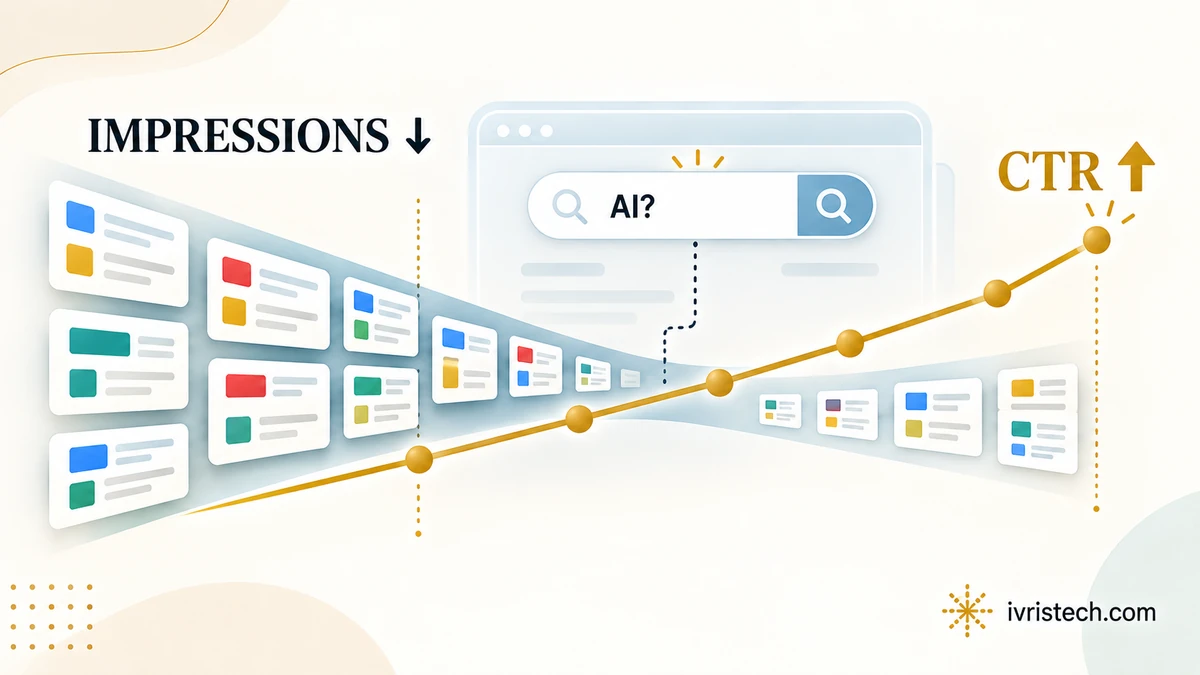
Smarter Ecommerce’s Market Observer, updated September 7, 2026, shows a striking split in European ecommerce ads: Q3 Shopping impressions were down roughly 6% year over year while clicks were up about 3%. Performance Max impressions were down roughly 9% while clicks rose about 1%.
Mike Ryan, head of ecommerce at Smarter Ecommerce, thinks AI Overviews may be part of the explanation. But his September 7 analysis explicitly labels that connection a hypothesis. The benchmark does not observe AI Overview exposure query by query or establish causation.
For paid-media teams, that distinction matters. A higher click-through rate can look like better efficiency even when the impression pool is shrinking. CTR needs to be read with impressions, total clicks, query coverage and business outcomes, consistent with our B2B Google Ads measurement framework.
Direct answer — Are AI Overviews causing Shopping ad impressions to fall?
Fresh September 2026 data shows Shopping and Performance Max impressions falling while CTR or clicks improve, but it does not prove AI Overviews are the cause. Ryan’s explanation is a hypothesis. Google also documents that Shopping ads can appear above, below and, in supported markets, inside AI Overviews, so the experiences are not categorically mutually exclusive.
Key Takeaways
- Q3 Shopping impressions fell about 6% YoY while clicks rose about 3%; PMax impressions fell about 9% while clicks rose about 1%.
- Shopping CTR finished near 2% versus roughly 1.5% a year earlier in Smarter Ecommerce’s European benchmark.
- Ryan calls the AI Overview connection a hypothesis; the public data does not provide query-level AI Overview exposure or a causal control.
- Google says Shopping ads can be eligible inside AI Overviews in supported markets, but Google Ads does not currently provide segmented AI Overview ad reporting.
What the September Data Actually Shows
The Market Observer methodology summary covers European ecommerce and retail across €450 million-plus in annual ad spend, thousands of active Google Ads campaigns and more than 4,000 PMax campaigns. It tracks Search, Shopping and PMax separately and updates weekly.
The September 7 traffic snapshot is not just a CTR story. Q3 impressions declined roughly 9% for PMax, 6% for Shopping and 4% for Search. Clicks rose about 3% for Shopping and 1% for PMax, while Search slipped about 1%. A separate CTR benchmark puts Shopping near 2% versus 1.5% a year earlier. The main dashboard reports Shopping conversions up roughly 13% with cost up 4.5%, and PMax conversions up about 6% with cost up 3%.
Why the AI Overview Link Is Still a Hypothesis
Ryan’s proposed mechanism is that Google could serve AI Overviews more often on queries with lower predicted ad-click probability, leaving Shopping ads concentrated on queries more likely to produce clicks. That would shrink the denominator and lift CTR. In an August 11 Smarter Ecommerce podcast, he had already described the idea as a hypothesis rather than a confirmed explanation.
The public data does not match each ad impression to whether an AI Overview appeared. It also does not publish a branded versus non-branded split for this analysis, an exact advertiser-account count for Ryan’s September chart, or a control that isolates AI Overviews from seasonality, demand shifts, budgets, bidding, auction pressure, feed changes or campaign migration. Smarter Ecommerce’s own benchmark commentary points to weaker demand and movement from Standard Shopping toward PMax as other possible contributors.
Google’s current Ads and AI Overviews documentation adds another constraint. Google says ads can appear above or below AI Overviews, and Text and Shopping ads from Search, Shopping and PMax can be eligible inside them in supported English-language markets. Advertisers cannot target or opt out of that placement, and Google Ads currently provides no segmented report for it.
Higher CTR Can Hide a Smaller Opportunity
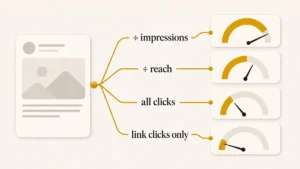
CTR is clicks divided by impressions. If impressions fall faster than clicks, CTR rises mechanically. That arithmetic says nothing by itself about why impressions fell, whether auction economics improved or whether the campaign reached more valuable demand.
Our read: the September data makes CTR less useful as a standalone health signal, not because AI Overviews have been proven to reduce Shopping impressions, but because a shrinking denominator can make the rate look healthier while total opportunity changes underneath it.
When we covered Google’s May AI Overview changes and publisher CTR pressure, the measurement problem was lost organic clicks. Shopping ads show a different aggregate pattern, so the organic “AI Overviews kill clicks” narrative cannot simply be copied onto paid media.
What Paid-Media Teams Should Test Now
- Pair CTR with volume and outcomes. Track impressions, clicks, CPC, impression share where available, conversions, conversion value, cost and ROAS. A higher rate with less reach is not the same as expanding efficient demand.
- Separate query mix. Compare branded and non-branded demand, high-intent commercial terms and broader discovery queries. A shift toward stronger intent can raise CTR without an AI Overview effect.
- Log campaign and auction changes. Budgets, bid strategies, feed edits, PMax migration and competition can move impressions. Compare matched periods before assigning the change to a SERP feature.
- Capture AI Overview exposure separately. Because Google Ads does not segment this placement, testing Ryan’s hypothesis requires an external or manual query-level record of AI Overview presence and matched cohorts, not campaign totals alone.
Frequently Asked Questions
The September 2026 evidence does not establish that. Smarter Ecommerce measured falling Shopping and PMax impressions alongside stronger CTR or click trends, while Mike Ryan proposed AI Overviews as one possible explanation. The public analysis does not match AI Overview presence to each query or control for other factors that can change impression volume.
CTR equals clicks divided by impressions. If impressions decline faster than clicks, the rate rises even without a large increase in click volume. Query mix, auction eligibility, budgets, bidding, campaign structure or SERP behavior can all change that relationship, so the rate alone cannot identify which explanation is responsible.
Yes, in supported markets. Google says Text and Shopping ads from existing Search, Shopping and Performance Max campaigns can be eligible inside AI Overviews when the query has commercial intent and the ad is relevant. Ads can also appear above or below AI Overviews across markets where the feature is available.
Read CTR with impressions, total clicks, CPC, impression share where available, query mix, conversions, conversion value, cost and ROAS. For this hypothesis, teams also need a separate record of AI Overview exposure because Google Ads does not currently provide a segmented report showing when an ad served inside an AI Overview.