OpenAI’s current ChatGPT Ads custom-audience documentation draws a hard line at 25,000 matched users: inclusion audiences and audience bid adjustments need at least that many matches, but smaller audiences can still be used for exclusions. When checked on September 8, 2026, the Help Center page was marked “Updated: 3 days ago.”
The word matched matters. OpenAI says invalid, duplicate, and unmatched identifiers do not count toward the final audience size. A CRM export with 25,000 rows is therefore not the same thing as a 25,000-person eligible inclusion audience.
Our read: this is not a small-list ABM targeting breakthrough. It is a small-list suppression breakthrough. Classic named-account programs are deliberately narrow, while ChatGPT Ads inclusion and bid weighting still demand far broader audience scale. The useful exception is that a smaller customer or prospect list can remain operational as an exclusion instead of becoming unusable.
Direct answer — Can small B2B lists use ChatGPT Ads custom audiences?
Yes, but only for exclusions when the audience has fewer than 25,000 matched users. OpenAI requires at least 25,000 matched users for campaign inclusion and audience bid adjustments, and recommends 100,000 or more for those uses. Smaller processed audiences can show as Ready with an “Exclusion only” note, making them useful for suppression without turning them into narrow ABM targeting lists.
Key Takeaways
- ChatGPT Ads requires 25,000 matched users for custom-audience inclusion and ad-group bid adjustments.
- Audiences below 25,000 matched users can still be used for campaign exclusions.
- OpenAI recommends 100,000+ users for inclusion targeting or bid adjustments.
- Audience bid multipliers currently range from 0.1x to 10x; if several match, the highest multiplier applies.
- Current uploads support email, phone, SHA-256 hashed email or phone, and Google Advertising ID (GAID).
What OpenAI’s Current Custom-Audience Rules Actually Say
ChatGPT Ads custom audiences can be applied in three ways. Campaign-level inclusion limits eligibility to people in selected audiences. Campaign-level exclusion prevents delivery to selected audiences. At the ad-group level, an audience bid adjustment changes the maximum bid when the viewer matches the audience.
The size rule is asymmetric. Inclusion and bid adjustments require at least 25,000 matched users; exclusions do not. A sub-25,000 audience can reach Ready status with an “Exclusion only” note. If inclusion and exclusion are combined, the eligible audience remaining after exclusions must still contain at least 25,000 matched users. The same audience cannot be both included and excluded in one campaign.
Bid multipliers run from 0.1x to 10x. If a viewer matches several selected audiences, OpenAI applies the highest multiplier. The multiplier changes the ad group’s maximum bid; it does not determine campaign eligibility.
Current uploads support raw or SHA-256 hashed email and phone numbers plus GAID. Identifiers can be mixed in one CSV, and members can be added, removed, or replaced without recreating the audience.
Why the 25K Floor Still Breaks Classic Small-List ABM
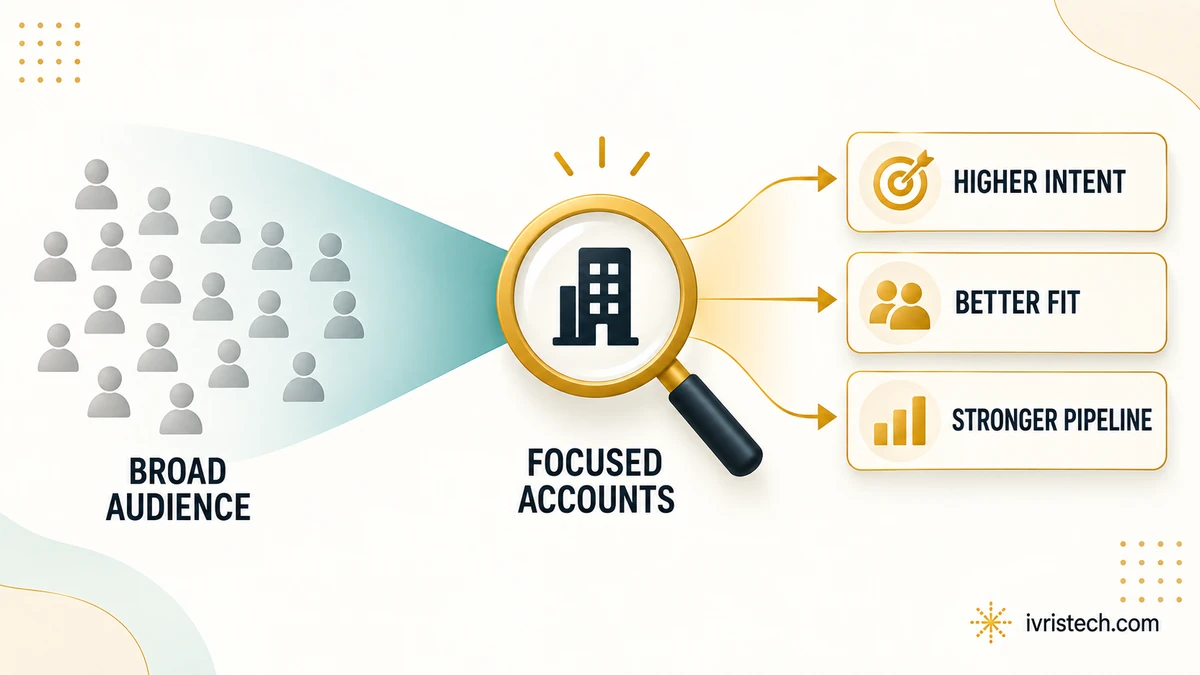
The B2B problem is identity scale. ChatGPT’s custom-audience inputs are person-level identifiers, while a disciplined ABM campaign starts from a bounded list of target accounts and then narrows to the buying committee, lifecycle stage, region, or use case that matters.
That makes the 25,000 matched-user floor structurally awkward for one-to-one and one-to-few ABM. Even a large CRM can shrink sharply after account selection, contact selection, cleaning, deduplication, and OpenAI matching. The threshold applies after those losses, not before them.
Inclusion therefore should not be read as “upload your target-account list and run ABM in ChatGPT.” A broad prospect or customer universe may clear the floor; classic named-account segments often will not.
This is separate from the spend question we covered when ChatGPT Ads moved to CPC buying. Financial access does not guarantee that a narrow B2B audience qualifies for the targeting mechanic.
Why Smaller Exclusion Lists Still Matter
Below the threshold, a smaller processed audience can still remove known people from a broader campaign even though it cannot be the inclusion gate or receive an audience bid multiplier.
For B2B acquisition, the clearest use is suppression. Existing customers can be excluded from a new-logo campaign so the campaign does not deliberately spend against matched people the advertiser already serves. OpenAI also names recent purchasers and other audiences that should not see a campaign as exclusion use cases.
Exclusion reduces an eligible audience; inclusion concentrates delivery onto one. Small lists can do the first job without being allowed to do the second.
When we covered the May Ads Manager measurement stack, the question was post-click attribution. The current audience rules add a different control layer: exclusion can keep known wrong-fit audiences out before measurement begins.
What B2B Teams Should Do Now
Start with the processed match count, not CRM rows. OpenAI does not guarantee match rate, audience size, reach, delivery, or performance. Wait for processing before deciding whether inclusion or bid adjustment is available.
Give each audience one job. Below 25,000 matched users, use it where exclusion solves a real waste or eligibility problem. Do not call that named-account targeting; the list is not defining who may receive the campaign.
Review bid overlap after an audience clears the floor. The range is 0.1x to 10x, and the highest matching multiplier wins when audiences overlap. Audience design is therefore part of bid governance.
Audit the data before upload. OpenAI’s Ad Tools Terms require audience data to be first-party rather than bought or sourced from data brokers, and require the advertiser to have the notices, rights, permissions, consents, and legal bases needed to provide it.
Treat 25,000 matched users as the boundary for targeting and bid weighting, not for usefulness. Smaller B2B lists can still earn a place in ChatGPT Ads, but today that place is suppression.
Frequently Asked Questions
OpenAI requires at least 25,000 matched users for campaign inclusion and audience bid adjustments. It recommends at least 100,000 users for those uses. The threshold is based on matched users after processing, so invalid, duplicate, and unmatched identifiers do not count toward the minimum.
Yes. OpenAI says audiences with fewer than 25,000 matched users can be used for campaign exclusions and may appear as Ready with an “Exclusion only” note. They cannot be used for inclusion targeting or audience bid adjustments until the matched audience reaches 25,000 users.
Current OpenAI documentation supports email addresses, phone numbers, SHA-256 hashed email addresses, SHA-256 hashed phone numbers, and Google Advertising IDs. CSV uploads can mix supported identifier types when the file uses the required header columns. GAIDs keep their dashes and are not hashed.
Audience bid adjustments currently allow multipliers from 0.1x to 10x at the ad-group level. If a viewer belongs to several selected audiences, the highest matching multiplier applies. Bid multipliers change the ad group’s maximum bid for that viewer; they do not determine campaign eligibility.