Most ABM conversations stop at the target account list. Pick 50 companies, buy a platform, fire off some LinkedIn ads, call it account-based marketing. That’s not a campaign. That’s a tool license with personalization sprinkled on top.
A real ABM campaign has a plan, an execution layer, and a measurement frame that connects to revenue. And if you’re running more than one campaign at a time, which most mid-market teams eventually are, you also need rules for when two campaigns try to touch the same account in the same week. Few teams get that far before the whole program fragments.
This guide gives you the operational playbook for running ABM campaigns as a repeatable function, not a one-off launch. If you haven’t run your first ABM campaign yet, start with our guide to ABM strategy examples. Everything below assumes you’re past the “what is ABM” stage and ready to run campaigns with discipline.
Key Takeaways
- An ABM campaign is a time-boxed, goal-specific engagement against a defined account list. An ABM program is the ongoing function that runs many campaigns over time.
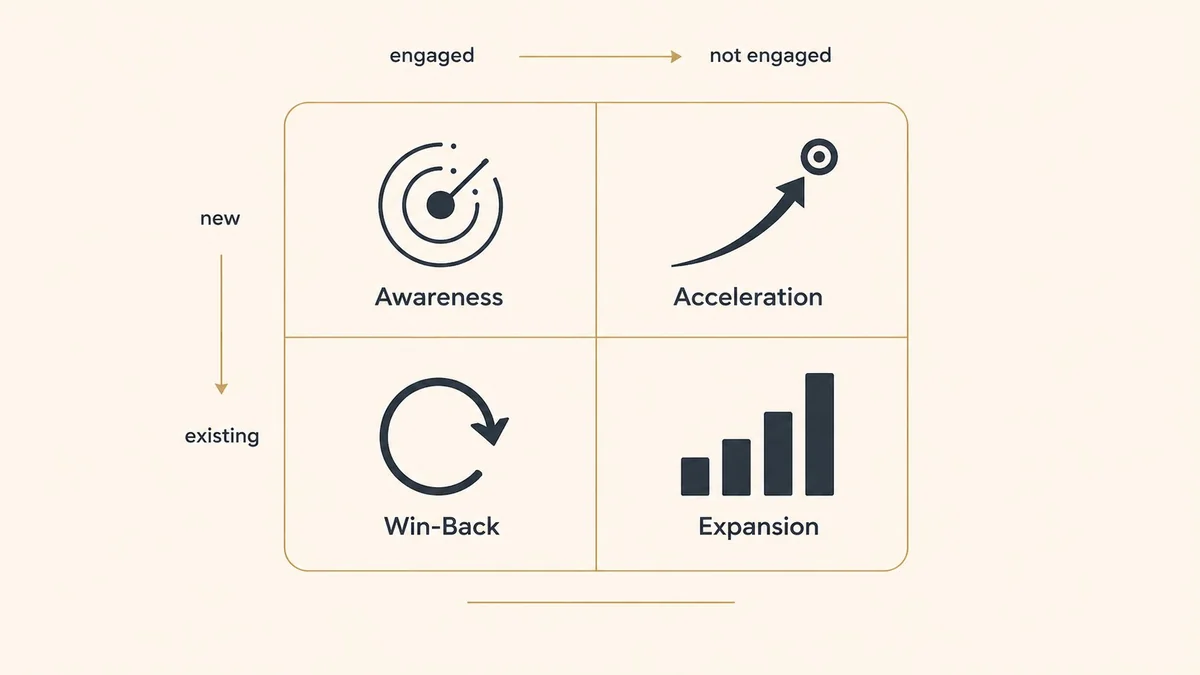
- Most B2B teams will run four types of ABM campaigns: awareness, pipeline acceleration, win-back, and expansion. Each type has a different playbook, cadence, and measurement frame.
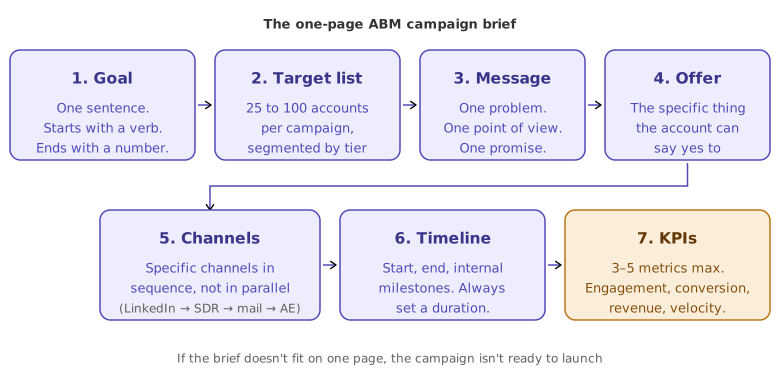
- Every campaign starts with a 7-part brief: goal, target list, message, offer, channels, timeline, KPIs. If the brief can’t fit on one page, the campaign isn’t ready to launch.
- Campaign execution fails more often on operations than strategy. Pre-launch QA, channel sequencing, and creative production workflow determine whether a good plan ships.
- Measure campaigns at campaign level (engagement, meetings booked, pipeline created) and programs at program level (coverage, MQA conversion, revenue influence). Don’t conflate the two.
- If you run more than two ABM campaigns at once, you need account collision rules. Without them, the same buyer gets three different messages in the same week.
What Is an ABM Campaign?
An ABM campaign is a time-boxed, goal-specific engagement against a defined list of target accounts, using coordinated messaging across multiple channels to move those accounts toward a specific revenue outcome. Every ABM campaign has a start date, an end date, a target list, a single goal, and a measurement frame that ties back to pipeline.
The word “campaign” matters because it separates one unit of ABM work from the broader program. An ABM program is the permanent function: the team, the tech stack, the target account list, the governance. An ABM campaign is what that program runs. You build the program once. You run campaigns continuously.
ABM Campaign vs ABM Program
The distinction is operational, not academic. Teams that conflate the two end up with budget fights, unclear ownership, and measurement that never lands. Here’s how the two differ in practice:
- ABM program: the always-on infrastructure. Includes your target account list, buying committee data, tech stack, internal SLAs, and the team that owns revenue from named accounts.
- ABM campaign: a bounded effort inside the program. Has a goal, a duration (usually 30 to 120 days), a specific subset of the target list, and a single owner accountable for the outcome.
The best-performing programs we’ve seen treat campaigns like software releases: planned in sprints, launched on a schedule, measured against a clear target, and retired when the window closes. Campaigns that run indefinitely without end dates tend to drift into “ongoing activity” with no owner left to defend the spend.
The 4 Types of ABM Campaigns
Most teams launch the wrong campaign for the account’s stage. They run awareness campaigns against accounts already deep in evaluation, or try to close accounts that haven’t heard of them yet. The fix is matching campaign type to where the account sits in the relationship. Reading that position accurately means tracking where each account sits in its buying journey, not just when it last opened an email.

1. Awareness Campaigns
Used against target accounts that don’t know you exist yet. Goal: get on the shortlist before they enter an active buying cycle. Channels skew toward LinkedIn thought leadership ads, display retargeting, content syndication, and industry events. Measurement is about reach and early engagement, not about booking meetings yet. Getting onto that shortlist early is demand creation aimed at named accounts, the account-based version of the Create stage in a full demand engine.
Typical duration: 90 to 180 days. You’re building familiarity, not forcing conversion.
2. Pipeline Acceleration Campaigns
Used against accounts already in the pipeline that have gone cold or are stuck in a stage. Goal: reintroduce momentum and progress the deal. Channels: personalized video, executive outreach from your leadership, direct mail, custom landing pages tied to their specific evaluation. Measurement is stage progression and deal velocity. Before that leadership outreach goes out, it pays to confirm the target is worth a senior calendar, and scoring a senior buyer on authority and intent keeps those at-bats on accounts that can actually move.
This is where ABM often produces its clearest ROI. According to Demandbase’s State of ABM 2026 report, which analyzed 1,452 companies, accounts supported by sustained buying-group-level engagement convert to opportunities at 2–3x the rate of accounts without it. Sustaining that engagement across every channel in real time, so each committee member sees the right next thing, is the work of orchestrating the journey at the account level.
3. Win-Back Campaigns
Used against closed-lost accounts that remain good-fit targets. Goal: create a reason to reopen the conversation. Channels: personalized content addressing the specific loss reason, champion tracking when contacts move to new companies, timed re-engagement tied to budget cycles. Measurement is re-engaged account count and pipeline reopened.
Influ2’s own win-back campaign targeted closed-lost prospects who had cited budget constraints, timed to Q4 when companies plan their next-year budgets. Simple, surgical, and re-opened deals that otherwise would have sat dormant.
4. Expansion Campaigns
Used against existing customers with upsell or cross-sell potential. Goal: grow account revenue through product expansion, new divisions, or new use cases. Channels: customer-success-led plays, targeted content for other functions, ABM ads to buying committee members outside your current contact. Measurement is net revenue retention and expansion ARR. Reaching contacts outside your current relationship is also where reporting quietly breaks, because resolving a whole buying committee to one account record is what decides whether those new touches land on the account at all.
PRO TIP
Most mid-market ABM programs should spend about 60% of campaign budget on pipeline acceleration (highest measurable ROI), 20% on awareness (long-term coverage), 10% on win-back (low cost, asymmetric upside), and 10% on expansion. Adjust based on your pipeline-to-customer ratio.
How to Plan an ABM Campaign: The 7-Part Brief
Every ABM campaign should start with a one-page brief. If you can’t fit the plan on a page, you don’t have a plan, only a wish list. After running this exercise with multiple mid-market SaaS teams, we’ve found that the campaigns that ship on time and hit their targets all share the same brief structure.
1. Goal
One sentence. Starts with a verb. Ends with a number. “Book 15 discovery meetings with VP-level buyers at Tier 1 accounts in Q2.” Not “drive awareness” or “build pipeline,” which are too vague to measure.
2. Target List
The specific accounts in scope, segmented by tier. Most mid-market teams run with 25 to 100 accounts per campaign. Larger lists dilute the personalization; smaller lists don’t produce statistically meaningful signal. That account-list logic now collides with ChatGPT Ads’ 25,000-matched-user inclusion rule: small named-account lists may still be useful for exclusions, but they cannot be used for inclusion or audience bid adjustments unless the matched audience clears the floor.
3. Message
The core idea that ties the campaign together. One problem. One point of view. One promise. If your creative team needs more than two sentences to explain the campaign message internally, the message needs sharpening before creative production starts.
4. Offer
The specific thing the account can say yes to. A meeting. A demo. A custom assessment. A piece of gated research. Offers that aren’t bounded (“learn more”) convert at a fraction of offers that are (“book a 20-minute security review with our solutions engineer”). For ESG-accountable buyers, a strong offer is often a sustainability assessment those accounts ask for, such as a supplier scorecard or a Scope 3 data pack tailored to their reporting.
5. Channels
The specific channels, in sequence. Not “LinkedIn plus email plus direct mail” but “Week 1: LinkedIn Sponsored Content. Week 2: SDR-sent video on LinkedIn. Week 3: direct mail kit. Week 4: AE-sent email with calendar link.” Sequence matters as much as the channel list.
6. Timeline
Start date, end date, internal milestones. Campaigns without a defined end date don’t end. They just bleed into a new campaign and nobody knows where one stops and the next starts. A typical pipeline acceleration campaign runs 60 to 90 days. An awareness campaign runs 90 to 180.
7. KPIs
What you’ll measure and the threshold that defines success. Three to five metrics maximum: one engagement, one conversion, one revenue, and optionally one velocity. Define these before launch. Pulling metrics at the end to match whatever happened is how ABM programs lose credibility. Set those thresholds from your own trailing numbers rather than a published figure, because almost no 2026 ABM benchmark describes a population that resembles your account list.
ABM Campaign Execution: The Operations Layer
This is where most campaigns die. Not from bad strategy, but from execution gaps: the creative slipped, the ad didn’t launch on time, the SDRs hadn’t been briefed, the CRM wasn’t updated, the landing page broke on mobile. Operations is the work between “here’s the plan” and “the campaign is live.” Validate intent-flagged accounts against multi-signal patterns before adding to a campaign list — DemandScience’s 2026 research found 98.9% of intent flags were false positives in its studied dataset. Execution gaps like these are exactly what a pre-launch gate exists to catch, and the checks that block a campaign launch are worth agreeing on while the timeline is still comfortable rather than at five o’clock on the Friday before go-live. Validate intent-flagged accounts against multi-signal patterns before adding to a campaign list — DemandScience found 98.9% of intent flags are false positives. Validate intent-flagged accounts against multi-signal patterns before adding to a campaign list — DemandScience found 98.9% of intent flags are false positives. Validate intent-flagged accounts against multi-signal patterns before adding to a campaign list — DemandScience found 98.9% of intent flags are false positives. Validate intent-flagged accounts against multi-signal patterns before adding to a campaign list — DemandScience found 98.9% of intent flags are false positives. Validate intent-flagged accounts against multi-signal patterns before adding to a campaign list — DemandScience found 98.9% of intent flags are false positives.
Channel Orchestration Logic
ABM channels don’t work in parallel. They work in sequence, each one warming up the next. A typical orchestration logic for a pipeline acceleration campaign looks like: organic social engagement → LinkedIn Sponsored Content → SDR-sent video → direct mail → AE-sent email. Each touchpoint assumes the last one landed. The LinkedIn Sponsored Content step in that sequence is what the LinkedIn-ads agencies and tools built to execute ABM on the platform own end to end, from audience match to frequency pacing. For format-specific LinkedIn ad creative patterns, see our LinkedIn ad examples by format.
When channels run in parallel without sequencing, with LinkedIn ads and cold email and direct mail all hitting the same buyer in the same week, the campaign reads as coordinated spam. Accounts don’t think “wow, they really want my attention.” They think “this vendor is everywhere, which is annoying.” Untangling which paid channel actually moved each account, instead of guessing, is what cross-channel ad reporting tools are built to do once a program runs LinkedIn, display, and search against the same list.
Creative Production Workflow
ABM creative is non-trivial because it’s semi-custom. You’re producing variants for each tier, sometimes each account. The teams that ship on time build a creative production sprint: brief signed Monday, copy draft Wednesday, design Friday, review Monday, finalize Wednesday. Two-week sprints, tracked in the same tool your product team uses. Producing a variant per account by hand is the wall most teams hit, and it’s the bottleneck AI-driven generative personalization is built to clear, drafting role-specific copy at a scale a two-week sprint can’t reach.
Creative that requires sign-off from three executives is creative that ships late. Agree on an approver structure before production starts: one marketing lead plus one RevOps partner for most campaigns, with executive sign-off only for Tier 1 campaigns where the CEO is a target.
Pre-Launch QA Checklist
Before a campaign goes live, check every item below. Missing any one of them can kill the campaign’s first week, which is when engagement peaks.
- Target list uploaded to ad platforms, deduplicated against existing campaigns
- Landing pages live, mobile-tested, tracking pixels firing correctly
- CRM fields and lead-source attribution set up for the campaign
- SDRs and AEs briefed on talking points, objection handling, campaign messaging
- Internal Slack channel created for campaign questions and real-time adjustments
- Weekly reporting cadence defined, dashboard built, owner assigned
- Kill-criteria documented: at what threshold do we pause or pull the campaign?
IMPORTANT
If your SDRs aren’t briefed on the campaign before it launches, the campaign will fail on week one. Inbound inquiries from ABM targets get routed like generic leads, the handoff feels cold, and the account remembers the misstep long after the campaign ends. Brief sales two weeks before launch, not two days after.
How to Measure ABM Campaign Performance
Campaign-level measurement is different from program-level measurement. At the campaign level, you’re answering: did this specific campaign hit its goal? At the program level, you’re answering: is our overall ABM investment producing returns? Conflating the two produces dashboards that are noisy and decisions that are slow. The physical-store version of that distinction is now in view: Vusion’s proposed in-store retail media combination could prove that media ran and link it to purchases, but incremental lift still needs a counterfactual test.
The program-level measurement framework — engagement velocity, account-level pipeline, multi-touch attribution across the buying committee — lives in our ABM metrics and dashboards piece. For a single campaign, the scoreboard is narrower:
- Engagement rate: percentage of target accounts that showed measurable engagement (ad clicks, website visits, content consumption, meeting accepts) during the campaign window.
- Meetings booked: absolute number of meetings with buying committee members at target accounts. The most reliable leading indicator of pipeline.
- Pipeline created: dollar value of net-new opportunities opened from campaign-sourced engagement.
- Campaign ROI: revenue (or pipeline, for in-flight campaigns) divided by total campaign cost.
Campaign ROI = (Pipeline Created − Campaign Cost) ÷ Campaign Cost × 100Enterprise ABM cycles run 12 to 18 months, so campaign-level ROI may not close within the campaign window. That’s fine: use pipeline created as the leading indicator and update the ROI number as deals close. Pulling the plug on a campaign because revenue hasn’t materialized in 90 days is one of the most common ABM measurement mistakes. Much of the return also lands after the deal, in the retention and expansion an account-based experience keeps measuring, which a campaign window that ends at closed-won never sees.
Running Multiple ABM Campaigns Without Collisions
Most articles on ABM stop before this section, because most teams haven’t run enough campaigns to hit the collision problem. Once you’re running three or more campaigns in parallel, the same buyer at the same account will appear in multiple target lists. Without rules, they get three different messages, feel overwhelmed, and disengage.
Account Collision Rules
Before any new campaign launches, run the target list against every active campaign’s list. Flag every account that appears on more than one. Then apply a simple rule: one account, one active campaign at a time. If an account shows up in a new campaign’s list but is already in an active campaign, defer it until the existing one ends, or escalate the account up a tier and merge the two campaigns.
The exception is awareness campaigns, which can run in the background against accounts in active pipeline campaigns because they’re low-frequency enough to coexist. Pipeline acceleration and win-back campaigns cannot coexist against the same account.
Campaign Calendar and Sequencing
Build a rolling 90-day calendar that shows every active and upcoming campaign, the date range, the account tier, and the owner. Review it weekly in a 30-minute meeting with sales, marketing, and RevOps. The calendar catches collisions early and forces sequencing decisions when budget or team capacity is constrained.
Pacing Across Concurrent Campaigns
Mature ABM teams cap total touchpoints per account at roughly 8 to 12 per month across all active campaigns. According to ABM benchmark research, mature teams run 50+ meaningful touchpoints per account per quarter, but they distribute that volume across channels and time rather than concentrating it in a two-week burst. Pacing is what prevents “coordinated spam.”
PRO TIP
Use a shared “active campaign” tag on account records in your CRM. When a rep or marketer tries to add an account to a new campaign, a warning fires if the account is already tagged. This simple guardrail prevents most collisions before they happen.
When to Kill, Extend, or Iterate a Campaign
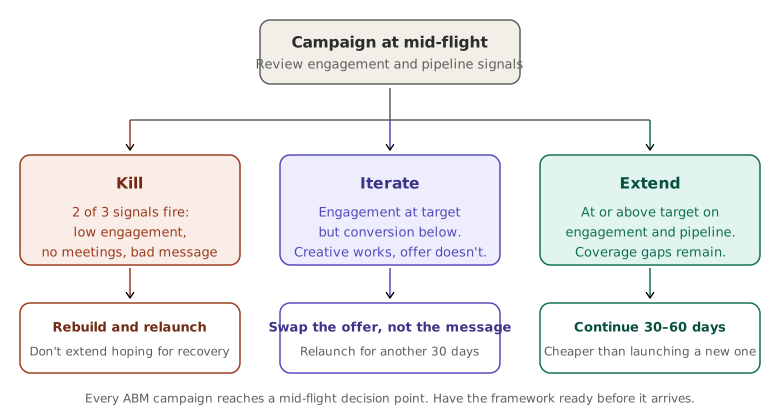
Every campaign reaches a decision point at mid-flight. The data is partial, the team is tired of the creative, and someone on the leadership team is asking whether this is working. You need a clear framework for what to do next.
Kill Criteria
Pull the campaign if two of three signals fire: engagement rate is more than 50% below target at mid-flight, no meetings have been booked, and sales feedback says the message is off. Two of three means the campaign is structurally wrong, not just slow. Don’t extend hoping for recovery. Rebuild and relaunch.
Iterate Criteria
Adjust the campaign in-flight if engagement is at target but conversion is below. This usually means the creative is working but the offer is wrong. Change the offer (not the message), relaunch the conversion touchpoints, and measure for another 30 days. We’ve seen campaigns double their meeting-booked rate with just an offer swap.
Extend Criteria
Extend the campaign if it’s at or above target on both engagement and pipeline, and the target list still has coverage gaps. Extending a working campaign is cheaper than launching a new one, and the creative has already cleared approval cycles. Most teams under-extend because “the campaign ended” feels final. It’s not. Campaigns are decisions, not deadlines.
ABM Campaign Examples From 2025-2026
Three additional examples worth studying, all from mid-market teams running ABM under resource constraints:
- FullFunnel for Iridium. A three-person team ran a one-to-few virtual summit campaign on a $3,000 budget. Segmented Tier 1 and Tier 2 accounts, sent personalized invites with content hubs and post-event workshops. Delivered 2,320 signups, 34 SQLs, and 5 new customers.
- Cognism’s scaled ABM. Cognism reported on their own blog that a scaled ABM program generated over $700K in pipeline in the first half of 2024. The program combined 1:many awareness with 1:few acceleration for accounts showing intent signals.
- Forrester 2026 B2B ROI Honors winners. The 2026 Forrester ROI Honors showcased several mid-market ABM programs with cross-functional alignment as the common thread. See our recap of the Forrester B2B Summit 2026 winners for the mid-market lessons.
The pattern across all three: small teams, tight account lists, disciplined campaign briefs, and sales-marketing alignment built into the operating cadence. None of them relied on massive budgets or enterprise ABM tech stacks.
Tools for Running ABM Campaigns
You don’t need every ABM tool on the market to run campaigns well. Most mid-market programs can run their first year of ABM with the tools below. Evaluate based on the campaigns you’re actually running, not the campaigns you might run someday. For the contact database, sales engagement, and AI enrichment tools that power ABM execution, see our lead generation tools guide.
For CRM-native ABM the platform choice usually comes down to HubSpot vs Salesforce — which one fits depends more on how your team works than on feature parity. Whichever you pick, the campaigns are only as good as the account scoring underneath them; lead scoring criteria walks through the signal-weighting that separates priority accounts from noise.
Frequently Asked Questions
An ABM campaign is a time-boxed, goal-specific marketing effort targeting a defined list of high-value accounts with coordinated messaging across multiple channels. Every ABM campaign has a clear goal, a target account list, a start and end date, and measurement tied to pipeline or revenue outcomes.
A pipeline acceleration campaign targeting 30 stalled opportunities with personalized video from your CEO, paired with LinkedIn Sponsored Content and a custom landing page, running over 60 days. The goal: reopen 10 stalled deals. Measurement: meetings booked and deal-stage progression during the campaign window.
The four main types are awareness campaigns (build familiarity before buying cycles), pipeline acceleration campaigns (move stuck deals forward), win-back campaigns (reopen closed-lost opportunities), and expansion campaigns (grow existing customer revenue). Each has a different channel mix, timeline, and measurement frame. Match the type to where the account sits in your funnel.
Pipeline acceleration campaigns typically run 60 to 90 days. Awareness campaigns run 90 to 180 days. Win-back and expansion campaigns sit in the 60 to 120 day range. Campaigns without defined end dates drift into always-on activity with no clear owner, so always set a duration at brief time.
Measure four campaign-level metrics: engagement rate on target accounts, meetings booked with buying committee members, pipeline dollar value created, and campaign ROI. Define the thresholds that count as success before launch. Campaign-level measurement is separate from program-level ABM measurement, which tracks coverage and long-term revenue influence.
Next Steps
ABM campaigns fail when they skip the operations layer. The strategy is the easy part: most teams know they should focus on high-value accounts with personalized messaging. The hard part is running the campaigns on a schedule, executing them without collisions, and measuring them with discipline.
If you’re launching your first campaign, start with the 7-part brief and a small 25-account pilot. If you’re running multiple campaigns already, audit them against the collision rules and the kill-extend-iterate framework. Both moves will tighten the program without requiring new budget or tools.
The teams that build ABM into a repeatable function rather than a quarterly campaign are the ones who set up the orchestration logic once, measure rigorously at the account level for two quarters, and refuse to launch the next campaign until the previous one’s lessons are documented and codified. ABM rewards operational patience more than tactical novelty.