B2B sustainability marketing is how a company proves its environmental and social performance to business buyers, so procurement teams and ESG-accountable customers choose it with confidence.
Most advice on the subject is recycled B2C green marketing: tell an authentic story, pick a cause, add a leaf to the logo. That approach fails in B2B, where a buying committee scores you against a supplier questionnaire before a salesperson ever picks up the phone. The b2b sustainability marketing strategies that actually win share one habit: they treat every green claim as something to prove, not something to assert.
This guide covers seven strategies, each tied to the buyer signal it answers and the proof artifact that wins it. The examples map to how business buyers really decide, through procurement scorecards, Scope 3 data requests, third-party certifications, and the European rules that, from September 2026, make honest claims a legal duty rather than a nicety.
Key Takeaways
- B2B sustainability marketing wins on proof, not adjectives: certifications, lifecycle data, and emissions numbers a procurement team can verify.
- By 2028, sustainability will be the second-most-important B2B purchasing criterion, just after quality, according to Bain.
- Procurement gates suppliers on third-party scores such as EcoVadis (a 0 to 100 scale with Platinum-to-Bronze medals) and CDP, often before any sales conversation.
- Around 40% of companies must now report and reduce their Scope 3 emissions, so buyers need your carbon data to close their own books.
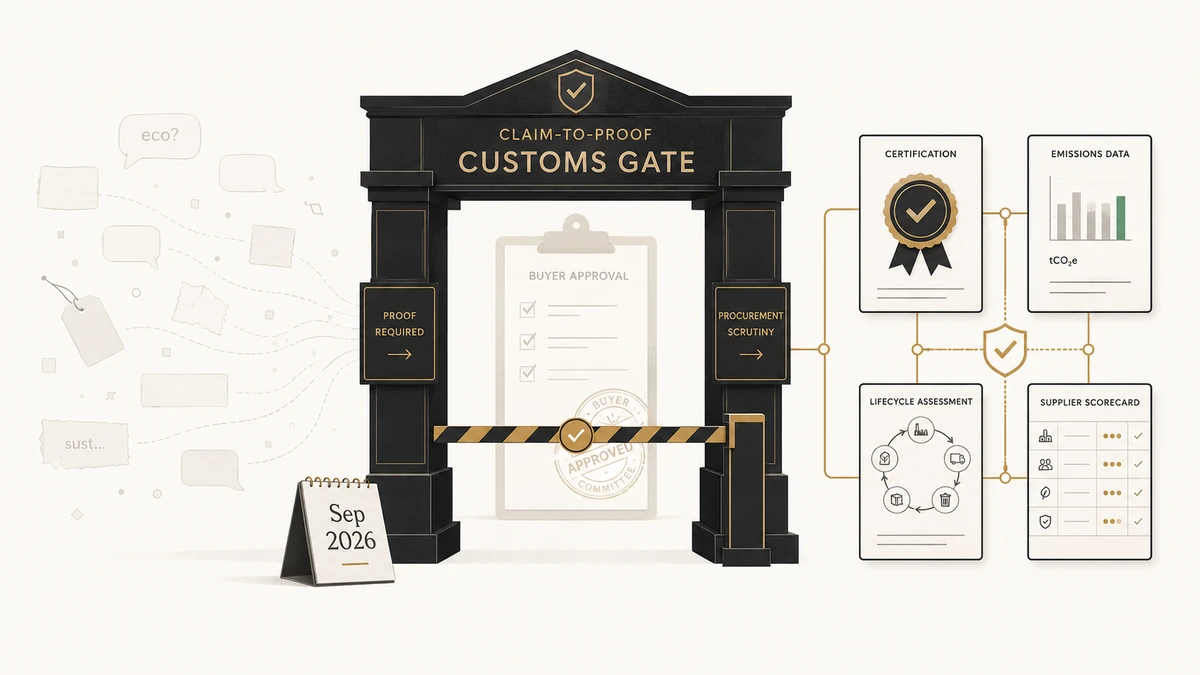
- From 27 September 2026, the EU’s Empowering Consumers Directive bans generic “eco-friendly” wording and offset-only “carbon neutral” claims.
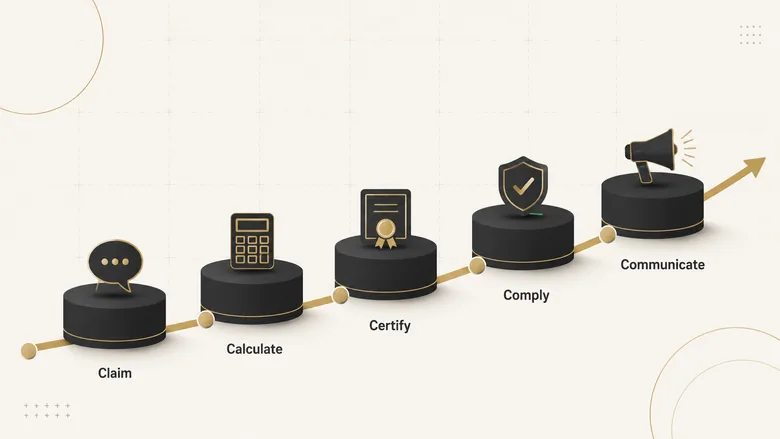
- The Claim-to-Proof Method packages each strategy into five steps: Claim, Calculate, Certify, Comply, and Communicate.
What B2B Sustainability Marketing Is (and What It Isn’t)
B2B sustainability marketing communicates a company’s environmental and social performance to other businesses using verifiable proof, not consumer-style emotional appeals. The audience is not a shopper choosing between two cartons of milk. It is a buying committee: a procurement lead running a supplier questionnaire, a sustainability or ESG manager checking your numbers against their own targets, a technical evaluator, and an economic buyer who signs off.
That committee changes everything. A consumer might buy a product because it feels green. A business buyer has to defend the decision to a CFO and, increasingly, to an auditor. They want evidence they can file: a certificate, a score, a lifecycle figure, an emissions data sheet.
In B2B, sustainability is not a brand mood. It is a line in a supplier questionnaire, scored and weighted alongside price and quality.
This is also where ESG marketing and green marketing part ways. Green marketing promotes the environmental benefits of a product, such as recycled content or lower energy use. ESG marketing is wider: it communicates Environmental, Social, and Governance performance across the whole company, often to satisfy investors and procurement. In a B2B deal, an ESG signal like an EcoVadis medal frequently decides who clears the supplier gate, long before the product’s own green features come up.
Strategy 1: Lead With Measurable ROI and Total Cost of Ownership
The first strategy is to translate sustainability into money: show the payback, the total cost of ownership, and the risk avoided, rather than the mission. Risk-averse buyers move when the numbers work, so put the financial case first and let the environmental benefit ride alongside it.
Total cost of ownership is the strongest frame because it captures what a sustainable product saves over its life: lower energy draw, less waste, fewer compliance penalties, longer replacement cycles. A claim like “uses less energy” is weak. “Cuts energy use 22% and pays back the price difference in 14 months” is a number a procurement team can take to finance. Back it with a case study that states the kilowatt-hours saved and the tonnes of CO2e avoided, because data travels through an organization in a way adjectives never do.
The willingness to pay is real. Bain’s 2025 survey of more than 750 B2B companies found that over 80% of B2B buyers paid a premium on their most recent purchase of a sustainable product. Consumer goods marketed as sustainable grow nearly twice as fast as conventional ones, at roughly a 28% price premium. The lesson for B2B is not to charge more for a logo. It is to quantify the value so clearly that the premium reads as savings.
Strategy 2: Pass Procurement With Third-Party Scorecards
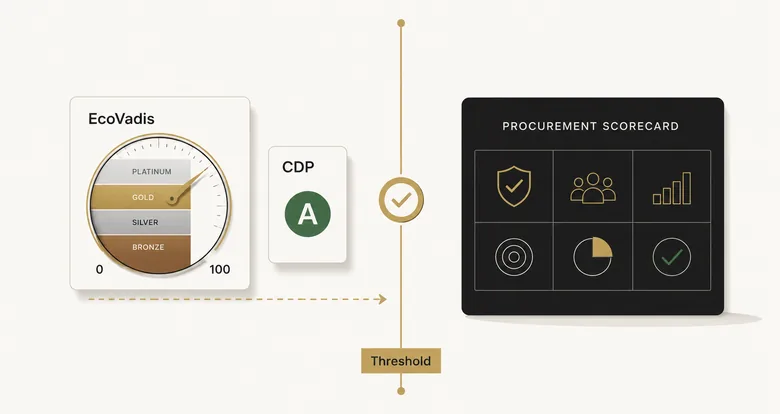
The second strategy is to earn the third-party scores procurement uses to screen suppliers, often before a sales conversation begins. Large buyers no longer take green claims on trust. They send a questionnaire, set a minimum threshold, and rank vendors on independent ratings.
EcoVadis is the one to know. It scores a company from 0 to 100 across four themes, Environment, Labor and Human Rights, Ethics, and Sustainable Procurement, then awards a medal by percentile: Platinum for roughly the top 1%, Gold for the top 5%, Silver for the top 15%, and Bronze for the top 35%. Since 2024 the medals track percentile rank rather than fixed scores, and a company is not eligible for any medal if a single theme falls below 30. CDP runs a parallel system for climate disclosure, with a supply-chain program that lets buyers request your data directly. Treat a strong EcoVadis medal as a marketing asset, not a compliance chore: put it on the website, in the RFP response, and in the first sales deck.
When a handful of strategic accounts gate on these scores, marketing has a clear job. Run an account-based campaign aimed at the procurement and sustainability leads inside those accounts, with your scorecard and supplier code of conduct front and center. The buyers you most want are the ones already filtering on the rating you just earned.
Strategy 3: Answer the Scope 3 Data Request Before Buyers Ask
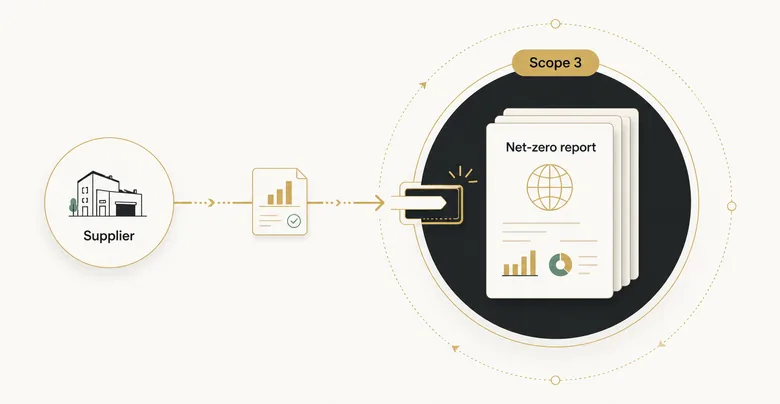
The third strategy is to hand buyers the emissions data they need for their own reporting, before they have to chase you for it. Your customer’s climate math depends on your numbers, and the supplier who provides them cleanly is the supplier who keeps the account.
Here is the mechanism. Under the GHG Protocol, a company’s emissions split into Scope 1 (direct), Scope 2 (purchased energy), and Scope 3 (everything in the value chain, including what they buy from you). Your product sits inside their Scope 3. MIT Sloan reports that around 40% of companies are now required to report and reduce Scope 3 emissions, which turns your carbon data into something they legally need.
So give it to them before they ask. Prepare a product carbon footprint and, where it fits, an Environmental Product Declaration built on a lifecycle assessment. Package the figures as a supplier data sheet aligned to the GHG Protocol, ready to drop into a customer’s CSRD filing or science-based target. Marketing that removes work from the buyer’s plate is marketing that wins the reorder.
Strategy 4: Replace Claims With Proof, Certifications, LCAs, and Labels
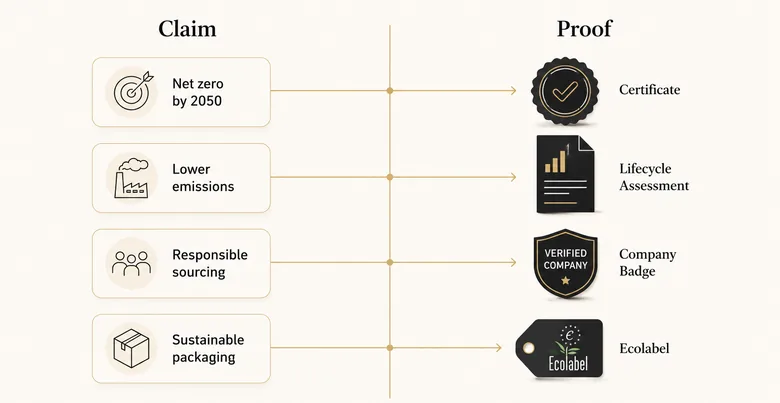
The fourth strategy is to attach a receipt to every green claim: a certification, a lifecycle assessment, or a third-party label a skeptic can check. This is the heart of anti-greenwashing, and it is the single biggest gap in most B2B sustainability marketing.
Match the proof to the claim. A management-system claim earns an ISO 14001 certificate. A product-impact claim earns a lifecycle assessment or an Environmental Product Declaration. A whole-company claim earns B Corp certification or a Science Based Targets initiative validation. A product-efficiency claim earns an ecolabel such as EPEAT or Energy Star. Each one converts an opinion into a fact a procurement reviewer can verify independently, which is exactly what removes the risk objection from the deal.
Then make the proof do marketing work. Turn each certificate and lifecycle summary into content built to generate leads: a gated white paper, a one-page proof sheet for the sales team, a verification badge on the pricing page. A certification filed in a drawer protects you legally. A certification published as a proof asset also sells.
Strategy 5: Stay Legal, Market Within the 2026 Green-Claims Rules
The fifth strategy is to write every claim so it survives the rules now governing environmental marketing on both sides of the Atlantic. Honest marketing is becoming a legal requirement, and the wording on your website is in scope.
In the European Union, the Empowering Consumers for the Green Transition Directive (2024/825) applies from 27 September 2026. It bans generic environmental claims such as “eco-friendly” or “climate neutral” when they are not backed by recognized proof, prohibits “carbon neutral” claims that rest only on offsetting emissions outside the product’s value chain, and outlaws sustainability labels that are not based on an official certification scheme. Claims about future performance, like a 2030 net-zero pledge, now need a public, time-bound plan verified by an independent third party.
The picture shifted in 2025. The separate, stricter Green Claims Directive was withdrawn in June 2025 after political support collapsed, which led some marketers to relax. That was a mistake: the Empowering Consumers Directive was already adopted in 2024 and remains binding from September 2026. In the United States, the FTC Green Guides set the substantiation standard, requiring competent and reliable scientific evidence behind any environmental claim, and they are under active review. The safe move is to keep a substantiation file for every claim and to retire vague language now.
IMPORTANT
Mark 27 September 2026 on the calendar. From that date, generic claims like “sustainable” or “eco-friendly” and offset-only “carbon neutral” labels are prohibited in the EU. B2B catalogs, spec sheets, and portals are in scope, not just consumer packaging. Audit your live collateral against the Empowering Consumers Directive before the deadline, not after a complaint.
Strategy 6: Arm Sales and Run Sustainable Digital Campaigns
The sixth strategy is to equip sellers to argue the business case and to run campaigns whose own footprint backs up the message. A proof pack is worthless if the salesforce cannot explain it and the campaign promoting it looks wasteful.
Start with commercial enablement. Bain found that 59% of suppliers believe their salesforce cannot explain why their sustainable products outperform conventional ones. Close that gap with a battle card for each product that links a spec to the buyer’s ESG goal, a short ROI calculator, and ready answers to the supplier questionnaire. Fold the proof points into your broader B2B campaign strategies so sustainability is a thread through every play, not a standalone microsite nobody visits.
Then practice what the message preaches. Sustainable digital marketing means cleaning email lists so you stop sending to dead addresses, compressing page assets so they load on less energy, choosing efficient or green hosting, and favoring ad networks that price in carbon. None of this is a headline on its own, but a buyer who notices a bloated, high-carbon campaign behind a green claim notices the contradiction too.
Strategy 7: Build Authority With Educational Thought Leadership
The seventh strategy is to teach the market the hard parts of sustainability, so buyers treat you as the expert rather than just another vendor. The companies that explain Scope 3, lifecycle assessment, and procurement scoring become the supplier buyers call first.
Thought leadership earns that position when it carries real substance: an original benchmark drawn from your own data, a webinar that walks a procurement team through an EcoVadis submission, a bylined article from a named expert with visible credentials. Authority signals matter to both readers and search engines, so put a real author, a real bio, and real citations on the work. Slot the program into a repeatable B2B marketing framework so the education ships on a cadence instead of in bursts, and borrow credibility by citing primary research from Bain, MIT Sloan, and the standards bodies themselves.
Video is one of the most effective formats for this kind of education, and it doubles as a trust signal on the page. The short talk below frames what every B2B brand needs to get right before it markets a sustainability story.
The Claim-to-Proof Method
The Claim-to-Proof Method turns the seven strategies into one repeatable sequence, so every sustainability message ships with evidence attached. Run any claim through five steps before it reaches a buyer.
- Claim: State one specific, bounded benefit. No vague adjectives, and no whole-company halo stretched over a single product.
- Calculate: Attach a number with a method behind it, from a lifecycle assessment, the GHG Protocol, or a total-cost-of-ownership model.
- Certify: Back the number with third-party validation, such as ISO 14001, EcoVadis, CDP, B Corp, or an Environmental Product Declaration.
- Comply: Pressure-test the wording against the Empowering Consumers Directive and the FTC Green Guides before it goes live.
- Communicate: Deliver the proof where buyers decide, in RFP responses, scorecards, case studies, and sales battle cards.
Strategy-to-Proof Matrix (Copy This Table)
The table below maps each strategy to the buyer signal it answers and the proof artifact that wins it, so you can audit your own program in a single pass. Find your weakest row, then build the proof it is missing.
| Strategy | Buyer / procurement signal | Proof artifact that wins it | Funnel stage |
|---|---|---|---|
| Lead with ROI and TCO | “Show payback, not vibes” (finance and ops scrutiny) | TCO model plus a case study with kWh saved and CO2e cut | Consideration |
| Pass procurement scorecards | Vendor-onboarding ESG questionnaire with a minimum threshold | EcoVadis medal (0 to 100 score) and a CDP climate score | Vendor qualification |
| Answer Scope 3 requests | “We need your emissions for our net-zero reporting” | Product carbon footprint and EPD aligned to the GHG Protocol | Due diligence |
| Replace claims with certs | “Prove the green claim or we discount it” | ISO 14001, an LCA summary, and an SBTi-validated target | Consideration |
| Market within the law | Legal and compliance review of collateral | Substantiation file mapped to the ECGT Directive and FTC Green Guides | All collateral |
| Arm sales (enablement) | “Your rep couldn’t explain why this beats the incumbent” | Battle card linking spec to buyer ESG goal, plus an ROI calculator | Sales conversation |
| Run sustainable digital | Buyer notices your own footprint behind a green message | Green-hosting proof, a clean list, and carbon-aware ad placements | Top of funnel |
| Educational thought leadership | “Who actually understands procurement-grade sustainability?” | Original benchmark, a webinar, and a credentialed expert byline | Awareness |
FREE WORKBOOK
Find the proof gap behind every green claim. Map claims to calculations, certifications, Scope 3 data, procurement signals, risk, and sales assets. Download the Claim-to-Proof Matrix.
How to Build a B2B Sustainability Marketing Program
To build a B2B sustainability marketing program, audit your claims, earn your scorecards, quantify with data, and ship proof your buyers and their auditors can check. The workflow below sequences the work, with the scorecard and lifecycle steps as the long poles.
Workflow · 8-12 weeks
How to build a B2B sustainability marketing program
Six steps that turn scattered green claims into a procurement-ready proof system your buyers and their auditors can check.
Audit your claims and gaps
List every sustainability claim in live collateral and mark each one proven, partly proven, or unproven, noting which lack a number or a certificate.
Earn or surface your scorecards
Complete an EcoVadis assessment and CDP disclosure if buyers request them, or gather existing certifications into one shareable proof pack.
Quantify with an LCA or carbon footprint
Commission or update a lifecycle assessment and product carbon footprint so you can answer Scope 3 requests with audit-ready numbers.
Compliance-check the language
Rewrite claims to pass the Empowering Consumers Directive and FTC Green Guides, dropping generic “eco-friendly” and offset-only “carbon neutral” wording.
Build proof assets and enable sales
Turn each proof point into a case study, white paper, RFP-answer snippet, and battle card so the team sells the same numbers.
Publish, measure, and iterate
Run thought-leadership campaigns, track pipeline influenced and win rate on ESG-gated deals, and refresh the proof every quarter.
Green-claims rules by region: what you must be able to prove
Sustainability marketing is now actively policed, and the substantiation bar differs by market. Treat every environmental claim as something you must evidence before publishing.
| Region | Regime (2026) | Enforcement teeth |
|---|---|---|
| United States | FTC Act + FTC Green Guides | Claims must be substantiated and non-deceptive; the Green Guides set expectations (and are being updated). |
| United Kingdom | CMA Green Claims Code + DMCC Act 2024 (consumer rules live since April 2025) | The CMA can now fine up to 10% of global turnover directly for misleading claims. |
| European Union | Empowering Consumers Directive (ECGT) | From September 2026 the ECGT bans generic green claims and offset-based carbon-neutral product claims. (The separate Green Claims Directive proposal was paused in 2025.) |
| Australia | Australian Consumer Law + ACCC greenwashing guidance | The ACCC has prioritised greenwashing enforcement; claims need a reasonable, evidenced basis. |
| Canada | Competition Act (Bill C-59 amendments; final guidelines June 2025) | Environmental claims must be backed by adequate and proper testing or a recognised methodology. |
Bottom line: if you cannot evidence it with a named method, do not publish it. This is a summary, not legal advice. Last reviewed: June 2026.
Frequently Asked Questions
No. The US relies on the FTC Green Guides; the UK DMCC Act lets the CMA fine up to 10% of global turnover for misleading claims (in force since April 2025); and the EU Empowering Consumers Directive bans generic green claims and offset-based carbon-neutral product claims from September 2026. Canada and Australia each require claims to be backed by proper testing or evidence. The same sustainability copy can be compliant in one market and a violation in another, so evidence every claim per region.
B2B sustainability marketing is how a company proves its environmental and social performance to business buyers. Instead of vague green slogans, it uses certifications, lifecycle data, and emissions numbers to satisfy procurement teams and ESG-accountable customers, turning credible sustainability into a reason those buyers choose and keep you.
Avoid greenwashing by backing every claim with proof a buyer can verify. Replace adjectives like eco-friendly with specific numbers, third-party certifications, and lifecycle assessments. Disclose your methods, limits, and progress honestly, and check the wording against the EU’s 2026 Empowering Consumers Directive and the FTC Green Guides before you publish.
Prove ROI by translating sustainability into money and risk. Show total cost of ownership, payback period, and measured savings in kilowatt-hours and CO2e from real case studies. Tie those numbers to the buyer’s own targets, such as net-zero goals and Scope 3 reporting, so the value is concrete rather than aspirational.
Green marketing promotes the environmental benefits of a product, like recycled content or lower emissions. ESG marketing is broader: it communicates Environmental, Social, and Governance performance across the whole company, often for investors and procurement. In B2B, an ESG signal like an EcoVadis score frequently decides who clears the supplier gate.
Examples include leading with ROI and total cost of ownership, earning procurement scorecards like EcoVadis and CDP, answering buyers’ Scope 3 data requests, replacing claims with certifications and lifecycle assessments, marketing within the 2026 green-claims rules, enabling sales with proof, and publishing educational thought leadership backed by original data.
Next Steps
Start with your weakest proof, not your boldest claim. Run an honest audit of your live collateral, mark every sustainability statement as proven, partly proven, or unproven, and you will usually find the gap is evidence, not ambition.
Then close one gap this quarter. Earn a single scorecard, publish one lifecycle summary, or rewrite the claims that won’t survive September 2026. Each proof point compounds, because the certificate that clears a procurement gate is the same asset that anchors a case study and answers the next RFP. Proof is the strategy; the seven plays above are just where you apply it.