Nearly every B2B marketing team now runs AI somewhere in its stack, yet most account-based programs still pick their targets off a spreadsheet and send the same three emails to the same two contacts. The tools arrived faster than the execution changed.
AI-driven ABM closes that gap. It doesn’t redefine account-based marketing; it changes who does the work at each step. The questions that used to eat an ABM manager’s week, which accounts are worth pursuing, who inside them matters, what to say to each person, and when to follow up, become model-run instead of hand-run. And unlike most AI marketing claims, the payoff is starting to show up in controlled tests rather than case-study theater.
Direct answer — What is AI-driven ABM?
AI-driven ABM is account-based marketing where AI runs the execution teams used to do by hand: it scores and selects target accounts from firmographic and intent signals, maps the buying group, generates messaging tailored to each persona at scale, and sequences multi-channel follow-up. It assumes you already run ABM and changes how each step gets done, not what ABM is. It differs from traditional ABM, which leans on manual list-building and one-size campaigns, and from generic marketing AI, which isn’t scoped to specific accounts.
Key Takeaways
- AI changes ABM execution, not its definition. The account is still the unit of value; selection, personalization, and follow-up move from manual to model-run.
- Account selection is where AI pays off first. Predictive models rank firmographic, technographic, and third-party intent signals to surface in-market accounts before anyone fills a form.
- Generative personalization is where AI shows measured lift. In a head-to-head LinkedIn test, Snowflake’s AI-written ad copy beat human copy by 54% on click-through rate.
- Agentic workflows now handle list-building and follow-up, but they inherit your data quality. Bad account matching produces targeting that is confident and wrong.
- Buying groups average 22 people, 13 inside the company and nine outside it. AI’s committee mapping is the difference between reaching one champion and reaching the deal.
What AI-driven ABM changes about execution
AI-driven ABM keeps the strategy of account-based marketing intact and rebuilds its execution. You still choose a finite set of accounts, still align sales and marketing on that list, still measure by account rather than by lead. What changes is that the manual, judgment-heavy steps between the list and the pipeline get handed to models that read more signals than a person can hold in their head.
That distinction matters because it tells you where AI helps and where it doesn’t. It won’t invent your ideal customer profile or decide your positioning. It will do the repetitive, high-volume work ABM has always been bottlenecked on: reading intent across thousands of accounts, drafting a different message for every role, and never forgetting to follow up. The teams seeing real gains treat AI as an execution layer on a strategy they already own, which is the same discipline that separates the ABM programs that build real pipeline from the ones that just buy ad impressions against a target list.
Here is what actually moves from human to machine.
| ABM step | Traditional (manual) | AI-driven |
|---|---|---|
| Account selection | Reps and marketers build a list from firmographics and gut feel | A model scores every account on fit and live intent, and re-ranks weekly |
| Buying-group mapping | You work the two contacts who replied | AI surfaces the full committee, including roles you never emailed |
| Messaging | One campaign, lightly tokenized with a first name and company | Distinct copy per persona, industry, and pain point, generated at scale |
| Orchestration | A fixed sequence sent on a calendar | Channel and timing chosen per contact from engagement signals |
| Measurement | Leads and MQLs by campaign | Account-level lift measured against a holdout |
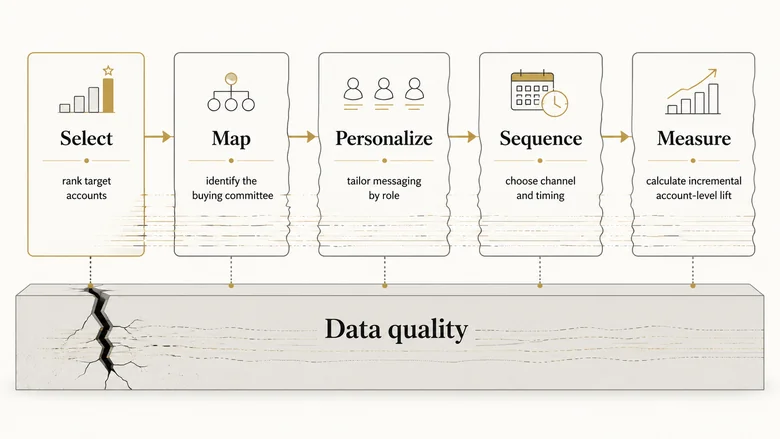
Read the table top to bottom and the pattern holds: AI doesn’t add a step, it replaces guesswork with a scored decision at each one. The rest of this guide takes the five rows in order, because that’s the order in which they compound. Bad selection can’t be rescued by good copy, and good copy can’t be trusted without an honest account-level model underneath.
Predictive account selection replaces the static target list
Predictive account selection uses a model to rank accounts by how well they fit your ICP and how strongly they’re showing buying intent right now. It’s the step where AI earns its place first, because everything downstream inherits the quality of the list.
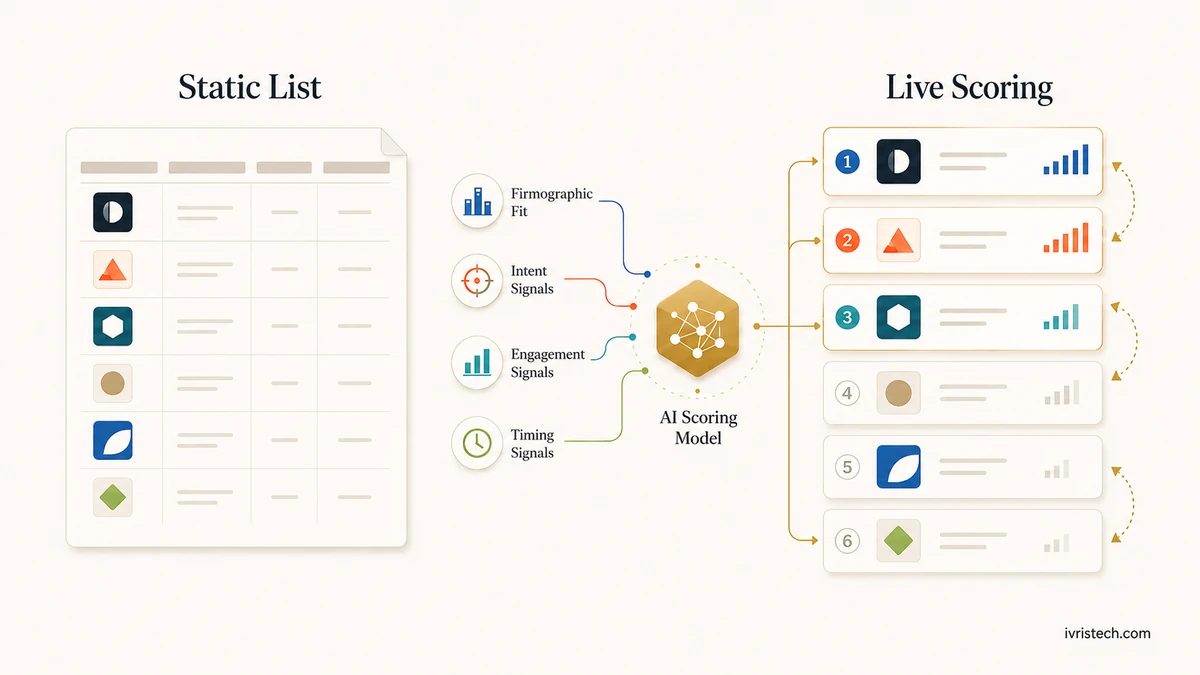
Traditional target lists go stale the day they’re built. A predictive model treats the list as a live ranking instead: it reads firmographics, technographics, and third-party research behavior, compares each account against the patterns in your closed-won history, and pushes the accounts heating up this week to the top. 6sense, whose model draws on CRM, marketing-automation, and first- and third-party intent data, reports that customers who concentrate effort on its highest-scored accounts see a 13% higher win rate and a 15% larger average deal, a vendor figure worth reading as directional rather than guaranteed. The mechanism is the point: a score that updates as behavior changes beats a list that was true once.
The signal that makes this work is intent, and it’s also the one most teams handle worst. Third-party intent arrives at the account level with no contact attached, which is exactly the shape a lead-based CRM struggles to store, so it gets averaged away or ignored. Sorting it out is its own discipline, the subject of how to source and score B2B intent data; for ABM, the thing to hold onto is that intent is what turns a flat fit list into a ranked, time-aware one.
Intent scoring and buying-committee mapping find the whole deal
Buying-committee mapping is the AI step that identifies every person involved in an account’s decision, not only the ones who have already engaged. It’s the antidote to ABM’s most common blind spot: running a whole program at the one contact who happened to download something.
The scale of that blind spot is well documented. Forrester’s 2026 State of Business Buying puts the typical decision at 13 stakeholders inside the buyer’s organization and nine more outside it, twenty-two people for one purchase. AI models crawl public and proprietary data to assemble that group, tagging likely economic buyers, technical evaluators, and champions so campaigns can address roles you’ve never had an email for. The nine outside influencers, the consultants and agency partners and trusted peers, don’t share the account’s email domain, so they stay invisible to contact-based tactics until a model names them.
Scoring then tells you which accounts to act on and when. Predictive intent separates accounts in early research, where top-of-funnel content fits, from accounts approaching a decision, where a competitive or solution play makes sense. That timing is the real line between AI-driven ABM and a faster version of spray-and-pray: the same message to everyone is still wrong, just delivered more efficiently. The same discipline doesn’t have to stop at closed-won; carrying that timing past the deal into onboarding and renewal is what turns account-based marketing into account-based experience.
Generative personalization at scale, without the slop
Generative personalization uses large language models to produce distinct messaging, landing pages, and ad copy for each persona and account, rather than tokenizing one template. It’s the AI capability with the clearest measured payoff, and the one most likely to backfire when you skip the guardrails.
The payoff is real and tested. When Snowflake’s ABM team ran a controlled LinkedIn experiment, half the audience saw human-written ads and half saw copy generated with the company’s own AI model; the AI-generated creative lifted click-through rate by 54%. The same program used a predictive model to book 2.3 times more meetings in high-potential accounts while spending 38% less. Those numbers came from a team that fed the model brand guidelines and structured prompts, not from turning a chatbot loose on the account list.
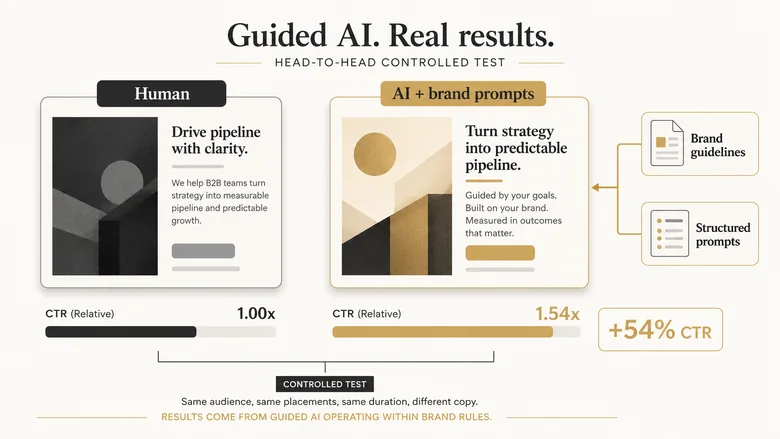
That last point is the whole game. Generative personalization fails when it produces fluent, generic copy that reads like every other AI email in the inbox. It works when the model is boxed in by real inputs: the account’s industry, the persona’s role, the specific pain the product addresses, and a brand voice it isn’t allowed to drift from. Teams doing this well treat it as one of several practical agentic AI use cases in marketing, with a human reviewing the outliers rather than every asset.
Agentic workflows handle list-building and follow-up
Agentic ABM workflows are chains of AI agents that carry out multi-step tasks, building target lists, enriching contacts, drafting sequences, and following up, with limited human intervention. This is the newest and least mature capability, and the one where the gap between demo and production is widest. G2 now draws a broader software-category line around Agentic GTM Platforms: the distinction is whether that execution spans GTM functions rather than remaining inside the account-based motion.
In practice, an agentic setup might watch for an intent spike, pull the matching accounts, enrich the buying group, draft a role-specific opening for each contact, and queue follow-ups that adjust based on who opens or replies. Teams already running AI agents inside revenue operations, the pattern documented in how AI agents are reshaping RevOps, tend to extend the same plumbing into ABM rather than buy a separate tool. The appeal is obvious: the follow-up reps forget and the list-building that eats analyst hours are exactly the work agents are good at.
IMPORTANT
An agent inherits every weakness in the data underneath it. Point one at a CRM with broken account matching and it will confidently build lists around the wrong companies, personalize to the wrong roles, and follow up on accounts that were never a fit. The agent doesn’t know the data is bad; it just executes faster. Clean the account and intent data before you automate the motion, or you scale the error instead of the results.
Maturity is the reason to stay careful. Fully autonomous ABM agents are still rare in production, and the sensible 2026 pattern keeps a human in the loop: agents draft and sequence, a person approves the edge cases and owns the account strategy. That preserves the speed while catching the failure the callout describes before it reaches a prospect.
AI orchestration times outreach across channels
Orchestration is the coordination of outreach across email, LinkedIn, display, and direct mail so each contact is reached on the right channel at the right moment. AI’s contribution is choosing that channel and timing per person, instead of running everyone through one fixed sequence.
A model watching engagement signals can tell that one stakeholder answers LinkedIn on Tuesday mornings while another only ever opens email, and route accordingly. It can hold outreach when an account goes quiet and re-engage when research resumes. This is where AI-driven selection and personalization turn into an actual campaign, and it’s also where operational discipline decides the result: the tracking, the sequencing rules, and the QA that keep a multi-channel program honest are the same fundamentals in the operational playbook for running ABM campaigns. AI makes those fundamentals faster to execute; it doesn’t excuse skipping them.
Which AI-ABM platform does what
The platform market has consolidated around a few full-stack vendors that fold predictive scoring, intent data, and orchestration into one system. They differ less on features than on which part of the job they do best, so the useful question is which bottleneck you’re solving, not which tool has the longest feature list.
| Platform | Where its AI does the most work | Best fit |
|---|---|---|
| 6sense | Predictive scoring and in-market detection across first- and third-party intent | Teams whose bottleneck is knowing which accounts are in-market now |
| Demandbase One | Account intelligence plus multi-source intent, with multi-channel orchestration in one place | Enterprise programs consolidating a fragmented data, advertising, and execution stack |
| Factors.ai | Account de-anonymization and multi-touch attribution back to pipeline | Teams that need AI targeting tied to spend and revenue |
Match the tool to the gap. Reach for 6sense when you can’t see which accounts are in-market, Demandbase One when execution and data are scattered across a fragmented enterprise stack, and Factors.ai when you can target but can’t prove what worked. And hold off on buying any of them until your account data and ICP model are clean, because every one of these amplifies the targeting you already have rather than fixing it.
Measuring AI-driven ABM without fooling yourself
Measuring AI-driven ABM means proving the AI-selected, AI-personalized motion produced more pipeline than the manual one would have, not just reporting that the AI accounts performed well. The trap is that AI systems pick the accounts most likely to convert, so they look effective even when they add nothing.
The clean test is a holdout. Hold back a matched set of accounts the model would have prioritized, run them through your normal manual process, and compare the two cohorts.
Incremental lift = (AI-cohort result − matched-holdout result) ÷ matched-holdout resultEverything else is diagnostics on top of that number. The full account-level metric set, buying-group coverage, engagement scoring, influenced pipeline, and the benchmark for each, is the job of the ABM metrics organized by funnel stage; this page assumes you’ll report those with a coverage figure beside them, so a reader knows how much of each account you actually saw. The AI-specific caution is narrower: a model’s numbers inherit its matching, so an engagement score computed over half a buying group quietly understates the account, and a win-rate lift measured without a holdout is usually just the model choosing easy accounts.
PRO TIP
Before you credit AI with a lift, check whether the accounts it picked were already in late-stage buying cycles. If the model mostly surfaced accounts your reps were about to close anyway, the lift is selection, not causation. A holdout catches this; a dashboard never will.
Frequently Asked Questions
An AI-driven ABM strategy uses models to run the execution of account-based marketing: scoring and ranking target accounts on fit and intent, mapping the buying committee, generating per-persona messaging, and timing multi-channel follow-up. The strategy still comes from you. AI handles the high-volume decisions that used to be manual.
Traditional ABM builds target lists by hand, sends lightly personalized campaigns, and measures by lead. AI-driven ABM scores accounts on live intent, personalizes to each role at scale, and measures account-level lift against a holdout. Same strategy and same account focus, but the execution shifts from manual judgment to model-run decisions.
Snowflake’s ABM team is a documented example. It built a predictive model to rank accounts by meeting propensity, booking 2.3 times more meetings in high-potential accounts, and generated LinkedIn ad copy with its own AI that beat human-written copy by 54% on click-through rate in a controlled test.
Most teams use a full-stack ABM platform such as 6sense, Demandbase One, or Factors.ai, which combine predictive scoring, intent data, and orchestration. The tool matters less than the data underneath it. Clean account matching and an ICP model come first, because every platform amplifies the targeting you already have.
A practical framework follows five levers in order: predictive account selection, intent scoring and buying-committee mapping, generative personalization, agentic workflows for list-building and follow-up, and holdout-based measurement. They compound, so each depends on the one before it. Bad selection can’t be rescued by good copy.