Backlinks still decide who wins competitive search results, yet the wrong ones can sink a site overnight. That tension sits behind how to get backlinks without Google penalty risk in 2026: the same signal that lifts your rankings can also get you demoted. Google’s own data shows how much links matter, and its spam policies are just as clear about what crosses the line.
This guide separates the links that earn rankings from the links that trigger manual actions and algorithmic demotions. You’ll see what Google treats as a link scheme, the white-hat methods that hold up over time, how to keep a natural link profile, and how to audit and disavow a risky profile if you’ve already been burned. The move that removes most of the risk is simple: treat link building as one input into a broader B2B SEO strategy, not a standalone growth hack.
Direct answer — How do you get backlinks without a Google penalty?
Earn editorial links instead of buying them. Use digital PR, original research, broken-link building, and genuine guest contributions to attract contextual links from relevant, authoritative sites. Keep the profile natural: diverse anchor text, a steady link velocity, and a healthy mix of follow and nofollow. Avoid link schemes, PBNs, and paid do-follow links, which breach Google’s link spam policy. If you’ve already been hit, audit your backlinks and disavow the toxic ones.
Key Takeaways
- Penalties come from link schemes, not from links themselves. Paid do-follow links, PBNs, excessive exchanges, and automated link building are the tactics Google names in its spam policy.
- Safe links are earned and editorial: digital PR, original research, broken-link building, and real guest contributions on relevant sites.
- A natural profile means diverse anchors, steady velocity, and a follow/nofollow mix. Sudden spikes and exact-match anchors are the loudest risk signals.
- Trouble comes in two forms: algorithmic demotions (automatic) and manual actions (a human reviewer). Both cost rankings and traffic.
- If a risky profile already exists, audit, request removals, then disavow what’s left and file a reconsideration request if it’s a manual action.
What actually triggers a Google link penalty
Google doesn’t penalize you for having backlinks. It penalizes patterns that look built to manipulate rankings. Its spam policies for web search define link spam as any link created mainly to influence rankings, whether it points to your site or out from it. That word, manipulation, is the line you don’t want to cross.
The policy names specific tactics, and nearly every link penalty traces back to one of them.
Buying or selling do-follow links
Exchanging money, goods, or services for links that pass ranking credit is the clearest violation, and it covers advertorials or sponsored articles where the payment buys a ranking-passing link. Paid placements aren’t banned outright, but the link has to carry a rel="sponsored" or rel="nofollow" attribute so it doesn’t pass PageRank. Strip that attribute off a paid link and you’ve built a penalty waiting to happen.
Private blog networks and link farms
A PBN is a set of sites you own or rent for the sole purpose of linking back to a money site. Google treats these as manipulative by design. They can lift rankings briefly, then wipe out an entire profile the moment the network is detected.
Excessive link exchanges
An occasional reciprocal link between genuine partners is normal. Large-scale link swaps, or partner pages that exist only to cross-link, are not. Scale and intent turn an ordinary relationship into a scheme.
Automated and over-optimized links
Two related traps live here. The first is using automated software to spin up links at volume. The second is stuffing exact-match keywords into your anchor text: a profile where most anchors read “best B2B CRM software” is a pattern no organic link graph produces. Both are among the fastest ways to earn algorithmic scrutiny.
Algorithmic demotion vs. manual action
Two different things can go wrong, and they need different fixes. Google’s automated link-spam systems can quietly discount or demote manipulative links, which you’ll notice as a ranking slide with no warning. A manual action is different: a human reviewer flags the site, and the notice appears in Search Console, usually as unnatural links pointing to your domain. Your first job after a sudden traffic drop is working out which of the two you’re facing.
Safe, white-hat ways to get backlinks
Here’s the reframe that makes safe link building easy: stop trying to get links and start trying to earn them. Every method below produces links Google wants to count, because a real person chose to cite you. These are the white-hat link building tactics that actually move rankings without putting your site at risk.
Digital PR and unlinked mentions
Digital PR earns coverage, and links, from journalists and industry sites by giving them something worth writing about: a data point, a sharp opinion, an expert source. Pair it with unlinked-mention reclamation. Tools like Ahrefs Brand Monitoring or Google Alerts surface sites that named your brand without linking, and a short, polite email asking them to make the mention clickable is one of the highest-conversion links you can build.
Original research and linkable assets
Original data is the most reliable link magnet there is. Backlinko’s analysis of 11.8 million search results found the top result has roughly 3× more referring domains than positions two through ten, and the pages that attract those domains are almost always the ones publishing something citable. Surveys, benchmarks, original calculations, and detailed guides all qualify. Build link-worthy assets into your SEO content strategy so every important page has a reason to be cited.
Broken link building
Broken link building trades a favor for a link. Use a backlink tool to find dead outbound links on authoritative, relevant pages, then offer your equivalent resource as the replacement. The site owner fixes a broken page, you earn a contextual link, and nothing about the exchange breaks policy.
Genuine guest contributions and expert quotes
Guest posting still works when it’s editorial rather than industrial. Contribute genuinely useful articles to relevant, reputable publications, keep it to one or two contextual links, and use natural anchors. Services like HARO connect you with reporters who need expert quotes, and a featured answer often earns a link from a major outlet at no cost. If you’d rather outsource the outreach, choose link building services worth vetting over anonymous marketplaces selling links by the hundred.
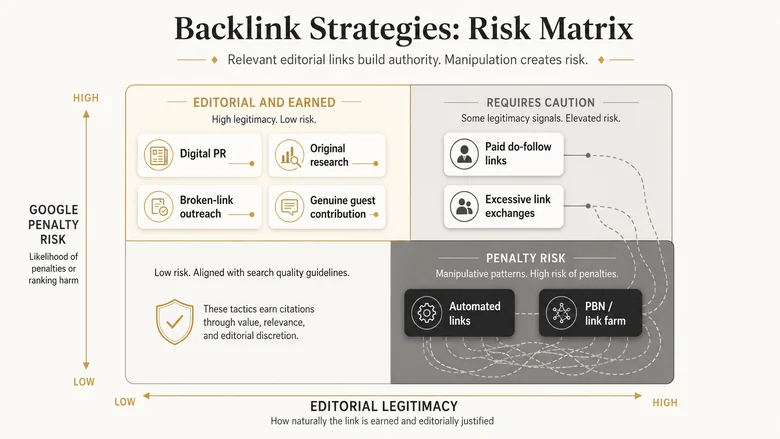
The difference between safe and risky link building usually comes down to a few clear signals. This table sorts the common tactics by which side of the line they fall on.
| Tactic | Safe or risky? | What Google sees |
|---|---|---|
| Digital PR, original research, HARO quotes | Safe | Editorial links from relevant sites, earned on merit |
| Broken link building, unlinked-mention reclamation | Safe | Contextual links a real editor approved |
| Genuine guest posts (1–2 natural links) | Safe | Topically relevant contributions, varied anchors |
| Paid do-follow links, sponsored posts without nofollow | Risky | Money exchanged for ranking credit, a policy violation |
| PBNs and link farms | High risk | Networks built only to pass PageRank |
| Automated link tools, mass directory submissions | High risk | Volume patterns no organic profile produces |
| Exact-match anchor text at scale | Risky | Over-optimization, a classic manipulation signal |
How to keep a natural link profile
Once links start arriving, the shape of the whole profile matters more than any single link. Algorithmic systems are pattern-matchers, and three patterns do most of the talking: anchor text, link velocity, and your follow-to-nofollow mix.
Diversify your anchor text
A natural profile is dominated by branded and URL anchors, such as your company name or bare domain, with partial-match and descriptive phrases mixed in and only a light sprinkling of exact-match keywords. When you control the anchor, on guest posts or profile links, default to branded or descriptive wording. Save exact-match for the rare cases where it genuinely reads well.
Watch your link velocity
Link velocity is the pace at which you gain links. Slow and steady looks earned; a sudden spike of hundreds of links looks bought and can trigger an automated review. A steady cadence of roughly five to fifteen new referring domains a month suits most sites, scaling with your size and the story you’re telling. If a piece goes viral and links surge on their own, that’s fine. The risk lives in manufactured spikes.
Keep a healthy follow/nofollow ratio
Not every link should be do-follow. Real profiles include nofollow, sponsored, and user-generated links from social platforms, forums, and directories. A profile that’s 100% do-follow looks curated rather than earned. There’s no magic ratio to hit, but a mix that includes nofollow signals reads as natural growth.
PRO TIP
Before you chase a new link, ask one question: would you still want it if Google didn’t exist? If the answer is yes because the audience is relevant and the placement sends real referral traffic, it’s almost always a safe link. If the only reason is PageRank, reconsider.
How to audit your backlink profile for risky links
You can’t disavow what you haven’t found, so auditing comes first. The goal is a clear list of links that violate Google’s policies, kept separate from the ordinary low-quality links that Google usually ignores on its own.
Start in Google Search Console’s Links report, which shows the domains linking to you straight from the source. Then pull a fuller picture with a dedicated backlink tool. Ahrefs, Semrush, and Moz each rate linking domains for spam or authority and flag the anchor-text and velocity patterns worth a closer look. If backlinks are only one part of a wider problem, run them alongside a broader technical SEO audit so you’re not cleaning links while other issues drag the site down.
As you review, a toxic link usually shows several traits at once: it sits on an irrelevant or foreign-language site with no real traffic, uses exact-match commercial anchor text, appears in a site-wide footer or blogroll, or lives on a domain that exists only to sell links. One or two odd links are normal for any site. A cluster with the same fingerprint is what you’re hunting.
Stay conservative. Most low-quality links do no harm, and Google can discount them without your help. If you’re weighing a full cleanup after a penalty and the stakes are high, it can pay to bring in an experienced B2B SEO agency rather than guessing with a tool that only rates its own metric.
How to disavow toxic links and recover from a penalty
Disavowing tells Google to ignore specific links when it assesses your site. Google’s own disavow links documentation is blunt that this is an advanced feature that can hurt your rankings if you disavow good links by mistake. Reach for it only when you have a real spam problem or an active manual action, never as routine hygiene.
IMPORTANT
The disavow tool can harm a healthy site if you submit legitimate links. Only disavow when you have a genuine pattern of spammy or manipulative links, ideally tied to a manual action. When in doubt, try to get links removed first and leave the rest alone.
Workflow · 45 min
How to audit, disavow, and recover from a link penalty
Clean up a risky backlink profile and, if a manual action has hit, get it reversed.
Export your full link profile
Download your links from Google Search Console, then supplement with a backlink tool so every referring domain sits in one list.
Flag the toxic links
Mark links on irrelevant, traffic-less, or link-selling sites, plus any cluster of exact-match anchors or site-wide footer links. Prioritize high-volume and recent sources.
Request removals first
Email the site owners and ask them to remove the link or add a nofollow attribute. Keep a record of every attempt, because it becomes evidence later.
Build the disavow file
List the links or domains you couldn’t remove in a plain-text UTF-8 file, one entry per line, using
domain:example.comto disavow a whole site and#for comments.Upload it to the disavow tool
Submit the file in Google’s disavow tool for your property. It replaces any previous file, so always upload the complete list, not just new additions.
File a reconsideration request
For a manual action, request a review in Search Console and document what you removed and disavowed. Reviews take days to weeks; algorithmic recovery instead resolves on its own once Google recrawls.
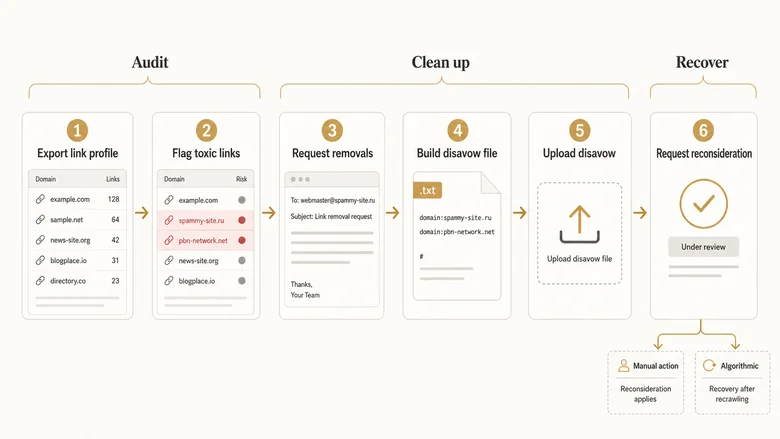
Recovery isn’t instant. A revoked manual action can restore rankings within a few weeks of a successful review. Algorithmic recovery is quieter: once Google recrawls and re-evaluates the cleaned-up profile, the drag lifts gradually. Either way, the sites that bounce back are the ones that fix the root cause instead of chasing the symptom.
Are backlinks still worth chasing in 2026?
Short answer: yes, though the bar is higher. Links are still one of Google’s strongest ranking signals, and they increasingly shape which sources AI engines cite in their answers. The same Backlinko analysis found that around 95% of pages have zero backlinks, which is exactly why the handful with several quality referring domains stand out. As search results fill with AI Overviews, being the linked, cited source matters more, not less.
What’s changed is the tolerance for shortcuts. Google’s detection improves every year, and the cost of a manipulative profile now outweighs any short-term lift. The winning move in 2026 is the boring one: earn fewer, better links from places that would vouch for you anyway.
Frequently Asked Questions
Avoid the tactics Google names as link spam: buying do-follow links, PBNs, automated link tools, large-scale link exchanges, and exact-match anchors at scale. Earn editorial links instead, keep a natural profile, and audit your backlinks periodically so problems are caught before they become penalties.
Yes. Backlinks remain one of Google’s strongest ranking signals and now also influence which sources AI engines cite. With around 95% of pages holding zero backlinks, a few quality referring domains still create a real competitive edge, as long as they’re earned rather than bought.
The best free links are earned: answer journalist requests through HARO, reclaim unlinked brand mentions, pitch original data or research, and run broken-link outreach. Each costs time rather than money and produces the contextual, editorial links Google is happy to count.
A toxic backlink is one built to manipulate rankings rather than to help readers. Common signs include irrelevant or traffic-less linking sites, exact-match commercial anchors, site-wide footer links, and domains that exist only to sell links. Clusters of these are what can draw a penalty.
For a manual action, rankings can return within a few weeks of a successful reconsideration request. Algorithmic recovery is slower and quieter: it happens gradually after Google recrawls and re-evaluates your cleaned-up profile, often over several weeks to a few months.