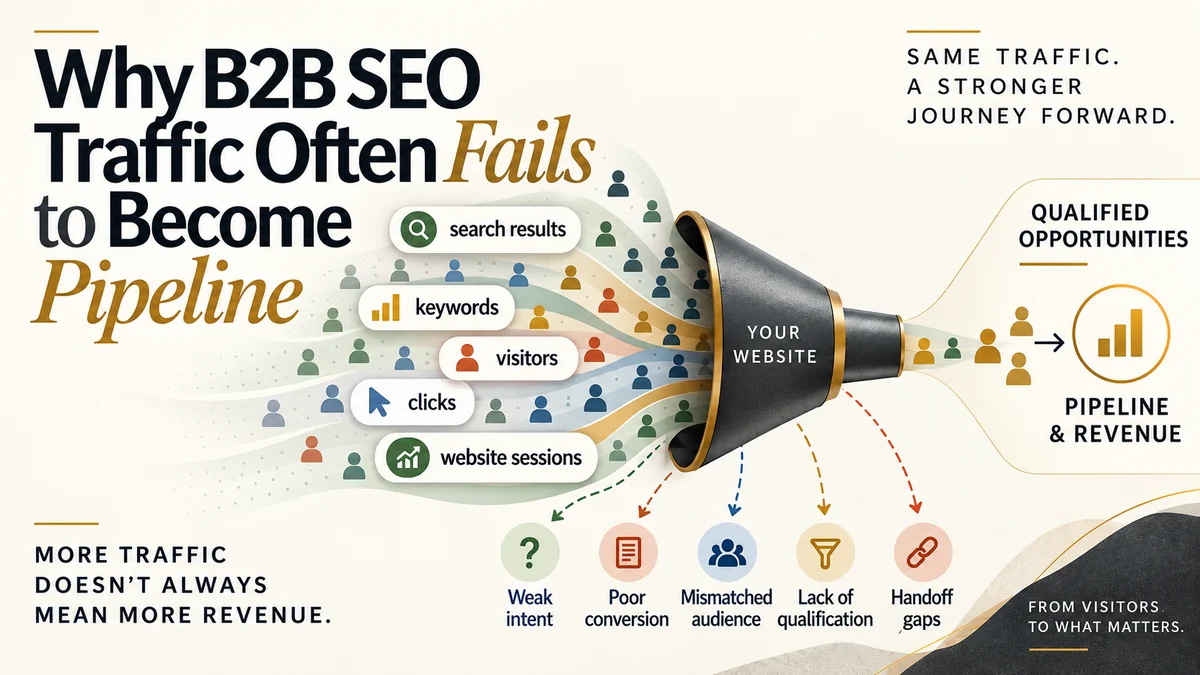
A B2B site can be visibly “doing better” in search while the business sees almost no change in qualified pipeline. Impressions rise. Clicks rise. More keywords enter the top 20. Yet sales still says the leads are weak, sporadic, or irrelevant. In practice, that usually means the SEO program is measuring acquisition in isolation while the buying journey is breaking somewhere between the query, the landing page, the inquiry path, and the sales handoff.
I see this most often on export-oriented B2B websites where SEO, website structure, and inquiry generation are handled as separate workstreams. The fix is not automatically “publish more.” The better first move is to diagnose which layer is failing and only then decide whether the next investment belongs in content, UX, proof, lead capture, or measurement.
1. Start With the Query-to-Page Match
The first diagnostic question is simple: are the queries bringing the right kind of visitor to the right kind of page? Google Search Console can show which queries and pages are earning impressions and clicks, but it cannot tell you whether those clicks represent real buying intent. That distinction has to be made manually.
Use the Search Console Performance report to group traffic by page type and intent. For a B2B site, I usually separate at least four intent groups: educational research, problem diagnosis, supplier evaluation, and direct product/service inquiry. If a service page is mainly attracting broad informational searches, the traffic can look healthy while the commercial fit is poor.
A common failure mode is that a blog article answers an early-stage question extremely well, ranks, and accumulates traffic, but has no meaningful bridge to a product, capability, comparison, or inquiry page. The content succeeds as a search result and fails as part of the buyer journey.
2. Separate Acquisition Problems From Messaging Problems
When traffic does not convert, teams often blame “low-intent keywords.” Sometimes that is correct. But sometimes the visitor is qualified and the page simply does not give them enough reason to continue.
On B2B export websites, weak messaging usually shows up in one of four ways:
- The page explains what the company sells but not which buyer or use case it fits.
- The page uses broad claims such as “high quality” or “professional service” instead of decision-making evidence.
- The page hides important commercial questions such as MOQ, customization, certifications, lead times, integration requirements, or process.
- The page has no clear next step between “learn more” and a high-commitment contact form.
This is why I prefer to audit the landing page before rewriting the keyword map. If a qualified buyer lands on the page, can they quickly understand whether the offer is relevant, credible, and worth discussing? If not, more rankings may simply increase the volume of the same failure.
3. Audit Trust Signals as Part of SEO
B2B conversion is unusually sensitive to perceived risk. The buyer may be evaluating a supplier, agency, or technical partner whose work affects revenue, production, compliance, or long-term infrastructure. That means trust is not a separate branding problem; it is part of whether organic traffic can become pipeline.
Useful trust signals are specific rather than decorative. Examples include process transparency, real team or company information, certifications where relevant, implementation steps, technical specifications, delivery expectations, warranties, client evidence, and clear explanations of what happens after an inquiry.
For service businesses, I also look for whether the site demonstrates how decisions are made. A page that explains a diagnostic process, what information is needed, and what the client receives often reduces uncertainty more effectively than a page full of superlatives.
4. Inspect the Conversion Path, Not Just the CTA
A call-to-action button can exist and still be functionally invisible. The issue is not just color or placement. The deeper question is whether the next step matches the visitor’s stage.
For example, an early-stage visitor reading a technical guide may not be ready to “Request a Quote,” but they may be willing to review a checklist, compare approaches, or move to a detailed capability page. A supplier-comparison visitor may be ready for a consultation but still needs to understand what information to prepare.
I normally map conversion paths in three layers:
- Low-commitment: related guide, checklist, comparison, technical FAQ.
- Mid-commitment: capability page, process page, case evidence, solution comparison.
- High-commitment: consultation, RFQ, audit request, demo, or contact form.
If every page pushes the same high-commitment CTA, the site may be asking for the sale before the visitor has enough context to act.
5. Treat Form Friction as a Revenue Problem
Forms are often optimized last, even though they sit at the exact point where marketing becomes pipeline. On B2B sites, forms tend to fail in two opposite ways. Some ask for so much information that a first-time visitor abandons. Others ask for so little that sales receives vague leads that require several rounds of clarification.
The right balance depends on the buying process. I prefer to ask only for the information needed to route and qualify the inquiry, then collect deeper details in the follow-up. For an export-oriented manufacturer, that might be product/application, target market, estimated volume, and contact details. For a service firm, it might be website URL, objective, current challenge, and timeline.
The confirmation experience matters too. A vague “Thank you” message wastes an opportunity. Tell the prospect what happens next, when they should expect a response, and what information would make the next conversation more productive.
6. Connect Search Data to Lead Quality
The biggest measurement gap appears when SEO reporting stops at traffic and lead reporting starts at the CRM. If the two systems never meet, the team cannot answer a basic question: which queries, pages, and content themes are producing qualified opportunities rather than just form submissions?
You do not need perfect attribution to improve this. A practical first version can be built with a small set of fields: landing page, inquiry source, service/product interest, qualification status, and sales outcome. The goal is to create enough feedback to detect patterns.
For example, if a page generates many inquiries but most are outside the target market, the issue may be targeting or messaging. If another page generates fewer leads but a much higher share becomes serious conversations, that page may deserve more SEO support even if its raw traffic is lower.
7. Diagnose the Bottleneck Before Publishing More
Before approving another content batch, I use a simple sequence:
- Query fit: Are the ranking queries aligned with a real buyer problem?
- Landing-page fit: Does the page match the intent implied by those queries?
- Trust: Does the page reduce the buyer’s perceived risk?
- Path: Is there a logical next step for this stage of the journey?
- Lead capture: Is the form balanced between friction and qualification?
- Handoff: Can marketing see whether leads become qualified sales conversations?
Only after this sequence do I decide whether the solution is more content. Sometimes the answer is yes: the site has a genuine topic gap or lacks bottom-of-funnel coverage. But often the fastest improvement comes from repairing existing pages and paths rather than adding another 20 blog posts.
8. A Practical Page-Level Diagnostic
For one high-traffic page, take the last 90 days and review it as a mini funnel. Start with the queries that bring clicks. Read the page as if you were the target buyer. Then inspect the next-step links, the commercial page they point to, and the inquiry mechanism. Finally, compare the resulting leads with sales feedback.
A useful worksheet has six columns: query theme, intent, landing page, expected next action, actual next action, and lead quality. The value of the exercise is not statistical sophistication. It is forcing the team to connect search behavior with the commercial journey.
This is also the logic behind our own B2B traffic-to-inquiry diagnostic: the objective is to find the break between visibility and qualified demand before investing in more acquisition.
9. What to Fix First
Prioritization matters because B2B websites often have many simultaneous issues. I rank fixes using two questions: how close is this page to revenue, and how certain are we that the issue is real?
- High commercial intent + clear conversion obstacle: fix immediately.
- High traffic + weak path to commercial pages: improve internal journey and messaging.
- Low traffic + high strategic importance: improve targeting and content depth.
- High traffic + low commercial relevance: keep only if it supports authority or assists another journey; otherwise reduce priority.
This keeps teams from spending weeks polishing low-impact technical warnings while obvious pipeline blockers remain untouched.
Conclusion: SEO Is a Pipeline System, Not a Traffic Channel
B2B SEO works best when search visibility, website structure, proof, conversion design, and sales feedback are treated as one system. Traffic is useful, but it is only the first observable step. The business result depends on what happens after the click.
When organic growth stops translating into pipeline, the most productive question is not “How do we get more traffic?” It is “Where does the right buyer stop moving forward?” Answer that question first, and the next SEO investment becomes much easier to justify.
Author bio: Lifeng works with Zheshan Tech on international SEO, WordPress websites, and B2B demand generation for export-focused companies. His work focuses on connecting search visibility with website structure, buyer journeys, inquiry quality, and manual outreach.
Disclosure: The author works with Zheshan Tech. The article reflects recurring patterns observed in B2B website and SEO work; no client-specific confidential data is included.