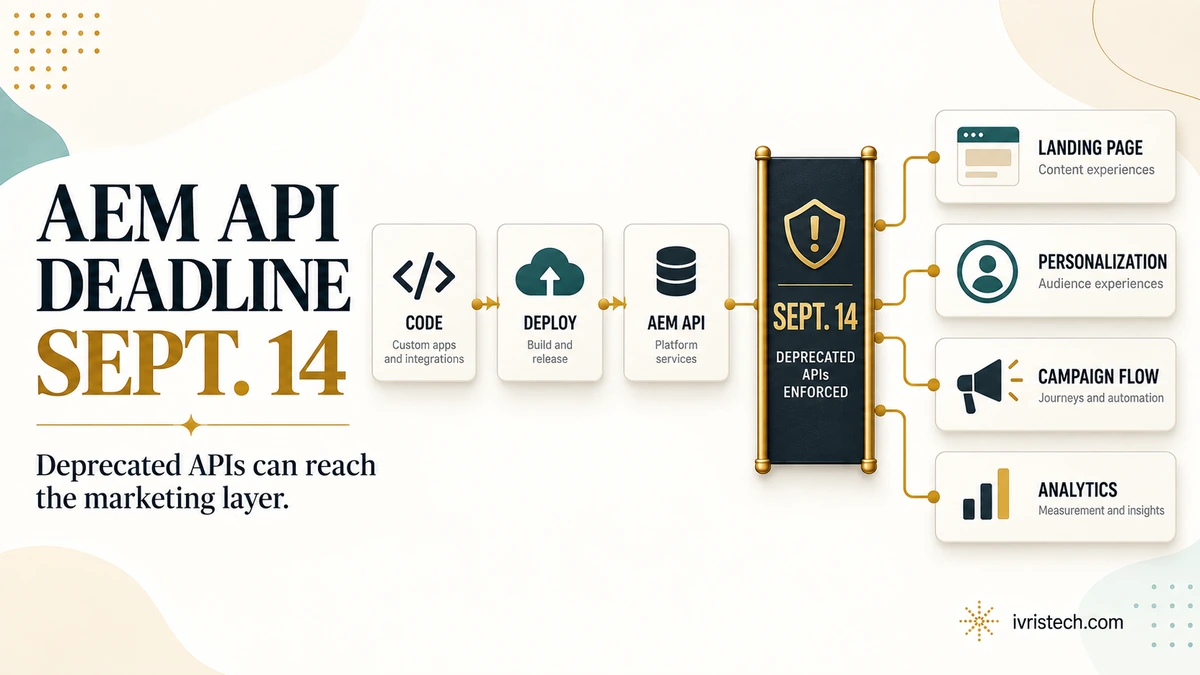
Adobe’s September 14 enforcement date for deprecated Java APIs in Experience Manager as a Cloud Service is now in effect. Under Adobe’s current deprecation notice, an AEM Cloud environment that is still using the targeted API cohort will no longer receive critical Adobe release updates and falls outside Adobe’s standard commitments around performance and availability.
This is the last step in an escalation already affecting deployments. Cloud Manager began pausing affected pipelines at Code Quality on February 26 and failing them on April 14. Adobe’s September 11 release notes keep September 14 as the current date and say affected environments will miss new features and bug fixes; Adobe also warns of greater stability, uptime, and security risk.
For B2B marketing teams, the important distinction is between a technical warning and a delivery dependency. The policy does not say every AEM site stops working today. But when a campaign, landing page, form integration, personalization component, or conversion fix requires code to move through a blocked pipeline, Java technical debt becomes marketing infrastructure debt.
Direct answer — what changes for AEM on September 14, 2026?
Starting September 14, affected AEM as a Cloud Service environments still using the deprecated Java API cohort targeted for February 26, 2026 removal stop receiving critical Adobe release updates and are no longer covered by Adobe’s standard performance and availability commitments. This does not apply to every AEM environment. Later-dated deprecations are not part of the current blocking wave.
Key Takeaways
- Since April 14, Cloud Manager pipelines using the targeted deprecated APIs have failed at Code Quality and blocked deployments.
- From September 14, affected environments stop receiving critical Adobe release updates and are outside Adobe’s standard performance and availability commitments.
- Adobe’s current blocking cohort is the set with a target removal date on or before February 26, 2026; later-dated deprecations do not currently block updates.
- Adobe says teams can restore release updates after remediation by successfully running a fullstack pipeline; the update should then be applied within a few days.
What Changes on September 14
The deadline is not the first enforcement point. Adobe began sending Actions Center notification emails on January 26. On February 26, affected Cloud Manager pipelines paused at Code Quality, with certain roles able to override the issue. Since April 14, the same usage has caused Code Quality failure and blocked deployment. September 14 adds the platform-update and service-commitment consequence on top of that existing deployment block.
Adobe’s current release notes group the affected Java API surface into 14 package families: org.apache.sling.commons.auth, org.apache.felix.webconsole, org.eclipse.jetty, com.mongodb, org.apache.abdera, org.apache.felix.http.whiteboard, org.apache.cocoon.xml, ch.qos.logback, org.slf4j.spi, org.slf4j.event, org.apache.log4j, com.google.common, com.drew, and org.apache.jackrabbit.oak.plugins.memory. The detailed deprecation table expands these into individual packages and classes.
Why This Becomes Marketing Infrastructure Debt
A failed Code Quality step becomes a marketing problem when a campaign needs a code-dependent change. A landing-page template, form or analytics integration, custom component, personalization release, or conversion-path repair can depend on the same deployment route Adobe has already blocked for affected codebases.
Content authors may still make ordinary changes that do not require code deployment. Adobe is not announcing a universal shutdown. The narrower risk is that a functioning site can coexist with a blocked code-release path and, from today, loss of the Adobe release stream described in the notice.
Our read: the hidden failure is ownership. If deprecated-API warnings live only in an engineering backlog, marketing can discover the constraint when a launch is already committed. AEM owners should expose pipeline health as a release dependency for marketing operations, with one named engineering owner for remediation and one marketing owner for campaign-impact decisions.
The Scope Is Narrower Than the Headline Sounds
A September 8 Adobe support article makes the boundary explicit: only deprecated APIs with a target removal date on or before February 26, 2026 currently block Cloud Manager deployments. APIs with later removal dates are flagged for future remediation but do not currently block updates.
An AEM Analyzer warning therefore does not automatically put an environment in the September 14 cohort. Adobe notes that some later-dated warnings can come from out-of-the-box libraries or Core Components. Trace each warning to its source and target date before treating it as a current blocker.
What AEM Teams Should Do Now
Adobe’s remediation tutorial recommends the latest AEM Analyser Maven Plugin and AEM SDK, then mvn clean verify -pl all to surface warnings. Prioritize the February 26, 2026-or-earlier cohort and trace each finding to custom code, a dependency, or an Adobe-managed component.
- Engineering: replace deprecated public APIs, refactor deprecated packages or classes, and upgrade third-party libraries where required. If ACS AEM Commons is involved, Adobe’s deprecation guidance says to use at least version 6.17.2 and the Cloud Service
cloudclassifier. - Marketing operations: map near-term campaigns to AEM dependencies. Separate authoring-only changes from work that needs component, integration, dispatcher, or other code deployment.
- Release owner: rerun Cloud Manager and verify the Code Quality step is clean. Adobe says a successful fullstack pipeline is required to resume release updates, which should then be applied within a few days.
- Launch governance: put the environment’s update and pipeline status into campaign go/no-go reviews until remediation is complete.
The practical lesson is not that marketers need to become Java developers. It is that teams running revenue-critical experiences on AEM need a shared view of platform debt before that debt reaches a launch date.
Frequently Asked Questions
No. Adobe’s current enforcement applies to AEM as a Cloud Service environments that still use the deprecated API cohort with a target removal date on or before February 26, 2026. Later-dated deprecated APIs can still produce warnings, but Adobe says they do not currently block environment updates.
Its Cloud Manager deployment pipeline is already blocked at Code Quality, and from September 14 Adobe says the environment will not receive critical release updates or its standard performance and availability commitments. Adobe also says new features and bug fixes stop, while stability and security exposure may worsen.
Adobe’s current release notes list 14 affected package families today, including Sling Commons Auth, Felix Web Console, Jetty, MongoDB, Abdera, Felix HTTP Whiteboard, Cocoon XML, Logback, SLF4J SPI and Event, Log4j, Guava, Drew metadata packages, and Jackrabbit Oak memory APIs.
Identify and remove the blocking deprecated API usage, verify the project with the AEM Analyser and current SDK, then successfully execute a fullstack Cloud Manager pipeline. Adobe’s deprecation guidance says release updates resume after that successful pipeline, with the update applied within a few days.