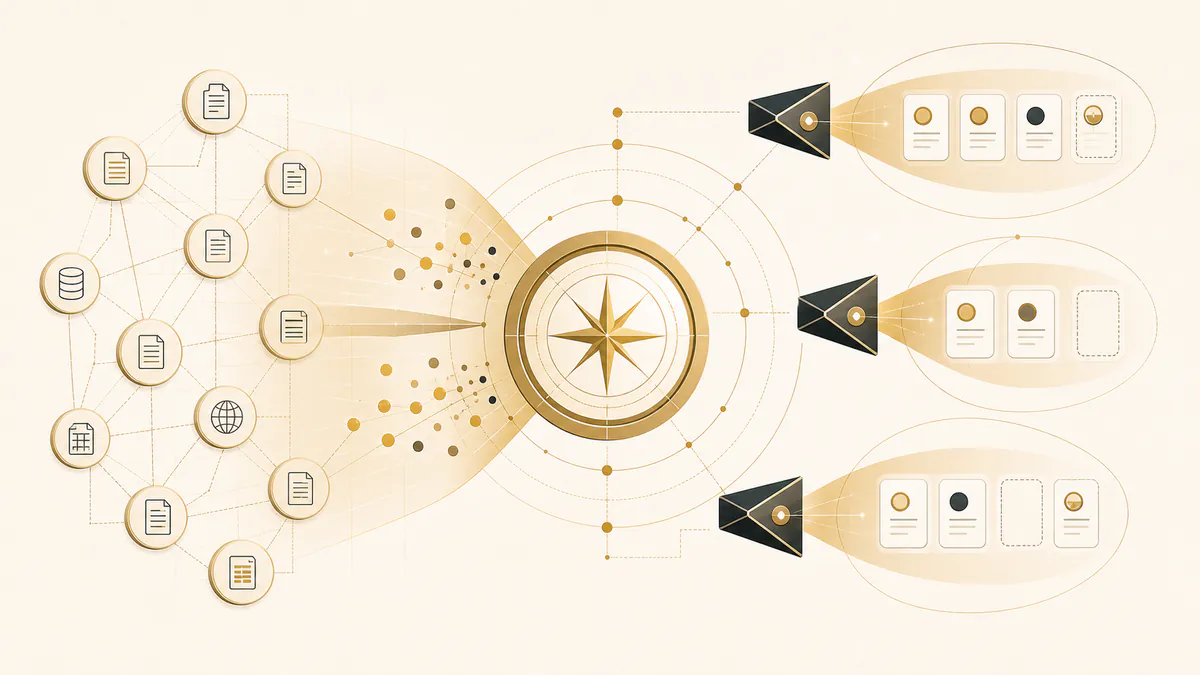
Two of the most widely repeated statistics in B2B AI search say opposite things, and both are roughly 85%.
Yext measured 6.8 million AI citations and reported that 86% come from brand-managed sources. Nobori analysed more than 200,000 commercial prompt runs and reported that 85% of AI visibility does not come from your own website. Same web, same year, same rough number, contradictory conclusions.
Neither is wrong. They count a brand’s Yelp listing or G2 profile differently: one calls it brand-managed because the brand controls what it says, the other calls it third-party because the brand does not own the domain. That single classification choice flips the headline.
This page is the working record of which B2B AI search citation statistics survive that kind of scrutiny, and which ones you should stop repeating. Every figure below was re-checked against its original source on 24 July 2026.
Direct answer — do third-party sites dominate B2B AI search citations?
It depends on the platform, the prompt and the definition. In one same-day study of 75 B2B SaaS prompts, third-party sources supplied 79.0% of product-query citations on Perplexity, Gemini and Claude, while ChatGPT GPT-5.4 pulled 74.6% of the same citations from vendor-owned sites. Across 57.2 million citations, brand-owned domains supplied 77.6% of responses to branded queries but only 2.2% of citations to unbranded ones.
Key Takeaways
- There is no universal source hierarchy. Ahrefs found roughly 12% of cited sources match across ChatGPT, Perplexity and Google AI features; Yext put cross-engine domain overlap at about 11%.
- The single biggest swing factor is whether the prompt names your brand. Brand-owned share moves from 77.6% of responses to 2.2% of citations on the same dataset.
- The famous “85%” has at least three separate origins with different denominators, and the most-quoted attribution does not carry the figure on its own published page.
- Domain rankings expire in weeks. Reddit went from about 60% of tracked ChatGPT responses to about 10% in six weeks.
- Ranking does not deliver citation. Only 12% of AI-cited URLs also rank in Google’s top 10, and the median enterprise B2B brand appears in 3.0% of the AI Overviews it is relevant to.
What counts as an AI search citation?
An AI search citation is a visible reference that connects a generated answer to a source, shown as an inline link, a numbered marker, a source card or an entry in a sources panel. Anything that is not visibly attached to the answer is a different measurement.
Most disagreement between published studies traces back to this definition rather than to the underlying behaviour. Six outcomes get reported under the same vocabulary, and they are not interchangeable.
| Term | What it measures | Common denominator | What it does not tell you |
|---|---|---|---|
| Citation | A visible source reference attached to an answer | Citations, unique URLs or unique domains | Whether the source influenced the answer |
| Brand mention | A company named in the text, linked or not | Responses containing the name | Whether any source was credited |
| Answer inclusion | Presence of a company or product in the response | Eligible responses | Whether the brand’s own site was used |
| Retrieval | Pages fetched during answer generation | Fetched pages | Whether anything was displayed |
| Citation absorption | How much a cited page contributed to the answer | Citation-level feature records | How prominent the citation looked |
| Referral traffic | Sessions arriving from an AI platform | Sessions, under an analytics rule | How often you were cited without a click |
Mention share is not citation share
Ahrefs labels its domain metric “mention share” and defines it as a domain’s citations as a percentage of the summed citations of the top sources. That denominator is the top 50 domains, not the whole web, so a 16.7% mention share for Reddit is not 16.7% of everything ChatGPT cites. Reporting it as citation share inflates it.
Citation volume is not evidence contribution
Research separating citation selection from citation absorption found that Perplexity and Google showed greater citation breadth while ChatGPT showed fewer citations with higher average influence from the pages it fetched. Counting links tells you how many sources were shown. It does not tell you which ones carried the answer.
Citations and traffic are separate metrics
Being cited and being clicked are measured in different systems, under different rules, and Google’s own channel definitions split AI Assistant referrals from AI Overviews traffic that stays inside Organic Search. Any programme that reports one number for both is measuring something it cannot name, which is the same failure mode that makes most B2B attribution models quietly disagree with each other.
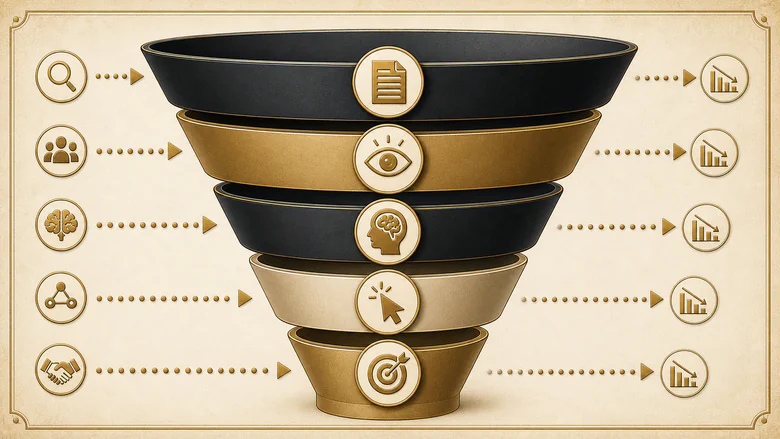
The 2026 B2B AI citation evidence ledger
The ledger below records each widely circulated claim about B2B AI citations, the source it actually traces to, the denominator behind it, and whether it is safe to quote. It is the part of this page built to be reused.
Every entry was re-verified against its original source on 24 July 2026. Where a figure could not be traced to an inspectable method, it is marked rather than dropped, because knowing a number is untraceable is more useful than never seeing it. That is the same source-revalidation discipline behind our audit of how quickly published AI pricing claims go out of date.
| Claim as circulated | Traces to | Denominator | Collected | Verdict |
|---|---|---|---|---|
| 79.0% of product-query citations are third-party | BeVisibleIQ, 28 Mar 2026 | Citations from Perplexity, Gemini, Claude on 75 B2B SaaS prompts | Single day, disclosed | Usable as stated |
| ChatGPT pulls 74.6% of product-query citations from vendor sites | BeVisibleIQ, 28 Mar 2026 | ChatGPT GPT-5.4 citations, same prompt set | Single day, disclosed | Usable as stated |
| Brand-owned domains supply 10.15% of citations | Foundation × AirOps | 57.2M citations, 50 brands, 7 verticals | Dec 2025 – Feb 2026 | Usable as stated |
| 86% of AI citations come from brand-managed sources | Yext | 6.8M citations, 4 consumer-facing industries | 1 Jul – 31 Aug 2025 | Usable with qualification: brand-managed includes listings on third-party domains, and the population is local and consumer, not B2B SaaS |
| Median enterprise B2B brand is cited in 3.0% of relevant AI Overviews | Walker Sands | 828 companies, 45M+ keywords, Google AI Overviews only | Not disclosed | Usable with qualification: one surface only, collection window undisclosed, full report gated |
| LinkedIn is the second most-cited source in AI answers | Meltwater × LinkedIn, May 2026 | 9.5M citations, 6 models; category count published as 14, reported elsewhere as 16 | Four weeks, dates undisclosed | Usable with qualification: rank 2 equals 0.53% of citations, and the study was co-produced with LinkedIn |
| Earned media distribution produces a 239% median citation lift | Stacker × Scrunch, 16 Mar 2026 | 87 stories, 30 clients, 2,600+ prompts, 8 platforms | 30 days, disclosed | Usable as stated: one of the few designs with a comparison condition and a reported p-value |
| Reddit fell from about 60% to about 10% of ChatGPT responses | Semrush, 14 Jul – 12 Oct 2025 | Response prevalence across 230,000+ prompts | 13 weeks, disclosed | Usable with qualification: response prevalence, not citation share |
| Only 12% of AI-cited URLs rank in Google’s top 10 | Ahrefs | 15,000 long-tail queries, 4 assistants | Not disclosed | Usable with qualification: long-tail and multilingual, not a B2B sample |
| 85% of B2B AI citations come from review sites, not brand websites | Attributed to Rampiq via trade coverage | Not disclosed | Not disclosed | Do not repeat as sourced: the figure does not appear on Rampiq’s own published page, which reports about 82% for a narrower branded-opinion query set |
| 85% of AI visibility does not come from your website | Nobori, 15 Apr 2026, internal analysis | Not stated; 200,000+ prompt runs | Not disclosed | Context only: no dates, model versions, geography or public dataset |
| 96% of B2B companies are effectively invisible in AI discovery | Published as a “2026 composite” | None | None | Do not repeat: no underlying study exists, yet Google’s AI Overview now presents it as fact |
| Trustpilot is the fifth most-cited site on ChatGPT | Reported for January 2026; attributed to Peec AI in secondary coverage | Not disclosed | January 2026 | Do not repeat: Peec’s published ChatGPT top five is Wikipedia, Reddit, Forbes and TechRadar, and by July 2026 Ahrefs placed Trustpilot 35th at 1.0% mention share |
DOWNLOAD THE EVIDENCE LEDGER
Audit the claims before you cite them. Use the editable evidence ledger workbook (XLSX) or the source data (CSV). Both are free and ungated.
How the verdicts are assigned
Each entry carries a transparency score built from six binary disclosures. The score measures how reproducible the reporting is, not whether the finding is true or representative.
Transparency = Sample + Population + Data period + Metric definition + Method + Accessible primary sourceA claim is marked usable as stated when its platform surface, denominator and collection window are all public. It becomes usable with qualification when one of those is missing or when the population differs materially from B2B evaluation queries. Context only covers claims with a plausible method that cannot be inspected. Do not repeat is reserved for claims with no traceable original, or where the named source does not support the figure.
Applying that last verdict to our own archive is part of the method rather than an exception to it. Our earlier news piece on Trustpilot’s ChatGPT visibility attributed the fifth-place ranking to Peec AI. Peec’s published ChatGPT list does not contain Trustpilot, and the correction is queued. Editorial consistency has to start at home, which is the same reason we published a public correction to our own form-capture methodology when the original test proved unsound.
Do third-party sites dominate B2B AI citations?
Third-party sources lead in most published B2B evaluation samples, but the margin is conditional on platform and prompt, and at least one major platform reverses the pattern entirely.
The ChatGPT exception
BeVisibleIQ ran 75 B2B SaaS buyer prompts across four platforms on a single day, 28 March 2026, using named model versions and a disclosed classification rule. Across Perplexity sonar-pro, Gemini 2.5-flash and Claude haiku-4.5, 79.0% of product-query citations pointed to third-party domains. On ChatGPT GPT-5.4, 74.6% of the same citations pointed to vendor-owned sites, which puts its third-party share at 25.4%.
Same prompts, same day, same method. The 54-point gap is the platform, not the market.
The branded and unbranded split is larger still
Foundation and AirOps analysed 57.2 million citations across 5.1 million AI responses between December 2025 and February 2026. Brand-owned domains took 10.15% of citations overall. Split by prompt type, brand content appeared in 77.6% of responses to branded queries and supplied just 2.2% of citations to category-level queries.
That is the widest documented swing in the public record, and it is driven by one variable: whether the buyer typed your name. Anyone quoting a single third-party percentage without stating which of those two situations it describes is quoting a number that moves by a factor of thirty.
IMPORTANT
No published study supports a universal third-party percentage for B2B AI search. The defensible range across compatible samples runs from 25.4% on one platform to 93.7% for decision-stage prompts on three others. Quote the range with its conditions, or quote nothing.
Where the 85% figure actually comes from
Three different organisations publish a number near 85%, and they do not measure the same thing. Trade coverage attributes 85% of broad-category B2B citations to Rampiq, but Rampiq’s own published analysis reports roughly 82% third-party for a narrower set of branded opinion queries and does not carry the 85% figure. Nobori reports 85% of AI visibility originating off your website, from an internal analysis with no published dates or model versions. Foundation’s measured equivalent is 89.85%, and Yext’s mirror-image measure is 86% in the opposite direction.
The lesson is not that any of these teams did poor work. It is that a memorable round number attracts claims that were never equivalent, which is exactly the failure the wider discipline of evidence-led organic strategy exists to prevent.
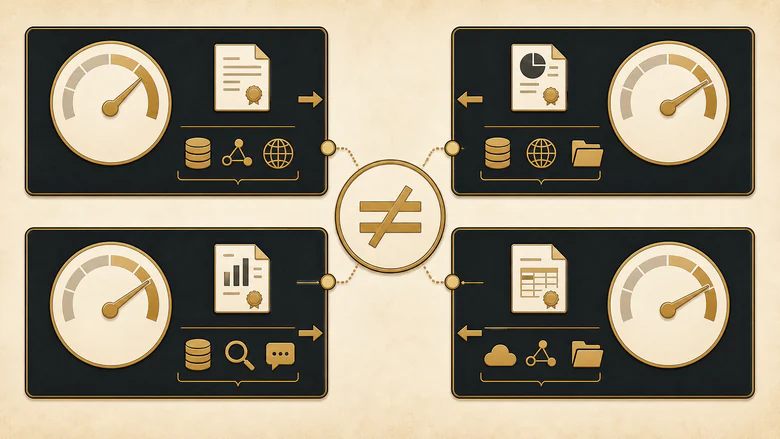
Which source types appear in B2B AI answers
Source type is two questions, not one: who controls the content, and what job the content does. Collapsing both into “first party versus third party” is what produced the contradiction at the top of this page.
| Source | Control relationship | Content function |
|---|---|---|
| Company product or pricing page | Brand-owned | Product facts |
| Company G2 or Yelp profile | Brand-managed third-party | Reviews and comparison |
| Independent G2 review | Platform-governed contribution | Reviews |
| Individual LinkedIn post | Platform-governed contribution | Professional network |
| Reddit thread | Platform-governed contribution | Forum and community |
| Trade publication feature | Earned editorial | Editorial publishing |
| Competitor documentation | Uncontrolled third-party | Product facts |
| Peer-reviewed paper | Institutional | Primary evidence |
Read Yext’s 86% through this grid and the conflict dissolves. Yext counts first-party websites at 44% and listings at 42%; listings sit on domains the brand does not own but does control. Foundation counts the same listings as external. Both are accurate. Only one of them is what a marketer means when they ask whether their own site gets cited.
Reviews, communities and professional networks
Reddit supplied 20.8% of third-party citations in Foundation’s B2B dataset, rising to 30.9% on unbranded prompts, with YouTube at 13%, LinkedIn at 11%, vendor help and support documentation at 8% and G2 at 4%. Meltwater’s separate analysis of 9.5 million citations across six models put LinkedIn second overall at 0.53% of citations, behind YouTube at 1.52%, with 75% of cited LinkedIn material coming from individual member posts rather than company pages. The category count is worth checking before you quote it: the published article tabulates 14 business categories while secondary coverage reports 16.
Second place at 0.53% is worth sitting with. Rank and share answer different questions, and a source can lead its category while accounting for a very small slice of everything cited.
Earned editorial is the one lever with a controlled test behind it
Nearly all AI citation research is observational, which is why causal language keeps getting attached to findings that cannot support it. Stacker and Scrunch ran one of the few designs with a comparison condition: 87 stories across 30 clients, eight platforms, over 30 days. Distributed versions produced a median 239% citation lift against brand-owned content alone. The accompanying research release adds the sample and significance detail: 2,600+ prompts, and 97% of distributed stories earning at least one citation versus 82% for owned content at p < 0.006.
That result gives earned distribution a stronger evidentiary footing than most tactics in circulation, and it puts a measurable return on the kind of third-party placement work that most B2B teams still treat as a link-count exercise.
How citation patterns differ by platform and product mode
Platform is not one variable. A provider name without its product surface and model version describes almost nothing, because the same company ships engines that cite differently.
| Finding | Source | What it establishes |
|---|---|---|
| ChatGPT Search leads with Wikipedia; Perplexity leads with YouTube | Conductor, Sept 2025 – Mar 2026 | Product surface changes the leading domain |
| ChatGPT and ChatGPT Search tracked as separate engines | Conductor, 1,056 data points | Search activation is a distinct measurement condition |
| About 11% of cited domains appear across multiple engines | Yext, 17.2M citations | 89% of cited domains are platform-specific |
| About 12% of cited sources match across ChatGPT, Perplexity and Google AI | Ahrefs, 15,000 queries | Independent confirmation of platform divergence |
| Gemini: 51% brand-owned plus 42% listings; Claude: 81% owned plus 15% reviews | Yext, Jan 2026 | Source mix is engine-specific, not market-wide |
Two vendors with different methods, different samples and competing commercial interests landed within a point of each other on cross-engine overlap. That is about as close to independent replication as this field currently gets.
Google’s surfaces need separating too. AI Overviews and AI Mode are different products with different behaviour, and the practical implications for on-page structure are covered in our guide to building pages that Google’s AI features can actually extract. The relationship between classic rankings and AI citation is looser than most teams assume, a gap we measured separately when comparing AI citations against Google top-10 positions for B2B queries.
How query intent changes the source mix
Intent moves the source mix more predictably than any other variable except brand naming. Within one compatible three-platform sample, third-party share climbs steadily as the buyer gets closer to a decision.
| Prompt class | Third-party share | First-party share |
|---|---|---|
| “Best X” recommendation prompts | 65.9% | 34.1% |
| Head-to-head comparison prompts | 81.7% | 18.3% |
| Decision and pricing prompts | 93.7% | 6.3% |
Those three rows come from the same prompts, the same day and the same three engines, which is what makes them comparable. Read across studies instead and the comparison breaks immediately.
The operational reading is narrow but useful: the closer a prompt sits to a purchase decision, the less your own site is doing the talking. Whether that is worth acting on depends on which prompts your buyers actually run, which is a monitoring question rather than a content one, and the tooling for it is covered in our review of the GEO platforms that track citations at prompt level.
Why AI citation studies disagree, and how fast they expire
Two studies can both be correct and still produce numbers that must never be averaged. Compatibility is a property of the measurement conditions, not of the topic. That cuts the other way too, and usefully: what your own logs record is a census rather than a sample, measured under conditions you set and can restate, which is why first-party data sidesteps the comparability problem that makes published citation studies so hard to stack.
The six-field compatibility test
Before comparing any two AI citation figures, check that both disclose the same six fields. Score one point per aligned field.
- Platform surface. ChatGPT default, ChatGPT Search, AI Overviews, AI Mode, Perplexity web, Perplexity API. A provider name alone is not enough.
- Query population. B2B product evaluation, B2B informational, local consumer, broad informational, news.
- Run conditions. Interface or API, logged-in state, whether search was forced, geography, number of repeated runs.
- Sampling and denominator. Prompts, responses, citations, unique URLs, unique domains, or responses containing a domain.
- Time. Exact start and end dates, plus the model or product version in force.
- Visibility outcome. Retrieval, visible citation, mention, inclusion rate, absorption or referral.
Six of six is directly comparable. Five is comparable with one stated qualification. Three or four is directional. Below that, the figures belong in separate sentences.
Three hard stops that no score overrides
A high total cannot rescue a comparison that fails on visibility outcome, denominator or platform surface. Those three are disqualifying on their own. A citation count and a response-prevalence percentage describe different things no matter how well documented both are, which is precisely why the Reddit figures below cannot be set against Foundation’s source mix.
Domain rankings expire faster than the articles quoting them
Semrush checked more than 230,000 prompts weekly for 13 weeks and watched Reddit fall from close to 60% of tracked ChatGPT responses in early August 2025 to around 10% by mid-September, with Wikipedia dropping from roughly 55% to under 20% over the same window.
Trustpilot makes the point more sharply. Reported as the fifth most-cited domain on ChatGPT for January 2026, it sat at 35th with a 1.0% mention share in Ahrefs’ July 2026 ranking. Six months, thirty places. Any page presenting a domain leaderboard without a collection date is publishing a photograph and calling it a map.
A workable rule: treat terminology and taxonomy as stable for a year, methodology principles for six months, intent and vertical patterns for a quarter, source-type shares for 90 days, and individual domain rankings for 30. Teams that outsource this monitoring should ask any prospective LLM visibility agency which of those five tiers they actually re-measure.
What B2B marketers can safely conclude
The safe conclusions from this evidence base are narrower than most published advice, and they are mostly about measurement design rather than tactics.
- Measure each platform separately, at the product-surface level, and record the model version alongside the result.
- Split your prompt set into branded and unbranded before reading any citation number, because that split moves brand-owned share by more than an order of magnitude.
- Track citation, mention, referral traffic and pipeline as four distinct metrics that will not agree.
- Treat review profiles, professional-network content and publisher coverage as distribution surfaces you influence, not substitutes for your own product documentation.
- Re-measure after every material platform update, and date every internal benchmark you circulate.
- Weight earned distribution higher than its current share of B2B budgets, because it is the one lever with a controlled comparison behind it.
PRO TIP
Before you quote any AI citation statistic in a deck, write the denominator next to it. If you cannot, you do not yet know what the number means, and neither will the executive who repeats it.
None of this settles who owns the work. Responsibility for AI visibility still sits between SEO, PR, product marketing and demand gen at most companies, an unresolved split we documented in the research on B2B generative-engine ownership and explored further with practitioners building a working operating model for AI visibility.
Methodology and inclusion rules
A claim enters the ledger when it is circulating in B2B marketing coverage and concerns visible source selection in AI answers. It is recorded with its original source, denominator, collection window and platform surface wherever those are public, and marked as undisclosed where they are not. Press-release claims without an accessible method are recorded but excluded from any calculation. No figure from any two studies is averaged, and no cross-platform benchmark is produced, because no identified public study covers the same B2B prompt set across all major surfaces on the same day with repeated runs and a public dataset.
Limitations
Explicitly B2B-only populations remain a minority of the available research, so several entries above are drawn from local, consumer or general-query studies and are labelled accordingly. Several stronger datasets, including Foundation’s and Walker Sands’, publish summaries while gating the full method. Logged-in state, personalisation and subscription tier are almost never disclosed, which prevents direct replication of most results. IVRIS did not run any of the studies recorded here; the original organisations retain ownership of their research and their findings.
Revision history and citation
Version 1.0, published 24 July 2026. Last reviewed 24 July 2026. Next scheduled review 24 August 2026 for domain-level entries and 24 October 2026 for the full ledger. Corrections and additions from original researchers are welcome; we will re-verify and date any change.
Suggested citation: IVRIS Tech, “B2B AI Search Citation Statistics” (2026). Of the widely circulated claims about B2B AI citations reviewed by IVRIS in July 2026, several trace to no inspectable method, and at least one is published as a composite with no underlying study.
Frequently Asked Questions
An AI search citation is a visible reference linking a generated answer to a source, shown as an inline link, numbered marker, source card or sources-panel entry. It differs from a brand mention, which names a company without crediting a source, and from referral traffic, which counts clicks rather than citations.
Usually, but not universally. Across Perplexity, Gemini and Claude, 79.0% of B2B product-query citations went to third parties in one same-day study, while ChatGPT GPT-5.4 took 74.6% of the same citations from vendor sites. Brand-owned share also swings from 77.6% to 2.2% depending on whether the prompt names the brand.
Not as a single sourced fact. At least three organisations publish a figure near 85% measuring different things, and the most-quoted attribution does not carry that number on its own published page. Yext’s comparable measure runs 86% in the opposite direction because it classifies brand-controlled listings as brand-managed.
No. Ahrefs found only about 12% of AI-cited URLs also rank in Google’s top 10 for the same prompt, with Perplexity the outlier at roughly one in three. Walker Sands separately found the median enterprise B2B brand cited in just 3.0% of the AI Overviews it is relevant to.
Individual domain rankings need monthly review, source-type shares roughly every 90 days, and the full evidence base quarterly. Semrush recorded Reddit moving from about 60% to about 10% of tracked ChatGPT responses in six weeks, and Trustpilot fell from a reported fifth place to 35th within six months.