In conversation with Carmen Hughes
The work that changes how AI engines describe a brand: triage the scorecard, run two citation clocks, and skip the founder-authority fix that backfires.
- Guest
- Carmen Hughes, Founder, Ignite X
- Format
- Written Q&A
- Core idea
- Legibility before fame: the first 30-day rule
IVRIS conducted this interview after covering the Ignite X Credibility Score because a diagnosis is only useful when teams know what to do next. Carmen explains how entity clarity, citation-building, founder authority, and third-party validation move on different timelines, and why the sequence matters: teams must first remove the signals that block AI engines from understanding the brand, then build the independent proof that can strengthen and sustain the answer.
- Fix comprehension gates before compounding authority signals.
- Read page citations and brand recognition on separate clocks.
- Track representation accuracy before the headline score moves.
From Scorecard to First Moves
Once a brand has its scorecard, what actually happens in the first 30 days? How do you decide whether the first move should be earned media, entity clarity, structured content, community presence, third-party validation, or founder authority?
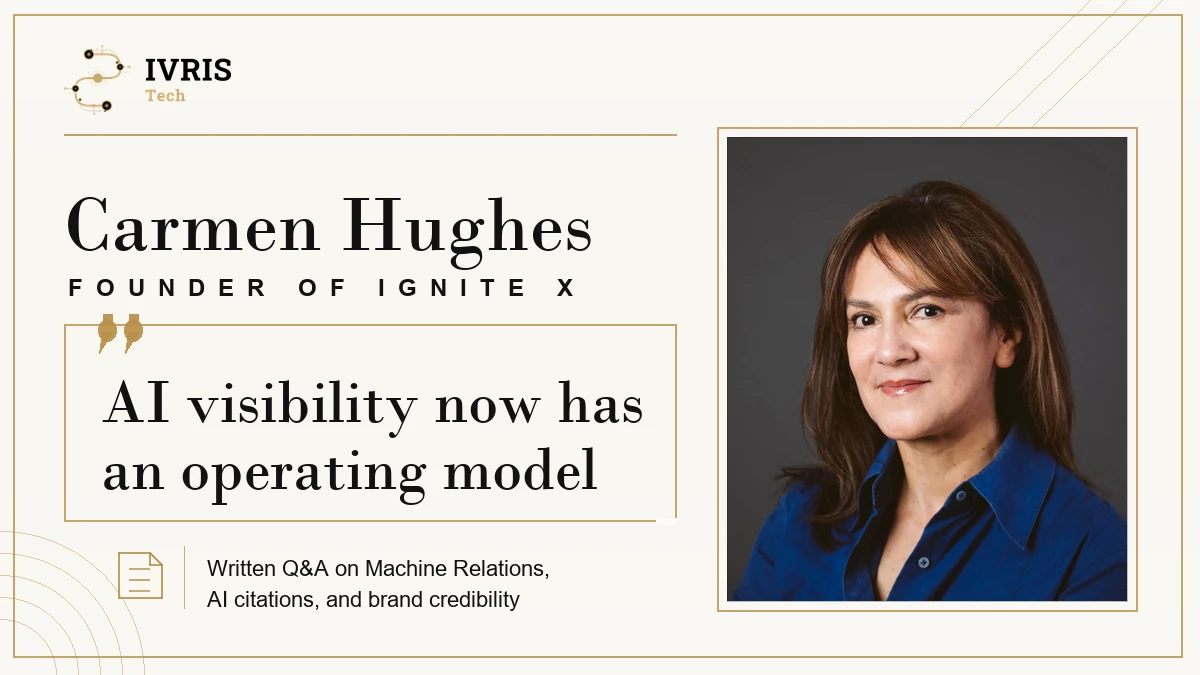
 Carmen HughesFounder, Ignite X
Answer 01
Carmen HughesFounder, Ignite X
Answer 01The first 30 days have one job: make the brand legible to AI engines. Not famous, legible. So we start with the dimensions that gate comprehension, not the ones that compound over quarters.
The triage logic comes down to a single question: does this weak dimension keep AI engines from forming a coherent answer about the brand in its category, or does it just suppress how strong that answer is? Entity confusion, an empty or stale AI Visibility baseline, and broken Digital Trust Signals are gating. If one brand has five name variations across Crunchbase, ZoomInfo, LinkedIn, and other indexed sources, AI engines cannot reconcile the entity cleanly. Those fixes come first, regardless of where they sit on the scorecard.
A 1 out of 5 in Community Presence or Founder Authority is low-scoring, but not always urgent in week one. Those signals compound over 60 to 90 days. They do not unblock the work that is already stuck.
In practice, week one is entity work. We standardize the brand name and core positioning across every indexed source. One canonical description goes on each surface, so AI engines see the same message everywhere. Week two builds citation surface area: a contributed article on a third-party domain that AI engines already trust, plus a directory or roundup submission so the brand starts appearing in the lists agents pull from for “best category” queries.
Week three is the first measurement checkpoint. We rerun the AI Visibility queries we ran at intake and look at which fixes moved the needle. That is a leading-indicator read on the page clock. The brand clock will not surface its verdict until the 60-to-90-day window. Early page-level citation movement from entity work and contributed articles tells us the foundation is being indexed correctly, which is what we are looking for three weeks in.
The dimension that surprises clients here is Digital Trust Signals. It scores low quietly, and clients do not think of it as PR work, but it sits upstream of every other dimension. If AI engines cannot reconcile the entity, none of the downstream Media Authority or Founder Authority work registers correctly. The triage rule of thumb is simple: gating dimensions first, compounding dimensions next, and vanity dimensions last.
The Clock, Without Overreading the Clock
The recent Profound benchmark gives the category one of its first real clocks for newly published pages in ChatGPT and Claude: 6.81 days to first citation at the median, and 37.10 days at the 90th percentile. How do you use that number without overstating it?
Carmen HughesFounder, Ignite X
Answer 02The Profound benchmark has been making the rounds on LinkedIn. The number is real. The interpretation usually is not.
| Metric | Value | Meaning |
|---|---|---|
| Median time to first citation | 6.81 days | Median time to first citation for a new page in ChatGPT and Claude. |
| 90th-percentile time to first citation | 37.10 days | 90th-percentile time to first citation for a newly published page. |
Source: Profound benchmark, as referenced in the interview.
What the benchmark measures is one clock. A second clock runs underneath it, and the two clocks do not run on the same time. Call them the page clock and the brand clock.
The page clock measures how long it takes a newly published page to be cited in ChatGPT or Claude. That is where the 6.81-day median and 37.10-day 90th percentile sit. It moves quickly because a single page either gets indexed or it does not.
The brand clock measures how long it takes AI engines to update the aggregate story they tell about a company across many queries and many platforms. That clock runs slower because AI engines weigh many sources and many signals before they shift how they answer the question, “who is this company?”
We use the Profound number to set realistic expectations for individual citation events, not for Credibility Score tier crossings. When we publish a contributed article on a top-tier tech or trade domain that AI engines already trust, we expect it to show up as a citation source somewhere inside the first 30 to 37 days. That is a page-clock event. What that single placement does not do is move a brand from the Emerging tier to the Credible tier. Tier crossing requires multiple page-clock events to accumulate, plus the slower-moving dimensions to catch up.
The page clock includes citation movement inside 30 days: entity standardization across directories, new third-party contributed content on indexed domains, profile updates on Crunchbase, ZoomInfo, X, and similar surfaces, a refreshed LinkedIn company page with current positioning, or a Quora or community answer in the right thread. These move first because they are page-level interventions on infrastructure AI engines already crawl.
The brand clock includes tier movement inside 60 to 90 days: Founder Authority, Community Presence, and Tier-1 Media Authority. Bylines compound. Speaking takes lead time. Podcasts need a back catalog. Organic Reddit and forum discussion cannot be manufactured without earning the conversation first. Editor relationships and contributed placements shift how agent-mode answers describe the brand, not just the search-mode result list.
The trap we work hardest to avoid is confusing fast citations with brand recognition. A new page that cites the brand is a leading indicator. AI engines treating that brand as a category authority is the outcome we are paid to produce. Page clock first, then brand clock second. The client conversations that go sideways are the ones where someone reads the Profound number and expects the brand clock to run at page-clock speed.
The Crossing Story
Can you walk us through an anonymized crossing story from invisible or emerging into credible? What moved first, and what ended up doing most of the lifting?
Carmen HughesFounder, Ignite X
Answer 03What follows is a composite drawn from three Series A AI engagements we have run over the past year. The dimension scores and the 90-day timeline come from one of those three specifically, a company that came in at 11 out of 30 on the Credibility Score, in the Emerging tier, and crossed into the Credible tier. The other two engagements moved on roughly the same arc. This is the part the marketing version usually skips, so here is the messier read.
At intake, the company’s six dimensions broke down like this:
| Dimension | Score | What the score reflected |
|---|---|---|
| Media Authority | 2/5 | Two niche placements, nothing tier-1. |
| AI Visibility | 2/5 | Cited inconsistently, mostly in search mode, not at all in agent mode. |
| Social Proof | 2/5 | A handful of customer quotes, no third-party reviews or case studies. |
| Founder Authority | 1/5 | Active on LinkedIn, but no bylines, podcasts, or speaking. |
| Community Presence | 1/5 | Zero organic discussion on Reddit, Hacker News, or category forums. |
| Digital Trust Signals | 3/5 | Clean site, but inconsistent company descriptions across Crunchbase, LinkedIn, and trade directories. |
| Total at intake | 11 / 30 | Emerging tier |
Outcome: after the 90-day engagement, the score sat at 19 / 30 and the brand had crossed into the Credible tier.
The first move was unglamorous, and it almost always is. We did entity work for the first two weeks: three name variants reconciled into one across nine indexed sources, description language standardized to one canonical paragraph, and old positioning quietly purged from places where it had lingered. When we reran the diagnostic queries at week two, the score barely moved. Digital Trust ticked from 3 to 4, and that was it.
What had moved, and this matters, was the way AI engines represented the company. The agent-mode answers stopped contradicting each other. The company still was not being recommended, but when AI engines did describe it, the description was finally accurate. That is the leading indicator nobody puts on a quarterly dashboard.
The heavy lifting came in weeks four through ten. Two contributed articles ran on indexed third-party domains. A tier-2 trade publication ran an earned-media placement that Perplexity cited inside the page-clock window. The founder published their first individual byline and recorded one podcast appearance with the full transcript indexed. We participated in two legitimate category threads with no promotional framing. At the end of that stretch, the score sat at 19 out of 30, and the tier had crossed.
The smaller proof points showed up first. Citation frequency rose before the brand-level score reflected it. The brand started being represented accurately in agent mode before it started being recommended. We saw competitor displacement in side-by-side comparisons two full weeks before the band crossed. If we had been watching the Credibility Score alone, we would have called it a slow start and panicked. We were watching the leading indicators, and they were moving the whole time.
One thing we did not do: we did not move Community Presence meaningfully. It went from 1 to 2, which is the difference between “no organic discussion” and “occasional mentions.” Real community presence is a six-to-twelve-month build, and we said so out loud in week one. The tier crossed with Community still underbuilt. That is worth saying because the temptation is to claim everything moved together, in proportion, on schedule. It did not, and pretending otherwise is how clients lose trust in the model when the second engagement hits a different shape.
The Bad Fix
When teams get a low score in one dimension, the instinct is usually to fix the visible output. What self-fix most often fails after a Credibility Score?
Carmen HughesFounder, Ignite X
Answer 04The most common issue we see is founder authority, and it is the most expensive bad fix because everyone has access to the wrong tool: LinkedIn.
A founder scoring 1 out of 5 on Founder Authority gets the scorecard, sees the gap, and almost always reaches for the same fix: post more on LinkedIn. Three posts a week, then five, then daily. The founder hires a ghostwriter to batch-write a month of content and schedule all of it. The visible output goes up immediately and the dimension feels like it is moving, but it is not.
The reason this is a bad fix is structural. AI engines weight Founder Authority on what they can verify across independent surfaces, not on volume inside a single platform that a person owns. A founder with 60 LinkedIn posts but zero bylines, zero podcasts, zero speaking, and zero independent citations looks to AI engines the way a brand with one X account and no press looks to a journalist. There is noise, but no third-party verification, so AI engines route around it.
Worse, the high-volume LinkedIn-only signal often hurts. It makes the founder visible enough that agent-mode answers start describing them, but the description gets pulled from the founder’s own self-narration with no independent source to cross-reference. That is how founders end up reading AI-generated summaries of themselves that sound oddly thin and cannot figure out why.
The real 90-day build for a 1 out of 5 founder looks much smaller than the LinkedIn version, and the volume is the giveaway. One contributed article on an indexed third-party domain in the first 30 days. One podcast appearance with full transcript indexing in days 30 to 60, where the host’s audience and domain authority matter more than reach. One earned-media mention with the founder quoted as the source on a category question in days 60 to 90. Three independent signals that AI engines can verify, in roughly that order.
LinkedIn stays in the mix, but the cadence drops to one or two strong posts a week, and the posts point at the third-party signals rather than substitute for them.
That is a 1-to-3 build on the rubric in 90 days, which is realistic. The version that goes for 1 to 4 or 1 to 5 in 90 days is the version journalists, buyers, and AI engines see through, all at slightly different speeds. Journalists see through it first. Buyers next. AI engines last, but they catch up faster than they used to, because retrieval is increasingly weighted toward independent corroboration over self-reported volume.
What to accept, question, and test
The Credibility Score is not a dashboard, and Machine Relations is not a campaign. They are the two halves of an operating model. The score tells a team which dimensions gate comprehension today. Machine Relations is the practice of moving those dimensions in the right order, on the right clock, and measuring whether AI engines actually change their treatment of the brand as a result.
The clearest sign the operating model is working is not the score moving first. It is the leading indicators moving first: AI-engine representation accuracy, citation frequency, and competitor displacement in agent-mode answers. The Credibility Score crosses the band when those signals have already been moving for weeks. If a team is only watching the score, it is watching the lagging indicator.
Separate the two clocks
The page-clock versus brand-clock split lets teams treat early citation movement as a signal without mistaking it for category authority.
Test category effects
An AI-infrastructure company, security vendor, and MarTech platform may not earn the same citation surfaces in the same order.
Split the indicators
Track representation accuracy, citation frequency, competitor displacement, and score movement separately for 90 days.
Questions readers ask after the interview
What is Machine Relations in AI visibility?
Machine Relations is Ignite X’s execution practice for changing how AI engines describe a brand. Where the Credibility Score diagnoses which of six dimensions is dragging a brand down, Machine Relations is the ongoing work that moves those dimensions: entity cleanup, citation surface building, founder authority, community presence, media authority, and repeat measurement. The score is the diagnosis; Machine Relations is the remedy.
What is the difference between the page clock and the brand clock?
The page clock is how long a single new page takes to be cited in tools like ChatGPT or Claude, around a 6.81-day median to first citation in the benchmark discussed here. The brand clock is how long AI engines take to update the aggregate story they tell about a company across many queries, which runs on a 60-to-90-day window. Fast page citations are a leading indicator, not proof that the brand is already treated as a category authority.
How long does it take to move an AI visibility or Credibility Score?
In the composite engagement Carmen describes, two weeks of entity work barely moved the score, with Digital Trust rising from 3 to 4, but it corrected how AI engines represented the company. The heavier lifting in weeks four to ten took the score from 11 out of 30 to 19 out of 30 and crossed the tier. Tier movement needs several page-level wins plus the slower dimensions catching up over 60 to 90 days.
Does posting more on LinkedIn improve founder authority for AI visibility?
Usually not by itself. AI engines weight founder authority on what they can verify across independent surfaces, not on volume inside one platform a person owns. A realistic 90-day build is three verifiable signals in order: one contributed article, one podcast with an indexed transcript, and one earned-media mention with the founder quoted, while LinkedIn drops to one or two strong posts a week that point at those signals.