Direct answer – what is SpotsNow AI Search?
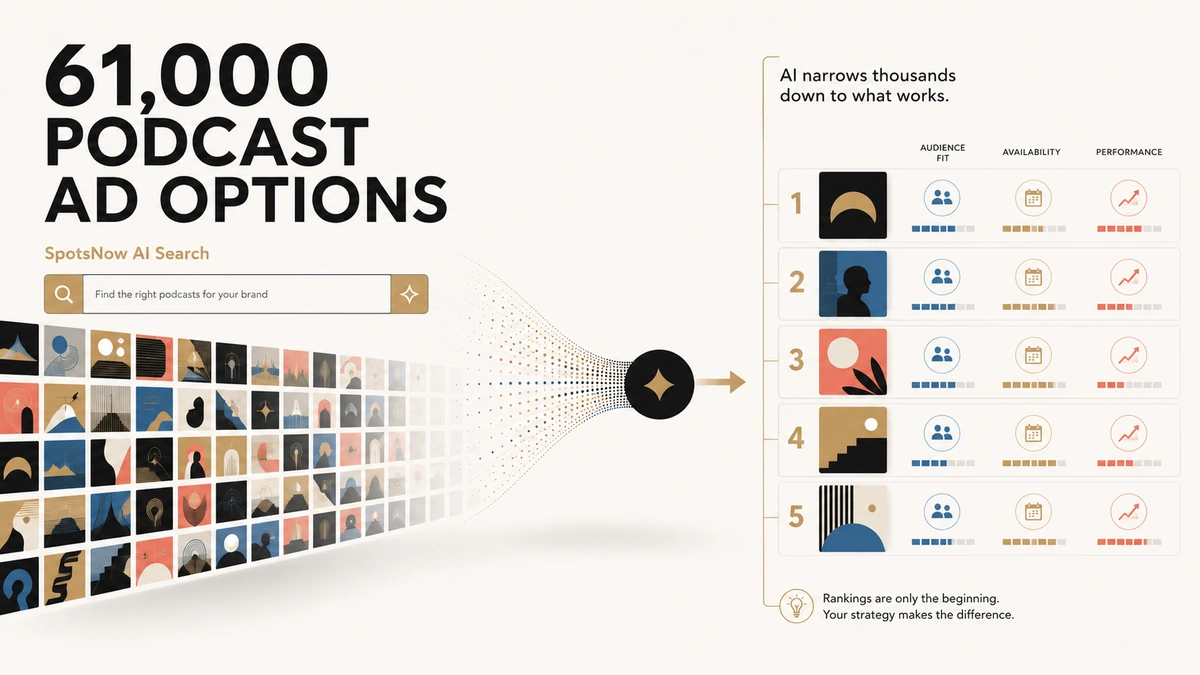
SpotsNow AI Search is a podcast-ad discovery tool that ranks shows by audience fit and targeting, then exposes performance history and available inventory for campaign planning. SpotsNow describes a commercial catalog of more than 61,000 shows, while current product pages cite more than 59,000 tracked or searchable shows. Advertisers should treat the ranking as a shortlist, then verify audience quality, brand safety, inventory, and incremental return before buying.
SpotsNow launched Search on July 14, 2026, giving podcast advertisers a free discovery layer that ranks shows by audience fit and targeting.
The launch joins search, historical ad activity, projected performance, and available inventory in one workflow. SpotsNow says buyers can use the web product or ask questions through MCP-compatible assistants such as ChatGPT and Claude. Detailed performance information sits behind a paid plan, while the initial ranking is free.
For B2B media teams, the ranking opportunity is clear: podcast planning is still fragmented across show lists, sales calls, media kits, and performance spreadsheets. The risk is equally clear. A fit score can make discovery faster without proving that a show will create incremental pipeline for a specific advertiser.
Key Takeaways
- SpotsNow launched its new podcast-ad Search product on July 14, 2026.
- Search ranks shows by audience fit and targeting before showing performance detail.
- The company describes a catalog of 61,000-plus commercially relevant shows.
- SpotsNow Intelligence can be queried through MCP-compatible AI assistants.
- Advertisers still need independent checks for audience quality, brand safety, and incrementality.
What SpotsNow AI Search Actually Adds
Search is the discovery layer inside the wider SpotsNow podcast-ad platform. A buyer can describe a brand, audience, or campaign requirement, then receive a ranked list of shows. The launch announcement says the ranking uses audience fit and targeting, with deeper performance information available in one click.
The product combines several jobs that are often separate. It can show previous advertisers, ad history, projected return on ad spend, and available or unsold inventory. Publishers can approve, decline, or counter a placement request, so the search result can move toward a transaction rather than ending as a research list. beehiiv’s Community and Copilot expansion adds the owned-audience side of that connection, combining podcast, discussion, subscriber, and monetization signals inside one publisher workflow.
The catalog numbers need one clarification. The announcement describes a verified catalog of more than 61,000 commercially relevant shows. Current SpotsNow Intelligence pages say the product tracks more than 59,000 shows, and the browse page displays a changing searchable count. Marketers should ask which shows are included in each number, how recently their data was updated, and which have enough performance history to support a ranking.
SpotsNow also exposes its intelligence through a read-only MCP connection. That is a useful contrast with RainFocus MCP Profiles, which can support scoped write actions against event data. SpotsNow says its connector pulls podcast intelligence into the assistant without accessing, storing, or training on the advertiser’s proprietary data.
Why Discovery and Inventory Belong Together
Podcast buyers do not only need a list of shows with the right topic. They need to know whether the audience matches, whether a competing advertiser is already present, whether inventory is available, what a test will cost, and whether earlier campaigns produced useful results.
Search can shorten that chain. A media planner could identify shows aligned with a niche buyer, inspect sponsor history, find likely open inventory, and send a request without waiting for multiple media kits. SpotsNow says last-minute inventory can also be surfaced when it matches campaign criteria.
That speed fits the wider ad-operations pattern. Multiply’s 10 Minute ABM compresses account-ad production; SpotsNow is trying to compress media discovery and buying. In both cases, the saved time is real only if the team does not recreate it as review work after weak recommendations appear.
The commercial incentive still matters: SpotsNow operates a marketplace and may earn a transaction fee when it introduces a new advertiser to a show. Buyers should understand how ranking, inventory, and marketplace economics interact.
The Catch: A Fit Score Is Not Buying Proof
Audience fit is a model output, not an audited media outcome. A podcast can look aligned by category, listener profile, sponsor history, or modeled conversion potential and still fail because the host read is weak, the offer is wrong, the flight is too short, or the audience overlaps with another channel.
Projected ROAS needs the same caution. Marketers should ask which attribution window, conversion event, historical campaigns, and category assumptions support the estimate. A ranking built from direct-response advertisers may not transfer cleanly to an enterprise brand measuring influenced opportunities months later. Nielsen’s cross-media Ad Intel AI launch raises the same evidence question at a wider scale: a recommendation is useful only when buyers can trace the dataset, market, period, and benchmark behind it.
SpotsNow’s terms note that audience metrics for discounted or time-sensitive listings may come from publishers and may reflect historical averages or estimates rather than guaranteed delivery. The plan therefore needs delivery checks and make-good terms.
Zappi Amplify AI offers a useful parallel: a predictive score can prioritize what deserves review, but it should not replace market evidence. SpotsNow AI Search should be used to form a better test set, not to declare a winning show before the campaign runs.
How B2B Advertisers Should Test SpotsNow
Begin with one audience and a fixed test budget. Ask SpotsNow for a ranked list, then compare it with a human planner’s shortlist. The goal is to see where the AI finds useful options the team missed and where its logic needs correction.
- Inspect the ranking inputs: Record the audience, category, sponsor history, conversion evidence, and inventory signals behind each recommendation.
- Check conflicts: Review competitor ads, category exclusions, host controversy, and recent episode context before approving a show.
- Confirm inventory data: Verify dates, placement type, expected downloads, rate, cancellation terms, and any publisher-supplied estimates.
- Use a clean measurement plan: Assign offer codes, vanity URLs, post-purchase surveys, and CRM campaign fields before launch.
- Measure incrementality: Compare new-customer or pipeline lift with a holdout, matched market, or controlled flight where possible.
SpotsNow AI Search can remove a large amount of manual discovery work. Its strongest use is as a planning and test-design layer. The buyer still owns the decision about evidence quality, brand fit, and whether the campaign created demand that would not have appeared anyway.
Frequently Asked Questions
SpotsNow’s launch materials describe a verified catalog of more than 61,000 commercially relevant shows. Current product pages cite more than 59,000 tracked or searchable shows. Buyers should confirm the active searchable count and data coverage for their category.
SpotsNow says the search and initial ranking are free to use. Deeper performance history and projected-return detail are available through a paid plan. Marketplace fees may also apply in qualifying transactions.
Yes. SpotsNow Intelligence offers a read-only MCP connection for ChatGPT, Claude, and other compatible assistants. SpotsNow says the connector returns podcast-ad intelligence without accessing or training on the advertiser’s proprietary files.
Verify audience and download data, sponsor conflicts, host and episode suitability, placement type, rate, inventory dates, attribution setup, and cancellation terms. Treat modeled fit and projected ROAS as test inputs rather than guaranteed results.