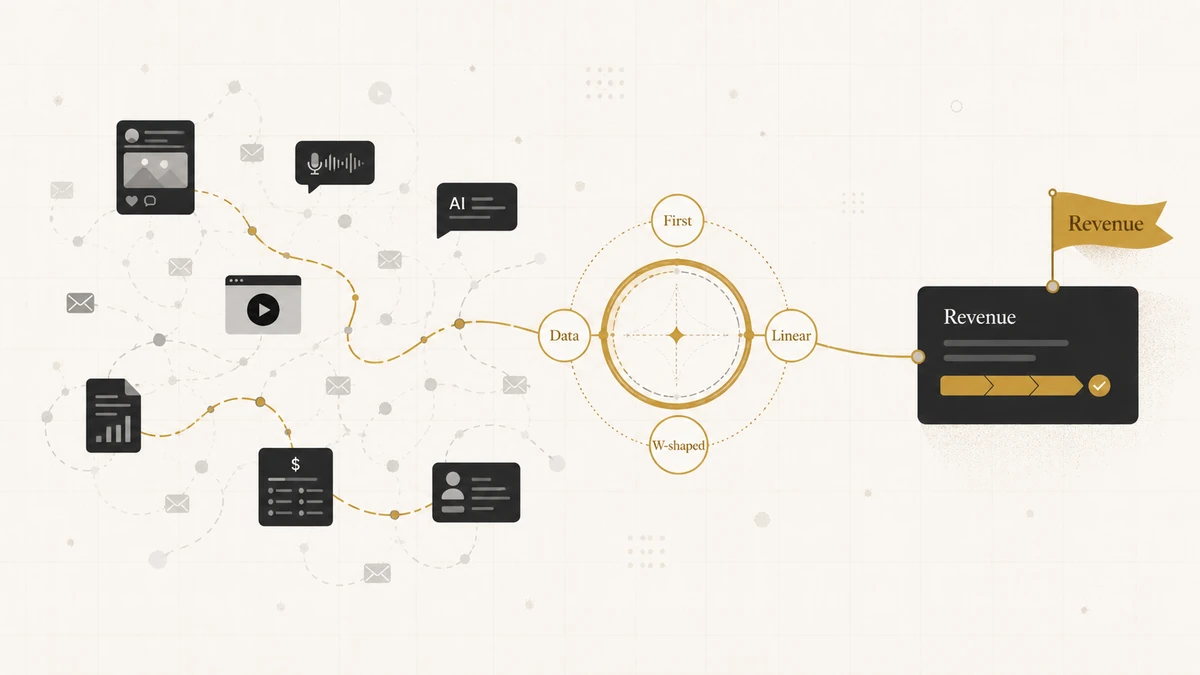
The most expensive question in B2B marketing is which touch actually created the deal. A buyer reads a peer’s LinkedIn post, hears your name on a podcast, asks an AI assistant for options, downloads a report, sits in a webinar, then forwards a pricing page to four colleagues. A form gets filled, and last-click attribution hands the whole deal to “Google / organic.” Marketing attribution software exists to replace that fiction with a defensible map of which channels, campaigns, and content moved real pipeline.
B2B attribution software connects every recorded touch, from the first anonymous visit to the closed-won record in your CRM, and assigns credit across them using one or more attribution models. It is harder than consumer attribution for a structural reason: a single B2B purchase pulls in 6 to 10 decision makers, and buyers now spend only 17% of the journey talking to any supplier at all, according to Gartner. Most of the buying happens where no pixel can follow it.
This guide reviews 12 marketing attribution software platforms sorted into four jobs: multi-touch attribution, pipeline and revenue attribution, self-reported and survey attribution, and the data pipes and free baseline underneath them. Each review carries a starting price as of Q3 2026, the attribution models it runs, the data it reads, and a one-line verdict. After the reviews comes a comparison table, use-case picks, pricing benchmarks, and an honest account of what this software cannot do. The aim is a shortlist of two or three to trial, not a fourteen-logo screenshot.
Direct answer — What is marketing attribution software?
Marketing attribution software connects every recorded marketing and sales touch to revenue, then assigns credit across those touches using a model such as first-touch, last-touch, linear, time-decay, or data-driven. It answers which channels and campaigns produced pipeline. GA4 does this free at the web-session level; dedicated platforms extend it across the CRM, the buying committee, and the offline close. It models the touches your tracking captured, so it cannot fix data it never received.
Key Takeaways
- Marketing attribution software for B2B splits into four jobs: multi-touch attribution (Dreamdata, HockeyStack, Factors.ai, Ruler Analytics), pipeline and revenue attribution (Adobe Marketo Measure, Salesforce, HubSpot, CaliberMind), self-reported and survey attribution (Cometly, Attribution), and data pipes plus a free baseline (Windsor.ai, GA4). Match the job to your problem before you shortlist a brand.
- The deeper the dark funnel gets, the more weight self-reported attribution carries. 6sense found buyers delay vendor contact until roughly two-thirds of the way through the journey, so a “how did you hear about us” field often beats any pixel.
- Pricing splits three ways as of Q3 2026: a free or self-serve baseline ($0 to about $200/mo), mid-market specialists ($200 to $1,000/mo), and enterprise platforms from about $1,250/mo. Four of the 12 publish no paid price at all.
- Attribution software is not a tracking-hygiene tool. It models the data your UTM and CRM setup captures. Dirty UTMs in means unreliable attribution out, no matter which platform you buy.
- GA4 is the free baseline almost every team already has. Dedicated attribution software earns its price when GA4’s data-driven model can no longer see across the CRM, the buying committee, and the offline close.
What Marketing Attribution Software Is
Marketing attribution software is a platform that ties marketing and sales touches to revenue outcomes, then assigns credit to each touch using an attribution model such as first-touch, last-touch, linear, time-decay, U-shaped, W-shaped, or a data-driven model. The output is a report that says, in effect, “these channels and campaigns produced this pipeline and this closed revenue.” The wider methodology this sits inside is covered in how B2B marketing attribution works.
A worked example makes the abstraction concrete. Say a $60,000 deal closes after six touches: the buyer finds a blog post through organic search, returns through a LinkedIn ad, downloads a report, attends a webinar, gets worked by an SDR, then converts on a branded search. Last-touch attribution credits branded search with the entire $60,000, which is nonsense, because that branded search only happened once the other five touches had done their work.
A linear model splits the credit six ways at $10,000 each. A W-shaped model loads it onto the three touches that matter most in B2B: first touch, lead creation, and opportunity creation. Same deal, three different stories, and the model you pick decides which one your CFO sees.
Almost every team already owns a free version of this in Google Analytics. GA4 runs a data-driven attribution model across web conversions, and our guide to tracking B2B traffic in Google Analytics covers how to set it up properly. The gap is that GA4 stops at the web session. It does not natively know that an anonymous visitor became a lead in HubSpot, joined a 7-person buying committee, and closed 90 days later as a $60,000 deal. Dedicated marketing attribution software is built to close that loop between the click and the CRM.
Why B2B Attribution Is Harder Than Ecommerce Attribution
Attribution looks simple until you try it on a real B2B deal. Four structural problems break the naive last-click view, and every tool below is an attempt to handle one or more of them.
Start with the split that decides which tools belong on your shortlist at all. Ecommerce and DTC attribution scores one shopper over days against an order value, which is why platforms like Triple Whale, Northbeam, SegmentStream, and Measured are built around paid-social ROAS and Shopify. B2B attribution scores a buying committee of 6 to 10 people over months against CRM revenue that lands long after the last click. Same word, different problem, different software. Everything below is the B2B answer.
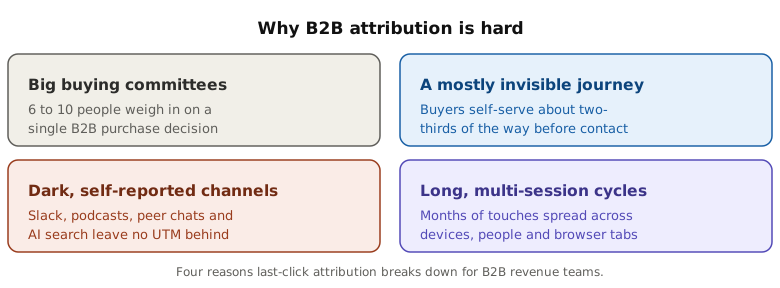
First, the buying committee is crowded. Gartner puts a complex B2B purchase at 6 to 10 decision makers, each arriving with their own research. Credit for one closed deal has to spread across many people and many sessions, which is exactly what the B2B marketing metrics a revenue team reports on are supposed to reflect.
Second, most of the journey is invisible. 6sense’s 2025 Buyer Experience Report found that buyers hold off on contacting a vendor until they are roughly two-thirds of the way through their journey, and that the first vendor a buyer talks to still wins about eight of ten deals. By the time a form is filled, the decision is half made in places you never measured. Modelling credit across that whole path, rather than the last click, is the problem customer journey attribution exists to solve.
Third, the channels that move buyers are increasingly dark. Slack communities, podcasts, peer DMs, and AI search send no UTM and leave no clean referrer. This is the same blind spot that shows up as “direct” traffic and the not-provided keyword gaps in analytics, and it is why self-reported attribution has moved from a nice-to-have to a category of its own.
Fourth, the cycle is long and multi-device. A purchase that spans months and crosses laptops, phones, and several people defeats cookie-based stitching. The fix is not a better cookie. It is a model that accepts incomplete data and still produces a usable read, the same way a disciplined B2B marketing campaign plans for signals it cannot fully see. Strong attribution also depends on a clean top of funnel, which is why it pairs with the lead generation tools that feed it.
How We Chose These Attribution Tools
The 12 platforms below each cleared four checks, and a few well-known names did not. Naming the cuts is part of the method.
1. Built for or proven in B2B. The tool had to handle long cycles, CRM-defined revenue, and account-level rather than purely individual conversions. This is where pure-ecommerce attribution tools like Triple Whale, Northbeam, SegmentStream, and Measured were set aside: they are excellent at Shopify and paid-social ROAS, but they are not built for a 90-day, committee-driven B2B deal.
2. Real attribution modeling, not just dashboards. A reporting dashboard that only restacks ad-platform numbers did not qualify. The tool had to assign credit across touches with named models, not just chart spend.
3. Active and supported in 2026. The product has to be selling and shipping today. Worth a clear note here: Bizible, a long-time B2B attribution name, is now Adobe Marketo Measure after the 2022 rebrand. It is still sold and supported, though its pace of new features slowed after the acquisition, and that trade-off is reflected in its review below.
4. Clean data in. Attribution is only as honest as the tracking beneath it. Every tool here assumes you have already done the work in our guide to QA your UTM links before launch. A platform cannot model touches it never received in a usable form.
Multi-Touch Attribution Platforms
This is the core category: software that stitches the full journey, assigns credit across many touches with multiple models, and ties it back to CRM revenue. These four lead the B2B field. Attribution reads that journey after the fact; acting on it while it unfolds is the flip side, which is what coordinating the next touch in real time does with the same cross-channel data these tools measure.
1. Dreamdata: Best Purpose-Built B2B Attribution
Dreamdata is the strongest standalone B2B revenue-attribution platform. It builds a full account-level journey from first anonymous touch to closed revenue, joining web, ad, CRM, and product data, then runs multiple attribution models on top. It is the default recommendation for SaaS teams with long cycles that want attribution as the core job rather than a feature bolted onto something else. Joining those sources is the whole difficulty, and it is worth knowing what account-level attribution actually asks of your data before judging any vendor on how well it does the join.
Best for: B2B SaaS and tech teams that want serious account-level attribution without an enterprise contract on day one.
Standout: A genuinely useful free tier for B2B web analytics and company identification, with a clear paid path as needs grow.
Starting price (as of Q3 2026): Free plan at $0/month. Paid pricing is quote-only: Dreamdata lists a single paid tier, Activation and Attribution, as custom-priced with no published figure.
2. HockeyStack: Best for Enterprise GTM Analytics
HockeyStack started as a B2B attribution tool and has grown into a wider go-to-market analytics platform, now marketed around AI “revenue agents.” It does multi-touch attribution well, adds self-reported attribution as a native field, and layers on ABM and warehouse sync. The trade-off is scope and price: it is built for enterprise and upper-mid-market teams with a dedicated analytics owner, not a solo marketer.
Best for: Larger B2B teams that want attribution plus broader GTM analytics in one well-resourced platform.
Standout: Combines pixel-based multi-touch attribution with built-in self-reported attribution, covering both the tracked and untracked journey.
Starting price (as of Q3 2026): No free tier and no public pricing. HockeyStack’s pricing page lists what each plan includes and routes buyers to a demo, with no published figures.
3. Factors.ai: Best for ABM and Account Intelligence
Factors.ai pairs revenue attribution with account intelligence and de-anonymization, which makes it a strong fit for teams running account-based programs. It identifies the companies behind anonymous traffic, scores account engagement, and runs six built-in multi-touch models, with a heavy tilt toward LinkedIn and paid B2B channels.
Best for: ABM and demand-gen teams that want attribution joined to account identification and intent.
Standout: Account de-anonymization plus attribution in one tool, with LinkedIn AdPilot for closed-loop paid social.
Starting price (as of Q3 2026): No free plan, only a free trial. Lite runs $199/month, Basic $6,000/year, Growth $20,000/year, and Enterprise from $30,000/year. LinkedIn AdPilot and Interest Groups are bundled into the higher tiers rather than sold as priced add-ons.
4. Ruler Analytics: Best for Offline and Phone Conversions
Ruler Analytics is a visitor-level attribution platform that connects anonymous sessions to CRM contacts and to closed revenue, with a particular strength in call tracking and form tracking. For B2B companies where deals still close over the phone or in person, Ruler fills the gap that web-only tools miss by tying those offline conversions back to the marketing source. Form tracking has a hard floor no attribution tool can lift, though, since a session can only be tied to a contact that exists: counting the submission at each checkpoint before it reaches any attribution model is what tells you whether the contact was ever created.
Best for: Mid-market B2B and lead-gen businesses with significant phone or offline conversions.
Standout: Built-in call tracking that links phone conversations to the exact campaign and keyword that drove them.
Starting price (as of Q3 2026): Four traffic-based tiers from £299/month (up to 10,000 monthly visits) to £1,499/month (100,000+), roughly $400 to $2,000, with 10% off annual billing. Ruler labels these figures indicative. Monthly billing is available and there is no free trial.
Pipeline and Revenue Attribution
These tools live closest to the CRM and the number a CFO cares about: pipeline and closed revenue by source. They suit teams whose attribution question is less “which ad” and more “which programs built the pipeline,” and they fit the wider revenue stack, from RevOps software down to the motion a B2B go-to-market strategy sets.
5. Adobe Marketo Measure: Best for the Adobe and Marketo Stack
Adobe Marketo Measure, formerly Bizible, is the enterprise B2B multi-touch attribution standard for organizations already on Marketo Engage and the wider Adobe stack. It models pipeline and revenue across complex omnichannel journeys and integrates tightly with Adobe Analytics and Real-Time CDP. The honest caveat: evaluate it on current capability rather than legacy reputation, because the Bizible name still carries weight the present product has to earn on its own.
Best for: Enterprise marketing teams already invested in Adobe and Marketo Engage.
Standout: Deep, native integration with the Adobe and Marketo ecosystem that few competitors can match.
Starting price (as of Q3 2026): Custom and quote-based. Adobe publishes no list price and routes buyers to a consultation request. Positioned as an enterprise add-on to the Adobe stack, not a self-serve tool.
6. Salesforce Marketing Cloud Account Engagement: Best for Salesforce-Native Teams
For teams that run on Salesforce, Marketing Cloud Account Engagement (the platform formerly called Pardot) brings B2B Marketing Analytics and Einstein attribution into the same system as the CRM. Because the pipeline and revenue already live in Salesforce, attribution reporting avoids the join problems that external tools fight. Multi-touch attribution arrives at the Plus+ edition and up.
Best for: Salesforce-native B2B teams that want attribution inside the CRM of record.
Standout: Native Salesforce data model, so attribution maps directly onto existing pipeline and opportunity reporting.
Starting price (as of Q3 2026): Multi-touch attribution and B2B Marketing Analytics start at the Plus+ edition, $2,750 per org per month billed annually, with 10,000 contacts included. Advanced+, which adds Einstein Behavior Scoring and Campaign Insights, runs $4,400 per org per month. Growth+ at $1,250 does not include multi-touch attribution.
📊 Salesforce Account Engagement
7. HubSpot Revenue Attribution: Best Native CRM Attribution
If your team already lives in HubSpot, its native revenue attribution is the path of least resistance. It connects email, social, paid, and content touches to deals inside the same CRM, with multiple models and no extra integration to maintain. The nuance is scale rather than access: Marketing Hub Professional and Enterprise both include multi-touch revenue attribution, tracking up to 10,000 logged interactions per contact, so Enterprise buys reporting headroom and governance rather than switching attribution on. Getting attribution right here depends on clean form capture, which is exactly where hidden-field UTM capture in HubSpot tends to break.
Best for: HubSpot-native teams that want attribution without adding another vendor.
Standout: Zero integration overhead, since the touches and the deals already live in one CRM.
Starting price (as of Q3 2026): Marketing Hub Professional at $800/month and Enterprise at $3,600/month both include multi-touch revenue attribution. Enterprise adds scale and governance, along with larger seat and marketing-contact allowances.
8. CaliberMind: Best for Mid-Market and Enterprise B2B
CaliberMind is a unified B2B measurement platform that combines multi-touch attribution with marketing mix modeling, account-based reporting, and buyer-journey intelligence. It is built for mid-market and enterprise teams with messy data across several systems and a dedicated marketing-ops or RevOps function to run it. Smaller teams without that resource will find it heavier than they need. Its buyer-journey intelligence rests on the practice of stitching every touch into one connected path, the raw material any attribution model needs before it can assign credit.
Best for: Mid-market and enterprise B2B teams with complex data and a marketing-ops owner.
Standout: Multi-touch attribution and marketing mix modeling in one platform, so tracked and modeled views sit side by side.
Starting price (as of Q3 2026): Custom and quote-based. CaliberMind publishes no list pricing, stating only that it prices on data volume rather than per user. Annual minimums circulate on third-party listings but are not confirmable from the vendor.
Self-Reported and Survey Attribution
When two-thirds of the journey happens before a vendor is ever contacted, the most accurate signal is often the buyer’s own answer to “how did you hear about us.” Self-reported attribution captures that at the point of conversion, and it is the fastest-growing answer to the dark funnel. These tools specialize in it. Attribution shows you where the invisible journey happens; turning that visibility into higher conversion is a separate discipline, which is where reducing friction across the journey stages takes over.
9. Cometly: Best for AI and Server-Side Tracking
Cometly is a B2B SaaS attribution platform built around server-side tracking and AI analysis. It captures conversion events that browser pixels miss under iOS privacy rules and ad blockers, feeds enriched conversion data back to ad platforms, and connects spend to pipeline in close to real time. For paid-heavy B2B teams losing signal to client-side tracking loss, that resilience is the draw.
Best for: Paid-heavy B2B SaaS teams fighting tracking loss from privacy changes and ad blockers.
Standout: Server-side conversion tracking that recovers events client-side pixels drop, with AI-assisted analysis on top.
Starting price (as of Q3 2026): Core starts at $500/month, covering 40,000 monthly pageviews and 5 seats, with 20% off annual billing and usage scaling up to 1.5 million pageviews. An Enterprise tier adding data-warehouse connections is quote-only. No free trial.
10. Attribution: Best for Customizable Multi-Touch Models
Attribution (attributionapp.com) is a multi-touch platform whose selling point is auditability and control. It gives user-level cost data, fully customizable models, and raw-data export, so analysts can exclude direct traffic, set cutoff events for product-led funnels, or rebuild a model from scratch. It connects to HubSpot, Salesforce, Segment, and Shopify, and prices by monthly tracked users rather than seats.
Best for: Data-literate teams that want to audit and customize the attribution model, not accept a black box.
Standout: Auditable, exportable, fully customizable models with user-level cost data.
Starting price (as of Q3 2026): Priced by connected stack rather than one ladder: Shopify plans from $19/month, HubSpot and Segment from $399/month at the Pro tier, and Salesforce on Enterprise quotes only. Tiers scale by monthly tracked users, with overages at $10 per 1,000.
Data Pipes and the Free Baseline
The last category is the layer underneath the others: tools that move ad and marketing data into one place, and the free baseline almost every team already runs. They do not build a polished revenue model on their own, but they decide whether the model above them is fed clean, complete data. That last phrase deserves pressure before any of these tools gets a budget line, because clean and complete is a claim somebody has to prove rather than a property a pipe confers on the data passing through it.
11. Windsor.ai: Best for Connecting Data on a Budget
Windsor.ai is a no-code data-pipe tool. It pulls from 350-plus sources, including GA4, Google Ads, and LinkedIn Ads, into Sheets, Looker Studio, BI tools, or a warehouse, where you can model the joined data yourself. It is the budget-friendly way to centralize marketing data and run a first attribution model before committing to a heavier platform.
Best for: Cost-conscious teams that want to centralize data and run basic attribution themselves.
Standout: A 350-source connector library at an entry price most tools cannot touch.
Starting price (as of Q3 2026): Free plan available; Basic at $23/month, or $19/month billed annually, with the most popular Standard tier at $118/month, Plus at $299, and Professional at $598.
12. GA4: Best Free Baseline
Google Analytics 4 is the free attribution layer almost every team already has. It runs a data-driven attribution model across web conversions and integrates with Google Ads at no cost, which makes it the honest starting point before you pay for anything. Its limits are real: it lives at the web-session level, struggles to join the CRM and the offline close, and shares the privacy and consent constraints every web tool faces. Treat it as the baseline that dedicated attribution software extends, not replaces. That same baseline feeds a content-scoped performance view, where GA4 covers reach and engagement while the attribution layer fills in the pipeline and revenue it cannot see on its own.
Best for: Every team, as the free baseline and the benchmark a paid tool has to beat.
Standout: A capable data-driven model and Google Ads integration at no cost.
Starting price (as of Q3 2026): Free. The enterprise Analytics 360 tier is custom-quoted through a Google account rep or authorized reseller; Google publishes no rate card.
PRO TIP
Four more names belong on a shortlist even though they sit outside this 12. 6sense and Demandbase lead with intent data and ABM, with attribution as one feature among many. Fibbler is a newer LinkedIn Marketing Partner focused on paid-social-to-CRM attribution. LeadsRx is a multi-touch tool popular with agencies and call-heavy accounts. Shortlist these if your primary need is intent, LinkedIn, or agency reporting rather than attribution itself.
Marketing Attribution Software Comparison Table
The table below lines up all 12 tools on the dimensions buyers actually weigh: category, who it fits, starting price as of Q3 2026, the attribution models it runs, the data it reads, and a one-line verdict. Scroll sideways on mobile.
| Tool | Category | Best For | Starting Price (Q3 2026) | Attribution Models | Data Sources | Verdict |
|---|---|---|---|---|---|---|
| Dreamdata | Multi-touch | Purpose-built B2B SaaS | Free; paid quote-only | Multiple, incl. data-driven | Web, ads, CRM, product | Best standalone B2B attribution |
| HockeyStack | Multi-touch + self-reported | Enterprise GTM analytics | No public pricing | Multi-touch + self-reported | Web, ads, CRM, warehouse | Best for broad GTM analytics |
| Factors.ai | Multi-touch + ABM | Account-based teams | Lite $199/mo; Basic $6K/yr | 6 multi-touch models | Web, LinkedIn, CRM, intent | Best for ABM + identification |
| Ruler Analytics | Multi-touch | Offline + phone conversions | £299 to £1,499/mo | Multiple, visitor-level | Web, calls, forms, CRM | Best for call-driven B2B |
| Adobe Marketo Measure | Pipeline / revenue | Adobe + Marketo stack | Custom (enterprise) | Multiple, incl. custom | Marketo, Adobe, ads, CRM | Best inside the Adobe stack |
| Salesforce Account Engagement | Pipeline / revenue | Salesforce-native teams | MTA from $2,750/mo (Plus+) | Multi-touch + Einstein | Salesforce CRM, email, ads | Best for Salesforce shops |
| HubSpot | Pipeline / revenue | HubSpot-native teams | Pro $800/mo; Ent. $3,600/mo | Multiple, native (Pro and Ent.) | HubSpot CRM, email, ads, content | Best native CRM attribution |
| CaliberMind | Pipeline / revenue + MMM | Mid-market and enterprise | Custom; no public price | Multi-touch + marketing mix | CRM, MAP, ads, warehouse | Best for complex data + ops |
| Cometly | Self-reported + ad attribution | Paid-heavy B2B SaaS | Core from $500/mo | Multi-touch + self-reported | Ads, web (server-side), CRM | Best for tracking-loss recovery |
| Attribution | Self-reported + multi-touch | Custom-model analysts | Shopify $19; HubSpot $399/mo | Fully customizable | HubSpot, Salesforce, Segment | Best for auditable models |
| Windsor.ai | Data pipe + modeling | Budget-conscious teams | Free; from $23/mo | Model it yourself in BI | 350+ sources to BI / warehouse | Best low-cost data pipe |
| GA4 | Free baseline | Every team | Free | Data-driven, rule-based | Web, Google Ads | Best free starting point |
Quick Verdicts by Use Case
If you would rather skip the deliberation, here is the shortest path to a pick based on the situation you are actually in.
Best for B2B SaaS: Dreamdata. Purpose-built account-level attribution with a genuine free tier to start, though the step up to paid is a sales conversation rather than a checkout.
Best for the dark funnel and self-reported attribution: Cometly for server-side resilience, or HockeyStack if you want self-reported attribution inside a broader analytics platform.
Best for revenue and pipeline attribution: Adobe Marketo Measure or Salesforce Account Engagement if you already run those stacks, or CaliberMind for complex multi-system data. These map cleanly to account-based marketing metrics for target-account programs.
Best on a budget: Windsor.ai to centralize data and model it yourself, from $23/month, or Attribution from $399/month on HubSpot and Segment for customizable multi-touch.
Best free baseline: GA4. Start here, prove the gap, and let that gap justify the paid tool. It also reports on the same channels your ABM campaigns run across.
Marketing Attribution Software Pricing Benchmarks (Q3 2026)
Pricing in this market splits into three bands. Knowing your band stops you from over-buying an enterprise platform or under-buying a tool that breaks at your data volume.
One finding is worth stating before the bands, because it shapes how you shop. We re-checked all 12 vendor pricing pages in July 2026, and four of them publish no paid price whatsoever: Dreamdata lists its paid tier as custom, and HockeyStack, Adobe Marketo Measure, and CaliberMind publish nothing at all. Figures that circulate for those tools trace back to third-party review listings rather than the vendors, so we do not repeat them here. Budget for a sales call, not a checkout page.
Free and Self-Serve: $0 to About $200/Month (as of Q3 2026)
The starting band for small teams and proofs of concept. GA4 is free, Windsor.ai runs a free plan plus Basic at $23/month and Standard at $118/month, Dreamdata offers a genuine free plan, Attribution’s Shopify tier starts at $19/month, and Factors.ai’s entry Lite plan is $199/month. Best when you want to centralize data and run a first model before committing real budget.
Watch one change here. Factors.ai has dropped its free plan and now offers only a free trial, which leaves Dreamdata, Windsor.ai, and GA4 as the three tools on this list with a real $0 tier.
Mid-Market Specialist: $200 to $1,000/Month (as of Q3 2026)
The working tier for most serious B2B teams. Attribution’s HubSpot and Segment plans ($399/month), Cometly’s Core plan ($500/month for 40,000 pageviews), Windsor.ai’s Plus and Professional tiers ($299 and $598), Ruler Analytics’ lower tiers (£299 to £999/month), and HubSpot Marketing Hub Professional ($800/month) live here. You pay for full journey stitching, CRM revenue, and account-level reporting.
Enterprise: About $1,250/Month and Up, Mostly Quote-Only (as of Q3 2026)
Salesforce Account Engagement (Plus+ at $2,750/org/month for multi-touch attribution, Advanced+ at $4,400), HubSpot Marketing Hub Enterprise ($3,600/month), and Factors.ai’s Growth and Enterprise tiers ($20,000 and $30,000+/year) publish figures. Adobe Marketo Measure, CaliberMind, HockeyStack, and Dreamdata’s paid tier do not. This band buys deep integration, governance, and marketing mix modeling that the lower tiers cannot deliver, and it pays off only at real scale.
IMPORTANT
Most attribution tools price on tracked accounts, contacts, or data volume, not a flat seat fee. A plan that fits today can double as you add traffic, contacts, or connectors. Model the price at next year’s volume before you sign, so the tool that fits now still fits at scale.
What Marketing Attribution Software Can’t Do
The fastest way to waste money here is to expect attribution software to be something it is not. It models the journey; it does not clean the data, run the analytics, or make the decision for you.
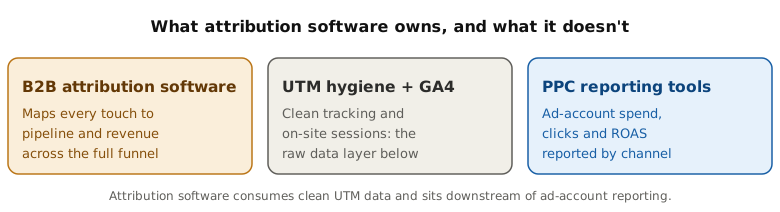
It cannot fix dirty tracking. Attribution models whatever touches it receives. If your UTMs are inconsistent or your form capture drops the source, the model inherits that mess. Clean tracking is upstream work, and it starts with the pre-launch UTM QA that keeps source data clean. Garbage in, confident-looking garbage out.
It also cannot tell you whether your tracking is broken in the first place. Before buying a platform to fix a capture problem, check that you have one. Our own study of how B2B demo forms capture campaign data submitted real test leads to 20 B2B forms and inspected every one by hand: 17 of the 20 carried the UTM and the click-ID into the submitted lead. An automated scanner reading the same forms detected capture on only 44 of 150, roughly a 3x undercount, because most forms capture at the moment of submission, where a read-only scan cannot see it. A scanner-based audit that says your attribution is broken is often reading its own blind spot rather than your funnel.
It is not a deterministic source of truth. No tool sees every touch across every device and dark channel. Self-reported attribution exists precisely because the tracked picture is incomplete, and privacy rules keep it that way. Useful attribution gives you a defensible directional read, not a perfect ledger, so treat any platform promising 100% accuracy with suspicion. The fact that 48% of marketers still guessing made a fresh Harris Poll headline is a reminder that the goal is better decisions, not perfect reconstruction.
It is not ad-platform reporting. Attribution software maps touches to revenue across the whole funnel; it does not optimize bids or report spend by channel the way PPC reporting and bid tools do. The two are complementary: PPC tools manage the spend, attribution software tells you which of that spend produced pipeline.
It does not set your strategy. A report showing LinkedIn drove 30% of pipeline does not tell you whether to double the budget or that the channel is saturated. The tool surfaces the number; you still have to read it in context and decide.
Frequently Asked Questions
A marketing attribution tool connects marketing and sales touches to revenue and assigns credit to each touch using an attribution model. GA4 is the free baseline; dedicated platforms like Dreamdata, HockeyStack, and Factors.ai extend it across the CRM, the buying committee, and the offline close. It answers which channels produced pipeline.
There is no single best; it depends on the job. Dreamdata is the strongest purpose-built B2B pick, HockeyStack suits enterprise GTM analytics, Ruler Analytics handles phone and offline conversions, and GA4 is the free baseline every paid tool has to beat. Match the category to your gap before you shortlist a brand.
For most B2B teams a multi-touch model (linear, time-decay, or a W-shaped model) beats first-touch or last-touch, because deals involve many touches and many people. Data-driven models go further when you have enough conversion volume. The honest answer: run two or three models side by side, since each tells a different and useful part of the story.
As of Q3 2026: a free or self-serve baseline at $0 to about $200/month (GA4 free, Windsor.ai from $23), mid-market specialists at $200 to $1,000/month (Cometly’s Core plan is $500/month, Attribution $399), and enterprise platforms from about $1,250/month (Salesforce Plus+ $2,750, HubSpot Enterprise $3,600). Dreamdata, HockeyStack, Adobe, and CaliberMind publish no paid price.
Self-reported attribution asks buyers directly, usually with a “how did you hear about us” field at conversion. It matters because much of the B2B journey happens in dark channels, like Slack, podcasts, and AI search, that send no trackable signal. 6sense found buyers stay anonymous until about two-thirds through the journey, so the buyer’s own answer often beats any pixel.
Your First Move
Start by naming the gap in one sentence. If it is “GA4 cannot see my CRM revenue,” shop the multi-touch tools (Dreamdata, Factors.ai). If it is “my dark funnel is invisible,” add self-reported attribution (Cometly, or HockeyStack). If it is “my data lives in ten places,” start with a pipe (Windsor.ai) and a clean GA4 baseline. The category follows the gap, not the brand.
Then trial two tools from that one category against a real, clean data feed, not five from across all four. Connect a live CRM, pick one closed deal, and check whether the tool’s story of how that deal happened matches what your sales team remembers. The platform worth paying for is the one whose attribution you would defend in front of a skeptical CFO, not the one with the longest model list.